Chapters (47)
- Cover
- DEDICATION
- MAP
- EPIGRAPH
- New York City
- New York City
- CHAPTER ONE
- CHAPTER TWO
- CHAPTER THREE
- CHAPTER FOUR
- CHAPTER FIVE
- CHAPTER SIX
- CHAPTER SEVEN
- CHAPTER EIGHT
- CHAPTER NINE
- CHAPTER TEN
- CHAPTER ELEVEN
- CHAPTER TWELVE
- CHAPTER THIRTEEN
- CHAPTER FOURTEEN
- CHAPTER FIFTEEN
- CHAPTER SIXTEEN
- CHAPTER SEVENTEEN
- CHAPTER EIGHTEEN
- CHAPTER NINETEEN
- CHAPTER TWENTY
- CHAPTER TWENTY-ONE
- CHAPTER TWENTY-TWO
- CHAPTER TWENTY-THREE
- CHAPTER TWENTY-FOUR
- CHAPTER TWENTY-FIVE
- CHAPTER TWENTY-SIX
- CHAPTER TWENTY-SEVEN
- CHAPTER TWENTY-EIGHT
- CHAPTER TWENTY-NINE
- CHAPTER THIRTY
- CHAPTER THIRTY-ONE
- CHAPTER THIRTY-TWO
- CHAPTER THIRTY-THREE
- CHAPTER THIRTY-FOUR
- CHAPTER THIRTY-FIVE
- Sunrise in Gotham Senior Living Center
- ACKNOWLEDGMENTS
- BACK ADS
- ABOUT THE AUTHOR
- BOOKS BY LAURA RUBY
- ABOUT THE PUBLISHER
They each took a stack of sheets and tried different arrangements of the letters. After a while, Tess lost herself in the work. That was what her grandpa Ben liked about puzzles—that you could forget yourself and your troubles for a while as you tried to solve them. Tess remembered when she was very small, only about four, sitting at her grandparents’ kitchen table, legs swinging back and forth, doing her best to work the very first crossword puzzle ever invented. But it wasn’t her grandpa Ben who had introduced her to crosswords, it was her grandma Annie. Though Grandma Annie didn’t much care for the Morningstarr Cipher the way Grandpa Ben did, she did love her crossword puzzles.
“Arthur Wynne developed this puzzle more than a hundred years ago,” Grandma Annie told Tess. “He called it a ‘word-cross.’”
It wasn’t like any crossword Tess had ever seen. This one was shaped like a diamond:
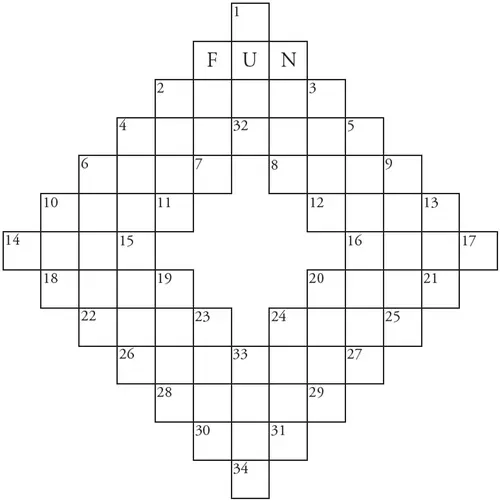
2-3. What bargain hunters enjoy.
4-5. A written acknowledgment.
6-7. Such and nothing more.
10-11. A bird.
14-15. Opposed to less.
18-19. What this puzzle is.
22-23. An animal of prey.
26-27. The close of a day.
28-29. To elude.
30-31. The plural of is.
8-9. To cultivate.
12-13. A bar of wood or iron.
16-17. What artists learn to do.
20-21. Fastened.
24-25. Found on the seashore.
10-18. The fibre of the gomuti palm.
6-22. What we all should be.
4-26. A day dream.
2-11. A talon.
19-28. A pigeon.
F-7. Part of your head.
23-30. A river in Russia.
1-32. To govern.
33-34. An aromatic plant.
N-8. A fist.
24-31. To agree with.
3-12. Part of a ship.
20-29. One.
5-27. Exchanging.
9-25. To sink in mud.
13-21. A boy.
Tess pointed at the squares. “I got 10–11. That’s dove. And 24–25. That’s sand. And I got F–7. Face! Also, 16–17. What artists learn to do. Draw! But I can’t figure out the rest. It’s hard, Grandma.”
“You just figured out one more.”
“What?”
“You’ve discovered the answer to 18–19. ‘What this puzzle is.’”
Tess looked at 18–19, saw that there were four spaces. She wrote h-a-r-d. “This puzzle is hard!”
“See? You’re doing great,” said Grandma.
Grandpa Ben, who had been reading through a batch of yellowed papers, looked over at the puzzle. “Oh, that thing. One of the clues is wrong.”
“You always say that,” said Grandma. To Tess, she said, “Ignore him, dear.”
“Wait, which one is wrong?”
“Look at 22–23,” Grandpa Ben said.
Tess read, “An animal of prey. That’s an animal that other animals like to hunt, right?”
“What do you think?” said Grandpa.
Tess wrinkled her nose. She didn’t like thinking about animals hunting animals.
“A deer?”
“What did I tell you?” He shook his head at Grandma Annie. “You’re just confusing the girl.”
“She’s not confused.”
“The answer is lion,” said Grandpa Ben. “But a lion is a predator, not prey.”