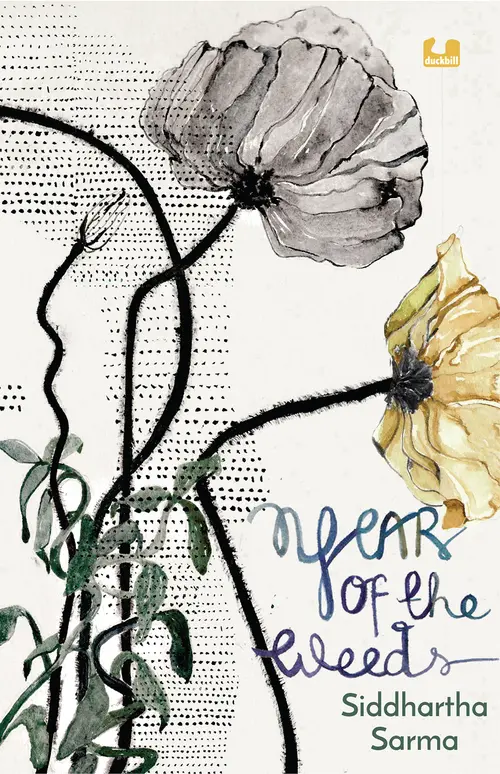
Year of the Weeds
Cover
Brand Page

Read more for young adults from Duckbill
Wanting Mor by Rukhsana Khan
Unbroken by Nandhika Nambi
When She Went Away by Andaleeb Wajid
Invisible People by Harsh Mander
Daddy Come Lately by Rupa Gulab
Facebook Phantom by Suzanne Sangi
Jobless Clueless Reckless by Revathi Suresh
Queen of Ice by Devika Rangachari
Shiva and the Rise of the Shadows by Kanika Dhillon
Talking of Muskaan by Himanjali Sankar
The Right Kind of Dog by Adil Jussawalla
The Wordkeepers by Jash Sen
Skyserpents by Jash Sen
Vortal Shockwave by Ashok Banker
Alice in Deadland by Mainak Dhar
Through the Killing Glass by Mainak Dhar
Zombiestan by Mainak Dhar
When Morning Comes by Arushi Raina
Read more by Siddhartha Sarma for young adults
The Grasshopper’s Run
103 Journeys, Voyages, Trips and Stuff
103 Historical Mysteries, Puzzles, Conundrums and Stuff
In the banyan is the cat
In the peepal Mirchak Rai
In the deep gully Bhutuk Rai
In the Hutang Spring is Kaniyat Rai
Greet them well.
—Muria Gond song

1
APRIL
The bus was late.
But ‘late’ and ‘early’ are words you can only use if you have a watch. If you have a watch, time becomes a number, and a bus becomes late or early or even—why not? on—time. None of the five persons who stood by the road had a watch. So the bus was an idea that would happen some time.
There was just one bus in these parts; one vehicle that went from Deogan and neighbouring villages to Balangir town fifteen kilometres away and back, from morning to night. Balangir was the headquarters of the district. The bus followed its own rules, so it arrived when it did. There were some days when it just didn’t arrive. But, as every villager here knew, it would always come when it was needed.
It was late morning and the sun was warm. There was just a thin tree by the road and Korok, by shifting both feet into a difficult angle, was trying to get under its shade. Even the leaves had given up trying to stick to the tree.
Korok was going to Balangir. He would have avoided it if he could, but he had to meet his father and he had to get his bicycle. He couldn’t avoid it. Either his father, or the bicycle, yes, but not both.
And here came the bus, a wonder of engineering, about thirty-seven sheets of metal hammered over an ancient engine. Over the bad parts of the road—and there were many—the passengers could feel the sheets trying to break away. Someday they would, and the bus would be just two rows of seats behind an engine.
And here, too, sitting on the steps, was Bishto. He was the same age as Korok but he was the handyman and conductor for the bus and lived in it. Where he came from, Korok didn’t know. It was even said that he was born with the bus, but that would make him very old.
Bishto had the thinnest arms anyone had ever seen. They said Korok also had thin arms. In fact, if anyone was looking for Korok in Deogan village, people would say: ‘That boy with the thin arms? He’s over there.’ That was how the villagers knew him, that and his garden. But Bishto’s arms were sticks, and he had just one hand. The other, it was said, he had lost when he picked up a bomb from the railway track across the river. That was just what they said. It is possible that Bishto was born with one hand. Besides, to get to the railway track, even an infant Bishto would have to get off the bus and cross the river, and Bishto never left the bus. But two arms or one, Bishto kept his place on the bus and never forgot to get the fares from his many passengers. One arm and two eagle eyes—that was Bishto.
Korok got on board after the other passengers.
‘To Balangir, to meet your father?’ asked Bishto at the steps, eating a ripe guava, his other arm around the handrail, and Korok nodded.
He had a folded, crumpled five-rupee note, the bus fare, but Bishto shook the guava at him and waved him in. Nobody took money from Korok, not in his village. In Balangir they took everything.
‘You pay the fare when your father comes from Balangir, not when you go there,’ said Bishto, smiling at his guava, before he hammered on the side of the bus and told the driver: ‘Go.’
Korok took his seat at the back of the bus. He had with him an aluminium tiffin box with rotis and vegetables for his father that he had cooked himself. By the time he reached Balangir town, it wouldn’t matter who had made the rotis; they would be just as hard and rubbery as the ones Korok had eaten in the morning. But the important thing was he was taking them to his father.
The Gonds of western Odisha don’t eat rotis as a rule, but just last week Korok had gone to the little room in the village trader’s house which was the state’s Public Distribution System outlet with a dirty bit of paper which said he could get rice and cooking oil at cheap prices because he had an ‘Antyodaya’ card. That is, he was very poor. But the store did not have red rice, which the Gonds ate. In fact, most of Odisha in these parts ate red rice, which was called Nali Swarna, ‘golden red’. But the government, or some Big Person in the coastal cities of the east had decided wheat was better, so Korok was given a packet of coarse flour and had to make what he thought were rotis.
The bus went west across the bridge on the Tel River, which at this point curved around Deogan and the other villages. The bridge, like the bus, was another engineering marvel, but it was built many years ago, when this part of Odisha supplied a lot of timber from the forests. Timber trucks would cross the Tel, and they needed a strong bridge to carry them over, so the bridge was built to last.
The Tel would last much longer than the bridge, although just then, at the beginning of summer, it was more stream than river. In the distance, it curved around Devi Hills, although its source was far to the west somewhere.
Along its banks reared the mass of Devi Hills. It was actually just one big hill, with three peaks, but the peaks were some distance from each other, and the sides came down almost to the level of the river, so it was called ‘hills’. Around it clustered the Gond villages, of which Deogan was the biggest.
As the bus rattled on towards town, on each side of the road, laid out for the curious, were fields of potatoes, millet and cereal, patches of thick forest, occasionally a village. A tribesman squatted in a field, poking the soil to see if it was ready for planting before the rains. A group of women walked along the road with branches and twigs from the forests for their kitchens. A chicken pecked in a dried-mud courtyard away from the road; sometimes a goat watched the road with no apparent motive. The chickens and goats, of course, were doing what other chickens and goats do all the time, whether they are owned by a Gond or someone else.
Korok never liked leaving his village and walking the two kilometres to the main road to catch the bus. He did not like the gradual change in the countryside as they approached Balangir town. He was not comfortable around the big houses, the cars, the masses of people.
Balangir wasn’t that big a town, nor did it have that many cars or traffic or people. But it was a distant world from Deogan village. It was a Big Place. It had Big People. It was where everyone from all the villages, Gond farmer or Odia trader, had to go to get anything done. Permissions. Paperwork. Fines. Taxes. Big Things.
At the main chowk in Balangir, the bus wheezed to a stop, that is, it slowed but kept moving by inches. The bus never really stopped anywhere and no one had ever seen it stop or its engine shut down. It was said that if the bus ever stopped it would fall to pieces and lie there and Bishto would turn into a parrot and fly away. This only proves that people had a lot of time to think about the bus and had covered every single possibility.
Bishto, the one-handed acrobat and guava-lover, leaned out from the door and said, unnecessarily: ‘Ei, Balangir …’
Korok got down and almost immediately a motorcycle went past, honking, although there was nothing on the road to honk at. That was just how things happened in Balangir. The bus went around the chowk and headed back out of town.
Korok walked along the fruit stalls of the chowk. It was puzzling to see the wives and servants of Balangir’s Big People at the stalls. In his village, people had their own fruit trees, and if you had more and your neighbours wanted some, they could have it, if they asked first. Of course, it was not always about sharing. It made more sense to give away what you did not want than to have it rot on the trees. So they would say: ‘Take the fruits, they are about to rot.’
But here the bananas and guavas and lime were put on display and sometimes the sellers would sprinkle them with water and say they were fresh. That was how Balangir was. A place where people said, ‘Take the fruits, they are so fresh.’
Down the road, past the shops and small restaurants. There was a new temple here. Very new, built by some organisation Korok had heard of. They’d put up loudspeakers and every morning and evening they would play religious songs in Odia. In Balangir, new things kept coming up, even new gods.
And so onward, past a doctor’s clinic and two pharmacies, to a thick, and very high, reddish brick wall. It was an old, old wall, but so thick and tall it was. When Korok was very small and had come to Balangir the first time with his father, that wall seemed to stretch all the way to the sky. It was a little shorter now, but not by much. Sooner or later, every Gond came to know it well.
There was a big, impressive and old iron gate set into the wall, and a wicket gate set into the big gate. Here stood a policeman at attention, that is, leaning against the wall and cleaning his ear. By now some of the Gond guards knew Korok, more or less, so after shaking the tiffin box a little, the policeman rapped on the wicket gate, which opened, and Korok entered Balangir District Jail.
In the courtyard, he stood among the few visitors after giving his name, until he was called, and walked through one of the doors into a thick-walled room smelling of new paint.
Here a fat and sweating policeman asked Korok his name and pressed a metal disc into his palm. The disc had the number fifteen etched on it, although it had been pressed and disfigured by many fingers over the years and the digits could be just barely seen. This was his visitor number.
Korok took this disc and walked into an inner courtyard, where other visitors were meeting their relatives or friends.
His father was sitting under the tree at the centre of the yard. This was his fifteenth month in prison. The police had arrested him for smuggling timber from Deogan Reserve, the huge forest on both sides of the Tel. That is, they had not actually caught him with the timber. They had arrested him near the main road on the other side of the village. Now, you can’t steal truckloads of logs of precious trees on your own, so Korok’s father must have been working with other people to smuggle the timber. But the police hadn’t found out who these people were. Actually, they hadn’t found the timber his father was supposed to be smuggling either. But the police had said the man was a timber smuggler, so they put him in prison.
Every once in a month or two Korok’s father’s case would come up in court and the magistrate would set another date for hearing it. Sometimes the files were not in court. Sometimes the policemen were absent. Sometimes even the magistrate was absent. So Korok’s father would be sent back to jail and wait for the next hearing. He thus became an undertrial—not yet convicted of anything, but not free either. Balangir Jail had more undertrials than convicts.
In the months since the police had picked him up, Korok’s father hadn’t changed much. His beard, particularly under the chin, had gone grey one hair at a time. But he was otherwise the same. He did not complain, nor did he talk about the past or future.
Even the way he opened Korok’s box and ate the rotis and vegetables was slow and methodical. And after eating, he held out his hand and Korok dropped a bundle of local beedis in it. In jail beedis were currency if you wanted friends or favours, but for undertrials they were difficult to come by. Korok, the good son, got him a bundle each week, all made in the village.
‘How is your garden?’ asked Korok’s father, in the weekly ritual they had of the same set of questions and answers. Not ‘the’ garden. Ever since his father had been arrested, it had become ‘your’ garden.
‘It is good.’
‘The epho lets you work in the garden, he does not cause problems?’
Korok worked in the big garden in the Divisional Forest Officer’s house. This was where his father used to work. Now Korok worked among the rare flowers and medicinal plants, and so well-known was his garden that it was his garden. The DFO, or epho as people here called such an important man, did not seem to mind that a jailed timber smuggler’s son worked in his house. But as everyone knew, only the police called Korok’s father a timber thief.
‘No, he is mostly away. I haven’t seen him since last week.’
And the week before, when Korok’s father had asked him the same question, he had given the same answer, because nothing much changed in their world, except the seasons.
Meeting time was over. Korok took the empty tiffin box from his father and put twenty rupees in his hands.
There remained the matter of the bicycle.
‘Korok? What about the bicycle?’
‘I am going to talk to them about it.’
‘Be careful. How many more times are you going to ask?’
‘One more time.’
Between the two of them, Korok could have avoided his father. But sooner or later, he would have to deal with the bicycle.
Which is why he walked out of the jail and down two streets towards the chowk till he came to a big white single-storey building with a red-tinned roof which said: ‘Balangir Police Station’. And next to it, in letters of the same size, ‘Office of the Superintendent of Police, Balangir District.’ This was one of the Big Places of Balangir.
In the yard in front and to the left of the office were the various odds and ends that the policemen brought there in the course of keeping the law around Balangir and the villages of the district. A bundle of tendu leaves, which are used to wrap beedis, was lying in the sun. A small coop with three thin chickens, probably seized after a village dispute. Half-a-dozen logs of rotting timber, sal timber too, very valuable. These must have been seized from real timber smugglers, but it must have been a long time ago, because their outer bark had fallen off and rain and sun had made the sal wood red like the back of ants. And in the middle of the yard, Korok’s father’s bicycle.
When Korok’s father was arrested, he had been on his bicycle, with a bundle of potatoes from his field which he was carrying to Deogan’s weekly market. In a fit of efficiency that Balangir police were never known for, they had put him in their jeep and gone off … and come back to pick up the bicycle and the potatoes.
The potatoes had been tried and sentenced to be eaten by the policemen, but while Korok’s father waited for the court to decide whether he was innocent or not, his bicycle was in jail at the police station.
Every week when Korok came to meet his father he would see the bicycle with its faded brown seat in the police station yard. Once he saw a constable riding it down the street.
Every once in a while, he would come to the police station to ask if it could be released, since the police did not need it, and his father couldn’t use it, but he could.
Inside the room of the officer-in-charge sat two Gonds on a wooden bench. They were from some other village and seemed to be here to settle a dispute, because they were not looking at each other and wouldn’t allow anyone else to share the bench with them so they could be pushed closer. Perhaps the dispute was over the three chickens in the coop outside. Korok stood on either leg for a few minutes and then crouched on his haunches.
An hour or so passed before the officer-in-charge, an inspector, made his appearance with great speed from another room, sitting behind his desk and flipping rapidly the pages of the biggest book Korok had ever seen in his life, not that he had seen many. This was the Daily Diary, the holy scripture of a police station, where every incident, complaint or action by the policemen was to be recorded.
Not all of what they did was recorded, of course, such as what happened to Korok’s father’s potatoes. They might have been important to Korok, or his father, but not for the police station. But the book was the Key, the Life of the station.
Korok approached the inspector, who looked up from licking his fingers to turn the pages.
‘Inspector-sir, I have come about my father’s bicycle …’
The inspector stared at Korok, as if he had never heard words like ‘father’ and ‘bicycle’ in his life. Korok had met him before, but then there were many Gond boys visiting the police station all the time, and this wasn’t his village.
‘What bicycle? Who stole it? Why do you buy bicycles if you let someone steal them all the time?’
‘Inspector-sir, no, my father was arrested for timber smuggling, I’m from Deogan, his bicycle is here outside. I was told I could take it home …’
The inspector looked down and flipped the pages rapidly, looking for the solution to some great mystery within them. ‘You have to wait for Patnaik-sir, he will be here soon. Only he can give you permission to take it away. Go sit over there and wait for him. Chickens and bicycles! We have better things to do …’
Korok did not have to wait for long because a car screeched to a stop outside, a warning honked from its horn, and the might and majesty of the law, the great and terrible Superintendent of Police of Balangir district, S. Patnaik, rushed in.
‘S. Patnaik’ was what it said in white capital letters on the polished and shiny rectangle of black plastic pinned on his chest. Some said it stood for ‘Sanjay’, but others said this was not true at all for a man who was the biggest police officer of the district and among the most powerful men in those parts. He was government personified, and how could such a godlike person have a simple name like ‘Sanjay’? They said the ‘S’ actually stood for ‘Sorkari’, if not something much worse. Yet others, the older people, said if his name was indeed ‘Sorkari’ there couldn’t be a worse name than that.
Now, if this was a different kind of story, the kind where people’s natures are seen in their bodies, Patnaik would be a fat man with three chins, an evil moustache and a squint. Not that a moustache by itself is evil, but some moustaches fit that sort of person. But this is not that kind of story, so Patnaik was as his mother expected him to be when he was growing up.
The Story Continues on BooksBarbecue!
Enjoyed this preview? ❤️ Do not stop here!
Read the complete book free online → 🔗
Continue reading now on BooksBarbecue and discover every page!
Love reading? Bookmark BooksBarbecue.com for more amazing books!
Happy Reading!