Written on the Dark
Cover
Also by Guy Gavriel Kay
The Fionavar Tapestry
The Summer Tree
The Wandering Fire
The Darkest Road
Tigana
A Song for Arbonne
The Lions of Al-Rassan
The Sarantine Mosaic
Sailing to Sarantium
Lord of Emperors
The Last Light of the Sun
Beyond This Dark House (poetry)
Ysabel
Under Heaven
River of Stars
Children of Earth and Sky
A Brightness Long Ago
All the Seas of the World
Dedication
For Laura, Sam, Matthew
With very great love, and an enduring awareness
that what I write, what I can shape in these stories,
is because of them, because it is for them.
Epigraph
Imagined voices, and beloved, too,
of those who died, or of those who are
lost unto us like the dead.
Sometimes in our dreams they speak to us;
sometimes in its thought the mind will hear them.
And with their sound for a moment there return
sounds from the first poetry of our life—
like music, in the night, far off, that fades away.
—Constantine Cavafy
Translated by Daniel Mendelsohn
What will you do,
when it is your turn in the field
with the god?
—Louise Glück
Map
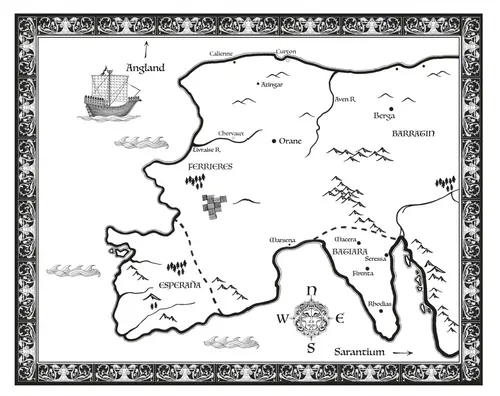
Map by Martin Springett
Characters
(a partial list)

Thierry Villar, a poet of Orane
Adelie, his mother
Ambroise Villar, a cleric, his adoptive father
Silvy Gautier, his friend, in The Lamb Tavern
Eudes, owner and proprietor of The Lamb
Anni, employed at The Lamb
Jolis de Charette, once a lover of Thierry
King Roch of Ferrieres, “the mad King”
Bianca di Rizzetto, his queen, from Batiara
Girald, their young son, the royal heir
Rollin, Duke de Montereau, the king’s brother and principal adviser, acting as regent when King Roch is unwell
Bettina, his wife
The king’s uncles and advisers:
Duke de Barille
Duke de Regnault
Laurent (“the Bold”), Duke de Barratin, a royal cousin, also an adviser
Arnoul and Guiart, his sons
Count Burkard van Aribert, Barratin’s principal adviser
Robbin de Vaux, the king’s provost in Orane
Medor Colle, his senior serjeant
Gauvard Colle, Medor’s uncle, acquainted with the half-world
Aubrey, another senior serjeant
Claquin Guiene, one of Montereau’s private guards
Corbez Barthelmy, once a soldier
Lambert Maar, a thief
Marina di Seressa, also a poet, living near the Livraise River, often at the court
Clare, her mother
Alaina d’Arceval, her neighbour in the countryside
Le Futrier, proprietor of The Fife Tavern
Fermin Lessieur, a (bad) poet there
Branco Merlant, proprietor of The Needle Tavern
Denis Cassin, a lawyer and academic at the university
Hutin Peyre, high cleric of Orane
Vicomte Fermin de Mardol, an aristocrat
Jeanette, a young woman from the village of Broché
Peire and Eran, her brothers
Lysbet Guerin, a young woman from the hamlet of Cassaude
Bascot de Thunier, a minor lord near the Livraise River
Mercier, high cleric of Aurage, residing nearby
Rogier, an innkeeper in a village by the Livraise
High Patriarch Tessio, in Rhodias
High cleric Viotti di Virenza, also in Rhodias
Claus van Leyland, an artist from Barratin, working in Rhodias
King Hardan V of the Anglcyn, at war with Ferrieres
Part I

Chapter I
The deepest part of the night in the most savage winter of the coldest year anyone could remember.
So he thought, hearing the middle-of-night bells that meant he needed to get up—to go outside, right now. Into the city. Into the ice, in the blackness.
He didn’t want to. Why would anyone in their right mind want to? Were there enough coins to steal to make it worth going out into the streets now?
Evidently, yes. Because they were going to try. Not so many coins but…enough?
He was lying alone in Silvy’s bed. Silvy had gone upstairs to Anni and Eudes’s room, carrying the candle. He had no light here. She had let him stay in her room, however. She knew why he’d wanted to sleep away from his mother’s house tonight. She didn’t ask questions, didn’t force him not to answer, or lie. Silvy was his most trusted friend, possibly his only trusted friend (he didn’t want to think too much about that, just now). They’d agreed some time ago not to bed each other. Probably wise. Most of the time he thought so. It protected the friendship.
He’d already been awake when the night’s third bells sounded from the sanctuaries. He’d counted them. He tended to awaken too early when he had a thing to do, a place to go in the dark, or at dawn. A lifelong fear of being late, oversleeping. He didn’t sleep well, in any case. Often lay in bed (at home, in a tavern bed with a girl) working up a poem. Lines in the dark. He was a man who shaped lines in the dark. He’d rise and light a candle at the embers of a fire to scribble by. That defined him, he thought. It would do as well as anything else to define him.
He was still young, of course. He might grow into something different, someone different. You weren’t the same through the whole of your life, were you? Not marked by one thing. If you lived long enough to change, of course.
Thierry Villar didn’t expect to live a long life. In this city, in this time, it was a reasonable way to feel. So he thought, anyway. Perhaps he might be modestly famous before he died? Not just known in a few taverns here in Orane. Known, and sometimes hated. His verses could be harsh, and he named names. Sometimes names of people who were, well, famous. And not happy with what he wrote about them. He took chances that way. Didn’t you do that for your art? For some reason the thought amused him, even though nothing was really amusing in this cold.
His poems, their mockery, drew raucous laughter in the taverns and had earned him drinking and dicing companions. And sometimes the company of women afterwards. Worthwhile, accordingly. He was young enough to judge things that way.
It really was time to get out of bed. He had some distance to cover, after curfew, through streets where the ice lay in places as a coating over manure and refuse.
But it was smart to have established his presence over at The Mule earlier this evening and then to sleep here tonight. Eudes had served him two cups of wine downstairs and Thierry had played dice for a bit, low stakes. He had no money to lose. Eudes would remember, would say as much: “Thierry Villar? Yes, was here drinking with some students, why?”
It was Jad-cursed cold outside. It was cold inside. It could make a man mad, or kill him. People died in a winter like this. There were wolves in the city. They slipped through the walls, crossed the frozen river, roamed the darkness, starving, bold. You didn’t want to encounter starving wolves in the night.
The god was supposed to battle demons on behalf of mortal men and women in the black cold beneath the world now. That was probably a lot like this, Villar thought. Heresy! His mother and stepfather were deeply pious. He was…less so. He didn’t know what his father had been like. Had been too young when Rochon Larraigne had died of a fall and mother and child had come to Orane the way so many did, desperate for food and shelter. Seeking a way to survive while poverty stalked the world.
They’d been lucky. Protected by the god, his mother would say. Had said. He had an education, a life of some security ahead if he wanted it. And yet here he was, about to dress and go outside to rob a holy place. Folly and need. Someone might say greed, but he’d stay with need, thank you. When you gambled at dice or cards and lost to certain people, you really did need to pay them back. And he’d long ago spent what money he’d ever had on a woman. The wrong woman entirely.
He was halfway dressed already, lying in bed. Ridiculous, but necessary. He pushed aside the three blankets Silvy had (Jad bless her forever) and pulled on and belted his trousers over leggings. The trousers were stiff, half-frozen. Of course. He swore. A second pair of socks over the ones he already wore, then a second ice-cold woollen shirt over his tunic. He pulled on his boots with difficulty, swearing at them, too, at himself, at the Jad-cursed world.
Not at the city, mind you. He loved Orane too much.
“I hate how much I love this city,” he’d even said to Silvy once. Said it to others too, but she was the one who’d told him it was an odd thought, and asked him why. It was the way she was. She asked questions.
They’d been in the tavern downstairs, he remembered. He’d just recited a new poem, received coins and drinks for it. And laughter. He chased laughter, Villar thought. Always had. Needed it.
In the inns and taverns he was quick with his words, was known (feared) for it. But that time he’d thought for a bit before answering her. “Because if you love something too much, you can be destroyed if you lose it,” he’d said, eventually.
She’d left it at that. She knew Jolis de Charette, too. Of course she did. Had even warned him about her. Silvy had an annoying habit of being right about things.
No time for that thought, either, just now. He needed money. He needed to do a thing tonight.
Villar found his cloth cap on a post at the end of the bed. Pulled over his ears, it made him look like an outlaw. One of the Jacquards, with their secret language and safe houses dotting the countryside, with door-knock sequences you needed to know to be admitted, not killed, and then coded phrases to speak. He even knew some of those, from a late-night conversation with a man who’d had too much to drink once.
He didn’t know the countryside at all. He didn’t like the countryside. He was a city person. This city. Which he loved. Too much.
It was holy for him, really, for all the violence and danger within it. For all that he hadn’t been born here. Orane was what he knew of the world, really.
Holy for him. He laughed at himself. He was about to take part in the robbery of a genuinely holy place. The cloth cap of an outlaw suited.
Moving cautiously in the utterly black room, trying to stay quiet, he retrieved his patched-up coat, pulled it on. Dark outside, dark in here. Dark in his heart? Not really, Thierry Villar thought. He just had needs. And perhaps one of those, beyond the fact of poverty and a dangerous debt, was for adventures such as this, with people such as the ones he was headed out to meet.
Of course calling it an adventure was to avoid certain questions. Silvy, if she’d been here and listening to him, if he’d been speaking aloud, which he might have been doing if she’d been here, might have said as much.
But she was upstairs. With Anni and Eudes. Warm in a wide bed.
He swore again. Opened the door and went out. Closed it softly behind him. Went down the stairs.
The tavern called The Lamb was, predictably, known for its mutton, when it could be obtained. There was a large door at the front, with the signboard over it. It would not reopen for some hours yet.
Robbin de Vaux, the king’s provost in Orane—the mad king’s provost—sat astride his horse, shivering. They heard the last of the three bells ring and fade away. They’d been waiting for some time, but he expected a door to open now.
Not the main door. The small, half-hidden one, recessed, to the side, that led to stairs and the private rooms The Lamb rented by the year, the month, or the hour sometimes.
The hooves of their horses had cracked the ice of the roadway as they stamped in the cold. The smell of the street came to de Vaux. People threw their refuse from upper-floor windows. Frozen dung and piss from pots and everything else one could hurl from a window. It was not one of the best neighbourhoods of Orane’s south bank, though hardly the worst.
There were no moons right now. That would have been planned, by the small-scale thieves and by the possibly much more important men whose reported deed had driven him from his bed tonight.
De Vaux had had years of war against the invading Anglcyn, or fighting outlaw bands, rebels against the crown, or disbanded soldiers who chose a different, unlawful life. He had known hardship, cold nights, savagery, wounds, fear.
He was more frightened right now than he could ever remember being.
And he could not have entirely explained why he had asked certain questions of his senior serjeant and come here to The Lamb, after being summoned to view a dead body on the other side of the river. An…identified dead body. A named one.
Was it instinct? Something else?
There was an extremely good chance that, come morning, when word of this death got out—he could only hold it back for so long—the city and much of the country would explode into violence. Possibly civil war. Depending.
Depending on a thing he really didn’t want to think about.
A sound. Soft, but he’d been listening for it. The small door opened. Precisely when he’d thought it might. A minor pleasure, of a sort, to have anticipated so well. A man, a shadow in blackness, stepped out.
“Torches,” de Vaux said quietly, and three were lit behind him from a single carried flame.
—
Villar knew he had a reputation for swearing. Invective worth remembering, and reusing with laughter. He didn’t mind that, though he knew that some of his own most quoted phrases he himself had taken from others, if modified sometimes. He was a poet, after all, he worked hard on his words.
Right now, standing outside The Lamb, he was shocked speechless when torches flared and he saw mounted men. Men waiting for him. Which last he knew because the one at the front said, calmly, “You can run, or go back inside, but we know you are here, and why, Villar, and we also know where your mother and stepfather live. And…Lambert Maar has already talked.”
They knew these things? They knew his name? And he, in turn, knew this voice. It shocked him even more. He cleared his throat, his mind whirling in helpless circles. He managed to say, “Lambert Maar, my lord?”
“Don’t bother trying, Thierry,” said Robbin de Vaux, his majesty’s provost, astride a horse in a vicious night, here waiting for him. For him? It made no sense! “He really has talked. Was careless in a tavern, someone reported it. I had him picked up. He’s a careless man, isn’t he?”
Fucking, fucking, fucking Lambert! Villar would have liked to have profanity equal to this moment.
He cleared his throat. “He is, yes. I’ve met the man. But you are not careless by reputation, my lord, and I have no idea why the royal provost himself would be here waiting for me at this hour, for something so…small?”
It was worth trying. What else did he have?
“Robbing a sanctuary of the god isn’t so small, but we’ll leave that for the moment, it is a fair observation.” The provost’s voice, which he’d heard many times, including at the gallows before an execution, was deep, memorable.
It was also, Villar realized, strained, tight, tense right now. Villar had no idea why. He had no idea about any of this. There were at least half a dozen horsemen behind the provost. Probably more, the three torches didn’t cast their light very far.
“I have robbed nothing, done nothing,” he said. He tried to sound confident. He failed. Why was there a fraying in the other man’s voice? And why was he here?
“You will doubtless wish to know why I am here,” said de Vaux.
His reputation was complex. Fair, usually, but a hard man, and too clever by half for the underworld of Orane. Two decades of warfare, mostly in the north but not only, before taking up his position here five years ago. Owned a large city home, had a large annual salary. It was an easier life than battling all over the country for the king and royal council, especially if you were no longer young.
“Of course I want to know,” said Villar, looking up at the big man lit by torches.
He realized he was shivering. So many stars overhead on a clear night, like gems above the streets and houses, above the myriad stupidities of mortal men and women, with sunrise a long way off, still.
“I want to know that, and also,” he added, taking a chance, but he was like that, “why you sound uneasy right now.”
A silence. Too long a silence.
He’d had a good enough life, on the whole, Thierry Villar thought. Aside from too much poverty, and Jolis de Charette, curse her. People liked his verses, were amused when they were meant to be. And women liked him, too.
He heard laughter now, short, bitter, but laughter. Only from the one man, the provost himself. The others, however many were behind de Vaux, remained silent. They’d kill him at a word, Villar knew, perhaps take pleasure in it. Or not. Just another thief killed in a city they tried to control for the mad king.
“I sound uneasy because I am,” de Vaux said. “It has to do with the reason I’m here.”
Thierry said nothing. But something like hope began, like a stringed instrument plucked, inside him. At least a chance, from that answer, that he might not be on his way to a cell in the Châtelet to be tortured into a confession, and then taken to be hanged on Gallows Hill. He thought of his mother weeping for him there. Curse Lambert Maar forever, he thought—loose-lipped, sober and drunk. Stupid at all times.
“There is a horse for you,” the provost of Orane said. “Mount up. Someone will help you. I’ll explain as we ride. You’re right, of course, I’m not out in this night with ten men to arrest a poet about to do something stupid.”
Ten. And the provost knew he was a poet.
“I don’t ride with any great—”
“I said someone would help you. You have two choices, Thierry Villar. You come with me, or we arrest you now and you are taken for interrogation. I like your stepfather, he’s an honest cleric, a better man than you deserve, but he won’t save you once you are with the questioners. Nor will your mother’s pleas.”
Bastard, thought Thierry. Had to mention his mother?
“I say these things,” said de Vaux, “to make matters clear for you, and because I have little time. I need to know some things before sunrise.”
Thierry blinked. There felt to be frost forming on his eyelids. An image for a poem? “And you expect me to know these things?”
“I do not, no. But I do need a clever man who is known in the taverns. Mount up, Villar. I won’t offer again.”
A clever retort came to his lips. He didn’t speak it. You didn’t have to say every witty thing you thought.
Also, they were not arresting him yet. And he was…Jad curse it, he was curious now. A vice, the key to his life and to his writing: curiosity. His life? A short life so far. He’d prefer it not end just yet. I would like, he thought, to see spring again and be warm.
“Someone lift me up, then,” he said, “and in the god’s name I hope the horse is gentle.”
—
Silvy was a restless sleeper and thought she heard a jingling sound outside. Then she heard the bells, and then that same sound again after the third one.
She got out of bed and crossed to the window, two pairs of heavy stockings on her feet. Stood there and looked down. Eudes, who was good with tools, had contrived a way to hinge the shutters on this third floor so a part could be folded back on either side. There was no light, no one could see her, the watcher, the witness. Behind her, Anni and Eudes slept, Anni snoring softly, as she usually did. The cold was appalling, but she knew the bed would be warm went she went back.
There were horsemen in the street. She saw them when Thierry came out and torches were lit. She was very afraid then, and there was nothing at all she could do. She was so angry with him. Nothing to do about that, either. Should she have told him not to go? Would it have done any good at all? Did he ever listen?
Maybe sometimes. Once or twice.
Words were being exchanged below. From the way he stood, she knew Thierry was frightened. He’d be thinking of running; he’d know there was no way he could. He stood where he was and spoke to the men on horses. To one of them.
Then, after more words, Silvy at her window saw him mount up, with assistance, on a horse. It was entirely unexpected. She’d never seen him on a horse. She’d never been on one either. Had dreams of riding sometimes, galloping on a vast plain under both moons, going nowhere that she knew in the world, but going there very fast.
She watched the riders disappear up the street towards the river. A dozen or so men, three torches, her friend inexplicably among them. She wondered if she’d ever see him again. She didn’t know who these men were. They had evidently been waiting for him at this impossible hour, for no reason she could even imagine.
Then the street was empty again, and black. Nothing to see. You could almost imagine you had dreamed the whole encounter.
The Story Continues on BooksBarbecue!
Enjoyed this preview? ❤️ Do not stop here!
Read the complete book free online → 🔗
Continue reading now on BooksBarbecue and discover every page!
Love reading? Bookmark BooksBarbecue.com for more amazing books!
Happy Reading!