Workhouse Orphans
Cover
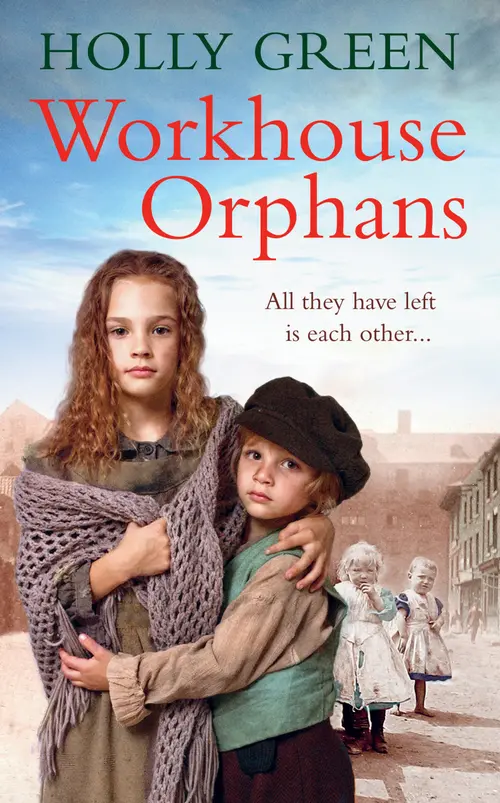
About the Book
All they have left is each other...
Life has always been tough for May and Gus Lavender. Their father went away to sea never to return, and then their mother falls victim to the typhus sweeping through Liverpool. Regarded as orphans by the authorities, May and Gus are sent to the Brownlow Hill Workhouse.
Like all workhouses, Brownlow is the last resort for the poor and the destitute. May and Gus will have to rely on each other more than ever if they are to survive the hardships to come...
About the Author
Holly Green writes historical sagas about love and war, and her books are inspired by the stories she heard from her parents when she was a child. Her father was a professional singer with a fine baritone voice and her mother was a dancer, but they had to give up their professions at the outbreak of World War II.
Holly is from Liverpool and is a trained actress and teacher – her claim to fame being that she gave Daniel Craig his first acting experience!
Holly is married and enjoys spending time with her two delightful grandchildren.
Prologue
‘They’ve got to go! I’ve told you. We’ve got five of our own. We can’t cope with any more. They’ll have to go.’
May could hear Mr Johnson shouting from downstairs. Then she heard the door bang as he went off to his work on the docks. She shifted her position in the narrow, crowded bed. Jenny’s elbow was sticking into her ribs and Maisie’s foot was right by her nose.
A sound reached her, a sniff followed by a half-stifled whine, like the cry of an animal in pain. Gus was crying, and trying not to be heard. She eased herself out of the bed and wrapped her shawl round her shoulders. The boys’ bed was close by and by the smell of it one of them had wet himself – not Gus, her little brother never did that. She bent down and scooped him up in her arms and he buried his face in her shoulder, snuffling. She moved over to the one rickety chair and sat down with him on her lap.
‘Don’t cry, Gus. It’ll be all right. You’ll see. We’ll be all right.’
She wanted to believe it, but it was hard. She had been three when their father disappeared, ‘lost at sea’, and Gus just a baby. That was nearly three years ago. They had never seen much of him, because he was a sailor and away from home most of the time. She had got used to being without him; but she had seen her mother grow thin and tired, taking in washing to keep them from starving.
Then, just a few days ago, she had come in from playing out in the cobbled yard, with its smell from the two privies shared between eight families, to find Mrs Johnson waiting for her. ‘Your mam’s poorly,’ she had said. ‘You’re going to stay with us for a while.’ She had watched people going in and out of the house where she had grown up, and one day four men had come out carrying a big box and Percy, Mrs Johnson’s eldest, had said, ‘Your ma’s dead. That’s a coffin. They’re taking her to be buried.’
As soon as they had eaten their breakfast, thin porridge made for six but shared out between eight, Mrs Johnson put on her cap and shawl and told Percy to keep an eye on the others and see they didn’t get up to mischief while she was out. When she got back she took Gus on her lap and pulled May close to her.
‘Now, listen to me. You understand your mam is dead, don’t you?’
‘What’s dead?’ Gus asked.
‘It means she’s gone to heaven to live with Jesus.’ ‘When’s she coming back?’
‘She can’t come back, love. When people die they can’t come back. But she’ll be watching out for you, looking down from heaven, wanting you to be good and brave. But now, there’s no one to look after you and you can’t stay here, because there’s too many of us already. You can see that, can’t you?’
May nodded.
‘So a nice man is coming today and he’s going to take you to live in a big house at the top of the hill with lots of other children. That’ll be good, won’t it? You’ll have your own beds again, and plenty to eat and friends to play with, so you must go along with him like good children. Understand?’
Gus just sniffed miserably but May nodded. Anything had to be better than sharing a bed with the other girls and hearing Mr Johnson shout at his wife.
The man arrived not long afterwards, a tall, thin man in a hat that made him look even taller and a coat that looked as if he had spilled something down it and not wiped it off properly. He and Mrs Johnson talked for a few minutes and then he said, ‘Right, you two. You come along with me.’
Mrs Johnson came to the entry from the court into the road to see them off. ‘Now, you be good children, and May, you look after your brother.’
‘I will,’ May promised.
They set off, almost running to keep up with the man’s long strides. Gus began to grizzle and May took hold of his hand to help him along. She tried to ask the man about the place they were going to, but he did not seem to want to talk, so she kept quiet and let her imagination wander.
When her mother was alive and not too tired to talk, she used to tell them stories. They were always stories about poor little girls who somehow met a mysterious stranger who turned out to be a prince and took them to live in his beautiful palace. When May had asked what a palace was, her mother said it meant a big house full of lots of fine things. Perhaps, she thought, that was what Mrs Johnson had meant by the big house where they were going to live.
Perhaps this man was really a prince in disguise, or perhaps he was the prince’s servant who had been sent to fetch them.
It seemed a long way, but at last they found themselves walking along the side of a high brick wall.
‘Not far now,’ the man said.
May thought the wall did not look much like the outside of a palace, but then perhaps it was just a wall round the palace gardens and the palace itself was inside. They came to a big gate and the man knocked. May held her breath, waiting to see what was on the other side. There was no palace, just a cobbled yard surrounded by more high brick walls. It was cold and the ground was damp, as if the walls stopped the sun from ever reaching it. Two men in shabby clothes were sweeping away dead leaves. As they crossed the space May heard a woman’s voice, high pitched and cracked, yelling something unintelligible. The man led them down a narrow alley and up a flight of steps to a door, on which he knocked.
A gruff voice called, ‘Come in.’
The man opened the door and he put one hand on May’s shoulder and the other on Gus’s to propel them inside. ‘The two new orphans, Governor.’
A man with a bushy beard and side whiskers was sitting behind a desk. ‘Very well. Ask Mrs Court and Mr Taylor to come here.’
The man left and the one he had called ‘governor’ opened a big book and picked up a pen.
‘Name?’
May’s legs were beginning to shake. ‘May Lavender, sir.’ ‘Age?’
‘Five and a half, sir. I’ll be six in May.’
‘And the boy?’
‘He’s Gus – Augustus, sir.’
‘Age?’
‘He was three last August.’
The governor peered at her as if he thought she might be telling fibs. ‘You are May, and your birthday is in May. And he is Augustus, and his birthday is in August?’
‘Yes, please, sir. It was our father’s idea, I think. That’s what my mam told me.’
The governor peered at his book and muttered as if he was talking to himself rather than her. ‘Father lost at sea, mother deceased. No other relations.’ There was a knock at the door. ‘Come in.’
Two people entered: a woman in a black dress with a white cap and apron, and a man in a grey suit. The governor looked up.
‘Ah, here you are. Two new inmates. May Lavender and her brother Augustus. I’ll leave them in your charge.’
The woman held out her hand. ‘Come along, May. You come with me.’
‘And you come with me, boy,’ the man said.
Gus looked at him and shrank back, grabbing May’s hand.
‘Please, sir,’ May said, ‘let him come with me. I always take care of him.’
‘You may have done so,’ the man said, ‘but now he is in my care and he will come with me.’
‘But why can’t we go together?’ May begged. ‘He’s my brother!’
‘That’s as may be. But boys and girls don’t live together here. Gus will sleep in the boys’ dormitory and be taught in the boys’ classes, and you will sleep and be taught with the girls. That is how things are here.’
‘But …’ May began.
‘Enough!’ It was the governor’s voice. ‘You will learn not to argue, or you will regret it. Now, get along with you.’
Gus was still clinging to May’s hand. She bent down to him. ‘You must be a brave boy, Gus. Go along with the gentleman, like he asks.’
‘No! No! I don’t want to,’ he wept, but the man stooped down and picked him up.
‘You will have to learn to do as you are told, boy,’ the man said. ‘Now, shut your noise.’
He headed for the door and as he carried Gus down the stairs May could hear him crying, ‘Let me go, let me go! I want May! May! May!’
The woman grabbed May’s hand. ‘Come along. There’s nothing you can do. He’ll get over it.’
As she was led down the stairs, May looked around her through eyes blurred with tears. ‘Please, ma’am, where is this? It’s not a palace, is it?’
‘A palace?’ The woman looked down at her and for a moment it seemed she was going to laugh. ‘Whatever put that idea into your head? Don’t you know what this place is?’
‘No, ma’am. Mrs Johnson said a big house.’
‘And you thought she meant a palace?’ The woman’s voice had softened. ‘You poor mite. This is the workhouse.’
One
‘Hold out your hand, girl!’
May bit her lip, scrunched her eyes closed and extended her hand, palm upwards. The ruler descended with a crack. There was a sharp sting, but May knew from experience that the worst pain would come a second later.
‘That will teach you not to waste your time scribbling instead of getting on with your work. You are not a baby. You are thirteen years old. You should know better.’
‘But …’ The word was out before May could stop it.
‘But … BUT!’ Miss Bale’s hollow cheeks flushed crimson. ‘You dare “but” me, miss? Hold out the other hand.’
This time the blow was harder and tears forced themselves between May’s closed lids. She opened her eyes and gazed up at the schoolmistress. It might mean further punishment, but the injustice was too great to be born.
‘But I finished all the sums!’
For an instant Miss Bale’s eyes flickered. ‘Show me.’
May held up her slate. Down the centre was a neat column of sums, all worked out and all, she was sure, correct. Around them, the borders of the slate were decorated with an intricate pattern of leaves and flowers. May thought it looked rather beautiful.
‘So you have time to waste!’ Miss Bale’s voice grated with anger. ‘We shall have to make sure in future that you have enough to keep you occupied. Now, clean this mess off your slate and do the sums again. Go back to your seat.’
May returned to her place on the bench and reluctantly began to scrub her slate clean. Her friend Patty nudged her arm and gave her a quick look of sympathy, but neither of them dared to speak.
By the time May had redone the sums the bell had sounded for dinner, but as she rose to follow the other girls, Miss Bale’s voice cut through the scraping of benches and the shuffling of feet. ‘Not you, miss! You can sit back down and work these new sums, since you’re so quick at it.’
She wrote six more sums on the blackboard and May’s spirits sank. By the time she finished them dinner would be almost over. She would be lucky to get anything to eat before supper.
When at last she had finished and was dismissed, it occurred to her that Miss Bale had probably missed her meal as well. That was some comfort. In the dining hall, the children had finished eating. The boys were dismissed first, and May had to wait by the door as they filed out. From habit she searched the line for one bright ginger head. Poor Gus! Saddled with the double burden of red hair and a ridiculous name. She had been luckier. Her hair was darker, more like the colour of one of last year’s conkers. She did not mind being called May, but she thought Augustus was a cruel infliction on a small boy.
As her brother drew closer she saw that his nose had been bleeding and his lip was cut. ‘Gus!’ she hissed. ‘You’ve been fighting again!’ He shrugged and made to pass by her. She caught his arm. ‘Meet me outside the chapel door at the end of dinner break.’
‘You there!’ It was the schoolmaster’s voice. ‘Get on and stop talking!’
Gus twitched his arm out of her grasp and walked on.
The girls were dismissed next and May was about to join the line, her stomach grumbling with hunger, when one of the women who had been given the job of supervising the dining hall called out to her.
‘May? Where’ve you been, ducks? You’ve missed your dinner.’
May looked across the room. It was Ruby, who always had a kind word for her. She was small, round-faced and cheerful, and how she had ended up in the workhouse, May did not know. It was not something you asked – not as a child to an adult, anyway. It was not hard to see why some of them were there. There was very little contact between the children and the adults, except for those like Ruby who were trusted to help in the running of the place, but she had seen them wandering the narrow lanes, dishevelled and muttering to themselves. But there were plenty of others, respectable-looking women, who were there for no reason May could understand. She went to Ruby.
‘Miss Bale gave me extra work to do.’
‘Oh, did she?! Yes, she doesn’t like the clever ones. ’Fraid they’ll show her up, I shouldn’t wonder. Sit down there. There’s still some broth in the kitchen.’
She bustled away and came back with a tin bowl full of soup, in which a few pieces of gristly beef floated, and a hunk of bread.
‘Get that inside you, but be quick. I’ll catch it if I’m not back in the kitchen soon.’
‘Thank you, Ruby. I’m famished.’ May ate rapidly, knowing that the dinner break was almost over and afraid that the bell might ring before she had time to swallow it all. The food they were given was wholesome enough but there was never quite enough of it and she could not afford to miss out completely. She just had time to wipe up the last of the gravy with her bread before Ruby whisked the plate away and hurried off to the kitchen.
Outside, she found Gus huddled into a corner of the porch in front of the chapel door.
‘What do you want?’ he demanded fretfully. ‘We’ll catch it if they find us nattering.’
‘I can talk to my own brother, can’t I?’ May asked, knowing full well that the answer was ‘no’. Any communication between the boys and the girls was strictly forbidden, even between brother and sister. ‘You know what I want,’ she went on, before he could contradict her. ‘Why were you fighting?’
‘What am I supposed to do?’ he replied. ‘Jackson was saying I never really had a father. He said I was a bas—’
‘Hush! You are not to use that word. You don’t need to fight him. You know quite well that we did have a father, and a mother. Just tell anyone who asks that our dad’s dead, that he was lost at sea.’
‘Lost at sea!’ he repeated angrily. ‘What’s that mean anyway?’
‘I suppose it means he drowned. I suppose his ship sank.’
‘He might not be dead,’ Gus said. ‘Lost doesn’t mean dead.’
‘Yes, it does. If he was still alive he would have come home, wouldn’t he?’
‘Maybe he couldn’t. Maybe he’s marooned on a desert island. I’ve heard stories like that. Maybe he found buried treasure and he’s living in a palace. Maybe he’s forgotten all about us.’
May looked at her brother’s small, fierce face and understood the pain behind it. ‘Don’t, Gus. He wouldn’t forget. He’s dead and gone. You have to get used to that.’
‘I don’t believe you. One day I’m going to go to sea and look for him.’
‘Gus …’ But he had turned and was already running back to the boys’ yard on the far side of the chapel.
The bell on the roof of the chapel sounded and May moved away. It was time for work. From her first days in the workhouse, May had been made to understand that one day she would have to leave and make her own way in the world. It was her duty to make herself ready to perform some useful function, which would allow her to earn her own living.
That meant, almost certainly, going into domestic service. It had taken her some time to understand that her future life would be spent scrubbing and cooking and mending for some family that was not her own, but she had had to accept it. So every afternoon was devoted to learning a skill that would prepare her for that.
That day, it was her turn to work in the nursery, where the babies of some of the women were cared for, along with the foundlings who were left outside the workhouse door. She made her way along the narrow lane between the tall buildings, the brick walls rising on either side to shut out all but a small strip of sky. In the yard a few women still recovering from childbirth were sitting in a corner where the autumn sun still penetrated, and May walked by them to the door of the nursery. Patty was waiting for her.
‘Where have you been? We’re late.’
‘I had to talk to Gus. He’s been fighting again.’
‘Oh, that brother of yours! Come on.’
They opened the door to be greeted by the sound of furious wails and the harassed voice of one of the workhouse women who had been given the job of caring for the infants. There were half a dozen of them, all inmates of the workhouse, and May had got to know them by now. Some had small children themselves and were, to some degree at least, patient with the little ones in their charge; but there were two who seemed to resent the job and who tried to impose order by fear. They were overseen by a paid matron, but she was too overloaded with work to supervise them effectively.
The noise was coming from an infant May had not seen before, a little girl with a mass of golden curls, her face red with the effort of screaming. One of the women, a hard-faced character who never used her first name and was always called Smithy, was holding the child up and shaking her, shouting at her to shut up. Instinctively May hurried across to her.
‘Shall I take her, Smithy? I know you’ve got a lot of work to get on with.’
‘Take her and welcome! I’ve had enough of the little devil.’
She thrust the child into May’s arms and went to deal with another wailing infant. May cuddled the little mite close and rocked her, singing softly. It was a song she remembered her mother singing as she nursed Gus.
‘Lavender’s blue, dilly dilly, lavender’s green. When I am king, dilly dilly, you shall be queen …’
Since her name was May Lavender she had always believed that the song was specially written for her. She still cherished a few memories from those long ago days, when she still had a family, when ‘home’ meant love and security, not brick walls and regimented discipline.
Smithy returned. ‘You seem to have a knack with her. You’d better look after her from now on.’
May looked down at the child in her arms. She had stopped screaming and was quiet except for occasional hiccupping sobs. Her hot little head was resting on May’s shoulder and she was sucking her thumb.
The Story Continues on BooksBarbecue!
Enjoyed this preview? ❤️ Do not stop here!
Read the complete book free online → 🔗
Continue reading now on BooksBarbecue and discover every page!
Love reading? Bookmark BooksBarbecue.com for more amazing books!
Happy Reading!