Wishtress
Cover

Dedication
FOR MOMMY.
Only now that I’m a mother do I begin to understand the depth of your love for your children.
Not one book—not ten books—could convey my thankfulness for you.
But it’s a start.
This one’s for you, and for all the sacrifices you made in the name of love, Jesus, and motherhood.
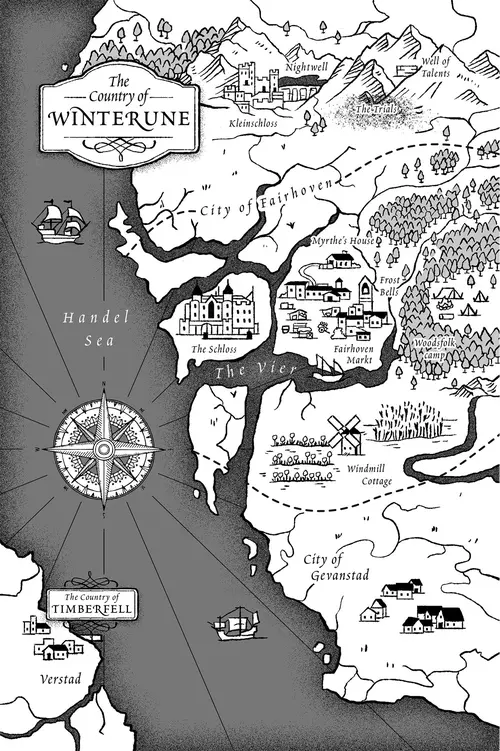
Map
Chapter 1
Myrthe
I didn’t cry until I was twelve years old.
Mutti and Pappje had caught the pox . . . from me. I’d recovered a fortnight prior and was still weak, unable to fully walk normally again. Oma said the pox ate away some of my bone. That didn’t stop me from sitting by their bedsides—in agony—day and night.
“I’m sorry,” I whispered.
“Myrthe,” my mutti rasped, reaching out a hand so frail the veins popped like scars. I gripped it in my own. Then I grabbed Pappje’s limp one. I held the two to my lips. Kissed their knuckles.
“I’m here.” How long would they know that? How long would they see and comprehend? Pappje hadn’t woken in days. Not even when we half-heartedly celebrated my birthday on the winter solstice last week. Mutti spent most days in feverish delirium. Every time I asked Oma when they’d get better, she responded with a crisp, “They may not.”
They grew worse by the day. Oma did what she could for them. Soup. Water. She made me chop and haul firewood into our humble canal cottage despite my limp and the pain shooting up my left leg with every other step.
I didn’t complain.
But none of our efforts changed the sickly pallor on my parents’ faces.
So I chopped more firewood. I plucked feathers from geese bought from markt, and while Oma boiled the meat, I stuffed the feathers into quilt squares and laid them over my parents.
Oma was wrong. I got better. So would Mutti and Pappje.
Chills seized Mutti’s body as though the three quilts atop her were made of paper. I adjusted them. Again. Pulled my own hat off and settled it over her icy brow.
That’s when the burning began in my throat. A fist of fire constricting my air. It moved to my eyes. Was I growing ill? This foreign sensation hurt, but it felt right. Like sorrow straining for release.
I bent my head over their clasped hands, listening to Mutti’s ragged breathing. This was all my fault. If I’d gotten better sooner, maybe they’d still be well.
“Oh, Mutti . . . I wish you’d never known me.” Never birthed me. Never hugged me and caught my illness. “I wish this would end.”
Get better. Get better. Please get better. It had been so different being under Oma’s cold care these past several weeks. Come back to me.
Mutti’s shivering stopped. Pappje’s hand became weighted, limper than the riverfish we ate in summer. My thumb swiped over something wet.
I looked at Mutti’s and Pappje’s hands in mine. Water smeared their knuckles where my face had rested. Wetness covered my cheek too. Tears—things I’d seen on Mutti’s face but never felt on my own.
Pappje’s hand turned to ice in mine. It suddenly didn’t feel like a hand at all. Startled, I dropped it. His arm fell with a slam against the edge of his cot. A chill entered my chest, though I couldn’t place why.
Something had changed.
Something unnatural.
“Is he dead?” asked a shaky voice beside me.
I nearly jumped out of my calfskin trousers. Mutti struggled to prop an elbow beneath her. Trembling, she stared at Pappje.
I didn’t know which to react to first—her question about Pappje or the fact she was up. Awake. Talking.
“Mutti!” I threw myself into her arms, remembering at the last minute to be gentle.
She didn’t return the embrace but instead slid out of my arms. Color was already returning to her face. “Mutti?”
She had eyes only for Pappje and scrabbled for his hand, nearly toppling out of her cot from the effort. “Koen. Oh, Koen, don’t leave me alone.”
“Mutti, I—”
“Give me peace, child,” she snapped. I startled away. “I’m not your mother.”
I had yet to look at Pappje. I wanted to grasp the joy of Mutti’s return. But . . . what did she mean she wasn’t my mother?
“Ilse.” Oma stepped into the room. If she was surprised to find Mutti awake and recovering, she hardly showed it. “Do you know this child?”
“Wilma!” Mutti reached for Oma. “Your son . . . he is . . . oh, he’s left us.”
“Yes.” Oma stared at the scene, held captive by the still-cold body of her own child.
Tears streamed down my face, but I sat. I waited for Mutti to comfort me. For her to see me. Why was she so angry at my presence? “Mutti?”
“Get this child away from me!” Mutti collapsed over Pappje’s body. “Oh, Koen . . .”
Oma yanked me into her bedroom—the only other room in our small home. I stumbled to the bed when she released me, sobs tearing from my chest. “Oma, what did she mean?”
“You’re crying.” She said it like an accusation, then turned her back to me and rummaged in an old trunk.
I sniffed. Not sure I liked crying. The more I did it, the less in control I felt. I was wet everywhere. My eyes, my nose, my face. But more than that, my chest hurt. “Why did Mutti say she’s not my mother?”
Oma whirled on me with a small bottle clutched in her hand. “Because you removed her memory of you.” She sounded . . . triumphant. “I was at the door, listening. You said you wished Ilse had never known you. Your tear struck her hand.”
She pressed the bottle against my cheek. I was so confused—so surprised—I didn’t think to move. A moment later, Oma held the bottle aloft and a small tear bounced around the bottom of the jar like a trapped guppy, flickering silver and white and magic.
“Finally.” She corked the bottle and placed it in her trunk. “You’re the Wishtress, Myrthe. Each tear you cry has the power to grant a wish.”
Wishtress? I’d heard of her—the most powerful Talented in all of Fairhoven. No, in all of Winterune. Maybe even the world. A Wishtress was born every hundred years or so. Always female. A heroine of the kingdom. That’s all I’d ever heard of the Wishtress—all anyone could tell me.
I couldn’t be the Wishtress. I was poor. Brittle boned. Distraught. I couldn’t even cry until today. Then I thought about what Oma said. “You removed her memory of you.” Because I’d cried and made a wish . . . Mutti couldn’t remember me?
Another part of my words—my desperate prayer—teased my memory. “I wish this would end.” I wished their sickness to end . . . and it did.
“I . . . I killed Pappje?” I gripped my hands in front of me, as though they could keep the broken whisper from reaching Oma’s ears.
But she heard. And she nodded. “You used a raw wish. More dangerous than a spark on cotton.” She faced me head-on and grabbed my shoulders. I couldn’t tear away from her intense gaze. “You’re never to use a wish again, Myrthe. Not until you’re trained properly. I’ve studied the ways of the Wishtress my entire life and will teach you in time. Every tear you cry must be bottled. I’ll protect them. I will protect you. Otherwise you could end up killing others.”
My small form seemed to shrink beneath the weight of her words. I was unable to comprehend much other than I killed my own pappje. And I made Mutti forget me.
This was my fault. All of it.
I wanted away from Oma. Away from her knowledge and her icy words. Her lack of feeling and the victorious glint in her eye over this new discovery.
I didn’t want to be the Wishtress.
I wanted to be Myrthe, holding my parents’ hands again . . . before they’d gone cold. Praying for them. Hoping for them. Caring for them and hugging them.
I fled the bedroom, knocking the doorjamb with my hip in my disjointed attempt at haste. I burst into the main room. It was empty of life. Pappje lay on the cot. Cold. Dead.
Mutti was gone.
The front door hung open on its hinges. Cold night air not yet breathed on by spring gusted into the room and caused the fire to flicker.
I ran toward it. “Mutti? Mutti!” I could see nothing in the darkness. No. She couldn’t leave me. She wasn’t well enough!
I reached for my coat, but Oma stayed my hand. “I’ll find her.”
“She’s my mutti!” I had to help. Had to fix this.
“She doesn’t remember you. She doesn’t want you.”
Doesn’t want you.
Oma slammed the door behind her, leaving me in our cottage with the body of my dead pappje.
* * *
The next morning, we stood over two graves.
She’d found Mutti frozen and lifeless less than a mile from our home. Oma didn’t let me see her. Didn’t let me kiss either of them goodbye. Instead, she woke me from where I’d curled in the corner by the fireplace. “Come say words over their graves.”
I had no words other than, “I’m sorry. I’m so sorry.”
I fell to my knees. This was so much worse than when they lay side by side trapped in illness. At least then I had hope. I could tuck myself into their arms and will my love for them to warm their bodies.
Now they lay in the earth, blanketed in darkness. I wanted to be with them, but I didn’t want to die. I sniffed hard as the frightening burning built in my throat. There was no stopping it from spilling over in hot tears.
Oma knelt beside me and wrapped an arm around my shoulders, an uncharacteristic show of tenderness. I moved to lean my head on her chest, but something cold and hard met my cheek.
A glass bottle.
“Let it out, child,” Oma whispered as the first tear slipped into the vial. “Just keep crying. I’m here.”
Chapter 2
Bastiaan
Five years later
Bastiaan’s soul was 107 years old.
His bare feet pressed into the dark soil between rows of blood-red tulips, sending his youthful body forward and leaving behind their signatures of ten toes and young soles. Scattered amid the tulip rows were women of varied ages. One bent over a row of purple buds, a woven basket in one arm and her hand stretched toward a stem. Another rested on her knees, a handkerchief pressed to her brow.
None moved. None breathed. Statues of blood, bone, and frozen breath.
Bastiaan fixed his gaze forward. Ahead, over the hill of carefully tended tulips and beyond the stretch of mature grain stalks ready for harvest, rose a windmill, its wide base pregnant with memories. Its wood-lattice blades paused midrotation.
Home.
He’d been away so long he’d nearly forgotten what that word meant. His fingers itched, begging him for permission to return his surroundings to life, but Bastiaan resisted their call. Not yet. He stopped at the front door. It hung open—inviting him back in. He both dreaded and desired what was about to happen.
With a bone-deep breath, he stepped over the threshold.
Sunlight spilled through the open doorway and wide windows, the end of springtime as it had been for the past thirty-two years. Bastiaan took in the equally familiar and foreign space. White stone counters and rough cabinets carved by his own hands before he understood woodwork. A worn and dented table beneath the widest window.
A young boy sat on a tall stool, one foot resting on the lowest rung. His fingers were frozen midtap on the table, his chin resting on the palm of his other hand. His eyes were closed. Anyone might think the boy asleep except for the distinct lack of rise and fall from his chest.
Tears burned Bastiaan’s eyes as he gazed upon the lad. A face he’d missed until he’d forgotten the boy’s features altogether. As with every return, it felt odd to find this boy, this place, unchanged despite Bastiaan’s absence. This time, he’d been gone so long that the Stillness, as he’d come to think of it, had begun to feel more constant than the Aging.
And that’s what frightened Bastiaan most.
The itch in his fingers reached an intensity reflective of screaming. He raised his right hand and tugged off his leather glove, finger by finger, until skin and air met like long-separated lovers. A single silver line shone against the tanned pad of his middle finger. The mark of magic—of a Talent.
For years Bastiaan had longed for this moment, yet now that it was upon him, he hesitated. A dim panic threatened his mind. This time the Stillness had changed him. Scarred him. He was far different from the man who’d first entered it. No one would understand. No one could know.
He feared the return of the noise. Of the life.
If it’s too much for me, I can always reenter the Stillness when the next full moon renews my magic. And with that glimmer of reassurance, he pressed his fingers together and snapped.
The Talent Mark dimmed to grey.
The rhythm hit first—the feeling of time moving once more, the sun inching across the sky, back to the position it held before he’d stopped time. The weight of aging took control of his body again. Bastiaan could never explain how tangible time was to him. He felt each second pass just as he perceived his own pulse. Each hour dissolved into his skin like moisture, promising to bring wrinkles and weakness and decay.
The sounds struck him next. The whoosh of lungs exhaling, a flutter of bird feathers on the wind. The buzz of a fly and the laughter of the women gardening outside.
Bastiaan squeezed his eyes closed, breathing deeply through the return. When he opened them again, the boy was staring at him. Earth-brown eyes set in a tanned face. Messy black hair ruffled by the breeze floating through the window.
He looked Bastiaan up and down, then slid cautiously off his stool. “Welcome back, sir.” He reached for the straps of Bastiaan’s pack. Bastiaan flinched but wasn’t sure why.
The boy slowed his movements as though approaching a beaten stray. He slid the pack from Bastiaan’s shoulders, then set it on the ground next to a set of stairs that spiraled upward in the center of the room. Then the boy withdrew a small leather book from inside his coat. He flipped it open, then dipped a pen nib into a jar of ink on the table. “How long were you gone?”
Bastiaan stared at him.
The boy waited one, two, three breaths. “What’s your name?”
“Bastiaan Duur.”
The boy made a mark on the page. This moment felt familiar, as though Bastiaan had lived it before.
“What’s my name?” The boy’s pen was poised over the book, ready to mark Bastiaan’s answer, as though this question were merely standard and not actually effortful.
But Bastiaan couldn’t answer it.
The pause lengthened. The patient cheer slipped from the boy’s face as slow confusion took its place, then gradually morphed into horror and then hurt.
Bastiaan broke from his stupor. Something inside him knew that to fail to answer this question would result in damage even his Talent couldn’t repair.
The boy opened his mouth, but Bastiaan held up a hand. “Wait.”
He clamped his lips shut, hope creeping into his wide eyes. Bastiaan took in his small form, gangly limbs, mussed hair, and chin lifted in an attempt to keep his emotions in check and present himself as a man.
Bastiaan’s emotions remembered him before his mind did. Somehow he knew the boy was ten years of age. He knew he loved the boy as a son, even though less than ten years separated them—well, ten years according to the Aging. But if he loved him so deeply, how could he forget his name?
“It’s okay, Bastiaan,” the lad said in a small voice. “You said this might happen. This is why I ask the questions.”
“No,” Bastiaan said roughly. “It hasn’t happened.” Not yet. He closed his eyes and sifted through old memories, pushing himself back to the origin—seeing the boy on the banks of an icy canal, so small Bastiaan almost mistook him for a stump. Fingers black with frostbite yet still holding up a whetstone and flask of oil, saying in a weak voice, “Can I sharpen your skates, sir?”
Bastiaan had stopped, his skates sending a spray of ice shavings along the edge of the canal. “What’s your name, boy?”
“I have none,” the boy answered through blue lips.
“All things have names.”
“What need is there for a name if I’ve no family?”
“A name is your own. No matter how poor you get, you can never lose it.”
“Then give me one.”
Bastiaan blinked and returned to the present. The boy still stood in front of him, only in this scene he was taller. No black fingers, no sallow skin. Healthy. Hopeful.
And this time, the boy had a name.
“Runt,” Bastiaan said.
Runt’s round face broke into a toothy grin. “Welcome home, sir.” Then, as though recovered from Bastiaan’s appearance and memory lapse, Runt returned to his stool and slapped his small book onto the table. “How long were you in the Stillness?”
“Thirty-two years.”
The scribbling stopped. Runt lifted his head slowly and swallowed hard. “Thir . . . thirty-two?”
“Years.” Bastiaan released the word as though expelling the weight of two lifetimes. It was supposed to be days. A few weeks at most. But things hadn’t gone as planned. Not at the start.
And certainly not at the end.
Fire. Illness. Father.
Bastiaan shook his head. No, that wasn’t right. “I’m . . . confused.”
“You look it.” Runt slid from his stool and disappeared up the spiral stairs. He descended moments later with a leather-bound book in each hand, both much thicker than the one he’d been taking notes in. He slid one toward Bastiaan. “Usually you retrieve these on your own, but . . . I think you need my help.”
Bastiaan opened the book and saw two words scratched across the first page in his own handwriting. The Stillness.
Runt passed him the dipping pen and inkwell. “Write about the past thirty-two years in this one. Then read through them both.”
“What’s the other book?” Bastiaan thought he should know.
Runt flipped open the cover on the second journal and Bastiaan read The Aging.
“I can’t write in these.” Bastiaan pushed The Stillness journal away from himself. “It would endanger me should anyone find it.” He was surprised his old self had even started the habit. Then again, he’d changed a lot in thirty-two years.
“Nah, no one but you can read them or write in them.” Runt had adopted the role of mentor—albeit a half-grown one. “You got the journals from a Talented in Gevanstad, remember?”
A rush of warmth toward the boy filled Bastiaan’s chest. Right now he needed Runt more than Runt knew. Because returning from thirty-two years in the Stillness—thirty-two years of failure and heartache that weren’t supposed to have happened—seemed impossible.
Bastiaan’s fingers itched, longing for his time snap to renew. “How long until the full moon?”
“More than a fortnight.”
“That’s a long wait.” Could he handle the Awake that long? He’d have to.
“It’ll get easier once you’ve fully recovered.” Runt slid Bastiaan’s glove toward him.
Bastiaan held it for a moment, then tugged it on. “Thank you.”
He picked up the dipping pen. The ink might as well have been his own blood for all the pain it caused to return to the beginning and write. The goal, the hopes, the hatred he felt for the old man . . . and how drastically everything had changed as the years slid by.
He didn’t stop writing when Runt put a plate of stew in front of him, nor when he set a bowl of water at Bastiaan’s dirty feet for a soak, nor when the sun set and Runt lit the candles and the women left the tulip fields.
Bastiaan forced himself to remember everything and to write it . . . in order that he might forget.
Chapter 3
Bastiaan
Bastiaan was neither dead nor fully alive.
He’d been so long in the Stillness that he’d forgotten the sounds and feel of daily life. The mere hum of Runt and Mother conversing in the garden startled him his first few days back. Then the memories of what had happened in the Stillness threatened to cripple him.
He kept waiting . . . waiting for the announcement. The news to come.
It didn’t come.
Life and time rumbled past, feeling painfully disjointed. When Bastiaan had found himself lingering in bed one morning, dreading the interaction with his own mother, he finally took action and headed to the Fairhoven summer markt on the day it opened—the loudest day.
That was two days ago.
He’d yet to return home. Yet to eat, really. Bastiaan sat in the dirt, barefoot and unshaven, his head back against a wood post that held the edges of a markt tent tight against the early season wind gusts. Eyes closed.
Waiting.
Summertime had hardly tiptoed its way into the breeze—cautious about being swept away by its vicious cousin, Winter. Gossip from the washerwomen floated through the air as smoothly and fine-tuned as the canal ships up and down the Vier. The country of Winterune’s notoriously long winters often trampled any evidence of spring. Even the summer breeze through the markt still carried a chill, but the sun sent down splashes of warmth when the drifting clouds allowed its rays through.
“Don’t stab me for coming too close.” The voice was soft like the approaching colors of the new season.
Bastiaan opened his eyes. A young woman, pale as a shell bleached from the sun, stood before him with a loaf of dark, round bread. Unlike the others who had mistaken him for a beggar, she met his gaze with her own—not with pity but with curiosity. As if she desired to know his story.
She held out the bread. “For you.”
“I’m no beggar,” he said. “And I certainly wouldn’t stab you.”
The Story Continues on BooksBarbecue!
Enjoyed this preview? ❤️ Do not stop here!
Read the complete book free online → 🔗
Continue reading now on BooksBarbecue and discover every page!
Love reading? Bookmark BooksBarbecue.com for more amazing books!
Happy Reading!