Winter in Sokcho
Cover
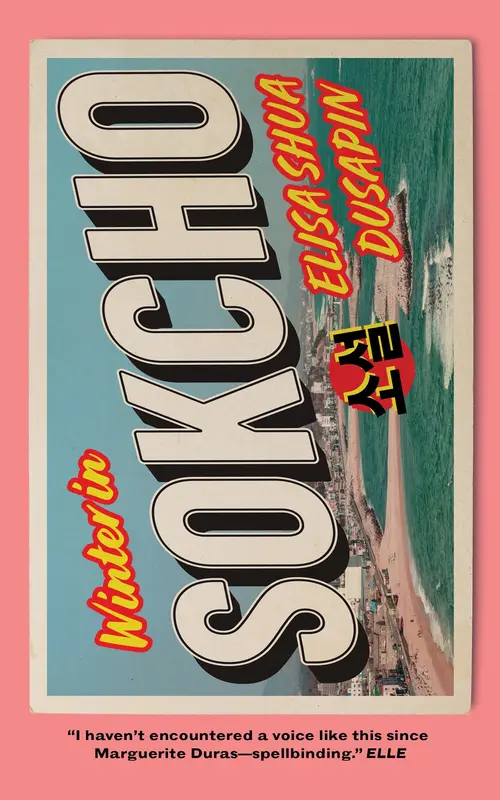
Winter in Sokcho
HE ARRIVED bundled up in a woolen coat.
He put his suitcase down at my feet and pulled off his hat. Western face. Dark eyes. Hair combed to one side. He looked straight through me, without seeing me. Somewhat impatiently, he asked me in English if he could stay for a few days while he looked around for something else. I gave him a registration form to fill in. He handed me his passport so I could do it for him. Yan Kerrand, 1968, from Granville. A Frenchman. He seemed younger than in the photo, his cheeks less hollow. I held out my pencil for him to sign and he took a pen from his coat. While I was checking him in, he pulled off his gloves, placed them on the counter, inspected the dust, the cat figurine on the wall above the computer. I felt compelled, for the first time since I’d started at the guest house, to make excuses for myself. I wasn’t responsible for the run-down state of the place. I’d only been working there a month.
There were two buildings. In the main building, the reception, kitchen and visitors’ lounge downstairs, and a hallway lined with guest rooms. Another hallway with more guest rooms upstairs. Orange and green corridors, lit by bluish light bulbs. Old Park hadn’t moved on from the days after the war, when guests were lured like squid to their nets, dazzled by strings of blinking lights. From the boiler room, on clear days, I could see the beach stretching all the way to the Ulsan mountains that swelled on the horizon. The second building was around the back of the first one, down a long alleyway. A traditional house on stilts, restored to make the most of its two rooms with their heated floors and paper dividing walls. An internal courtyard with a frozen fountain and a bare chestnut tree. There was no mention of Old Park’s in the guidebooks. People washed up there by chance, when they’d had too much to drink or missed the last bus home.
The computer froze. I left it to recover while I went over the information for guests with the Frenchman. It was usually Old Park’s job to do this but he wasn’t there that day. Breakfast from 5 A.M. to 10, in the kitchen next to the reception, through the sliding glass door. No charge for toast, butter, jam, coffee, tea, orange juice, and milk. Fruit and yogurt extra, put a thousand won in the basket on top of the toaster. Items to be washed should be left in the machine at the end of the corridor on the ground floor, I’d take care of the laundry. Wi-Fi password: ilovesokcho, all one word, no capitals. Convenience store open twenty-four hours a day, fifty meters down the road. Bus stop on the left just past the shop. Seoraksan National Park, one hour away, open all day until sunset. A good pair of boots recommended, for the snow. He should bear in mind that Sokcho was a seaside resort, I added. There wasn’t much to do in the winter.
Guests were few and far between at that time of year. A Japanese climber, and a girl about my age, seeking refuge from the capital while she recovered from plastic surgery to her face. She’d been at the guest house for about two weeks, her boyfriend had just joined her for ten days. I’d put all three of them in the main house. Business had been slow since the death of Park’s wife the previous year. Park had closed up the upstairs bedrooms. When you included my room and Park’s, all the rooms were taken. The Frenchman could sleep in the other building.
It was dark. We set off down the narrow alleyway past Mother Kim’s stall. Her pork balls gave off an aroma of garlic and drains that lingered in the mouth all the way down the street. Ice cracked beneath our feet. Pallid neon lights. We crossed a second alleyway and came to the front porch.
Kerrand slid the door open. Pink paint, plastic faux baroque mirror, desk, purple bedspread. His head brushed the ceiling, from wall to bed was no more than two steps for him. I’d given him the smallest room in the building, to save on cleaning. The communal bathroom was across the courtyard, but he wouldn’t get wet, there was a covered walkway all around the house. It didn’t bother him anyway. He examined the stains on the wallpaper, put down his suitcase, handed me five thousand won. I tried to refuse it but he insisted, wearily.
On my way back to reception, I took a detour through the fish market to pick up the leftovers my mother had put aside for me. I walked down the aisles to stand number forty-two, ignoring the looks people gave me as I passed. My French origins were still a source of gossip even though it was twenty-three years since my father had seduced my mother and then vanished without a trace.
My mother, wearing too much makeup as usual, handed me a bag of baby octopus:
“That’s all there is right now. Have you got any bean paste left?”
“Yes.”
“I’ll give you some.”
“No need, I still have some.”
“Why don’t you use it?”
“I do!”
Her rubber gloves made a sucking noise as she pulled them on and looked at me suspiciously. I’d lost weight. Old Park didn’t give me enough time to eat, she’d have a word with him. I told her not to. I’d been consuming vast amounts of toast and milky coffee every morning ever since I’d started working there, I said, I couldn’t possibly have lost weight. Old Park had taken a while to get used to my cooking but he didn’t interfere. The kitchen was my domain.
The octopus were tiny, ten or so to a handful. I sorted through them, browned them with shallots, soy sauce, sugar, and diluted bean paste. I reduced the heat to stop them getting too dry. When the sauce had thickened, I added some sesame and tteok, slices of small sticky rice balls. Then I started to chop the carrots. Reflected in the blade of the knife, their grooved surface blended weirdly with the flesh of my fingers.
I felt a chill as a draft blew through the kitchen. Turning around I saw Kerrand come in. He wanted a glass of water. He watched me work while he drank it, staring hard as if he were trying to make sense of the image in front of him. I lost concentration and nicked the palm of my hand. Blood welled onto the carrots, hardening to form a brownish crust. Kerrand took a handkerchief from his pocket. He stood close to me and held it to the wound.
“You should be more careful.”
“I didn’t do it on purpose.”
“Just as well.”
He smiled, pressing his hand against mine. I broke away, feeling uneasy. He nodded toward the pan.
“Is that for this evening?”
“Yes, seven o’clock, in the next room.”
“You’re bleeding.”
Irony, statement of fact, distaste. I couldn’t read the tone of his voice. And besides, he’d already left.
At dinner, there was no sign of him.
MY MOTHER WAS squatting in the kitchen, her chin pressed to her neck, arms plunged into a bucket. She was mixing fish liver, leeks, and sweet potato noodles to make the stuffing for the squid. Her soondae were known to be the best in Sokcho.
“Watch me work the mixture. See how I spread the stuffing evenly.”
I wasn’t really listening. Liquid was spurting out from the bucket, pooling around our boots and running toward the drain in the middle of the room. My mother lived at the port, above the loading bays, in one of the apartments reserved for fishmongers. Noisy. Cheap. My childhood home. I went to see her on Sunday evenings and stayed over until Monday, my day off. She’d been finding it difficult sleeping alone since I’d moved out.
Handing me a squid to stuff, she placed her liver-stained gloves on my hips and sighed:
“So young and pretty, and still not married …”
“Jun-oh has to find a job first. We’ve got plenty of time.”
“People always think they have time.”
“I’m only twenty-four.”
“Exactly.”
I promised her we’d get engaged officially, in a few months’ time. Reassured, my mother went back to her task.
That night, between the damp sheets, crushed by the weight of her head on my stomach, I felt her chest rising and falling as she slept. I’d gotten used to sleeping alone in the guest house. Her snoring kept me awake. I counted the drops of saliva leaking out one by one from her parted lips and onto my skin.
THE NEXT DAY I went for a walk on the beach that ran the length of the town. I loved this coastline, scarred as it was by the line of electrified barbed wire fencing along the shore. The border with North Korea was barely sixty kilometers away. A windblown figure stood out against the building works in the harbor. The name in the passport flashed through my mind. Yan Kerrand, walking toward me. A dog sprang up from a pile of nets and began to follow him, sniffing at his trousers. One of the workers called the dog back. Kerrand stopped to stroke it, said something that sounded like “that’s okay,” but the man put the dog back on its lead, and Kerrand carried on walking toward me.
He drew level with me and I fell into step beside him. “This winter landscape is beautiful,” he shouted into the wind, taking in the beach with a sweep of the arm.
I wasn’t convinced he meant it, but I smiled anyway. Over at the landing jetty, the screech of metal could be heard from the cargo ships.
“Have you been working here long?”
“Since I left university.”
His hat slipped, caught in a gust of wind.
“Can you speak up?” he asked, pressing the hat down over his ears.
All I could see of his face was a narrow band. Instead of shouting, I moved closer to him. He wanted to know what I’d studied. Korean and French literature.
“You speak French then.”
“Not really.”
To be honest, my French was better than my English, but I felt intimidated at the thought of speaking it with him. Luckily, he did no more than nod in agreement. I was on the verge of telling him about my father, but I held back. He didn’t need to know.
“Do you know where I can find ink and paper?”
The Sokcho stationery shop was closed in January. I told him how to get to the nearest supermarket.
“Will you come with me?”
“I don’t have much time …”
He stared at me intently.
I said I’d go with him.
We walked past an expanse of concrete. An observation tower rose up in the middle of it, pumping out the wailing of a K-pop singer. In town, restaurant owners dressed in yellow boots and green baseball caps stood in front of their fish tanks, waving their arms around to attract customers. Kerrand walked past the window displays without seeming to notice the crabs or the octopuses with their tentacles suctioned against the glass.
“What brings you to Sokcho in the dead of winter?”
“I needed peace and quiet.”
“You’ve come to the right place,” I laughed.
He didn’t respond. Perhaps I bored him. But so what? His moods weren’t my problem. Why should I worry about filling the silences? I was the one doing him a favor. A mangy-looking dog came shambling toward him.
“Dogs seem to like you.”
Kerrand nudged it away from him.
“It’s my clothes. I’ve been wearing the same ones for a week. They must stink.”
“I told you I do laundry.”
“I didn’t want you getting blood on my clothes.”
If he was trying to make a joke, it was lost on me. I thought he smelled fine. A mixture of incense and ginger.
In the Lotte Mart he took hold of a pen, turned it over and over in his hand, put it down again, and then started picking up blocks of paper, ripping open the packaging and sniffing the sheets. I looked around to make sure there were no cameras. Kerrand tested the different textures. He seemed to like the roughest ones best. He scrunched up the paper, touched it to his lips and the tip of his tongue, tasted the edge of one of the sheets. He seemed satisfied and went off toward another aisle. I hid the blocks he’d torn open under some binders. When I caught up with him, he hadn’t found what he was looking for. He wanted pots of ink, not cartridges. I asked the assistant and he went to fetch some from the stockroom. He came back with two bottles, one Japanese and one Korean. Kerrand didn’t want the Japanese ink, it was too fast-drying, he wanted to test the Korean ink. No, that was not possible. Kerrand raised his head. He asked again. The assistant was getting irritated. I asked him in
Korean, and he eventually gave in. Kerrand took a clothbound sketchbook from his coat pocket and traced a few lines. In the end he bought the Japanese ink.
At the bus stop, there was no one but us.
“So you’re French.”
“From Normandy.”
I nodded to show I understood.
“You’ve heard of it?”
“I’ve read Maupassant.”
He turned to look at me.
“How do you picture it?”
I thought for a moment.
“Pretty. A bit melancholy.”
“It’s changed since Maupassant’s day.”
“I’m sure it has. Like Sokcho.”
Kerrand didn’t reply. He’d never understand what Sokcho was like. You had to be born here, live through the winters. The smells, the octopus. The isolation.
“Do you read a lot?” he asked.
“I used to, before I went to university. I used to love reading. Now it’s more of a chore.”
He nodded, tightened his grip on the package he was holding.
“What about you?”
“Do I read?”
“What do you do for a living?”
“I draw comics.”
The word “comics’ didn’t sound right coming from him. It conjured up images of conventions, queuing fans. Maybe he was famous. I didn’t read comic books.
“Is your story set here?”
“I don’t know yet. Maybe.”
“Are you on vacation?”
“There’s no such thing as a vacation in my line of work.”
The bus arrived. We each took a seat by the window, on either side of the aisle. The light had faded. I could see Kerrand reflected in the window, his package on his lap. He’d closed his eyes. His nose stuck out like a set square. Fine lines fanned out from his thin lips, traces of future wrinkles. He’d shaved. I cast my gaze up toward his eyes and realized that he was looking at my reflection in the glass too. That same look he’d given me when he arrived at the hotel, friendly and slightly bored at the same time. I looked down. Our stop was announced. Kerrand brushed his fingers against my shoulder as he set off down the alleyway.
“Thanks for this afternoon.”
That evening he wasn’t there again at dinner. Feeling emboldened after our walk, I took him a tray of food that was less spicy than the meal served to the other guests.
He was sitting on the edge of the bed, his stooping figure silhouetted against the paper wall. The door had been left ajar. Pressing my face to the doorframe, I could see his hand moving over a sheet of paper. He’d placed the paper on top of a box on his lap. The pencil between his fingers was finding its way, moving forward and backward, hesitating, searching again. The point hadn’t touched the paper yet. Kerrand began to draw, with uneven strokes. He went over the lines several times, as if to erase and correct, etching the contours into the paper. The image was impossible to make out. Branches of a tree, or a heap of scrap metal perhaps. Eventually I recognized the shape of an eye. A dark eye beneath a tangle of hair. The pencil continued in its path until a female form emerged. Eyes a bit too large, a tiny mouth. She was perfect, he should have stopped there. But he carried on, going over the features, gradually twisting the lips, warping the chin, distorting the image. Then, taking a pen, he daubed ink slowly and purposefully over the paper until the woman was nothing more than a black, misshapen blob. He placed the sheet of paper on the desk. Ink dripped down on to the floor. A spider scuttled into view and started to run up his leg, but he made no move to brush it away. He looked down at his handiwork. In an instinctive movement, he tore off a corner of the sheet and began to chew on it.
I was afraid he’d see me. I put the tray down silently, and left.
I WAS LYING on my bed, distractedly leafing through a book. Jun-oh came in. Hair glinting chocolate brown. He’d been to the hair salon.
“You could have knocked.”
Park had let him in. He took off his shoes. Snow melting under the soles.
“Leave them outside.”
He said he’d leave if I carried on like this. I didn’t care one way or the other. If he was staying, he should put them outside. He grunted and did as I asked, and then came and sat down beside me. He asked me what I was reading. I tilted the book toward him. He moved my arm aside to pull up my sweater. My breasts tightened. His hand, ice-cold, dug into my flesh. He said nothing but I could feel him judging me, making comparisons, measuring, weighing me up. I pushed him away. Jun-oh sighed. Then he held out his phone to show me the website of a modeling agency in Gangnam. He was leaving in two days to go for an interview. He stood up, checked himself out in the mirror, said he didn’t think they’d expect him to have surgery, but if they did, he was prepared to have his nose, chin, and eyes done. He turned to face me. Clinics were offering deals, by the way, I should look into it, he’d bring me some brochures for facial surgery. He examined the back of his right ear. Everyone had things they could improve, he said. Me included, especially if I was hoping to go and work in Seoul at some point. Although in the literary world, looks didn’t count as much. Depending on the job you had, of course. He sat down again, one hand on my thigh. I was wearing a sweater dress, I’d taken off my tights. He ran his finger along my scar, the long, fine line that marked the time I’d fallen on a fish hook when I was little. I put my book down abruptly.
“Okay. Tell me what you want me to look like.”
He laughed. Why was I acting so hostile? He thought I was just perfect. He pushed a strand of hair back behind my ear and lay down, one leg on top of mine, to kiss me. I kept my mouth closed against his tongue. Why did I always do that, he protested, we weren’t going to see each other for days. I said I’d miss him, but the time would go quickly, I had lots to do at the guest house. Jun-oh got up to leave. He said I could sleep at his place the next day if I wanted to. Then he went out, slamming the door behind him.
The Story Continues on BooksBarbecue!
Enjoyed this preview? ❤️ Do not stop here!
Read the complete book free online → 🔗
Continue reading now on BooksBarbecue and discover every page!
Love reading? Bookmark BooksBarbecue.com for more amazing books!
Happy Reading!