Window Poems
Cover Page
WINDOW POEMS
Title Page
Copyright
Copyright © 1985 by Wendell Berry
Foreword copyright © 2003 by James Baker Hall
First Shoemaker & Hoard edition 2007
Based on the fine press edition by the Press on Scroll Road
All rights reserved. No part of this book may be used or reproduced in any manner whatsoever without written permission from the Publisher, except in the case of brief quotations embodied in critical articles and reviews.
Library of Congress Cataloging-in-Publication Data is available.
ISBN 978-1-58243-623-4
eISBN 978-1-64009-172-6
Interior design by Bob Baris
Cover design by Tabitha Lahr
COUNTERPOINT
2560 Ninth Street, Suite 318
Berkeley, CA 94710
Distributed by Publishers Group West
10 9 8 7 6 5 4 3 2
FOREWORD BY JAMES BAKER HALL
WENDELL’S WINDOW & THE WIND’S EYE
THE summer after Wendell and Tanya were married, before they moved into quarters befitting his first teaching job at a Baptist college with mandatory daily chapel, they lived in a cabin on the Kentucky River bank—with kerosene for lamp light and butane for cooking & for heating water, which had to be hauled in a few gallons at a time. There wasn’t enough elbowroom in that cabin for more than a change of clothes, if you could find berth enough between the bed and everything else to get into them, but it was rendered spacious by the great excitement of their protracted honeymoon. Wendell had thrown himself into the preparations, repairing the screen and windows & doors, white washing the walls, cutting the weeds and generally shaping up the setting. It was called the Camp, a power place from his boyhood in nature, a locus of his independence from home rule, and for him the perfect summer hinge into his marriage. For Tanya it was something quite other, a crash course in just what she’d signed up for, until death do them part. Those of us fortunate enough to be watching joined the newlyweds in delight at the romance of it all. For his wedding present to his bride, Wendell toppled the old outhouse & built a new one—still without a door, as befit the view. Until that summer of 1957, Tanya’s idea of rustic was classy Mill Valley, California, where her professional aunts & uncles lived on a treed hillside a few minutes from the Golden Gate Bridge. For her wedding present to Wendell, twenty-one year old Queenie—for her striking resemblance to the profiled Nefertiti—rolled up her sleeves, got out the mosquito spray, and proceeded to figure out what the situation expected of her—so that she could exceed expectations. She multiplied that cabin space with fresh flowers, and turned the screened-in porch into a place to be, where everything happened. Wendell, who’d already made it into famous Poetry magazine and was on his quick way, wrote out there, on a folding card table in the corner, with a view of the old brown river. Overnighters slept on a narrow cot out there that during the day was a bolstered place to sit. And before we went to bed, we sat out there on the porch with the lamp turned low & watched fireflies and listened to the crickets and the tree frogs and the river, sometimes talking quietly but not always. In Wendell’s presence you understood without him saying anything that it was his well-thought-out conviction that there were often better things to listen to than humans, even those so distinguished and interesting as yourself. Owls, for instance, the sound of an owl would shut down conversation at the Camp. A towboat pushing barges upstream, for another. The Camp wasn’t just a quiet place, it was a place of quiet, where the click & clack of dishwashing in an enameled pan hung in the trees, sometimes welcome but not always, and where a speedboat was a messenger straight from hell, shoot the s.o.b. before he reproduces. Before light Wendell got up and put on his tall rubber boots, stealing down the slope to a johnboat tied up to a sycamore, & ran his trot lines, in the dark, as any poet for real would want to do. In the middle of the night once he hauled up a twenty-seven pound catfish, waking his bride to share in the excitement. Chunks of Ivory soap were used sometimes as bait.
Although that cabin was left standing for another six-plus years, the newlyweds were the old Camp’s glorious last hurrah, just as it was their set up and send off and an emblem of what brought them back. Between that summer of 1957 and their return in 1964 to settle in a house just up the road, they lived on the West Coast, in Italy, and in New York City, where they got to know artists and intellectuals of reputation. Some of those new worldly friends would visit them there on the river bank in the coming years; many others, along with the growing number of Wendell’s readers, kept track of the now famous story unfolding there through poems, stories & essays. Salvage from the original Camp was used in the construction of the new one, which was well-insulated & lined inside with six inch tongue-and-groove, and had the look and feel not of a weekend, like its predecessor, but of a life. No, a way of life. Wendell was out to prove that the received opinion of the day about not being able to go home again was seriously wrong-headed, confused, short-sighted. The Long Legged House was the new cabin’s literary name, bestowed in his magnificent essay by that title, but no one has ever called his writing place anything but the Camp. The makeshift cardtable from the old cabin was replaced by a long, deep work counter fastened to the wall and floor, and the vacation view from the old porch was framed before eternity in the grand window above it, the ‘wind’s eye’ in these elegant and wise meditations. The old Camp, where you were among the river gods, embraced by a simpler, freer way of life, it wasn’t gone: trusting birds at the feeder a hand-reach away testified to that, the same wildflowers around the door entrance and down the slope, the same ever-changing muddy river rising and falling and swirling and going quiet on the surface as the same blue heron, or his progeny, lifted off upstream and disappeared. The old Camp was very much still in the air, but things were considerably more complicated & momentous now for the still-very-young writer-man no longer on his honeymoon. A sprawling vulnerability came close to being his base condition, as his conversation & writings testified. There were children in the picture now, history was tightening the ecological and political screws, more people were paying attention to him, more causes needed his voice. In 1957 he’d been a camper on that river bank, now he was an outspoken citizen of the endangered world. He shook his head in despair often, and stared off into space as though he did not want to talk any more about what he saw. His trot lines had grown heavy, I find myself saying, and the dark in which he worked them no longer a thrilling challenge, a source of juice, more like a fear now, a dread, a terrible drain. The delightful twenty-seven pound catfish had been replaced during the intervening years with two-ton tar-babies like agri-business and world population and the fossil-fuel culture.
The artist had good use for ordering devices, and the many-paned window provided him with one, a grid with more than two dimensions, a way to measure & to frame anything of his choosing. ‘The window has an edge / that is celestial, / where the eyes are surpassed,’ he sums up at the end of the sequence. What we’ve been witnessing is the transforming power of the presiding image, from random thought & perception into picture, from time into timelessness. The way these poems move, each within itself, and within the overall—how the flat rock of the voice skips—suggests to me the equal influence of both the grid & the river. How to put this? The other shore is out of reach, but the language aspires there: dramatizing where it settles, commencing its pulsing circles.
He wrote these poems in longhand, probably with a pen, on a long yellow legal pad (made dear to him early on by his lawyer father), sometimes with his feet propped up on the desk and a pencil or a Camel cigarette behind his ear. After breakfast every morning that he wasn’t off teaching or reading or lecturing, he went to the Camp to write, disappearing out the back door and around the side of the house with a brief case and a thermos. Depending on the weather, the stove would be the first order of business, and he would be dressed in coveralls, wearing a stocking cap as he swept the floors, often joyfully. Or the doors would get propped open to the joy of the breeze, and he’d be dressed in khaki work pants & work shirt & wearing Red Wings, a tall thin man, six four, good-looking, with a deep voice & a big laugh & a real mean streak, and an Irish charm that still disarms many who think they aren’t going to like him, the self-appointed Jeremiah from Hicksville. In any portrait of Wendell, there hangs nearby a Cezanne calendar, he loves especially the landscapes, and a Vermeer postcard, maybe a Degas too. Depending on which dog was current, there could be one stretched on the pine floor of the Camp as these poems were being written, but he would be the only possible distraction. The birds coming and going at the window feeder weren’t a distraction from his work, more like the other way around. The level surfaces were well-ordered & sparsely populated, in spirit akin to the book you are holding. To the right of the working counter were deep shelves, with manuscripts, correspondence, journals, tasks, books, and to the right of that, the door onto the porch with its swing, hoisted to the ceiling in off-season.
I remember many times sitting beside him at that window— he would insist that I take his more comfortable chair, and sometimes I would. One summer evening as the sun was setting we were there talking about William Carlos Williams & Rexroth’s translations from the Chinese, when a towboat came up the river, its sound preceding it. The foliage gave one barge and took it back and returned two, until I was wishing I’d counted, and then there the whole rig was with its running lights: sand barges on their slow, flat push upstream to Frankfort. Without comment Wendell handed me the binoculars so that I could see what was going on in the pilot’s cabin of the caboose towboat, a forward-facing man at the wheel, and another at a side window—much as these poems hand you access to what’s in the author’s deepest mind & most eloquent language. I was poised between wanting to say what I thought the boatman was called to the window to witness—the last sun sliding across the flat white face of the hillside Berry house—and not wanting to break the silence. The encompassing spirit of this suite of poems is thus poised, under equal influence from art and nature—it’s in that straddle they find their tension, and their terms. The tall house up the road, caught in time, is the centerpiece of their landscape, and the river, with it’s deep dark power & ongoingness, is the trope of their vision.
From the legal pad he typed them there at the Camp on an office model Royal, out from under its cover, using 20pd Corrasable bond and making a carbon on yellow seconds or onionskin (this was a long time before copy machines) which he sent to me—in the margins I noted my responses, and sent them back. Or kept them because I didn’t want to part with them, and wrote a fan letter. I loved these poems when I first read them, and found them thrilling, and inspiring—he was so far out ahead of the rest of us—already he knew what he had to write about and who he wanted to be and what he wanted to sound like—already he was becoming very accomplished, one good book after another. And I still love them, for the load-bearing freedom they manifest, flying out of the gravities they debate and flying back in, the simultaneous grace and momentousness of their moves transforming their lashings-out and their propositions into notes of a song. Of all Wendell’s poetry, I think I like best the work he did during that period, mid-sixties through early seventies, the first four or five books, when he was still feeling his way, earning each step, testing himself.
The depth of thought & feeling in these Window Poems transform the notational style, and vice versa. They add up the way a Breughel does, each little scene intense and absorbing, yielding to its small place in the encompassing community. There’s hesitation, self-doubt, vulnerability, life-sizeness here, in and among blazing visions where everything is writ large. There’s an ear with perfect pitch, a lightness of touch, which makes for a voice deeply afraid of getting nailed, especially by its own anger and righteousness. In the corner of the forty-paned window at the Camp, feeding from a roofed flat, the nuthatches, chicadees, sparrows, bluejays, cardinals flew in and grabbed something up and flew off, and the poems did and keep doing likewise, hunting for what to trust. All taken together they sound like what they do, not what they say: the author is throwing the dice, the stakes are high: his long wrists are loose, he’s on a roll.
February 2003 Harrison Co, Kentucky
WINDOW POEMS
WINDOW. WINDOW.
The wind’s eye
to see into the wind.
The eye in its hollow
looking out
through the black frame
at the waves the wind
drives up the river,
whitecaps, a wild day,
the white sky
traveled by snow squalls,
the trees thrashing,
the corn blades driven,
quivering, straight out.
2.
The foliage has dropped
below the window’s grave edge,
baring the sky, the distant
hills, the branches,
the year’s greenness
gone down from the high
light where it so fairly
defied falling.
The country opens to the sky,
the eye purified among hard facts:
the black grid of the window,
the wood of trees branching
outward and outward
to the nervousness of twigs,
buds asleep in the air.
3.
The window has forty
panes, forty clarities
variously wrinkled, streaked
with dried rain, smudged,
dusted. The frame
is a black grid
beyond which the world
flings up the wild
graph of its growth,
tree branch, river,
slope of land,
the river passing
downward, the clouds blowing,
usually, from the west,
the opposite way.
The window is a form
of consciousness, pattern
of formed sense
through which to look
into the wild
that is a pattern too,
but dark and flowing,
bearing along the little
shapes of the mind
as the river bears
a sash of some blinded house.
This windy day
on one of the panes
a blown seed, caught
in cobweb, beats and beats.
4.
This is the wind’s eye,
Wendell’s window
dedicated to purposes
dark to him, a seeing into
days to come, the winds
of the days as they approach
and go by. He has come
mornings of four years
to be thoughtful here
while day and night
cold and heat
beat upon the world.
In the low room
within the weathers,
sitting at the window,
he has shed himself
at times, and been renewed.
The spark at his wrist
flickers and dies, flickers
and dies. The life in him
grows and subsides
and grows again
like the icicle throbbing
winter after winter
at a wrinkle in the eave,
flowing over itself
as it comes and goes,
fluid as a branch.
5.
Look in
and see him looking out.
He is not always
quiet, but there have been times
when happiness has come
to him, unasked,
like the stillness on the water
that holds the evening clear
while it subsides
—and he let go
what he was not.
His ancestor is the hill
that rises in the winter wind
beyond the blind wall
at his back.
It wears a patched robe
of some history that he knows
and some that he
does not: healed fields
where the woods comes back
after a time of crops,
human history
done with, a few
ragged, fences surviving
among the trees;
and on the ridges still
there are open fields
where the cattle look up
to watch him on his walks
with eyes patient as time.
The hill has known
too many days and men
grown quiet behind him.
But there are mornings
when his soul emerges
from darkness
as out of a hollow in a tree
high on the crest
and takes flight
with savage joy and harsh
outcry down the long slope
of the leaves. And nights
when he sleeps sweating
under the burden of the hill.
At the window
he sits and looks out,
musing on the river,
a little brown hen duck
paddling upstream
among the windwaves
close to the far bank.
What he has understood
lies behind him
like a road in the woods. He is
a wilderness looking out
at the wild.
6.
A warm day in December,
and the rain falling
steadily through the morning
as the man works
at his table, the window
staring into the valley
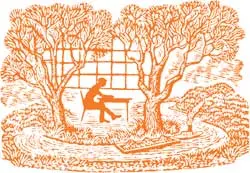
as though conscious
when he is not. The cold river
steams in the warm air.
It is rising. Already
the lowest willows
stand in the water
and the swift currents
fold round them.
The bare twigs of the elms
are beaded with bright drops
that grow slowly heavy
and fall, bigger
and slower than the rain.
A fox squirrel comes
through the trees, hurrying
someplace, but it seems
to be raining everywhere,
and he submits to wetness
and sits still, miserable
maybe, for an hour.
How sheltering and clear
the window seems, the dry fireheat
inside, and outside the gray
downpour. As the man works
the weather moves
upon his mind, its dreariness
a kind of comfort.
7.
Outside the window
is a roofed wooden tray
he fills with seeds for the birds.
They make a sort of dance
as they descend and light
and fly off at a slant
across the strictly divided
black sash. At first
they came fearfully, worried
by the man’s movements
inside the room. They watched
his eyes, and flew
when he looked. Now they expect
no harm from him
and forget he’s there.
They come into his vision,
unafraid. He keeps
a certain distance and quietness
in tribute to them.
That they ignore him
he takes in tribute to himself.
But they stay cautious
of each other, half afraid, unwilling
to be too close. They snatch
what they can carry and fly
into the trees. They flirt out
with tail or beak and waste
more sometimes than they eat.
And the man, knowing
the price of seed, wishes
they would take more care.
But they understand only
what is free, and he
can give only as they
will take. Thus they have
enlightened him. He buys
the seed, to make it free.
8.
The river is rising,
approaching the window
in awful nearness.
Over it the air holds
a tense premonition
of the water’s dark body
living where yesterday
things breathed. As he works
through the morning
the man has trouble
in the corner of his eye,
whole trees turning
in the channel as they go by,
the currents loaded
with the trash of the woods
and the trash of towns,
bearing down, and rising.
9.
There is a sort of vertical
geography that portions his life.
Outside, the chickadees
and titmice scrounge
his sunflower seed. The cardinals
feed like fires on mats of drift
lying on the currents
of the swollen river.
The air is a bridge
and they are free. He imagines
a necessary joy
in things that must fly
to eat. He is set apart
by the black grid of the window
and, below it, the table
of the contents of his mind:
notes and remnants,
uncompleted work,
unanswered mail,
unread books
—the subjects of conscience,
his yoke-fellow,
whose whispered accounting
has stopped one ear, leaving him
half deaf to the world.
Some pads of paper,
eleven pencils,
a leaky pen,
a jar of ink
are his powers. He’ll
never fly.
10.
Rising, the river
is wild. There is no end
to what one may imagine
whose lands and buildings
lie in its reach. To one
who has felt his little boat
taken this way and that
in the braided currents
it is beyond speech.
‘What’s the river doing?’
‘Coming up.’
In Port Royal, that begins
a submergence of minds.
Heads are darkened.
To the man at work
through the mornings
in the long-legged cabin
above the water, there is
an influence of the rise
that he feels in his footsoles
and in his belly
even while he thinks
of something else. The window
looks out, like a word,
upon the wordless, fact
dissolving into mystery, darkness
overtaking light.
And the water reaches a height
it can only fall from, leaving
the tree trunks wet.
It has made a roof
to its rising, and become
a domestic thing.
It lies down in its place
like a horse in his stall.
Facts emerge from it:
drift it has hung in the trees,
stranded cans and bottles,
new carving in the banks
—a place of change, changed.
It leaves a mystic plane
in the air, a membrane
of history stretched between
the silt-lines on the banks,
a depth that for months
the man will go from his window
down into, knowing
he goes within the reach
of a dark power: where
the birds are, fish
were.
11.
The Story Continues on BooksBarbecue!
Enjoyed this preview? ❤️ Do not stop here!
Read the complete book free online → 🔗
Continue reading now on BooksBarbecue and discover every page!
Love reading? Bookmark BooksBarbecue.com for more amazing books!
Happy Reading!