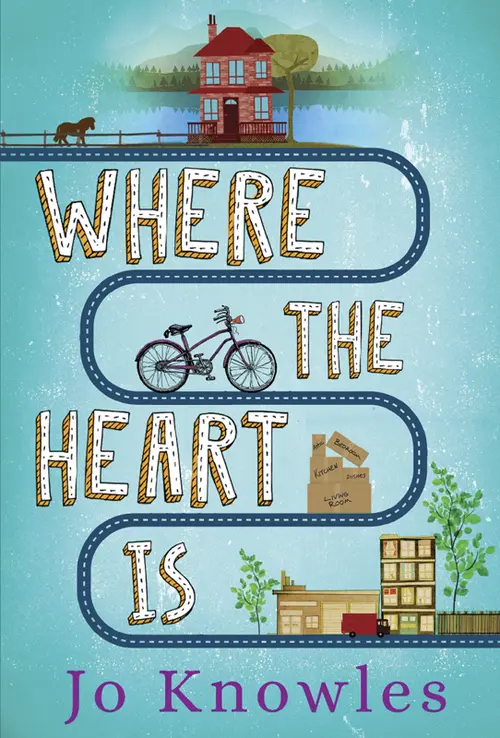
Where the Heart Is
Cover
Title Page

Dedication
Chapter One

I was six years old when I got engaged to Micah Sasaki. It was during coffee hour at church, when the adults were busy in the fellowship hall, eating banana bread and gossiping and letting the kids run wild on the front lawn. We were playing Sardines. I found Micah under the lilac bushes by the steps and we huddled together, waiting to be found. We held hands and giggled quietly each time we heard footsteps and heavy breathing as someone ran past.
We waited like that for a long time, and then, out of the blue, Micah whispered, “I love you, Rachel.” His breath smelled like bananas.
He squeezed my hand, and my small heart thumped in my chest as if it were a hummingbird trapped inside.
“Do you want to marry me?” he asked.
“Yes!” I said without hesitation.
He was my first and best friend, and my favorite neighbor. We liked almost all the same games and even the same food. Marriage made perfect sense.
“Move over!” Nadia Collins said, interrupting our engagement.
Micah and I smiled at each other and squished even closer together. The lilac bushes were in full bloom, and the smell of the blossoms engulfed us each time someone jostled the branches.
Cole Jenkins found us next. Then a few others, and then the game was over. We all climbed out from under the bushes, but before we went back inside, Micah gave me a lilac and kissed me on the cheek. Then we found our parents and told them the news.
They laughed and said, “How sweet,” as if it were a silly joke.
Micah got mad and stomped off, which only made the grown-ups laugh harder.
I found Micah back under the lilac bushes, red-faced. “They don’t know anything,” I told him.
“We’ll always be together,” he said. “Right?”
I climbed under the branches and sat next to him and held his hand again. “Always,” I said. We sat like that until our parents came and found us and apologized for being insensitive.
Even though that was six years ago, sometimes one of our parents will bring it up, asking us in a jokey kind of way how the wedding plans are going. Micah always blushes and smiles awkwardly, and maybe even a little hopefully. But more and more, I’m filled with guilt. Because deep down, as much as I love Micah, I know it will never happen.
“Rachel, wake up right now!” my sister yells, pounding on my door.
I sit up and feel dizzy. A familiar panic rises in my chest. I can’t believe I’m going to be late for school again.
Then I remember. Today is the first day of summer! Not only that: it’s my thirteenth birthday.
Ivy bangs on my door again.
“There’s no school!” I yell back. “Remember? Summer!”
“Mom wants us up for something else!” she calls. “So get up!”
I bet she made me birthday pancakes. I sniff and smell something delicious. Maybe waffles.
Outside my window, the leaves are bright green and the birds chirp extra loudly. It’s like the whole outside woke up for summer vacation. Better yet, for my birthday. Warm, sunny days stretch out before me. No more getting up early to catch the bus. No more homework. No more math class with Mr. Drake, who hates me because I never show my work and he thinks I cheat because I still get the right answers. No more worries! Plus I’m a teenager now. I can get more babysitting jobs. I can save money for a better bike than the crappy one my dad scavenged from the dump when I was eight. I can —
“Rachel, would you get up?” Ivy yells through my door again. “The new neighbors are here!”
I peer through my window. Across the street, a moving truck pulls into the long driveway where construction has been going on all year. The house was built on a long, sloping hill in the field we’ve used for sledding every winter and riding my old pony Rainbow in the summer. It was designed to look like a rustic barn, but we peeked through the windows after the workers went home one night and there is nothing rustic about it inside. There are fancy marble counters in the kitchen, and the bathrooms are like the ones you only see on TV, with glass bowls for sinks instead of regular old white porcelain ones. The floors are so polished, they showed the reflection of the windows, as well as our heads, when we peeked through the glass.
“Wow,” I remember Micah saying the first time we looked in.
“They must be loaded,” Ivy said.
“Why on earth would they move here?” I asked.
They were a mystery, and the whole neighborhood was speculating about who these people could be and where they might come from. Behind the house, they’d built a real barn, with stables, several little sheds, and what looked like a chicken coop. They seemed to be planning on having lots of animals, which Ivy was very excited about. Micah and I made up a whole story about the types of animals they’d have. We decided the new neighbors were rare animal collectors and they’d have tigers and zebras and things, but that got Ivy all upset, so we stopped.
The cat meows from the foot of my bed when I get up and step into my slippers. George hates being woken up as much as I do.
“I’m coming!” I yell.
I pull my hair into a ponytail. “Go back to sleep,” I tell George. “It’s summer!”
He walks in a circle and settles down again in his little nest in the squares of sunlight coming through my window.
Downstairs, the sweet smell from the kitchen is even stronger.
“Go back up and get dressed, Rachel,” my mom says, pushing me away before I can go into the kitchen to see what she’s made. She has on a red apron that’s covered in flour. There’s some on her face, too.
“We need to take a pie over to welcome the new neighbors, and it’s almost finished. I want you dressed so we can all go over together to introduce ourselves.”
Pie? So that’s what was baking. Not my birthday breakfast? I hope she didn’t make an extra pie for my birthday cake. Pie is good, but not for birthdays. I want a tall layered cake with thick frosting and fourteen candles because you always have to have one to grow on. Licking syrupy fruit off a candle just isn’t the same as licking off frosting.
I wait a minute before going back upstairs. I look around for the familiar birthday banner my mom made, which she hangs from the ceiling on the morning of our birthdays. It isn’t in the usual place above the kitchen table. Maybe because this is a special year, we’ll eat in the dining room, which we only use to celebrate big holidays. The rest of the time, the dining-room table is piled with mail and newspapers and bills and homework and lots of other junk.
“Go on!” my mom says, still not wishing me a happy birthday.
I turn away from her slowly and take my time walking back to the stairs, just to give her a chance to remember.
“Hustle your buns!” she yells at me.
Sheesh.
From my bedroom window, I watch the new owners boss the movers around. They don’t seem very promising. They look too old to have kids our age, which is fine with me because I don’t really feel like having to make new friends with someone who lives in a house like that. Just walking around, peeking in the windows and being that close to something so nice made me feel crappy about my holey sneakers and cutoff shorts. Micah said maybe they’d have older kids and I’d get their hand-me-downs. Whoop-de-do! It’s bad enough I have to wear the things family friends hand down to us, or cheap clothes my mom finds at the local thrift store. I get itchy just thinking about it. Micah says I sound like a snob when I complain. I tell him I’m just a clean freak, and he says that’s what washing machines are for, which is a good point. But still. I’ll never like wearing other people’s old clothes. They have all these memories in them that I don’t know about. Sometimes I wonder what interesting places they’ve been to. But mostly I try not to think about it.
“Rachel and Ivy, get down here!” my mom yells up the stairs.
I pull on my old shorts and a T-shirt and go to the bathroom to brush my teeth, but Ivy is already inside. I bang on the door, even though that’ll probably make her stay in extra long.
“Mom’s calling us!” I urge through the door. “Get moving!”
She finally opens the door and shines her clean teeth at me. “All yours, sucker!” she says.
I step in and get accosted by the smell of her poop. “You are so gross!” I scream. I hold my breath, grab my toothbrush, and run downstairs to use the other bathroom.
“Can we please get going?” my mom says when I finish brushing my teeth.
I glare at Ivy again. “So gross,” I say again. “You’re eight years old, not five.”
“Everyone poops,” she says. “Even eight-year-olds.”
“Don’t be disgusting,” my mom says. “Now, let’s go.”
We follow her outside and down the driveway. Even from across the street, we can hear the new neighbors still giving orders to the movers, who roll furniture out of a massive moving truck. We weave through the parked trucks up the newly paved driveway. It smells like burning tar in the hot morning sun. Everything over here smells new.
“Hello?” my mom calls, stepping toward the neighbors.
The wife turns around. She looks like she’s in her sixties or so. She’s so tan that the creases in the wrinkles in her face look like someone made them with a dark-brown pen. Like she’s spent so much time in the sun, her skin has turned to leather.
“We’re your new neighbors from across the street,” my mom says to the lady. “These are my kids, Rachel and Ivy. I’m Lydia Gartner.”
The lady smiles, and her face lines deepen and darken even more. “Well, hello!” she says, all friendly. “It’s so nice to meet you!”
“We baked you a pie,” my mom says, holding it out. “Peaches aren’t quite in season yet, so I hope you like strawberry rhubarb.”
“So thoughtful of you.” The lady takes the pie and smells it. “My name’s Greer. Greer Townsend. My husband over there is Bev. Bev, honey, come meet our new neighbors!”
Bev seems like a strange name for a man. I wonder what it’s short for. He has the same kind of tanned and wrinkly leather face as Greer. He’s wearing bright-green shorts that have little white boats embroidered on them, and a matching white polo shirt. He looks like a guy you might see playing golf on TV. Greer has on a similar outfit, only a skirt, not shorts. It’s pink, and I think it’s a tennis skirt, the kind with shorts underneath.
Greer and Bev seem old but sporty. Just like the rest of their stuff, their clothes look brand-new. Like they haven’t even been washed yet, or sweated in.
“How do you do?” Bev asks, reaching for my mother’s hand.
I didn’t know people said How do you do? in real life. He has a funny accent, like his voice is still being haunted by his rich English ancestors or something. Later I’ll learn that he says things like baaaaath instead of bath and lauuuuugh instead of laugh, the way a sheep might if a sheep could talk.
Ivy holds out her hand and Bev shakes it, then mine. He squeezes pretty hard for an old man. His hand is soft and smooth, not like my parents’ hands, which are rough from gardening and stacking wood and all the other outdoor work we all do.
“You have nice weather for moving day,” my mom says. “Is there anything we can help you with?”
Greer nods distractedly and motions for a mover to be careful with a tiny wooden bookcase. “No, no, that’s what the movers are for, dear,” Greer says. “But thank you.”
“Well, we’ll leave you to it. Welcome to the neighborhood.” My mom is acting so awkward, like she doesn’t know how to behave around rich people.
“Thank you for the pie,” Bev says, turning to walk up the driveway.
“We’ll have to have you over for drinks when we’re settled in,” Greer adds.
“That would be lovely.” My mom motions for us to go.
“Snobs,” I say when we cross the road to our side.
“Don’t say that,” my mom says. “Just because people are wealthy doesn’t make them snobs.”
“They took away our sledding hill,” I say.
“Oh, Rachel, it was never ours. We were lucky to be able to use it as long as we did.”
Ivy runs ahead, but my mom and I walk slowly up the driveway, with the weeds growing through the cracked pavement. Our old farmhouse is red, and the paint is peeling. Some of the shutters hang a little off-kilter. Even though we don’t really live on a farm, my grandfather made a sign for the house, just like real farms have. My mom decided on the name Bittersweet Farm when she and my dad moved in, before Ivy and I were born. She had taken a walk on the property with my father and discovered bittersweet running all along the stone wall that ran next to the road and defined the property line years ago when it was still a working farm and the stone wall kept the cows and sheep from getting out. Every fall she cuts branches and makes bittersweet wreaths to hang on the walls throughout the house. The vines are full of bright-yellow shells that open up when they dry to reveal a red berry inside. My mom says they make our drafty old house feel cheerful on cold, dark days.
Whenever we come home from someplace, the sign welcomes us and reminds us that life isn’t perfect, just like my mom always says. It’s a little bitter and a little sweet.
We stop midway up the driveway to look at the sign, which also needs painting. My mom puts her hand on my shoulder. “Happy first day of summer,” she says, squeezing.
But not Happy birthday.
In fact, the whole day no one says a word about me turning thirteen, and I finally realize that they’ve forgotten. Micah always says there’s no such thing as lucky or unlucky numbers, but thirteen sure feels pretty unlucky so far.
Chapter Two

I always thought my tenth birthday would be remembered as the most awkward and disappointing in history, but my thirteenth takes the cake. At least when I turned ten, everyone remembered. But it was really the best day for my mom, not me. She called me downstairs for my “birthday meal,” but instead of having anything ready, she was holding a winter scarf.
“Close your eyes and let me cover your face,” she said, wrapping the scarf around my head.
It was an old woolen scarf she’d knitted for my dad years ago when they were still dating. It was brown with white stripes and smelled like an ancient sheep. It scratched my cheeks.
“Now let me lead you outside,” my mom said.
“What’s happening?” Ivy asked as she bounded into the room. “Why are you tying up Rachel?”
“I’m not tying her up. I’m covering her eyes so she can’t see.”
“How come?”
“We have a special birthday present for her.”
“Is it outside?”
“Yes.”
The door slammed, and I heard Ivy woot in the distance.
I hoped that meant I was getting a new bike.
My mom led me slowly across the room and out the front door, down the old loose and wobbly stone steps.
“Just let me lead you,” my mom said, guiding me down the driveway.
“Are you ready?” she called out to someone in the distance.
“Ready when you are!” my dad replied.
My mom stopped me and put her hands on my shoulders. The scarf was really starting to itch now, and the smell was making me feel funny.
“Here we go,” she said, untying the scarf.
I blinked a few times and looked around. We were at the foot of the driveway. At one corner was a horse trailer and next to it was my dad, standing with a tiny horse. It was black and white and had a bright-green halter.
“What’s that?” I asked.
The tiny horse stared at me suspiciously.
My dad was clutching the halter tightly, as if he knew the horse might bolt at any second.
“It’s your birthday present!” my mom said. Tears slipped down the side of her face. “Your very own pony. His name is Rainbow. Isn’t he just beautiful?”
He blinked at me as I stepped closer. Beautiful wasn’t the word I would have picked. He was cute, though. He nodded his head at me and I patted his nose. The hairs around his eyes were gray, and I wondered how old he was. Surely not a “new” pony like you might expect a kid might get for her birthday.
“He’s a rescue,” my mom said. “He’s going to need a lot of love and patience.” She hugged him then, and I could tell without a doubt that this was definitely a present for her and not me.
The favorite story my mom likes to tell about her childhood is the day she got her own pony, Buddy. The story goes that for three whole years she prayed every night for a horse. Finally, on her tenth birthday, her prayers were answered. My grandfather took her out to the front lawn on the morning of her birthday, a scarf wrapped over her eyes, and when he took it off, there was Buddy, a palomino pony with a big brown patch over one side of his face and all white on the other. There’s an old photo of my mom on the back of Buddy that she keeps on the mantel in the living room. She’s sitting backward and leaning forward, resting an open book on his rump. He’s tethered to a stake in the ground, eating grass on the front lawn of the house she grew up in. This is the way I picture my mom’s entire childhood: carefree summers sitting on Buddy, reading the days away. The problem is, it’s how she’s always envisioned mine, too.
Rainbow sniffed my hand, then licked it, leaving a trail of sticky saliva.
My mom pulled a plastic bag filled with baby carrots out of her pocket and handed them to me. “Put one in the palm of your hand and hold it out flat so he doesn’t nip you,” she said. “Like this.”
I put a carrot in my hand and held it out, and Rainbow slurped it up with his big velvety lips.
“I want to try!” Ivy yelled. Rainbow reared his head at the sound and stepped back, frightened.
“Don’t scare him, Ivy. You have to use a gentle voice,” my mom said.
“Hi, Rainbow,” Ivy whispered, letting him take a carrot from her hand.
We spent the rest of the day preparing a stall for him in the old barn behind the house, and Ivy and I took turns walking him on his lead while the other rode bareback. My mom said we needed to spend a lot of gentle, loving time with him in order to bond. But I think Rainbow would be friends with anyone with a carrot and a soft voice. My favorite thing to do with him was put Ivy on his back and tie him to a stake in the grass, just like in my mom’s photo. Then I’d sit in my mom’s old plastic lawn chair and read to Ivy while she braided the bits of mane she could reach.
For my eleventh birthday, I got a new bridle for Rainbow, since the one he came with was so worn, the leather reins kept splitting in two and my mom kept having to patch them together with duct tape. I don’t even know why I bothered to try to ride him, he was so fat and lazy. The girth on the old saddle he came with barely stretched over his round belly. No one knew how old he really was, but the guess was that he was in his twenties. There was something special about him, though, and whenever I came toward him with his bridle, he’d sniff my hand for a treat and sometimes lick it fondly, like he did the first time we met. I knew it was his way of accepting me, even though I was sure he preferred being read to in the grass than taking me for rides. I was allowed to ride him to the bottom of the field across the street, but it was agony getting him to go. The only time he picked up speed was when we turned around and he knew he was heading for home. Then he would trot slowly with his ears perked up and pointed straight for the barn, where he knew my mom was waiting with a sugar cube. Riding in the field felt like our special time, and sometimes I’d sing “Over the Rainbow” to him as we trudged along. I know it sounds silly, but I think it made him feel special.
The Story Continues on BooksBarbecue!
Enjoyed this preview? ❤️ Do not stop here!
Read the complete book free online → 🔗
Continue reading now on BooksBarbecue and discover every page!
Love reading? Bookmark BooksBarbecue.com for more amazing books!
Happy Reading!