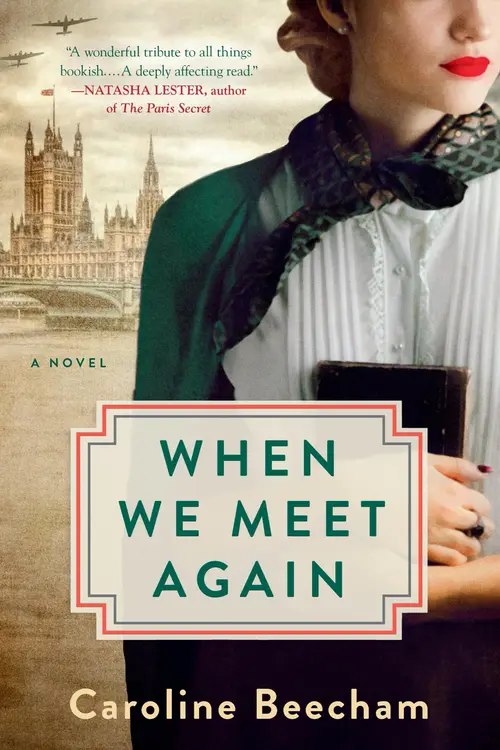
When We Meet Again
Cover
Dedication
This book is for the Brighton girls—Amanda, Becky, Gill, Lisa and Vicky—for your love and friendship
Epigraph
If you cannot read [all your books], at any rate handle them and, as it were, fondle them. Peer into them. Let them fall open where they will. Read on from the first sentence that arrests the eye. Then turn to another. Make a voyage of discovery, taking soundings of uncharted seas. Set them back on their selves with your own hands. Arrange them on your own plan, so that if you do not know what is in them, you at least know where they are. If they cannot be your friends, let them at any rate be your acquaintances.
—Winston S. Churchill
People die, but books never die. . . . No man and no force can take from the world the books that embody man’s eternal fight against tyranny. In this war, we know, books are weapons.
—Franklin D. Roosevelt
Prologue

Brighton, March 18, 1943
Alice woke with a start, seagulls screeching from the gabled rooftop. The dawn glow bled through uneven curtains, illuminating the white wicker crib that stood only a few feet away. She was curled on her side at the very edge of the bed, eye level with the crib, which sat beside the splintered paintwork of the windowsill.
Her lips curved into a smile. She needed to nurse Eadie now, just as the midwife had shown her the day after the birth. Alice tried to ease herself up onto one elbow, but her limbs were so weak with tiredness that her arm wouldn’t support her, and she collapsed back onto the pillow. Everything was so tranquil; Eadie must still be sleeping—this most precious time preserved—and all Alice could hear was her own breathing. It was clear that no one else in the guesthouse was awake.
Her lips twitched into a half smile as she wondered if her daughter would always be so calm when she slept; her mother had told her that she’d snored like a grown man.
Alice pushed herself up again, trying to ignore the soreness and discomfort as she carefully swung her legs around and levered up with both hands. With eyes alight, she beamed in anticipation as she tilted forward, ready to see her newborn, her face hovering over the crib—but when she looked down, it was empty.
Her eyes flashed wide in horror, staring unblinking at the wrinkled crib sheet and white crocheted blanket flung over the sides.
The sound of traffic intruded from the road outside as the clock hands carried on their twin journeys, and several moments passed before Alice regained the capacity to think, running her fingers across the place where Eadie’s tiny swaddled body had lain.
It was stone cold.
Was her mind playing tricks on her? Could she be hallucinating, even though they had refused her any pain relief?
No, she could feel it in each aching tendon and the viscera of her body, in the thickness of her womb. Eadie had been born weeks early; Alice’s mother hadn’t arrived by the time the baby came squalling into the world, so her aunt had taken charge, calling the doctor. He had stitched Alice with unsympathetic detachment before telling her to rest and that any questions should be saved for the nurse who would come the following day.
Her aunt had been on hand, helping with hot water and the constant supply of towels, until the other guests complained there was no supper on the table.
That was it: her aunt must have taken Eadie downstairs.
Alice relaxed as she gathered the white crocheted blanket between her fingers and lifted it to her nose, breathing in her daughter’s scent.
Then she saw the handwritten note.
I’m sorry, Alice, but this really is for the best.
She recognized the handwriting.
One
London, November 1942
Five months earlier
The baby’s face was scratched and dirty, the blanket barely covering its pale unwashed skin. But the haystacks looked as if they could provide some warmth and comfort, as did the Three Wise Men standing nearby—even though one was missing his head. Alice stared at the nativity scene a fraction longer, a smile broadening her lips as she gazed at the infant, fear and excitement blooming inside her.
Shopfronts glistened with Christmas decorations and seasonal greetings, the frosted windows strewn with multicolored tinsel and sprigs of holly, handmade decorations and signs: defiant gestures by Londoners determined to get on with their lives. Alice wished she had time to stay awhile longer, but she had to hurry; it was Monday morning, so they would all be assembled for the weekly meeting, and she would make the speech that she’d been practicing for some time.
More shops and offices were opening as she hurried by, their entrances and doorways crowded with the morning rush. She carried on past a line of steam-filled cafés, only slowing when the storefront of W.H. Smith & Son came into view. A sign above the entrance read, blacked-out evenings—take home some books, and a familiar poster stood propped against the end of the bookstand:
IMPORTANT
Newspapers and Magazines Supplied to order only.
The only way to make sure of regular supplies is to give a standing order for all newspapers, periodicals and magazines required, whether these are to be delivered or bought over the counter.
Please give your order NOW.
Alice buttoned her coat as she read, trying to even out her breath, the brutal sting of cold air reawakening her nervousness over what she was about to do. There was no time for second thoughts now, no chance to turn back the clock, so she placed her hand protectively across her belly and carried on into Russell Square.
Above the dark slate roofs, the firewatchers’ platforms and terra cotta chimneys, a reluctant winter sun struggled through a sullen sky and the city grew more orderly. Alice headed south toward a Gothic building flanked by taller neighbors, trying not to step on the cracks between the paving stones as she ran through her speech one more time.
The old five-story building creaked as it welcomed her inside. Since the entrance hall was empty, she stood and looked longingly around: at the substantial glass lantern overhead, still hanging obstinately despite the bombing raids; at the black-and-white tiled floor with its worn oriental rug, and the two wingback chairs on either side of the buffet table. An oversized mirror hung above it, reflecting the vase of cascading silk flowers. On the opposite wall, an imposing carved Victorian coat stand resembled an upended fishing vessel full of coats, hats and umbrellas, with Nelson’s leash dangling at one end; he was her employer’s black Labrador.
She dropped her belongings at her feet, heart hammering in her chest, grateful no one was there to see her disheveled state. She’d caught her reflection in a shop window: her dark-blond hair frizzy in the damp air, navy eyes ringed red with tiredness. Her mother was right, she did need more sleep. For her and the baby’s sake.
Her colleagues had told her that lots of people had once milled about in the entryway to Partridge Press: agents, delivery boys, a visitor from one government department or another, or a journalist on the scent of a story about one of their writers. Their offices had once been in Paternoster Row, in the heart of the city, until a tragic night in December 1940 when their building and seventeen other publishing offices had been destroyed, larger ones like Hutchinson, Longman and Blackwood included. The firms had moved to locations around the British Museum and further west, the event uniting the industry as publishers lent each other office space in a show of solidarity. That was when she had joined Partridge, and she still tried hard not to imagine the collective loss of books and artworks. Her company had lost thousands of works and illustrations, and most of their steel and copper engraving plates and woodcuts, and they were still struggling to recover.
She took another long sweep of the hallway, trying to quell her fear as she remembered the day nearly two years ago when she’d stood in this exact spot, an administrator with little knowledge of the industry. How welcoming they’d been, and how like a family they’d become.
On the left of the entrance was the closed office door of the managing director, George Armstrong-Miller, his name engraved in bright gilt script. On the opposite side was the office of his son, Rupert, onetime financial controller and now an engineer in the Royal Air Force. His image, in full uniform with a teasing half smile and a mass of dark hair, commanded attention from his portrait beside the door; his expression was the one that always beguiled people, its playful immaturity making him seem harmless and charming. That look had drawn her in, made her trust him, and given her the ill-conceived idea that she was protected here. When she took a step backward his eyes seemed to follow her, just like when they’d first met and he’d always kept her within his sight. He’d never hidden what he thought of her or been too shy to show it.
Alice averted her eyes and tried not to think of him as she hurriedly backed away, trying to focus on what lay ahead as she recovered her things and climbed the staircase.
The third-floor editorial department was accessed from a helter-skelter arrangement of stairs, with uneven landings pivoting off in all directions. It always felt to Alice as if she were stepping off a fairground ride to be propelled through small doorways, their brass handles far too low down. She held on to the handrail and planted her feet firmly as she climbed, striving to ignore the growing tightness in the pit of her stomach as she passed the production department on the first floor, with its unmistakable chemical reek, then accounts on the second floor.
On the third floor she stood outside the boardroom for a moment to steady her breathing, worried her rapid heartbeat and flushed cheeks might give her away—just as Nelson had, scratching at the bottom of the door.
Alice unbuttoned her coat, letting it fall loosely around her hips, and turned the handle. The door opened into a large wood-paneled room where a meeting was under way, and they all turned to look at her. George was at the head of the grand mahogany table in a haze of cigarette smoke; Tommy Simpson, their bald-headed production controller, was seated at his side; and Emily Dalrymple, the nonfiction editor, was at the other. Ursula Rousson, the fiction editor, had her back to the door, a brightly patterned scarf tied around her neck and her chestnut hair tousled into a hairstyle every bit as unorthodox as her personality. She swung round to look down her nose at Alice, then tutted good-humoredly. “Good morning, Alice,” she said, smiling warmly.
“Come in,” George said, motioning at the seat next to Ursula. “You haven’t missed anything, although I was just saying that we do have some important discussions to get through.”
Nelson greeted her with his wet nose, and she bent down to scratch his neck. “I’m sorry I’m late. The bus was so crowded I had to wait for the next one.” She quickly looped her bag and gas mask over the back of the chair before she sat down, gathering her coat self-consciously across her lap.
“Can’t be helped,” George replied in his gravelly voice, “and you’re here now.” He smiled broadly as he leaned back in his chair, lifting his elbows as he smoothed back his wisps of hair with both hands.
He was the younger of the two sons in the publishing family, and he had a gregarious and generous nature. He’d given Alice an opportunity, ignoring the gaps in her education as if he already knew what other powerful men didn’t—that thousands of young women like her around the country were completely unqualified for the roles war had chosen for them but immensely capable, nevertheless.
He leaned forward abruptly, resting his arms on the desk in front of him, which reminded her where Rupert got his habit of fidgeting from. “Actually, we started early because there have been some developments. Tommy, why don’t you fill Alice in?”
The boardroom had formerly been a morning room, its ornate light fixtures and oversized windows allowing in plenty of light as well as providing glorious views over Russell Square. Spread across the vast table were several editions of Bomber Command and The Battle of Britain, their eye-catching covers featuring images that had become all too common in recent months: the faces of actual pilots—the real heroes of the empire—not fictional characters. In the six months following its release by the Ministry of Information, The Battle of Britain had sold nearly five million copies to become a surprise bestseller, and none of them—not Penguin nor Hutchinson nor any of the other major book publishers—had been able to replicate the success.
“Rumor has it they’re planning a new one on minesweepers,” Tommy said, leaning across the table to push the latest edition toward her.
“You can imagine the drama and intrigue in that one,” Emily said, raising an eyebrow.
“The truth is, we can’t really compete with the Ministry anymore,” Tommy said, sounding glum. “We need some big new ideas of our own.”
George stood and moved over to the window, leaning his shoulder against the architrave, hands thrust into his trouser pockets as he gazed out onto the grass square.
The others glanced at one another, waiting for him to speak, and Tommy offered cigarettes from a smart leather case. Only Ursula accepted, and as Alice watched him light it for her, she desperately hoped the smoke wouldn’t nauseate her now as it had started to. She’d been lucky with her pregnancy so far, only developing a deep distaste for fish and eggs, and since they were both difficult to get hold of, it hadn’t been too much of an inconvenience—but most of her co-workers smoked.
George turned to face them. “The public’s appetite for books is still growing across all genres, but we don’t have the resources to try anything new, that’s the maddening thing. Tell them, Tommy.”
“Our paper ration has been reduced again.” He waited for their collective groan to end. “And since it takes one ton of paper to produce three thousand books—”
“Only if they’re two hundred and fifty pages long.” Emily clearly wasn’t willing to be outdone.
“Well, yes, that’s right,” he said. “But it still means we can’t publish as many titles as in previous years. We’ll be lucky if we get five nonfiction and ten fiction books out of our paper stocks this quarter, and that means we can only produce two new titles.”
“It’s difficult to take risks with only two new titles,” Ursula said, with the trace of her eastern European accent.
“Precisely,” George agreed.
The knot in Alice’s stomach tightened; this really wasn’t the day to be telling them that she was leaving, when what they needed were winning new ideas. The public was reading more than ever in shelters and in their homes during blackouts, as were the troops and voluntary services as they waited, and yet here was the publishing industry without the means to produce more books.
Tommy said, “You all know the new rules, that we don’t get the paper ration next year unless we get the book sales this year. So, we can’t really afford to take risks. We need certainty, and to give booksellers titles they can sell.”
“Well, that means more crime and romance, then,” Emily said confidently.
“If we want to play it safe, it does,” Ursula replied.
The Bookseller published a weekly chart of the bestsellers and the most borrowed books, and they included Agatha Christie, Ernest Hemingway, Daphne du Maurier, Graham Greene and Victor Gollancz, as well as the propaganda bestsellers that the Ministry of Information produced.
“What about children’s books?” Alice suggested. “Apparently Five on a Treasure Island is proving popular.”
“It’s just novelty,” Emily scoffed. “It’s not going to last. Do you seriously think anyone is going to be interested in reading about what four children and their dog get up to in the school holidays?”
“I don’t know,” George said thoughtfully. “I really don’t, but we need to try something.”
“Maybe we should publish new fiction,” said Alice. “We could take a chance on some new writers. It would be more economical, wouldn’t it?”
“I like how you’re thinking, Alice,” said Tommy, “but now is not the time to be launching authors.”
“All right, then maybe we should relaunch the classics,” Emily said. “Our most-loved authors, like Penguin did.”
George sighed. “Yes, the backlist would have been the answer, if we hadn’t lost all the plates in the bombing.”
“Oh yes, of course, I’m sorry.” Emily looked sheepish. She was as plain-looking as she was plain-thinking, with her short brown bob and knitted clothes that no one in their twenties should be seen in, even during wartime, but Alice didn’t hold that against her; it was the frequency with which she said such inappropriate and thoughtless things.
“We do know the MOI books are popular, that they’re a new kind of narrative,” Ursula said. “We’d be insane not to try to find our own version of them.”
“We don’t have the same access, though,” George said, as he paced the room. “Those books rely on expert knowledge and firsthand accounts from serving officers.” He picked up The Battle of Britain, tapping the front cover with his finger. “Look, diagrams and photographs from the army—where would we get any of those?”
“Rupert would have known what to do,” Emily said under her breath.
“Yes, well, Rupert’s not here, is he?” Tommy snapped.
Alice chewed her lip as she tried to put Rupert from her thoughts and decide whether she should tell them about her idea, or just that she was leaving. But the smoke was beginning to nauseate her, and her brain was like wet porridge. It was excruciating: here she was, about to tell them that she wouldn’t be working for the foreseeable future, and they needed her more than ever.
Instead, she blurted, “We could get our most popular authors to write on a topic of war, long essays from their point of view—just like Hilary Saunders did.”
“That’s because Saunders isn’t just popular, he’s damn good,” said George. “He’s just done a six-week sellout tour of America. What do the rest of you think?”
As they carried on discussing the idea, Alice picked up a copy of Bomber Command and found herself caught up in a story from one of the returning aircrew members, even though she’d read it before. There was no getting away from the fact that these topical nonfiction titles were compelling; when real life became more dramatic than fiction, it was hardly surprising that people wanted to read these types of books. Her gaze fell across the bookshelf that took up the entire back wall, containing an edition of every one of Partridge’s books that hadn’t been destroyed: the successful crime series, the one-off novels, the how-to’s, the breakthrough successes, and even titles that had been returned. There were hundreds of emotions and thousands of brave words and ideas bound inside those covers, and she needed to show bravery now too.
“Well, what about real lives and real voices?” Alice said hesitantly. “They make better storytelling these days.”
Tommy looked puzzled. “But we’re not in the business of producing propaganda, Alice, which is what these ‘real life’ books are intended for.”
“I know, but I’m talking about civilian stories,” she said, “and they are just as dramatic as any Hollywood film, but they’re real.”
“What do you have in mind?” Ursula asked, leaning forward, resting her chin on her clenched hand.
“Stories from the home front . . . not the soldiers’ point of view but the women behind the scenes. The female wardens and the ambulance drivers, the Wrens and the WAAF—we could show their side of the story and that their experiences count too.”
“But why would we want to tell the same stories that Picture Post and Illustrated do?” Emily said, shaking her head. “And why would people pay sixpence for them?”
“These titles wouldn’t be like the magazines you read once then give away to your next-door neighbor—they would be books to treasure. The first could include stories of what women and children are doing to cope, how they’re helping and being affected.” Alice pushed the book back into the center of the table. “Families will want to keep them for their children, to remember this aspect of how we won the war and understand what was sacrificed for them. It’s about the women and children first.”
“Hear, hear,” George said, clapping, “marvelous!”
Alice wasn’t sure what had come over her, but it had seemed the right moment to share an idea she’d been thinking about for some time. After all, she had nothing to lose now. “They’ll be extraordinary stories of ordinary people,” she said, smiling at the thought.
“It is rather clever,” Tommy said slyly. “We won’t need to pay any advances or royalties.”
“So, what are we going to give them then, Alice?” Emily asked, with a note of skepticism. “What specifically is the first story going to be about?”
The Story Continues on BooksBarbecue!
Enjoyed this preview? ❤️ Do not stop here!
Read the complete book free online → 🔗
Continue reading now on BooksBarbecue and discover every page!
Love reading? Bookmark BooksBarbecue.com for more amazing books!
Happy Reading!