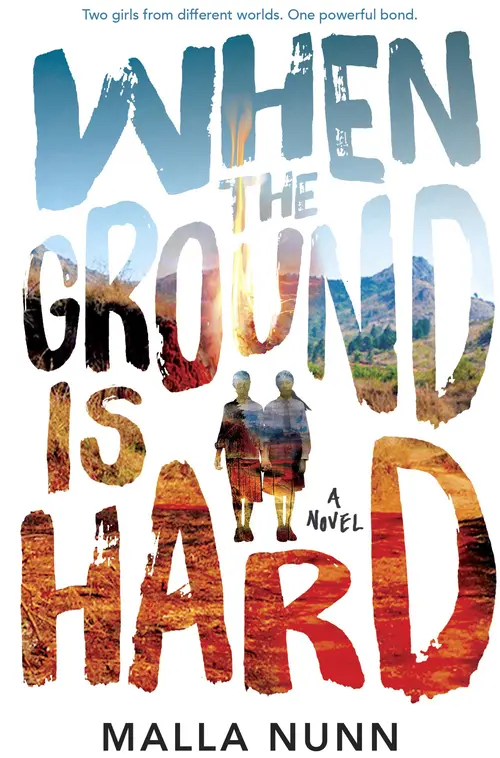
When the Ground Is Hard
Cover
Dedication
For my mother, Patricia Gladys Nunn
Epigraph
When the ground is hard, the women dance.
—African proverb
1
Dying Days
It’s Thursday night, so we walk down Live Long Street to the public telephone booth at the intersection of three footpaths called Left Path, Right Path, and Center Path. My flashlight beam bounces the length of the dirt road and picks out uneven ground and potholes, of which there are many. Mrs. Button, who lives in the pink house behind the mechanic’s workshop, says that all streets should be paved like they are in England, but we’re not in England—we are in the British protectorate of Swaziland, fenced in on all sides by Mozambique and the Republic of South Africa—so what does she know?
“Pick up the pace,” Mother says in a fierce whisper. “We can’t be late.”
We hurry past cement-brick houses with cracks of light spilling from under locked front doors. Dogs bark in fenced yards. A curtain twitches, and a face peers at us through a space the width of a hand. The face belongs to Miriam Dube, the church minister’s wife, who makes it her duty to spy on our weekly pilgrimage to the public phone box. It’s dark, but I imagine that Mrs. Dube's expression is smug disapproval.
Mother holds her head high, like she is balancing the weight of an iron crown or suffering a garland of thorns. The neighbors are jealous, she says. Jealous gossips who frown on her high heels and her dresses straight from Johannesburg that show too much leg. They know we have carpet in the living room, she says. We also have Christmas bicycles with flashing chrome, in the backyard, and new Bata school shoes that still smell of the factory, under our beds.
They have concrete floors, and if they do have rugs, they are sure to be ugly when compared to the tufted field of purple flowers that blossom under our feet when we walk from the settee to the kitchen. That’s why they hate us. That’s why they don’t stop to give us a lift when they see us walking at the side of the road, weighed down with shopping bags. The Manzini market is three miles from our house, Mother says. Three miles across dry fields pocked with snake and scorpion holes. A dangerous walk. A Christian would see our suffering and pick us up. But our neighbors—who call themselves Christians and stuff the church pews every Sunday—they drive by and leave us in their dust.
The phone booth appears in my flashlight beam: a rectangle of silver metal cemented into the red earth. Right Path, Left Path, and Center Path split off and disappear into vacant land covered in weeds. Bored children and drunks have left their initials and their boot prints on the glass walls, but, by some miracle, the interior light still gives off a dim glow, which attracts a circling cloud of white moths.
Mother feeds four silver coins into the change slot and dials a number. Her hands shake, and her breath comes short from walking the uneven road in high heels. As a rule, she never leaves our house in flat sandals or, Lord save us, the loose cotton slippers worn by women who value comfort over fashion sense. The coins drop, and she shapes her mouth into a smile.
“It’s me,” she says in a throaty voice that she reserves for the telephone.
The voice on the other end says something that makes her laugh, and she flashes me a triumphant glare. You see? her look says. I call every Thursday night to talk about what’s happening with you, me, and your brother, Rian, and he answers just like that . . .
Mother wants me to know that, no matter what names the church ladies call her, her relationship with him is special. She has a good man she can rely on, and how many “loose women” and “tramps” can say the same thing? Zero. That’s how many. Mother, I think, wants me to be proud of our weekly walk to the phone box.
I pick a twitching moth from my hair and blow it into the air. Its wings leave a fine white powder on my fingertips, and I brush it off onto the front of my skirt while Mother talks low and soft into the receiver.
“Of course. Adele is right here.” She snaps her fingers to get my attention. “She’s dying to talk to you.”
I take the receiver from her and say, “Hello. . . . I’m fine. How are you?”
The voice tells me that he’s tired but it’s good to hear my voice and Mother’s. Did the rest of the Christmas holidays go well? Am I ready for my second-to-last year of high school, and, good heavens, where does the time go? He pays the fees, so I tell him, “Yes, yes, I can’t wait to go back to Keziah Christian Academy.” It’s January 21, three days before the term starts, but my bags are already packed. “It will be good to see my friends again.” Phone time is precious. I can’t waste a second of it by mentioning the bad food or the sharp edge of Mr. Newman’s ruler that raps against my knuckles when I get a wrong answer or look at the mountains through the classroom window for too long. Mother says: Have some pride, girl. Nobody wants to hear your problems. Nurse your sorrows in private like the rest of us. She double-snaps her fingers to let me know that my time is up.
“See you soon, I hope.” I surrender the receiver and step away to give her privacy. A cloud of moths beats a white circle around the phone box while others lie on the ground with broken wings.
I pull a strand of wild grass from the side of the road and chew the sweet end while Mother whispers promises into the telephone. Her right hip and shoulder press against the glass, and in that moment, surrounded by fields of rustling weeds and the low night sky, she seems small and completely alone. Just her and the moths dancing together in the pale light while darkness swallows everything around them.
Minutes pass. She hangs up and strides across the pockmarked road with her high heels clicking and her hips swinging to a tune that only she can hear. A loose curl bounces against her flushed right cheek, the way it always does after she’s talked to him on the telephone. I can’t tell if winding a strand of hair around her index finger is a nervous habit or a soothing motion. She throws her arms wide and hugs me tight. Air escapes my lungs with a hard whoosh.
“He’s coming,” she whispers into my ear.
“When?” I want dates and times. In one way or another, he is always on his way. He tells us he’ll be in Mkuze, only five hours’ drive from us. Or he has a meeting coming up in Golela, and it’s a quick hop across the border from South Africa to us. Next, he’s visiting Kruger Park with the other children and he might drop by for a few hours. Maybe he’ll show up. Maybe he’ll come this weekend . . .
“Saturday.” Mother is giddy with joy. “He wants to see you before you leave for boarding school. And he wants to see Rian. You know how he worries about Rian’s asthma. Missing school. He cares about us, my girl, but you know how things are.”
Yes, I know “how things are.” I am an expert in the unwritten rules that govern our family and the boundaries that can’t be crossed or even mentioned out loud. I was born knowing. Mother reminds me of “how things are,” on a regular basis so I’ll remember that certain things in life can’t be changed.
“Come.” Mother grabs my arm, and we retrace our footsteps back in the direction of home. The vacant land around us rustles with sounds: secretive porcupines digging up roots, the soft pads of a house cat hunting small creatures through the bush, and a nightjar’s escalating song. Mother hums “Oh Happy Day” under her breath. She used to sing in the church choir, and she has a lovely voice even now.
Car headlights swing off Center Path, and two bright beams illuminate the craggy length of Live Long Street. We automatically jump off the road and into the tall grass that grows thick along the edge. A truck speeds past, and we tuck our faces into the crooks of our arms to avoid being choked by dust. The white Ford pickup truck with a dented front fender belongs to Fergus Meadows, who lives in the house opposite ours and inherited his father’s lumberyard five years ago.
A stone pings my leg, and I see that I’m cut. I wipe the blood away with white powdered fingers and step back onto the street. This is where Mother usually says, Hooligan! His father would die twice if he knew how spoiled that boy has turned out. He saw us walking in the dark. Don’t you think he didn’t. Two females. Alone. Yet he doesn’t even slow down. Imagine!
But tonight is different. Instead of criticizing Fergus Meadows’s manners, she flicks dust from her skirt and tucks her arm through mine. She hums and smiles at the half-moon in the sky. The neighborhood gossip and the sly glances thrown at her in the aisles of the new hypermarket on Louw Street can’t touch her. She is bulletproof. She is armored by a simple fact:
He is coming.
• • •
I lie awake to the rasp of my little brother’s asthmatic breath in the next room and the hard scrap of steel wool on the kitchen stovetop. Mother is cleaning in preparation for the visit. A maid comes every day except Sunday, but you can’t trust them, Mother says. They don’t know how to treat nice things. They are careless, and you have to watch they don’t break the fine china cups or leave streak marks on the windows.
It’s better to do the important things yourself, she says. That way you know they are done right. His arrival is the number one most important thing. The house has to be perfect when he walks through the door on Saturday, so Mother takes care of the details. She cleans the stove, washes the floors, and dusts the porcelain angels on the sideboard next to the settee. Tomorrow, on Friday, she will choose our outfits for his visit: a pretty dress with strappy sandals for me, and a pair of khaki shorts and a collared shirt for Rian. We will be clean and neat, to match the house.
The oven door opens, and the scratch, scratch, scratch of the steel-wool pad continues. To my knowledge, he has never once looked inside the oven or opened the cupboards. Maybe this visit he will, so Mother has to make ready.
I roll over and blink at the windup clock on my bedside table. It is twelve minutes to midnight.
Rian coughs and Mother cleans, and I think of the moths suspended above the phone booth, their delicate wings beating the air until dawn.
• • •
Sixteen is four years too old to be sitting on his knee, but when he collapses on the lounge chair, all rumpled and sweaty from driving tar roads and gravel paths and narrow dirt lanes to get to us, I do just that. I take his right knee and Rian takes his left, and we simultaneously plant kisses on opposite cheeks: a ritual that goes back to before my memory begins. Bristles prick my lips, and I think that he is tired, that he is older than when he delivered our Christmas presents five days before Christmas Day. He wanted to spend the holidays with us, Mother says, but you know how things are.
“Look at you,” he says to Rian, who is pale and exhausted from last night’s asthma attack. “You’ll be bigger than me soon.”
That’s possible. Rian is thirteen and sprouting fast while our father gets smaller each year, the black strands of his hair now overrun with gray. What he lacks in muscle and youth, he makes up for with brains, Mother says. He is an engineer. He builds the dams that hold the water that feeds the cornfields and fills the bathtubs of the people who live in town who’ve forgotten how to wash in rivers.
“And you.” He pinches my cheek. “You are even more beautiful than the last time I was here. I’ll have to buy myself a shotgun to keep the boys away.”
The idea of him armed with anything but a pen and a contour map makes me laugh. He loves reading books, drinking scotch, and cutting wood-block puzzles with Rian in the lean-to behind the kitchen. And what good will a gun do when he’s not here to take shots at those limber night-boys who might, one day, creep over my windowsill? He lives in faraway Johannesburg with the other children, who I imagine are red-haired and clever, with skin as white as smoke. Family friends stop them on the street corner and marvel at the resemblance. “Goodness,” they say. “You certainly take after your father. It’s uncanny.”
The others naturally take top billing. They are classified “European,” and Europeans are the kings and queens of everything. We are not European. Our skin has color. Our hair has curl, but not the steel-wool kink that’s hard to get a comb through, and praise Jesus, Mother says, for that small mercy. Our green eyes shine too bright in our brown faces, as if to confirm the combination of white and black blood that flows through our veins.
When he is here, he loves to tell us the story of how they met. Him on a work trip to the land title office in Mbabane, and her, slotting ancient charts into the right pigeonholes in the map room. Mother in a blue polka-dot dress, making order of the chaos. She smiled at him. A smile like an arrow to my heart, he says. Beautiful and shocking, all at once. And how he knew in a flash that, no matter what, Mother would be a part of his life. And so she is. Not the whole part, he forgets to add, but a small, bright piece of his life that’s hidden away in Swaziland. We are an add-on to Father’s regular life. We are the secret well that he drinks from when no one else is looking.
Mother sits cross-legged on the flowered carpet and beams to see us perched on his lap. She’d dip the scene in amber to preserve it if she could. We are together for one day and one night, and that will have to be sufficient until the next time.
“Are you thirsty?” she asks.
“Ja . . . I’m parched. The drive took longer than I thought, and Swazi roads . . .” He shakes his head as if remembering the high mountain passes and dangerous hairpin turns. “The minute you cross the border, it’s like going back fifty years. Cows and people everywhere, and more potholes than tar.”
“Go get a beer from the icebox, Adele.” Mother tucks a strand of freshly ironed hair behind her ear and pulls a tragic face. “Daddy has to wash the Swazi dust from his throat.”
Father smiles at her comical expression, the way it distorts her features without touching her natural beauty. Whoever picks combinations of skin color, eye color, and body shape got Mother just right. She is mixed-race, like us, with golden-brown skin, flashing green eyes, and pleasing curves.
I go to the kitchen to get the beer. The maid is in the backyard, hanging up my blue-checkered school uniform and the knee-high white socks that go with it. Keeping white socks white in the blooming dust and the red earth of Keziah Christian Academy is almost impossible. I plunge my hand into the icebox, and the shock of the cold bottle against my palm shifts my thoughts from the dying days of the school break. Bowls of stiff porridge and stale toast will come around soon enough.
I shake off my bad feelings about returning to school. He is here and sulking is forbidden. When he is here, we are happy. When he is here, we are grateful and well-behaved so he’ll have a good reason to come back and visit us again. You catch more flies with honey than vinegar, Mother says, and don’t believe what people tell you, miss. Misery might love company, but misery has to learn to shut up and take care of itself.
I pop the cap from the beer with a metal opener, and white foam rims the lip. I step into the lounge room, and I remember to smile.
2
And the First Shall Be Last
We are late. Of all the times and places to be late, the Manzini bus station is the worst. Men drag goats through the maze of buses while women hold live chickens with their feet tied together. The women push through the crowd while the chickens flap and squawk. Children and women sell roasted corn, boiled peanuts, and bags of deep-fried fat cakes to passengers about to board the smoky buses, from pans they carry awkwardly in their arms. Passengers also buy pineapples, mangoes, and bananas from woven baskets carried on sellers’ heads. Pickup trucks reverse out of narrow spaces, with their horns blaring, their worn tires flattened by the weight of the passengers packed shoulder to shoulder in their open beds.
Dust is everywhere. The purple heads of the bougainvillea strangle the chain-link fence outside of B&B Farm Supplies: YOU NEED IT. WE GOT IT. Red dirt weighs the flowers down. A million motes suspended in the air catch the early-morning sun.
Animals bleat, children cry, and bus-ticket sellers call out their destinations in singsong voices. “Quick, quick time to Johannesburg. No stopping. Best seat for you, Mama.” “Smooth ride to Durban by Hlatikulu, Golela, and Jozini. Brothers, sisters . . . all welcome.”
We hurry through the dust and noise to the far end of the bus ranks. My heart lurches against my ribs. We are too late. All the good spots are already taken. If Delia, my best school friend, hasn’t saved a place for me, I will be forced to the middle of the bus, where the lower-class students sit dressed in hand-me-down clothing, or, worse still, I’ll have to make the long walk to the very back of the bus, where the poor and smelly students group together like livestock. I walk faster, and the corner of my suitcase bumps against my knees.
“There.” Rian points to a decrepit bus with a faded blue wave painted on the side.
All the buses have names. There’s Thunder Road, True Love, Lightning Fast, and finally, the Ocean Current, which drops students off at Keziah Christian Academy at the beginning of the school term and picks them up again on the first day of the holidays. It’s a public bus, but today the exclusively mixed-race students of the academy will take up most of the spaces. Black people with common sense wait to catch the next bus heading south to the sleepy part of Swaziland. They know that mixed-race children only stand up for white people.
On paper, we are all citizens of the British protectorate of Swaziland, but really, we are one people divided into three separate groups: white people, mixed-race people, and native Swazis. Each group has their own social clubs and schools, their own traditions and rules. Crossover between the groups happens, but it’s rare and endlessly talked about on the street corners and inside Bella’s Beauty Salon for All Types.
My sweaty palms grip the handle of my suitcase, and my shoulders ache from hauling its dead weight from the crossroads where Father dropped us off on his way back to Johannesburg.
“See? The bus is still here.” Mother’s breath comes fast. She is annoyed that I rushed us to get here. “All that fuss over nothing, Adele. We have plenty of time.”
I give my suitcase to a skinny black man, who throws it onto the roof of the Ocean Current, where another skinny black man, barefoot and shining with sweat, adds my case to a mountain of luggage already piled there. Faces peer out of the dusty windows. I look frantically from the front row to the back. I cannot see a vacant window seat.
“Here.” Mother gives me a small cardboard box of impago, food packed especially for long road trips and enough to tide me over on the eighty-eight-mile journey ahead. Inside will be boiled eggs, strips of air-dried beef, thick slices of buttered bread, and maybe an orange. Whatever the cupboard had to give.
I say, “Sorry for the rush.”
The Story Continues on BooksBarbecue!
Enjoyed this preview? ❤️ Do not stop here!
Read the complete book free online → 🔗
Continue reading now on BooksBarbecue and discover every page!
Love reading? Bookmark BooksBarbecue.com for more amazing books!
Happy Reading!