When I Was Ten
Cover
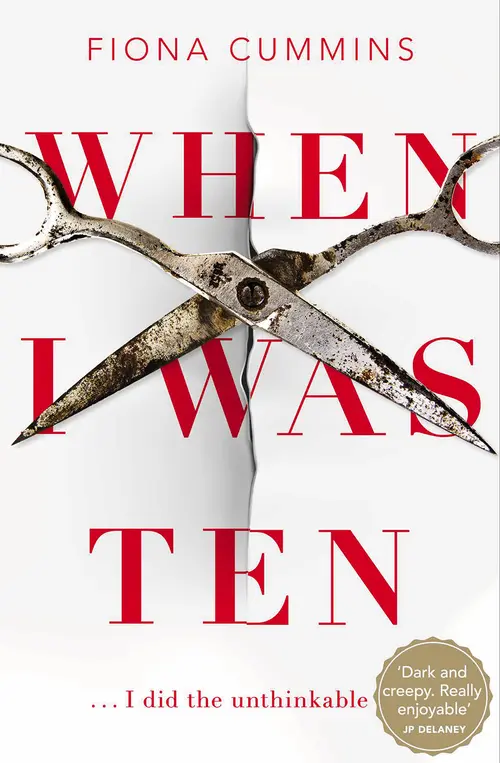
WHEN I WAS TEN
FIONA CUMMINS

Dedication page
For Isaac and Alice, always
Epigraph page
But for God’s sake, I was a kid; what else could I do but lie?
– Mary Bell in Cries Unheard by Gitta Sereny
Tell Tale Tit, your tongue shall be slit; and all the dogs in town shall have a little bit.
– Nursery rhyme, nineteenth century
PROLOGUE
Sunday, 20 April 1997
The girl is twelve and she is running.
Her feet pound the grass, powered by the twin engines of grief and fear. She does not stop until she reaches the summit of Saltbox Hill.
Below her, the village huddles under the cloak of an impending storm. She bends at the waist, panting and crying, and it is hard to breathe. Across the bruised horizon, she glimpses Hilltop House and her nausea ripens into a darkness she dare not think about.
There are cars, so many cars with blue and white livery and flashing lights, and they snake along the stretch of road between the stuccoed mansion and her own smaller home.
The grown-ups are dead.
The sky trembles with thunder. The girl’s body vibrates with it too. She glances upwards as a lightning arc blanches the clouds. Sporadic drops of rain hit her arms, as if they can’t be bothered, and then harder and faster until she is soaked through.
She starts running again, seeking shelter from the downpour.
An oak tree crowns the hill and it’s there the girl heads, damp seeping into her trainers, deep cuts of sorrow inflaming her heart. In this baptism of rain, she thinks: The sky is grieving too.
The air is sharp with ozone but it is not enough to rid her of the old-penny scent of blood, or the sweet-rot sickliness of the makeshift bedroom downstairs.
The grown-ups are dead.
Her mother.
Mrs Carter.
Dr Carter.
Deader than disco, her father would say, in that deadpan tone of his, and an appalled laugh spills from her.
It is her birthday tomorrow but there will be no celebration. Cards, yes, but of condolence, the first pushed through the letter box at lunchtime. No cake with pink icing, but still-warm lasagnes left on the porch, condensation collecting on their tinfoil lids. She swipes the back of her hand across her eyes and runs harder.
The girl is almost at the tree, spring thickening its leaves, branches spread in welcome. Their faces blink on and off in her memory like the rotating lights of a merry-go-round. Mother. Mrs Carter. Dr Carter. To her twelve-year-old self, their deaths are entwined like brambles, choking everything.
She has told a lie. A big one.
There is no way back from it now.
She pauses to catch her breath, bent in half, hands on knees. Across the valley, two private ambulances pull out of Hilltop House. She watches their slow progress through the village but they are too far away to be anything more than grey smudges on the skyline.
The water sheets off her shoulders, trickles down her neck. Her hair hangs in clumps around her face. She is a handful of footsteps from the tree when the sky lights up again.
The girl lifts her head and watches the shape of lightning against violet clouds. She waits for it to happen again. She is still waiting when a crack opens up above her and a bright bolt strikes the right upper quadrant of her back.
The lightning moves at one-third the speed of light. It haloes her. It scorches the silver necklace at her throat, flashes across her torso, the current scrambling the electrical impulses of her heart. It exits through the soles of her feet, leaving two coin-shaped holes and singe marks on her trainers.
The girl is thrown to the grass, her body smoking, the grumble of thunder in the air.
PART ONE
WHO?
1
Thursday, 13 December 2018
In eleven minutes and fourteen seconds, Catherine Allen, who only wants to be ordinary, will be dead.
She doesn’t know it yet. Her face is pressed into the clean sheet she smoothed across their bed that morning, darkness wrapped around her like an old friend. Mouth slightly open. Deep and even breaths.
The snow began to fall at midnight and hasn’t stopped. Four hours later, it covers the square of their front garden, the roof of their boxy cottage and the street outside. A thickness that suffocates the sounds of the night until it is too late to run.
Even then, she can’t be sure what disturbs her. A minute ago, she was asleep, a reprieve from the turmoil of the last few days. Now here she is, jerked into wakefulness like a fish on a hook, eyes wide in the still of their bedroom, the thunder of adrenalin in her veins.
Honor?
She listens to the blackness, for the cries of her twelve-year-old daughter. Honor’s night terrors, a recent affliction, have been known to wake up the rest of the family, but tonight she is quiet.
The tip of Catherine’s nose is cold. The heating went off hours ago and the air tastes of ice. She pulls the duvet over her head. Immediate warmth. The sound of her heartbeat in her ears.
Intruders?
She strains to hear beneath the quickening of her own breath. Some nights, she is convinced of footsteps tracking across the kitchen floor or the whisper of voices in the hallway, but there is never anyone there.
Edward rolls over, dragging the duvet with him. His snoring fills up all the silent spaces, and she nudges him with her foot. He stops snoring and starts grinding his teeth.
She despises that sound, the grating of enamel against itself. She touches his jaw, trying to hold it still. Edward only grinds his teeth when something is on his mind. He’s been doing it a lot lately.
But she’s hardly seen him this week, and when their lives have collided over a late dinner or half an hour’s television, she hasn’t liked to ask why he’s been keeping her at arm’s length.
She knows it isn’t a woman, at least not in that way; even though the years have deepened his boyish good looks into the kind of crumpled attractiveness that makes the school mothers look twice, Edward’s always had strident views on fidelity. But he is short-tempered and secretive with his phone, shutting down the screen whenever she surprises him, staring at her with an expression she cannot place.
Last Thursday night, he lied to her. I’ve been playing squash, love. With Mark from work. But one of the fathers from football saw him getting off the train from London when he was supposed to be on the court.
On her bedside table, the clock clicks forward another minute. Each tiny hair on her arm rises until her skin is stippled with goosebumps.
4.07 a.m.
Even now, that combination of digits has the power to root her in place.
Twenty-one years ago, in another bedroom and another life, a different clock stopped forever at precisely the same time, a web of hairline cracks across its face.
Catherine never speaks about that night. The past is put away now. It will not define her. She tries her best not to think about it, but every now and then it shoves its way in, ugly and unwelcome. The devil’s clock, her mother called it, those hollow hours before dawn when the darkness is full of horrors and sleep will not come.
Her memories unfold like a macabre chain of paper dolls.
The bodies of her parents. A black pool spreading across the carpet. The moon’s reflection in the handle of the scissor blade buried in her father’s neck. Her mother’s limp hand hanging over the bed, pastel-pink varnish on her nails.
Her older sister, pyjamas soaked with blood, blonde hair like a halo, being led away by police.
How she had loved her then.
Catherine closes her eyes and calls up Honor’s face, all braces and apple-red cheeks. Laughing and dancing, making up songs. Warm hands. Wholesome and happy. A talisman to protect them all.
A car door slams outside.
Edward stirs again. Catherine half rises from their bed. In this pretty village on the anonymous edges of an Essex market town, most inhabitants are asleep by ten o’clock.
As she crosses the bedroom to the window, arms wrapped around herself to keep out the cold, a blue light begins to pulse against her floral wallpaper, a neon wash that keeps time with her heartbeat.
With trembling fingers, she nudges the curtains apart, instinct warning her to be discreet.
On the road outside, there is a battalion of parked cars. A knot of figures in hats and gloves are gathered by her gate, their breath coming in smoky gasps. Television cameras. Lights. A babble of voices.
The urgent carousel of a police car’s beacon.
Catherine covers her mouth with her hand. She knows what this means and has prayed every night for more than twelve years – since that first, faint line on her pregnancy test – that it would not come to this. But the events of the last few days prove she’s been stupid to think otherwise.
She pulls on her jeans and a jumper and grabs the packed rucksack she keeps hidden in her wardrobe. Stumbles across the landing into Honor’s bedroom. The night light is on and she glimpses herself in her daughter’s mirror. Mousy hair, brown eyes, not overweight exactly, but a comfortable body. An ordinary thirty-one-year-old woman.
Forgettable.
The girl mumbles something unintelligible. A tear trickles down Catherine’s cheek. She presses her palm against her daughter’s face and feels something inside her break.
‘Wake up, Honor. We have to go now, sweetheart.’
Her daughter kicks out a restless foot and turns towards the wall. Catherine shakes her again, more forcibly this time. When Honor doesn’t react, she tugs at the duvet. ‘It’s time to leave. Come on, love. Get up.’
Mussed-up hair and screwed-up eyes. One pyjama trouser halfway up her leg. A yawn, and through that, a mumble. ‘What’s happening, Mum?’
Someone bangs on the front door.
Time slows. Catherine is aware of each catch of her breath and drum strike of her heart. Edward is awake now too. She can hear him, moving about in their bedroom. Every part of her longs to freeze this moment, to protect her girl from Before and After, and preserve the life she has made for herself and her family. The life she never expected to have.
But while she possesses a great many talents, she is not yet able to stop time.
In one minute and twenty-six seconds, Catherine Allen will be dead.
2
Three days earlier –
Monday, 10 December 2018
Catherine had never understood that song. She liked Mondays. To her, Mondays meant a new week, and every new week pulled her further from her past.
This Monday had begun in the way they usually did. Catherine had said goodbye to Edward, who was wearing a shirt she had ironed and carrying a leather satchel the right side of stylish. She watched him walk down the narrow lane towards the bus stop that would take him to the station. At the bend in the road, before he disappeared behind the conifers, he would always stop and wave. He had done this for the last twelve years, since Honor was born. But on this particular Monday morning he did not break his stride, but walked on, head bowed into the knifing wind.
Catherine lingered on the doorstep in case he changed his mind, but after a couple of minutes, she realized he wasn’t coming back. The sting of it surprised her. Even so, she boiled milk for porridge and pasted on a smile for her daughter, whose hair was still damp from the shower, resisting the urge to nag her to dry it before she walked the short distance to school in the winter chill.
Honor was quiet that Monday morning, mauve shadows beneath her eyes, rolling blueberries around her spoon but not eating them. Her mobile was on the table and the girl checked it obsessively. Once upon a time, she would have devoured her breakfast, chattering non-stop about the day ahead. Not now. She was changing, hardening, on the cusp of adolescence.
‘Looking forward to the Christmas holidays?’ Catherine smeared redcurrant jam on a croissant, eyes firmly on her plate. Honor did not enjoy scrutiny. It made her clam up.
She sensed rather than saw her daughter’s shrug.
‘I suppose so.’ The ghost of a grin, a flash of her old self. ‘No homework.’
Honor put down her spoon, leaned against the back of her chair and yawned for what felt like a long time. Catherine risked a glance. Her daughter had covered her mouth, but through the gaps between her fingers, her teeth were full of metal. It gave her the appearance of a snarling animal.
‘Tired, love?’ This was a sensitive subject, but the words were out of Catherine’s mouth before she could bite them back.
Another shrug, and a flick of her hair, but when Honor’s eyes met her mother’s, Catherine saw shame in them. ‘Did it happen again?’
‘’Fraid so, but I’m sure you’ll grow out of it soon.’ A concerted attempt at jollity. ‘We can make another appointment with the doc—’
In a burst of petulance, Honor shoved her hands against the edge of the table, cutting short her mother. Catherine’s coffee cup wobbled, but she buttoned down the urge to shout. Her daughter didn’t mean it. At twelve, embarrassment was a powerful driver of behaviour. As God was her witness, Catherine knew all about that.
She stood up and put an arm around Honor’s shoulder. ‘Is there something on your mind, love? You can talk to me about anything, you know. I promise I won’t get cross. The doctor said stress or worry can trigger—’
‘I’m fine.’ Her rebuttal was clipped and impatient. She shook off her mother’s concern and left the kitchen, breakfast uneaten.
Not for the first time, Catherine wondered if lying about her daughter’s nocturnal disturbances might make for a quieter life. But while Honor’s friends were still inviting her for sleepovers and Catherine was persuading her to decline, the girl deserved the facts.
Although she had lied about so many things, Catherine refused to airbrush the truth about what happened to Honor during the night. Protecting her daughter was her primary motivation. She’d been doing it since she was born.
Despite her claims to the contrary, Catherine knew Honor would rather die than risk exposing herself to ridicule by the alpha girls in her class, who were the head-tilting, shiny ponytailed, insincere types. Her mother didn’t blame her. Catherine had extensive experience of her own with girls like that.
Mostly, it began with the scratching. Honor would claw at her arms, dragging her nails down her skin, marking it with chalky tramlines that reddened into welts.
Catherine, a light sleeper, would catch the creak of Honor’s bed as her scratching intensified and she thrashed around, throwing out her arms and kicking against her covers.
Sometimes, Honor would scream, a primordial expression of fear that was dragged from a secret place inside her, a sound that belonged in the past, to long-dead ancestors clad in animal pelts, cornered by their nightmares while hunting in the dark.
Sometimes, she would whisper.
This whispering frightened Catherine more than the screaming. She would slip from her own bed and stumble down the hallway to her daughter’s room, unease crawling across the nape of her neck. She knew what she would find when she opened Honor’s door. The girl pressed into her pillows, blonde hair spread around her shoulders, eyes fixed on a distant corner of the wall.
While her mumbling was incoherent, her daughter’s body language was not. Arms stiffened into sticks, the cords of her neck pronounced above her collar bone, panic carved into the planes of her body.
Catherine would smooth back her daughter’s fringe and settle her back into bed, waiting until the shadows left her and she softened into sleep.
In the morning, Honor would have no memory of it, but the sight of her daughter’s distress would linger with Catherine through the daylight hours, the winter sun too weak to banish her sense of dread.
The front door slammed, shaking a picture of the Allen family that hung on the wall. Honor had left for school without saying goodbye.
Catherine hurried into the hallway, a dirty porridge bowl in each hand, even though it was too late. ‘Have a good day, love,’ she said softly.
With husband and daughter gone, the house settled into morning quietude.
As soon as the breakfast dishes were cleared away, Catherine switched on her computer and logged on to her share-dealing platform, checking the performance of her stocks and shares.
She was later than usual, unlike those early-bird suits in the City, who exchanged family life for the pursuit of money. Although she had never been a trader in the salaried sense of the word, she had taught herself, dabbling in small sums of money at first, making a profit here and there.
Nothing had surprised her more than discovering she had a gift for it, an instinct for the markets that allowed her to support herself and contribute to the family finances. Getting a job which involved keeping her past a secret had always seemed like scaling an unconquered mountain. Thank God she didn’t have to.
She pecked at the keys, relishing the pockets of drama played out through the rise and fall in share prices, the buying and selling, the mistakes and triumphs. About half past ten, chilled from sitting still at the kitchen table, she stopped work to go outside and fill up the basket from the log store.
It was snowing, the first of the season. The flakes settled on her eyelashes and her hair, and on the cashmere wrap she had draped around her shoulders. She drew in lungfuls of cold air and its sharpness filled her up. From her garden, which overlooked Coggsbridge’s narrow main street, she could see the fluorescent lights of the butcher’s, a stick figure carrying a shopping bag, head bowed, and a bobble-hatted toddler, face raised in wonder to the sky.
When Honor was born, a sun rising over the dark valley of Catherine’s teenage years, moving to this village, which reminded her so much of her childhood home, had allowed her to start again.
Back inside, she set the basket next to the wood burner, logs damp with melting snow. A spider ran across the bark and she recoiled, dropping the hearth brush. Mostly, she did not mind the silence, but in that moment, the house felt lonely. On impulse, she reached for the remote control on the coffee table and switched on the television.
A magazine-style show was broadcasting, the presenters full of sunshine smiles. She wondered what it felt like to be on the inside, burnished with the gleam of success and belonging. A famous chef was talking about home-made mince pies and cooking for family. Bright studio lights. Puffs of icing sugar. Laughter. In contrast, the sitting room had darkened in the shadow of snow clouds, the faces in the photographs on the mantelpiece blurring into grey.
Catherine opened the door to the wood burner and built a lattice of kindling over the grate. She unwrapped a firelighter and tucked it between the sticks, the kerosene fumes making her cough. She was concentrating on what she was doing, only half an ear on the television.
The tempo of the programme changed to the strains of the ITV morning news bulletin. Catherine fumbled with the matches and dragged one across the box’s striking surface. It flared into life. As she leaned forward to throw it into the stove, the newscaster began to read the headlines.
Catherine’s back was to the screen, and, at first, the words didn’t penetrate. But as the man’s voice echoed around the room, she froze, mid-breath, an animal caught in a hunter’s cross hairs.
The delivery of each sentence was crisp and precise and dispassionate. Catherine did not move, could not. But inside, her body betrayed her. Blood charged through her veins, flushing her face and filling her ears with a roaring sound that drowned out the television. She felt her heart crashing in her chest, a sensation of light-headedness. Her mouth was dry. The chill from the room crept under her skin and into the marrow of her bones.
Her life – the ordinary, dull, precious life she had fought so hard to build – tilted sideways.
But still Catherine could not move, not even when the match she was holding burned down to its nub, blistering the skin of her thumb.
3
My name is Brinley Booth. When I was twelve, I was struck by lightning.
Aunt Peg insists it was God’s doing, that he fired a thunderbolt at me for telling a lie. I thought it was because I’d been stupid enough to stand under the oak tree at the top of Saltbox Hill, but she’s said it so many times over the years I’m almost convinced she’s right.
Mind you, Aunt Peg blames God for everything. For allowing my useless lump of a father to run off with Maureen Connolly. For giving Mum a tumour that ate up her insides. For making my thighs rub together when I walk. How can God be responsible for how many biscuits I eat? Everyone worries about me being fat. Except me. I worry about running out of Ginger Nuts.
Being struck by lightning doesn’t smell like roast pork cooking, before you ask. And everyone does. Instead, I steamed like a pudding in a pot, electricity vaporizing the rain on my skin, and the sweat on my nearly teenaged body. My ears filled with ringing bells, my body engulfed in a halo of white. Mum’s necklace was so hot it burned my neck, although I can’t remember much more than that. I do know it felt like being thumped on the back.
Ah, yes, my back.
The Story Continues on BooksBarbecue!
Enjoyed this preview? ❤️ Do not stop here!
Read the complete book free online → 🔗
Continue reading now on BooksBarbecue and discover every page!
Love reading? Bookmark BooksBarbecue.com for more amazing books!
Happy Reading!