What You Never Knew
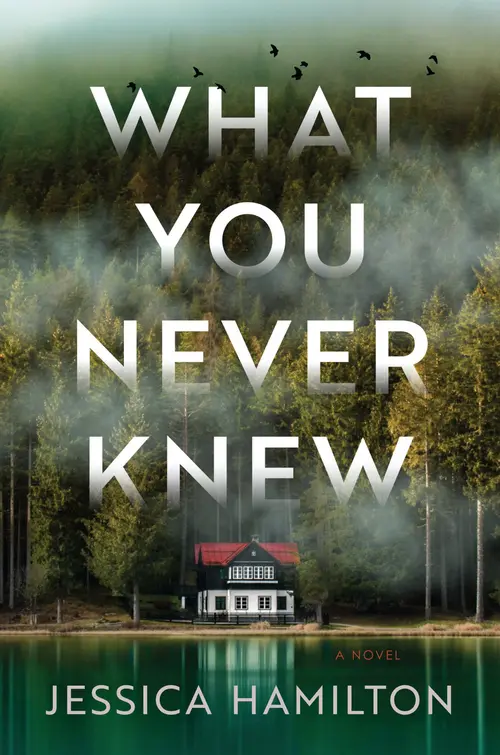
Title Page
WHAT YOU NEVER KNEW
A Novel
JESSICA HAMILTON

Dedication
For my sister Rebecca, and for Tyree, and the memories we made there.
ACKNOWLEDGMENTS
Thank you firstly to my agent Carolyn Forde for believing that a publication would absolutely happen, for convincing me of that, and then working tirelessly until it did. Much gratitude to my editor Jenny Chen for seeing what this book could be and guiding me in all the right directions. And to Melissa Rechter and Madeline Rathle for getting me through the final stages.
To my husband Josh, you gave me a room of my own, the time and support to chase this lofty goal and I will be forever grateful for that. To my children, Luke and Ruby who are daily inspiration to do more, be more and never give up on a dream. To my older sister Rebecca, thank you for always being my biggest fan and my safest place. And to all of my friends and family whose support and encouragement never wavered along this long road of writing.
To my longtime friend Megan Bell, thank you for always being there to read and critique, I swear I would not know if something was good if you weren’t there to tell me. To my Tea with Wordsmiths writing group who kept me writing through the many times when I was ready to quit.
To my grandmother, the woman responsible for my childhood summers at the cottage. Thank you for making Tyree my most favorite place in the world and for all of the wonderful things that you were to me.
Lastly, to my mother, no matter where we ended up, nothing will ever overshadow, the support, encouragement, and belief you had in me, when it came to writing.
MAY
One hour before I died, I was sitting in a stuffy lawyer’s office dealing with the probate details of my mother’s will. It figures I was dealing with her mortality right before facing my own. Very little happened in my life that wasn’t in some way connected to her. She’d passed away seven months earlier, which meant my time of freedom from her had been brief and fleeting.
Lung cancer. It was long and drawn out, with great suffering, and cause for constant, round-the-clock care. During the months of her illness I often thought she’d finally gotten what she’d wanted all along—our undivided attention, daily displays of love, and deep concern for her well-being. She couldn’t have chosen a more suitable and satisfying exit from the world.
I’d gone to the lawyer’s that day confused. My mother had insisted that all her assets be divided while she was alive. She’d signed the house over to me (I’d sold it promptly upon her death, splitting the proceeds with my younger sister, June). She’d gifted her savings, jewelry, and antiques to me and my sister and my nieces—more efficient than waiting for lawyers to do it, and it meant she was present for the proclamations of gratitude that came with it.
I’d thought all her affairs had been wrapped up nice and tidy while she was alive. How very naïve of me. I should have known that my mother would leave something messy for me to deal with. One last reminder of what I’d spent my life trying to forget.
The lawyer casually passed the envelope across his desk to me, as though it were light as a feather. “The only asset willed from your mother’s estate,” he explained.
I kept my hands in my lap. “What is it?”
He pushed the document half an inch closer to me, as though he didn’t want it either. “Just a deed of some kind. Property your family has owned for years. An island, I believe it said. Somewhere in Vermont?”
“You mean Avril Island? On Lake Champlain?” I shook my head. “That can’t be right. My mother sold that place years ago.”
The lawyer gave the envelope one last push toward me. “Yes, that’s the place.”
Avril Island. The words boomed around the room, bouncing off the heavy wood paneling and crashing back against my skull, making my head throb. I took the envelope from the desk and placed it on my lap. I didn’t need to look inside.
My father had bought Avril Island for my mother as a wedding present. Her very own island, complete with a five-bedroom cottage and acres of land. Where we spent every single summer until the summer I was fifteen years old. That year we left in a hurry, never went back, and a couple of years later my mother told me and June that she’d sold it.
Staring down at the envelope, I could feel the lawyer’s watery blue eyes on me, see the arch of his white hairy eyebrows out of my peripheral vision as he waited for my response.
“I’m just a little bit confused,” I managed to get out.
He nodded sympathetically. “If only the dead could talk, I always say. Would make my job easier.” He chuckled to himself, unaware that he’d just handed me a grenade that could blow up my life.
I tucked the manila envelope into my purse, thanked him politely, as I’d been taught to do, and then left his office. The world narrowed into a slim, silent tunnel, only expanding again with the beep of my car door unlocking. Inside smelled of the banana I’d eaten on the way to the appointment and was hot and stuffy from the early spring sun beating through the windshield.
The leather upholstery was warm against the back of my thighs as I sat in the driver’s seat staring straight ahead—a little vessel of the familiar, which slowly helped to bring me back to reality.
I had to work hard to hold back the violent rage that was building. My mother had said she’d taken care of it. She’d lied. She often lied. I really couldn’t understand why she hadn’t told me about Avril Island before she died. It was like some sick joke she’d waited to play on me—waited to unleash until she was gone and didn’t have to deal with any of it herself. I’d spent years trying to escape that part of my life, and she’d dropped it right back into my lap.
The smell of rotten banana, combined with the heat of the car and my roller coaster of emotions, brought on a surge of nausea. I opened my door and swung my legs out, taking deep breaths of fresh air. I grabbed the banana peel, threw it onto the black pavement, and rolled my window down before shutting myself back in the car.
Funnily enough, there were no tears. Me, who cried at the drop of a dime—I felt only empty inside. It might have been my fight-or-flight impulse. I wanted to protect June from everything she didn’t know about our parents, but mostly from what she didn’t know about me. I’d never hated my mother more than in that moment.
I reached for my phone, glad when it went to message. If my sister had heard me, she’d have known there was something I was hiding, just out of sight, tucked sloppily somewhere around my rib cage. She’d have heard the flutter in my voice, felt the restraint of my vocal chords, and then demanded to know what was keeping the real me from her. June never accepted anything but all of me.
I’m going to be a bit late for dinner. The appointment went longer than I thought, and I have to do a few things before I can come by. Should be there by seven instead of six. Love you.
I hung up before she could hear the catch in my voice, before the fake lilt faltered and she heard the darkness underneath. It didn’t dawn on me to cancel the dinner plans we’d made only the day before. We were going to discuss my meeting with the lawyer over wine and some takeout. A light, airy plan that we’d thought would include a bit of reminiscing—some jokes about the good and the bad. Some healthy sorrow for the loss of the woman who at times had made our lives hell but was our mother still. But that was before the final parting gift of Avril Island.
I took a deep breath to settle my nerves and turned the key in the ignition. Slowly I pulled out of my parking spot. The world was fractured and unsafe all of a sudden, and my every move had to be in accordance.
I drove only a block before the urge forced me to pull over. Taking the deed from the manila envelope, I tore it into many pieces, then hopped out of my car and scattered it into a trash bin at the end of somebody’s driveway. A garbage truck would be by soon, and my last tie to Avril Island, and all the horrible things that had happened there, would be swallowed up by pounds of other people’s trash and driven far away from me. The thought was the only thing that allowed me to put the car in drive and carry on.
Once I was on the highway, moving with the flow of traffic, my grip on the steering wheel began to loosen. I had a two-hour drive and one hour at home to figure out a plan before I’d see June. What would I tell her the appointment had been about? Could I lie right to her face? Could I tell her the truth?
A flock of birds, black ones—I think they were crows, so then it would have been a murder of crows; very fitting—rose up from a farmer’s field to the left of me, offering a quick distraction from my heavy thoughts. They looked like ink blotches on the gray sky, only their wing tips standing out with any definition. They soared upward, weightless, and swirled like a circus of acrobats, grabbing my attention, pulling it away from the road.
It would have been fine if it weren’t for the white van, which changed lanes too quickly—impatient with the slow driver in front of him and unaware that I was bird watching.
I looked away from those fluid black spots too late. There was a wall of white, my foot on the brake, metal eating metal, glass smashing. The air bag inflated like an angry balloon, punching me in the chest and snatching my breath away.
Then the spinning started. For a second I thought I had turned into one of those black birds—free and twirling through the sky—but it was my car bouncing off the guardrail and dancing across the four lanes of highway.
There was the sound of squealing tires, brakes trying desperately to work; then came a flash of blue, and everything went dark.
I was dead in an instant. I leaked out of my body and into the atmosphere just above the road. I watched as the paramedics pulled me from my car, which was crumpled in the front, curled in on itself. T-boned, I believe they call it, on the driver’s side.
The driver of the white van stumbled along the side of the road, refusing to be stilled. He gestured wildly at my car, called out obscenities. The driver of the blue car sat trapped in her vehicle, alive but looking as though she might be dying on the inside.
I watched it all unfold like some bad TV drama. The black birds continued to circle above the farmer’s field, unaffected by the man-made tragedy only a hundred or so feet away.
One of the three ambulances pulled away from the gory scene, my body inside. My only thought—June’s going to be so mad at me.
JUNE
I fit the plastic cup back into the round indentation of the seat tray. The wine tastes like vinegar, and I can bear only three small sips. My book rests open on the edge of the tray, but only to keep the passenger beside me from making small talk.
I haven’t been able to read since May died. Forty-three days. I’ve lived without my older sister for forty-three days. I wake up surprised by this every morning—it’s like realizing you don’t actually need oxygen to survive. We always said we’d die if the other one did. It wasn’t so much a promise as scientific fact. We just didn’t think one could survive without the other. And yet here I am, on a plane to a place I should be going to with my sister.
The flight attendant drops a bag of pretzels on my tray, then moves on, his plastic smile locked in place. Reflex has me pull the small plastic bag open and bite down on one of the salty twists of sawdust. The wine is the only thing I have to move the dry clump down my throat. I wince as it travels through me.
“The red is just as bad,” the man in the seat beside me says. I give him a polite smile and set my gaze back on my book. I used to be a friendly person, happy to engage in airplane small talk. Now everyone annoys me—all inane intrusions into my grief. Except my teenage daughters and maybe my ex-husband. Actually, no, my ex-husband annoys me too, maybe the most.
Before I got in the cab for the airport, I said to Leo, “Keep our girls safe.”
He did his little you’re a total idiot laugh and said, “Of course I will, June. They’re my kids too.”
You only have to lose something once to feel like every other important thing in the world is in constant jeopardy. He should have known that. He should have put his arms around me and said he’d take care of everything. Instead he followed it up with, “This trip is a good idea. It will snap you out of this thing you’re going through. I think it’s exactly what you need.” He gave me a polite peck on the cheek, and I resisted the urge to punch him in the gut.
I’m not on this trip to snap myself out of anything. Nothing will ever snap me out of losing May. My sister was ripped from my life without warning, no old age, no long illness. One minute she was there and the next she wasn’t, and I had no say in it.
The plane bumps up and then drops suddenly, and the seat belt sign dings. We’re starting our descent. I shoot back the rest of the wine, endure the burn, knock my pretzels onto the floor, lock the tray into place, and put my seat-back in the upright position.
Avril Island. The name whispers through my mind, getting louder the closer I get. My nerves of nostalgia stand on end.
MAY
I was only two and a half when they brought June home from the hospital. I remembered it, though, all through my life—vivid and clear as though memory hadn’t started to matter until the day she arrived.
My mother took great efforts to settle me on the couch. She propped throw cushions on either side of my legs. She put a hand against my stomach and pushed me as deep into the couch as I would go.
Then she placed the tightly wrapped pink bundle into my arms, and I was surprised at how heavy she felt.
“This is your baby sister. This is June,” my mother said softly. She pointed to herself: “April.” Then to me: “May.” Then she pointed to the baby: “June.” She paused to let the understanding sink in. “The three of us are the best months of the year.” She chuckled, the warm, rich sound sending happiness surging through my belly.
I would come to understand much later the narcissism of our names. She was a month, and therefore the two of us must be as well—her month starting things off, our months following right behind.
I looked down at June and she looked up at me, her eyes bottomless pools of navy. We stared at each other, our gazes unwavering while a bond made up of blood, brain waves, and particles, pulled out of the atmosphere from sisterhoods that had come before us, was tightly knit together.
My mother stayed uncharacteristically still, smiling down on both of us. Her scent of French perfume, sour milk, and skin that had sweated out a baby draped itself all over us. Her closeness and unsolicited love, combined with the emotions my new sister inspired, brought me to tears. They rolled down my cheeks and gathered in short, toddler sobs in my throat.
My mother misunderstood, thinking my crying was out of sadness for the new arrival, that I saw June as competition for her affection. She swept my sister out of my arms and against her chest like I was only moments away from chucking the bundle right onto the floor.
My mother didn’t understand unconditional love. She didn’t know what it looked like, smelled like, or felt like. That’s why she could never really understand my relationship with June. She was in awe of it as much as she was suspicious of it, fluctuating between believing it was a coup against her and taking it as an example of her superior parenting. No matter her outlook, June and I stayed steadfast in our love for each other. We had to. It was the only way to survive our mother.
I don’t know if all dead people are assigned to just one person. It makes sense, though, that I’m assigned to June. Basically, I was assigned to her the day she was born, and now that she’s dead, she’s the one I haunt.
Being dead isn’t as bad as everyone imagines. It’s lonely in some ways, but peaceful, and there’s a contentment that comes with it that you’ve searched for all through life but never found. Perhaps because in so many ways we spend our lives running from death, so when it finally comes we have no choice but to accept it. Gone are the fear, the avoidance, and the desperation that living so often brings.
No more insecurities, guilt, shame, or regrets. There’s just no point to them anymore. Full memories have disappeared for me as well, my entire life presenting like a fuzzy dream that happened in the course of one restless sleep. I know who the main players were and have some sense of myself but can’t gather together the full details of actual events that made up my lifetime. The only clear memory I have is of the moment of my death, and I try my best to avoid reliving that one.
My time, which feels simultaneously endless and momentary, is split between the living realm and floating in a beautiful abyss of nothingness. A sea of total darkness, with small bursts of light throughout and no definition between me and the nothingness. I am as much a part of it as it is of me. I’m peaceful in this nothingness, but there’s a sense of limbo. As though I’m in some kind of ethereal waiting room until the universe has decided I’m ready for the next stage.
At times, undetermined by me, I slip from the nothingness and into the living realm. There, just by thinking it, I’m able to move from one spot in the room to another, where I spread into things or hang in the air like dust particles. I am aimless and powerless, but there’s this feeling that I’m there to do something and I just don’t know what it is yet.
When I’m in the living realm, memories appear in my consciousness like scheduled commercial breaks—unbidden and determined by something outside me. As though it’s all part of a greater plan, one that I have yet to be made aware of. This is death, knowing all and knowing nothing at once.
The first time I shifted from the nothingness to the living realm, I arrived in June’s bedroom. She was rolled up in a mess of sheets on her bed—a sloppily constructed cocoon of sorrow. The blind was pulled down against the daylight, but a stubborn thin line of sun at the bottom broke its way into the warm, stuffy room.
I remembered that I’d seen her like that before. After her divorce. She’d left the family home, moved into a townhouse, put the bed together, and then she hadn’t gotten out of it for almost two weeks.
I went to say her name but quickly learned there’s no such thing as talking when you’re dead, so the word came out like a thought. Still, she lifted the covers, revealing her messy short black hair. Her blue, puffy, bloodshot eyes darted around the room. I thought her name again, concentrating even harder this time.
She squinted. “May?”
June. I’m right here. Words so clear and loud to me did nothing to penetrate the silence of the room. She pulled the covers back up over her and moaned like a wounded animal.
I stayed in that room as long as I could, talking at June, begging her to get up. I called her names, apologized, soothed her, challenged her. I tried every tactic until I became depleted by the effort and started fading away from the space.
The Story Continues on BooksBarbecue!
Enjoyed this preview? ❤️ Do not stop here!
Read the complete book free online → 🔗
Continue reading now on BooksBarbecue and discover every page!
Love reading? Bookmark BooksBarbecue.com for more amazing books!
Happy Reading!