What We Carry
Cover
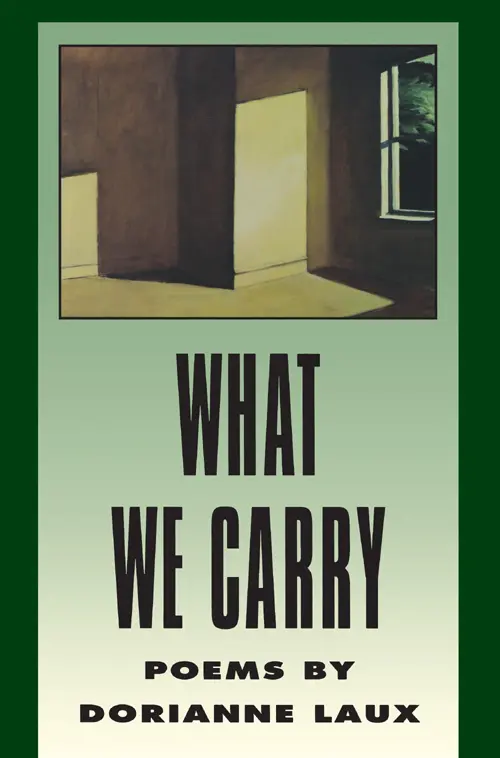

What We Carry

POEMS BY
DORIANNE LAUX

BOA EDITIONS, LTD. • BROCKPORT, NY • 1994
Copyright
Copyright © 1994 by Dorianne Laux
Manufactured in the United States of America
LC #: 94–71369
ISBN: 978-1-880238-06-6 cloth
ISBN: 978-1-880238-07-3 paper
ISBN: 978-1-938160-37-0 eBook
10 11 12 13 12 11
For information about permission to use any material from this book please contact
The publication of books by BOA Editions, Ltd., is made possible with the assistance of grants from the Literature Program of the New York State Council on the Arts and the Literature Program of the National Endowment for the Arts, as well as from the Lannan Foundation, the Lila Wallace–Reader’s Digest Literary Publishers Marketing Development Program, and the Rochester Area Foundation.
Cover Design: Daphne Poulin
Typesetting: R. Foerster, York Beach, ME
Manufacturing: McNaughton & Gunn, Lithographers
BOA Logo: Mirko
 |
BOA Editions, Ltd. 250 North Goodman Street, Suite 306 Rochester, NY 14607 A Poulin Jr., Founder (1938-1996) |
 |
Dedication
for my mother
WHAT WE CARRY

Late October
Midnight. The cats under the open window,
their guttural, territorial yowls.
Crouched in the neighbor’s driveway with a broom,
I jab at them with the bristle end,
chasing their raised tails as they scramble
from bush to bush, intent on killing each other.
I shout and kick until they finally
give it up; one shimmies beneath the fence,
the other under a car. I stand in my underwear
in the trembling quiet, remembering my dream.
Something had been stolen from me, valueless
and irreplaceable. Grease and grass blades
were stuck to the bottoms of my feet.
I was shaking and sweating. I had wanted
to kill them. The moon was a white dinner plate
broken exactly in half. I saw myself as I was:
forty-one years old, standing on a slab
of cold concrete, a broom handle slipping
from my hands, my breasts bare, my hair
on end, afraid of what I might do next.
Dust
Someone spoke to me last night,
told me the truth. Just a few words,
but I recognized it.
I knew I should make myself get up,
write it down, but it was late,
and I was exhausted from working
all day in the garden, moving rocks.
Now, I remember only the flavor —
not like food, sweet or sharp.
More like a fine powder, like dust.
And I wasn’t elated or frightened,
but simply rapt, aware.
That’s how it is sometimes —
God comes to your window,
all bright light and black wings,
and you’re just too tired to open it.
If This Is Paradise
The true mystery of the world is the visible…
— OSCAR WILDE
If this is paradise: trees, beehives,
boulders. And this: bald moon, shooting
stars, a little sun. If in your hands
this is paradise: sensate flesh,
hidden bone, your own eyes
opening, then why should we speak?
Why not lift into each day like the animals
that we are and go silently
about our true business: the hunt
for water, fat berries, the mushroom’s
pale meat, tumble through waist-high grasses
without reason, find shade and rest there,
our limbs spread beneath the meaningless sky,
find the scent of the lover
and mate wildly. If this is paradise
and all we have to do is be born and live
and die, why pick up the stick at all?
Why see the wheel in the rock?
Why bring back from the burning fields
a bowl full of fire and pretend that it’s magic?
What Could Happen
Noon. A stale Saturday. The hills
rise above the town, nudge houses and shops
toward the valley, kick the shallow river
into place. Here, a dog can bark for days
and no one will care enough
to toss an empty can or an unread newspaper
in his direction. No one complains.
The men stand in loose knots
outside Ace Hardware, talk a little, stare
at the blue tools. A few kids
sulk through the park, the sandbox full
of hardscrabble, the monkey bars
too hot to touch. In a town like this
a woman on the edge of forty
could drive around in her old car, the back end
all jingle and rivet, one headlight
taped in place, the hood held down with greasy rope,
and no one would notice.
She could drive up and down the same street
all day, eating persimmons,
stopping only for a moment to wonder
at the wooden Indian on the corner of 6th and B,
the shop window behind it
filled with beaten leather, bright woven goods
from Guatemala, postcards of this town
before it began to go under, began
to fade into a likeness of itself.
She could pull in at the corner store for a soda
and pause before uncapping it,
press the cold glass against her cheek,
roll it under her palm down the length of her neck
then slip it beneath the V of her blouse
and let it rest there, where she’s hottest.
She could get back in her car
and turn the key, bring the engine up
like a swarm of bottle flies, feel it
shake like an empty caboose.
She could twist the radio too high
and drive like this for the rest of the day —
the same street, the same hairpin turn
that knocks the jack in the trunk from one wheel well
to the other — or she could pass the turn
and keep going, the cold soda
wedged between her legs, the bass notes
throbbing like a vein, out past the closed shops
and squat houses, the church
with its bland white arch, toward the hills,
beyond that shadowy nest of red madrones.
After Twelve Days of Rain
I couldn’t name it, the sweet
sadness welling up in me for weeks.
So I cleaned, found myself standing
in a room with a rag in my hand,
the birds calling time-to-go, time-to-go.
And like an old woman near the end
of her life I could hear it, the voice
of a man I never loved who pressed
my breasts to his lips and whispered
“My little doves, my white, white lilies.”
I could almost cry when I remember it.
I don’t remember when I began
to call everyone “sweetie,”
as if they were my daughters,
my darlings, my little birds.
I have always loved too much,
or not enough. Last night
I read a poem about God and almost
believed it — God sipping coffee,
smoking cherry tobacco. I’ve arrived
at a time in my life when I could believe
almost anything.
Today, pumping gas into my old car, I stood
hatless in the rain and the whole world
went silent — cars on the wet street
sliding past without sound, the attendant’s
mouth opening and closing on air
as he walked from pump to pump, his footsteps
erased in the rain — nothing
but the tiny numbers in their square windows
rolling by my shoulder, the unstoppable seconds
gliding by as I stood at the Chevron,
balanced evenly on my two feet, a gas nozzle
gripped in my hand, my hair gathering rain.
And I saw it didn’t matter
who had loved me or who I loved. I was alone.
The black oily asphalt, the slick beauty
of the Iranian attendant, the thickening
clouds — nothing was mine. And I understood
finally, after a semester of philosophy,
a thousand books of poetry, after death
and childbirth and the startled cries of men
who called out my name as they entered me,
I finally believed I was alone, felt it
in my actual, visceral heart, heard it echo
like a thin bell. And the sounds
came back, the slish of tires
and footsteps, all the delicate cargo
they carried saying thank you
and yes. So I paid and climbed into my car
as if nothing had happened —
as if everything mattered — What else could I do?
I drove to the grocery store
and bought wheat bread and milk,
a candy bar wrapped in gold foil,
smiled at the teenaged cashier
with the pimpled face and the plastic
name plate pinned above her small breast,
and knew her secret, her sweet fear —
Little bird. Little darling. She handed me
my change, my brown bag, a torn receipt,
pushed the cash drawer in with her hip
and smiled back.
Aphasia
for Honeya
After the stroke all she could say
was Venezuela, pointing to the pitcher
with its bright blue rim, her one word
command. And when she drank the clear
water in and gave the glass back,
it was Venezuela again, gratitude,
maybe, or the word now simply
a sigh, like the sky in the window,
the pillows a cloudy definition
propped beneath her head. Pink roses
dying on the bedside table, each fallen
petal a scrap in the shape of a country
she’d never been to, had never once
expressed interest in, and now
it was everywhere, in the peach
she lifted, dripping, to her lips,
the white tissue in the box, her brooding
children when they came to visit,
baptized with their new name
after each kiss. And at night
she whispered it, dark narcotic
in her husband’s ear as he bent
to listen, her hands fumbling
at her buttons, her breasts,
holding them up to the light
like a gift. Venezuela, she said.
Graveyard at Hurd’s Gulch
His grave is strewn with litter again,
crumpled napkins, a plastic spoon, white
styrofoam cup tipped on its side, bright
half-moon of lipstick on the rim.
I want to scold her for the mess she’s left,
the flattened grass and squashed grapes,
but I’ve seen her walking toward the trees,
her hollow body receding, her shadow
following behind. I’m the intruder,
come not to mourn a specific body
but to rest under a tree, my finger tracing
the rows of glowing marble,
the cloud-covered hips of the hills.
I always take the same spot,
next to the sunken stone that says MOTHER,
the carved dates with the little dash between them,
a brief, deep cut, like a metaphor for life.
Does she whisper, I wonder, to the one
she loves, or simply eat and sleep, content
for an hour above the bed of his bones?
I think she brings him oranges and secrets,
her day’s torn and intricate lace.
I have no one on this hill to dine with.
I’m blessed. Everyone I love is still alive.
I know there is no God, no afterlife,
but there is this peace, the granite angel
with moss-covered wings whose face
I have grown to love, her sad smile
like that sadness we feel after sex,
those few delirious hours when we needed nothing
but breath and flesh, after we’ve flown back
into ourselves, our imperfect heavy bodies,
just before the terrible hunger returns.
What We Carry
for Donald
He tells me his mother carries his father’s ashes
on the front seat in a cardboard box, exactly
where she placed them after the funeral.
Her explanation: she hasn’t decided
where they should be scattered.
It’s been three years.
I imagine her driving home from the store,
a sack of groceries jostling next to the box —
smell of lemons, breakfast rolls,
the radio tuned to the news.
He says he never liked his father,
but made peace with him before he died.
That he carries what he can
and discards the rest.
We are sitting in a cafe.
Because I don’t love him, I love
to watch him watch the women walk by
in their sheer summer skirts.
From where I sit I can see them approach,
then study his face as he watches them go.
We are friends. We are both lonely.
I never tell him about my father
so he doesn’t know that when I think of his —
blue ashes in a cardboard box — I think
of my own, alive in a room
somewhere in Oregon, a woman
helping his worn body into bed, the same body
that crushed my sister’s childhood, mine.
Maybe this wife kisses him
goodnight, tells him she loves him,
actually means it. This close to the end,
if he asked forgiveness, what could I say?
If I were handed my father’s ashes,
what would I do with them?
What body of water would be fit
for his scattering? What ground?
It’s best when I think least. I listen
to my friend’s story without judgement
or surprise, taking it in as he takes in
the women, without question, simply a given,
as unexceptional as conversation between friends,
the laughter and at each end
the relative comfort of silence.
The Job
for Tobey
When my friend lost her little finger
between the rollers of a printing press,
I hadn’t met her yet. It must have taken
months for the stump to heal, skin stretched
and stitched over bone, must have taken
years before she could consider it calmly,
as she does now, in an airport cafe
over a cup of black coffee.
She doesn’t complain or blame the unguarded
machine, the noise of the factory, the job
with its long unbroken hours.
She simply opens her damaged hand and studies
the emptiness, the loss
of symmetry and flesh, and tells me
it was a small price to pay,
that her missing finger taught her
to take more care with her life,
with what she reaches out
to touch, to stay awake when she’s awake
and listen, to pay attention
to what’s turning in the world.
For the Sake of Strangers
No matter what the grief, its weight,
we are obliged to carry it.
We rise and gather momentum, the dull strength
that pushes us through crowds.
And then the young boy gives me directions
so avidly. A woman holds the glass door open,
waits patiently for my empty body to pass through.
All day it continues, each kindness
reaching toward another — a stranger
singing to no one as I pass on the path, trees
offering their blossoms, a retarded child
who lifts his almond eyes and smiles.
Somehow they always find me, seem even
to be waiting, determined to keep me
from myself, from the thing that calls to me
as it must have once called to them —
this temptation to step off the edge
and fall weightless, away from the world.
What I Wouldn’t Do
The only job I didn’t like, quit
after the first shift, was selling
subscriptions to TV Guide over the phone.
Before that it was fast food, all
the onion rings I could eat, handing
sacks of deep fried burritos through
the sliding window, the hungry hands
grabbing back. And at the laundromat,
plucking bright coins from a palm
or pressing them into one, kids
screaming from the bathroom and twenty
dryers on high. Cleaning houses was fine,
polishing the knick-knacks of the rich.
I liked holding the hand-blown glass bell
from Czechoslovakia up to the light,
the jewelled clapper swinging lazily
from side to side, its foreign,
A-minor ping. I drifted, an itinerant,
from job to job, the sanatorium
where I pureed peas and carrots
and stringy beets, scooped them,
like pudding, onto flesh-colored
plastic plates, or the gas station
where I dipped the ten-foot measuring stick
into the hole in the blacktop,
pulled it up hand over hand
into the twilight, dripping
its liquid gold, pink-tinged.
I liked the donut shop best, 3 AM,
alone in the kitchen, surrounded
by sugar and squat mounds of dough,
the flashing neon sign strung from wire
behind the window, gilding my white uniform
yellow, then blue, then drop-dead red.
It wasn’t that I hated calling them, hour
after hour, stuck in a booth with a list
of strangers’ names, dialing their numbers
with the eraser end of a pencil and them
saying hello. It was that moment
of expectation, before I answered back,
the sound of their held breath,
their disappointment when they realized
I wasn’t who they thought I was,
the familiar voice, or the voice they loved
and had been waiting all day to hear.
Singing Back the World
I don’t remember how it began.
The singing. Judy at the wheel
in the middle of Sentimental Journey.
The side of her face glowing.
Her full lips moving. Beyond her shoulder
the little houses sliding by.
And Geri. Her frizzy hair tumbling
in the wind wing’s breeze, fumbling
with the words. All of us singing
as loud as we can. Off key.
Not even a semblance of harmony.
Driving home in a blue Comet singing
I’ll Be Seeing You and Love Is a Rose.
The love songs of war. The war songs
of love. Mixing up verses, eras, words.
Songs from stupid musicals.
Coming in strong on the easy refrains.
Straining our middle aged voices
trying to reach impossible notes,
reconstruct forgotten phrases.
Cole Porter’s Anything Goes.
Shamelessly la la la-ing
whole sections. Forgetting
the rent, the kids, the men,
the other woman. The sad goodbye.
The whole of childhood. Forgetting
the lost dog. Polio. The grey planes
pregnant with bombs. Fields
of white headstones. All of it gone
as we struggle to remember
the words. One of us picking up
where the others leave off. Intent
on the song. Forgetting our bodies,
their pitiful limbs, their heaviness.
Nothing but three throats
beating back the world — Laurie’s
radiation treatments. The scars
on Christina’s arms. Kim’s brother.
Molly’s grandfather. Jane’s sister.
Singing to the telephone poles
skimming by. Stoplights
blooming green. The road,
a glassy black river edged
with brilliant gilded weeds. The car
an immense boat cutting the air
into blue angelic plumes. Singing
Blue Moon and Paper Moon
and Mack the Knife, and Nobody Knows
the Trouble I’ve Seen.
Balance
I’m remembering again, the day
we stood on the porch and you smoked
while the old man told you
about his basement full of wine,
his bad heart and the doctor’s warning,
how he held the dusty bottle out to you,
glad, he said, to give it away
to someone who appreciated
its value and spirit, the years
it took to settle into its richness
and worth. I’m watching again,
each cell alive, as you reach
for the wine, your forearm exposed
below the rolled sleeve, the fine hairs
that sweep along the muscle, glowing,
lifting a little in the afternoon breeze.
I’m memorizing the shape of the moment:
your hand and the small bones
lengthening beneath the skin
as it tightens in the gripping,
in the receiving of the gift, the exact
texture and color of your skin,
and the old man’s face, reduced
to its essence. That,
and the brief second
when both of you had a hand on the bottle —
the thing not yet given,
not yet taken, but held
between you, stoppered, full.
And my body is flooded again
with an elemental joy,
holding onto it against another day
in the unknowable future when I’m given
terrible news, some dark burden
I’ll be forced to carry. I know
this is useless, and can’t possibly work,
but I’m saving that moment, for balance.
SMALL GODS
For My Daughter Who Loves Animals
Once a week, whether the money is there
or not, I write a check for her lessons.
But today, as I waited in the car for her
to finish her chores, after she had wrapped
this one’s delicate legs, brushed burrs
and caked mud from that one’s tail,
I saw her stop and offer her body
to a horse’s itchy head. One arm up,
she gave him the whole length of her side.
And he knew the gesture, understood
the gift, stepped in close on oiled hooves
and pressed his head to her ribcage.
From hip to armpit he raked her body until,
to keep from falling, she leaned into him
full weight, her foot braced
against a tack post for balance.
Before horses, it was snakes, coiled
around her arms like African bracelets.
And before that, stray dogs, cats
of every color, even the misfits,
the abandoned and abused.
It took me so long to learn how to love,
how to give myself up and over to another.
Now I see how she has always
loved them all, snails and spiders,
from the very beginning, without fear or shame,
saw even the least of them, ants,
gnats, heard and answered
even the slightest of their calls.
Planning the Future
I never dreamed my daughter would be 16
until the day arrived with a car full of kids
and balloons, take-out Mexican food
and a Baskin Robbins ice cream cake.
A few months later and she has a boyfriend
in a baseball cap and baggy pants, two gold hoop
earrings and a shaved head. They are happy.
After school they do their homework together,
stretched out on her bed, the door open
to the edge of the legal limit.
Every history question finished deserves
a kiss. They’re embarrassed by the names
they’ve invented for each other,
by their tenderness. Toward evening
they watch MTV, mute the volume
during the commercials and plan their future —
junior college, then marriage, then kids,
what they’ll take with them — his dog,
her rat. I’m happy for them, even knowing
what will happen — the last gift, the last
kiss, her huddled on her bed, blinded
by her own bright pain. And I can see clearly
the day she’ll walk away, keys on a ring,
a suitcase banging her legs.
Then the real work of motherhood will begin,
the job of waking into each morning, trusting.
Finding What’s Lost
In the middle of the poem my daughter reminds me
that I promised to drive her to the bus stop.
She waits a few beats then calls out the time.
Repeats that I’ve promised.
I keep the line in my head, repeat it under my breath
as I look for my keys, rummage through my purse,
my jacket pockets. When we’re in the car, I search
the floor for a Jack-in-the-Box bag, a ticket stub,
a bridge toll dollar, anything to write on.
I’m still repeating my line when she points
out the window and says “Look, there’s the poppy
I told you about,” and as I turn the corner I see it,
grown through a crack between the sidewalk and the curb.
We talk about it while I scan driveways for kids
on skateboards and bikes, while the old man who runs
the Rexall locks up for the night and a mangy dog
lifts a frail leg and sprays the side of a tree.
Then we talk about her history essay and her boyfriend,
and she asks again about summer vacation, if we’re
going somewhere or just staying home. I say
I don’t know and ask what she’d rather do, but by now
we’re at the bus stop and she leans over
and, this is so unlike her, brushes her lips
quickly against my cheek. Then, without looking back,
she’s out the door, and the line, the poem,
is gone, lost somewhere near 8th and G, hovering
like an orange flower over the gravel street.
Homecoming
At the high school football game, the boys
stroke their new muscles, the girls sweeten their lips
with gloss that smells of bubblegum, candy cane,
or cinnamon. In pleated cheerleader skirts
they walk home with each other, practicing yells,
their long bare legs forming in the dark.
Under the arched field lights a girl
in a velvet prom dress stands near the chainlink,
a cone of roses held between her breasts.
Her lanky father, in a corduroy suit, leans
The Story Continues on BooksBarbecue!
Enjoyed this preview? ❤️ Do not stop here!
Read the complete book free online → 🔗
Continue reading now on BooksBarbecue and discover every page!
Love reading? Bookmark BooksBarbecue.com for more amazing books!
Happy Reading!