What Is This Thing Called Love
Cover
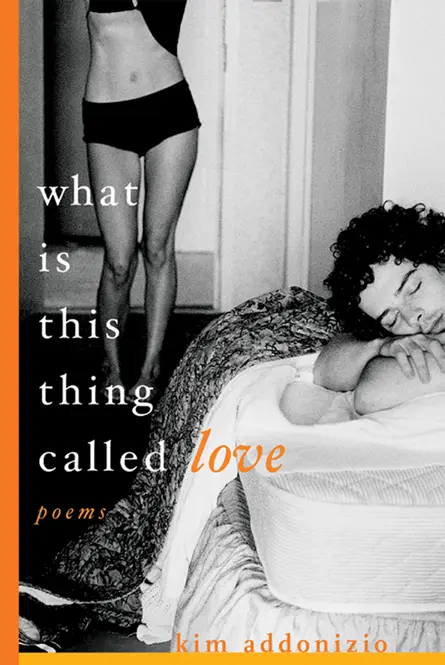
Title Page

WHAT IS THIS THING CALLED LOVE
kim addonizio
w. w. norton & company new york london
Dedication
DEDICATION
For Robert—
lightning twice
Epigraph
EPIGRAPH
The wind was shaking me all night long;
shaking me in my sleep
like a definition of love,
saying, this is the moment,
here, now.
—Ruth Stone, “Green Apples”
The blues are the true facts of life.
—Willie Dixon
ONE
ONE
First Kiss
FIRST KISS
Afterwards you had that drunk, drugged look
my daughter used to get, when she had let go
of my nipple, her mouth gone slack and her eyes
turned vague and filmy, as though behind them
the milk was rising up to fill her
whole head, that would loll on the small
white stalk of her neck so I would have to hold her
closer, amazed at the sheer power
of satiety, which was nothing like the needing
to be fed, the wild flailing and crying until she fastened
herself to me and made the seal tight
between us, and sucked, drawing the liquid down and
out of my body; no, this was the crowning
moment, this giving of herself, knowing
she could show me how helpless
she was—that’s what I saw, that night when you
pulled your mouth from mine and
leaned back against a chain-link fence,
in front of a burned-out church: a man
who was going to be that vulnerable,
that easy and impossible to hurt.
Stolen Moments
STOLEN MOMENTS
What happened, happened once. So now it’s best
in memory—an orange he sliced: the skin
unbroken, then the knife, the chilled wedge
lifted to my mouth, his mouth, the thin
membrane between us, the exquisite orange,
tongue, orange, my nakedness and his,
the way he pushed me up against the fridge—
Now I get to feel his hands again, the kiss
that didn’t last, but sent some neural twin
flashing wildly through the cortex. Love’s
merciless, the way it travels in
and keeps emitting light. Beside the stove
we ate an orange. And there were purple flowers
on the table. And we still had hours.
Blues for Dante Alighieri
BLUES FOR DANTE ALIGHIERI
. . . without hope we live on in desire . . .
Inferno, IV
Our room was too small, the sheets scratchy and hot—
Our room was a kind of hell, we thought,
and killed a half-liter of Drambuie we’d bought.
We walked over the Arno and back across.
We walked all day, and in the evening, lost,
argued and wandered in circles. At last
we found our hotel. The next day we left for Rome.
We found the Intercontinental, and a church full of bones,
and ate takeout Chinese in our suite, alone.
It wasn’t a great journey, only a side trip.
It wasn’t love for eternity, or any such crap;
it was just something that happened . . .
We packed suitcases, returned the rental car.
We packed souvenirs, repaired to the airport bar
and talked about pornography, and movie stars.
What Was
WHAT WAS
The streets fill with cabs and limos,
with the happy laughter of the very drunk;
the benches in Washington Square Park,
briefly occupied by lovers, have been reclaimed
by men who stretch out coughing under the Chronicle.
We’re sitting on the cold slab
of a cathedral step, and to keep myself
from kissing you I stare at the cartoony
blue neon face of a moose, set over the eponymous
restaurant, and decide on self-pity
as the best solution to this knot
of complicated feelings. So much, my love,
for love; our years together recede,
taillights in the fog that’s settled in. I breathe
your familiar smell—Tuscany Per Uomo,
Camel Lights, the sweet reek of alcohol—and keep
from looking at your face, knowing
I’m still a sucker for beauty. Nearby, a man decants
a few notes from his tenor sax, honking his way
through a tune meant to be melancholy. Soon
I’ll drive home alone, weeping and raging,
the radio twisted high as I can stand it—
or else I’ll lean toward you, and tell you
any lie I think will bring you back.
And if you’re reading this, it’s been years
since then, and everything’s too late
the way it always is in songs like this,
the way it always is.
So What
SO WHAT
Guess what. If love is only chemistry—
phenylethylamine, that molecule
that dizzies up the brain’s back room, smoky
with hot bebop, it won’t be long until
a single worker’s mopping up the scuffed
and littered floor, whistling tunelessly,
each endorphin cooling like a snuffed
glass candle, the air stale with memory.
So what, you say; outside, a shadow lifts
a trumpet from its case, lifts it like an ingot
and scatters a few virtuosic riffs
toward the locked-down stores. You’ve quit
believing that there’s more, but you’re still stirred
enough to stop, and wait, listening hard.
31-Year-Old Lover
31-YEAR-OLD LOVER
When he takes off his clothes
I think of a stick of butter being unwrapped,
the milky, lubricious smoothness of it
when it’s taken from the fridge still hard
the way his body is hard, the high
tight pectorals, the new dimes of the nipples pressed
into his chest, the fanning of the muscles underneath.
I look at his arms, shaped as though a knife
has slid along the curves to carve them out,
deltoids, biceps, triceps, I almost can’t believe
that he is human—latissimus dorsi, hip flexors,
gluteals, gastrocnemius—he is so perfectly made.
He stands naked in my bedroom and nothing
has harmed him yet, though he is going
to be harmed. He is going to have a gut one day,
and wiry gray hairs where the soft dark filaments
flow out of him, the cream of his skin is going
to loosen and separate slowly, over a low steady flame
and he has no idea, as I had no idea,
and I am not going to speak of this to him ever,
I am going to let him stretch out on my bed
so I can take the heavy richness of him in
and in, I am going to have it back the only way I can.
Muse
MUSE
When I walk in,
men buy me drinks before I even reach the bar.
They fall in love with me after one night,
even if we never touch.
I tell you I’ve got this shit down to a science.
They sweat with my memory,
alone in cheap rooms they listen
to moans through the wall
and wonder if that’s me,
letting out a scream as the train whines by.
But I’m already two states away, lying with a boy
I let drink rain from the pulse at my throat.
No one leaves me, I’m the one that chooses.
I show up like money on the sidewalk.
Listen, baby. Those are my high heels dangling from the phone wire.
I’m the crow flapping down,
that’s my black slip
you catch sight of when the pain
twists into you so deep
you have to close your eyes and weep like a goddamned woman.
You Don’t Know What Love Is
YOU DON’T KNOW WHAT LOVE IS
but you know how to raise it in me
like a dead girl winched up from a river. How to
wash off the sludge, the stench of our past.
How to start clean. This love even sits up
and blinks; amazed, she takes a few shaky steps.
Any day now she’ll try to eat solid food. She’ll want
to get into a fast car, one low to the ground, and drive
to some cinderblock shithole in the desert
where she can drink and get sick and then
dance in nothing but her underwear. You know
where she’s headed, you know she’ll wake up
with an ache she can’t locate and no money
and a terrible thirst. So to hell
with your warm hands sliding inside my shirt
and your tongue down my throat
like an oxygen tube. Cover me
in black plastic. Let the mourners through.
Blues for Roberto
BLUES FOR ROBERTO
It’s an ugly circus, to leave you again.
It’s a carnival act: bound, chained
underwater in a glass tank, near-drowned,
I’ve gotten free. I’m incredible.
I’ve gotten so good I’m terrible.
Bring on the elephants, their great legs hobbled.
Bring on a lion, I’ll feed it my head.
Bring a small scrap of paper to wipe up the blood.
I’ll hang myself from the high wire, nude . . .
Once you loved me, but walked away.
Once was too often, for a girl like me—
Since then I’ve made you pay and pay.
Don’t call me, ever. I’ll tell you I’m sorry.
Don’t call me, I tell you; it’s boring, boring
always to leap to the end of the story.
And this is the end. I’m leaving town.
This is the end: the tents torn down,
the animals making caged animal sounds.
Ever After: A Paradelle
EVER AFTER: A PARADELLE
He lies on his side like a glass knocked over.
He lies on his side like a glass knocked over.
Only a little sweetness left, poor boy.
Only a little sweetness left, poor boy.
Only his little lies, a glass-like sweetness.
Poor he, a left boy knocked over on side.
Now she loves him more, but won’t come back.
Now she loves him more, but won’t come back.
In dreams she cries and paints his face like a girl’s.
In dreams she cries and paints his face like a girl’s.
A girl’s more in dreams. She won’t like him now,
but loves his face. Come back, she paints and cries.
It rains and falls dark on the house they lived in together.
It rains and falls dark on the house they lived in together.
She is alone there, afraid when it falls and breaks over the roof.
She is alone there, afraid when it falls and breaks over the roof.
It is on the roof. Rains and falls. The house afraid
when it lived alone. There she breaks and falls over in dark.
Now, in the dark, he dreams.
She is like a sweetness in his side; she loves him back.
But it paints more lies. Afraid, his face won’t come together.
Little boy lived there on and on alone, only a girl’s poor roof
knocked over. When it breaks, the house cries like they left.
She rains. And a glass falls and falls.
note: for an explanation of the paradelle form, see Billy Collins’s “Paradelle for Susan” in his book Picnic, Lightning.
Sonnenizio on a Line from Drayton
SONNENIZIO ON A LINE FROM DRAYTON
Since there’s no help, come let us kiss and part;
or kiss anyway, let’s start with that, with the kissing part,
because it’s better than the parting part, isn’t it—-
we’re good at kissing, we like how that part goes:
we part our lips, our mouths get near and nearer,
then we’re close, my breasts, your chest, our bodies partway
to making love, so we might as well, part of me thinks—
the wrong part, I know, the bad part, but still
let’s pretend we’re at that party where we met
and scandalized everyone, remember that part? Hold me
like that again, unbutton my shirt, part of you
wants to I can tell, I’m touching that part and it says
yes, the ardent partisan, let it win you over,
it’s hopeless, come, we’ll kiss and part forever.
note: The sonnenizio was invented in Florence in the thirteenth century by Vanni Fucci as an irreverent form whose subject was usually the impossibility of everlasting love. Dante retaliated by putting Fucci into the seventh chasm of the Inferno as a thief. Originally composed in hendecasyllabics, the sonnenizio gradually moved away from metrical constraints and began to tackle a wider variety of subject matter. The sonnenizio is fourteen lines long. It opens with a line from someone else’s sonnet, repeats a word from that line in each succeeding line of the poem, and closes with a rhymed couplet.
Ex-boyfriends
EX-BOYFRIENDS
They hang around, hitting on your friends
or else you never hear from them again.
They call when they’re drunk, or finally get sober,
they’re passing through town and want dinner,
they take your hand across the table, kiss you
when you come back from the bathroom.
They were your loves, your victims,
your good dogs or bad boys, and they’re over
you now. One writes a book in which a woman
who sounds suspiciously like you
is the first to be sadistically dismembered
by a serial killer. They’re getting married
and want you to be the first to know,
or they’ve been fired and need a loan,
their new girlfriend hates you,
they say they don’t miss you but show up
in your dreams, calling to you from the shoeboxes
where they’re buried in rows in your basement.
Some nights you find one floating into bed with you,
propped on an elbow, giving you a look
of fascination, a look that says I can’t believe
I’ve found you. It’s the same way
your current boyfriend gazed at you last night,
before he pulled the plug on the tiny white lights
above the bed, and moved against you in the dark
broken occasionally by the faint restless arcs
of headlights from the freeway’s passing trucks,
the big rigs that travel and travel,
hauling their loads between cities, warehouses,
following the familiar routes of their loneliness.
Dance
DANCE
When you are finally, magically, able to clone
yourself into several identical women,
so that each one can move toward a man
who’s been waiting for his turn
to come around for the first time, or maybe again,
won’t you be happy then,
all of you together in a lustrous ballroom,
each woman wearing her distinguishing number,
the judges scoring everyone the same, music spilling
from the bandstand, the men thrilled
to be near you, each one whispering
a different pet name, each one polishing
with his black shoes a perfect circle of floor
while he raises you up, holding your
hips in his hands, gazing at you with his brown
or mottled green eyes, looking down
with his startling blue ones, taking you into a corner
then spinning you out toward the center
where the light from the mirrorball
splinters over your skin, sidereal
as your sequined dress, and you feel
as complete as you’ll ever feel,
moving through all your true and beautiful lives
while the real one pales.
TWO
TWO
Death Poem
DEATH POEM
Do I have to bring it up again, isn’t there another subject?
Can I forget about the scrap of flattened squirrel fur
fluttering on the road, can I forget the road
and how I can’t stop driving no matter what,
not even for gas, or love, can I please not think
about my father left in some town behind me,
in his blue suit, with his folded hands,
and my grandmother moaning about her bladder
and swallowing all the pills, and the towns I’m passing now
can I try not to see them, the children squatting
by the ditches, the holes in their chests and foreheads,
the woman cradling her tumor, the dog dragging its crippled hips?
I can close my eyes and sit back if I want to,
I can lean against my friends’ shoulders
and eat as they’re eating, and drink from the bottle
being passed back and forth; I can lighten up, can’t I,
Christ, can’t I? There is another subject, in a minute
I’ll think of it. I will. And if you know it, help me.
Help me. Remind me why I’m here.
Scary Movies
SCARY MOVIES
Today the cloud shapes are terrifying,
and I keep expecting some enormous
black-and-white B-movie Cyclops
to appear at the edge of the horizon,
to come striding over the ocean
and drag me from my kitchen
to the deep cave that flickered
into my young brain one Saturday
at the Baronet Theater where I sat helpless
between my older brothers, pumped up
on candy and horror—that cave,
the litter of human bones
gnawed on and flung toward the entrance,
I can smell their stench as clearly
as the bacon fat from breakfast. This
is how it feels to lose it—
not sanity, I mean, but whatever it is
that helps you get up in the morning
and actually leave the house
on those days when it seems like death
in his brown uniform
is cruising his panel truck
of packages through your neighborhood.
I think of a friend’s voice
on her answering machine—
Hi, I’m not here—
the morning of her funeral,
the calls filling up the tape
and the mail still arriving,
and I feel as afraid as I was
after all those vampire movies
when I’d come home and lie awake
all night, rigid in my bed,
unable to get up
even to pee because the undead
were waiting underneath it;
if I so much as stuck a bare
foot out there in the unprotected air
they’d grab me by the ankle and pull me
under. And my parents said there was
nothing there, when I was older
I would know better, and now
they’re dead, and I’m older,
and I know better.
Dead Girls
DEAD GIRLS
show up often in the movies, facedown
in the weeds beside the highway.
Kids find them by the river, or in the woods,
under leaves, one pink-nailed hand thrust up.
Detectives stand over them in studio apartments
or lift their photos off pianos
in the houses they almost grew up in.
A dead girl can kick a movie into gear
better than a saloon brawl, better
than a factory explosion, just
by lying there. Anyone can play her,
any child off the street
can be hog-tied and dumped from a van
or strangled blue in a kitchen, a bathroom,
an alley, a school. That’s the beauty
of a dead girl. Even a plain one
who feels worthless
as a clod of dirt, broken
by the sorrow of gazing all day
at a fashion magazine,
can be made whole, redeemed
by what she finally can’t help being,
the center of attention, the special,
desirable, dead, dead girl.
Echo and Narcissus
ECHO AND NARCISSUS
Poor love-struck Echo, stuck with repeating
everything he said. He might
have thought he deserved it,
to have a nymph for a girlfriend, who’d confirm
everything he said; he might
have loved how she mirrored him,
a girlfriend who’d say You’re pretty
when he told her she was pretty,
who’d love him more than her mirror.
Not that they had mirrors in those days;
that was the problem. Anyway, she was pretty,
but he wasn’t interested in nymphs.
If only they’d had mirrors in those days
he wouldn’t have drowned in that reflecting pool,
finding it more interesting than nymphs.
But maybe he’d have hit his head against a mirror
if there’d been one instead of a pool, and died anyway.
No free will in those days—it was all the gods.
You could beat your head against your fate, but still,
if you were Narcissus, you’d end up a white flower
stuck in the ground with no will, plucked or trampled by gods,
and someone would say it was deserved,
for beauty to come down to a white flower,
a poor echo, and someone’s love stuck
in the ground, the ground, the ground, the ground.
Eating Together
EATING TOGETHER
I know my friend is going,
though she still sits there
across from me in the restaurant,
and leans over the table to dip
her bread in the oil on my plate; I know
how thick her hair used to be,
and what it takes for her to discard
her man’s cap partway through our meal,
to look straight at the young waiter
and smile when he asks
how we are liking it. She eats
as though starving—chicken, dolmata,
the buttery flakes of filo—
and what’s killing her
eats, too. I watch her lift
a glistening black olive and peel
the meat from the pit, watch
her fine long fingers, and her face,
puffy from medication. She lowers
her eyes to the food, pretending
not to know what I know. She’s going.
And we go on eating.
Cat Poem
CAT POEM
The cat’s hardly moving; she’s stopped eating, stopped shitting, she puts her face to a bowl of water
but doesn’t drink. My friend says not to write about her, he says no one wants to read about my pet
so let’s say it’s your cat, not mine, or maybe you have a dog; even I, a cat owner, think that dogs
are superior, they have such compassionate eyes. Once, an actor—not just any actor, but Al Pacino—
did an entire stage performance keeping in mind the liquid brown eyes of someone
in the audience, playing to those eyes, and when the house lights went up he realized
it was a guide dog, a German Shepherd, so maybe if you imagine your dog or even better
Al Pacino’s dog, hardly moving, its ribs heaving, that would be preferable, but if you don’t
like dogs maybe a bird will do, or whales, people seem to care about the whales, lying on their great sides
on the beach, or the seals with their skulls crushed by clubs—think of them, their orphaned pups—
or just forget about the animals entirely; forget the beagles smoking while they run on treadmills
and those rabbits the cosmetic companies seem to favor, though it’s harder to discount
the chimpanzees injected with simian AIDS, unless maybe the retrovirus inhabiting your friend
has just become immune to the protease inhibitors, so forget the chimpanzees, too,
remember my cat? She’s lying on the bathroom rug, her organs shutting down—imagine I wept
all day for her—Vanilla is her name, my daughter named her at five, now my daughter’s grown,
now the cat’s old, I’ve put her on the bed and I’m talking to her, saying It’s all right,
go if you need to, and I’m watching death—he’s stroking her fur, making his rounds,
he’s talking to her softly, telling her to stop, ignoring me for now, ignoring you.
Noir
NOIR
Everybody dies, Bob Roberts, the crooked fight promoter,
tells Charlie Davis early in Body and Soul,
and it’s the line Charlie throws back at him
like a perfect counterpunch at the close of the film.
The fix was in—go the distance and lose the decision—
but Charlie refused to take a dive,
thereby losing sixty grand but regaining his soul
and his long-suffering true love. What’re you gonna do,
kill me? Everybody dies, Charlie says, and he
and his true love go laughing into the final frame.
In the alternate ending, written but never shot,
Charlie’s killed and stuffed into a trashcan. What difference
if the audience leaves the theater believing
Charlie’s still out there somewhere,
working a cash register like his mother
The Story Continues on BooksBarbecue!
Enjoyed this preview? ❤️ Do not stop here!
Read the complete book free online → 🔗
Continue reading now on BooksBarbecue and discover every page!
Love reading? Bookmark BooksBarbecue.com for more amazing books!
Happy Reading!