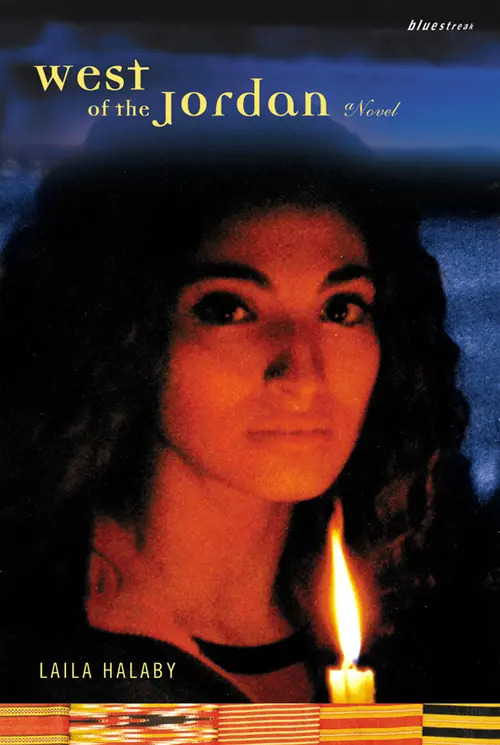
West of the Jordan
Cover
Dedication
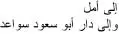
for Amal
and for the Abu Saud Sawaid family
Make It Delicious
Make It Delicious
You are late today.
Please do not be angry that I have taken so long, you write.
Don’t rush.
Tell your news the way they tell their stories: slow and tasty ... no rushing. Make it delicious like the olives, black and bursting with sweetness and sourness.
Remember the bottles of olive oil Um Saud gave you, and how you could drink a cup like a shot of whiskey, only without the burn, the white balls of cheese, sour with the bitterness of another land spread on bread so thick you could sleep under it.
Remember coming back from school, kicking dirt and passing dusty children up up up a road to the house where a meal and a family waited for you with loud kisses and steaming plates and many stories that you gobbled up or packed in your suitcases.
Stillness in dusty streets comes back when the sun shines, oceans and miles away.
That house told stories of courage and sadness and joy in every season, and now they come back to you at the wrong time, at the right time, at times that make you hate where you live, or love it more than you can make your words describe.
Cross the ocean, Abu Saud whispered, and take with you what you have learned, who you have seen, and the tastes that have nourished you, and please, do not forget us.
Now you sit in your sweet house with the desert outside and hostility all around you, thankful you have not forgotten altogether but wishing the memory could walk away a little further.
Please do not be angry I have taken so long, you write again, and soon a page is filled with news, congratulations for a baby’s birth, and words of longing you cannot soften, you cannot hide.
As with every letter you have written since the dark night you left just over a dozen years ago, you write Be careful and know that you are always with me. God keep you safe.
You are late today, but try to remember the wisdoms you unpacked that lie scattered around your living room.
Don’t rush ... make it delicious.
L.H.
Tucson, 2003
PART ONE
PART ONE
1 HALA Going Home
1HALAGoing Home
My gray, ankle-length dress scratches me everywhere, no matter how I shift in my regular-class, no-frills seat. It tickles my bottom and has a scooped back and scooped front, so people can peek from all angles. I thought the dress would give me confidence—mostly covering me, but pretty—but instead I fold myself, hunch, and calculate whether a tiny airplane bathroom is big enough to hold me as I change my clothes.
Next to me a diabetic Syrian woman has talked nonstop since our Royal Jordanian flight left LAX. Her body fills her seat and creeps into mine as well. Hennaed tendrils sneak from beneath her flowered scarf. She has lived in Los Angeles for thirty years and says that she does not speak a word of English.
“Why should I bother?” she shouts, so close to me that I taste her egg breath.
“You might enjoy it more,” I suggest, trying not to inhale.
“Nothing to enjoy.”
“Then why do you stay?”
“My children and grandchildren are there.” She glares at me and clutches a cardboard box with pictures of hypodermic needles. “Can you please have a woman from the plane come here.”
I pull my scratchy, gray shoulders up so they almost reach my neck, stretch my arm up, and push the button for the stewardess.
A slender, manicured finger pushes the button off and green eyes peer into mine. “Yes?”
The Syrian woman sits silently.
“She wanted me to ring for you,” I say.
“What do you need, Auntie?” asks the stewardess, whose name tag reads “Nadia.”
“I want you to know that I have to take these every day,” she says, holding up the box of needles. “I don’t know how to do it, so could you please get the plane’s doctor to come and give me an injection.” She smiles, exposing two gold teeth.
We stare at her. Nadia looks at me.
“We just met now,” I say in English in case she thinks we are related.
“Let me see if I can find a doctor for you,” she says.
The Syrian woman faces forward and says in a loud voice to no one in particular, “I have to go to the bathroom.”
“Well, you should go then. They’re very close.” I point to the lavatories, just two rows away.
“I couldn’t set foot in such a place!”
“Why not?”
“They’re filled with the smell of dirty pigs.”
“I beg your pardon?”
“You would use the same toilet, breathe the same air, as a strange man? I’d prefer exploding.”
The Syrian woman stares at my scoops. I turn away.
It is early evening when the plane lands, the sun a dull orange on the runway. I stare out the window, brush my hair for the third time, and rub some of the shininess from my face.
I have come back to Jordan to visit my dying grandmother—my father’s mother—one last time. I have been living with my mother’s brother, Hamdi, and his American wife, Fay, in the United States for three years now.
“It’s time for you to see your father,” my uncle told me in the airport. “Stay with him for as long as you like and come back when you are ready. You are always welcome here.”
My mother died two years ago. She sent me away because she knew she was dying, though I learned this later.
I am the youngest in a family that already had one boy, Jalal, and two girls, Latifa and Tihani. My mother was diagnosed with cancer just after my sister Tihani was born. It was caught early and my father sent her abroad for chemotherapy. The doctors said that she would make a full recovery. Tihani is six years older than I am, and in the time between our births, my mother miscarried four babies. Then she got pregnant with me. Between being physically drained from the miscarriages and her cancer and already being the mother of three children, she was a tired woman when I was born. She was never in good health and always suffered from one thing or another.
She adored me most—after Jalal—but she left much of the work in raising me to my oldest sister, Latifa, who was always a little slow. Latifa would take on all chores and tasks with great seriousness, admirable in an employee, unbearable in an older sister. If my mother had told her to throw me off the roof, she would have done so.
In dealing with me, she either tried to enforce my mother’s rules exactly or tried to teach me how to do her chores. She had no sense of what I could and couldn’t do at what age. When I was four (she was twelve), she tried to teach me to iron. I burned my hand and one of my father’s shirts and she yelled at me as though I had burned the house down. This incident started a cycle: Latifa would take care of me, then would do something so awful that my mother would take over. She would indulge me and cuddle me, and tell me stories and teach me embroidery and other things I can’t imagine her ever having done with Latifa, who resented me more and more.
And then I would see my mother start to fade: fall asleep in the middle of her embroidery, curse when she dropped something, with words I had never heard anyone else use. (My mother had a distinct way of cursing herself when she was sick: “God damn your stupid, useless, jackass mother.”) I tried to stay out of her way, but invariably Latifa would come to the rescue and take care of me, only this time a little angrier and more resentful than the time before. I learned that the only salvation from Latifa was avoidance, which is how it came to be that I spent a lot of time alone reading, a source of embarrassment or concern for almost everyone in my family.
“She will be blind before she is fifteen years old,” Aunt Suha, my father’s sister, would tell my mother every time she came over and found me bent over a book. “You shouldn’t let her do this or no one will marry her.”
My mother would nod, appeasing Aunt Suha enough to let the subject rest until the next time she came over. She never discouraged me, though, and liked to hear about the books I was reading, and read them herself if she had not done so previously. My father didn’t approve of reading outside of school texts, and he used to take away my books when he came across them. Jalal was the only one beside my mother who encouraged me. He often countered my father’s attempts by bringing me books he thought I’d find interesting, usually about animals or folktales from other countries.
During the summer before I was to start high school, Uncle Hamdi wrote from America to say that I could live with him and Fay, and that I could go to high school there. My mother was excited, perhaps because she thought I’d have a chance to finish what she barely started, or perhaps because she thought I’d have a freer education. Regardless, I was terrified at the thought of being away from my family, even though the idea of going to America—the America my mother had only tasted—was exciting. I was so tired of being made fun of for reading, for being too headstrong, for speaking my mind. My father said there was not a chance in the world that he would let such a young girl go live in America with only a maternal uncle and his American wife. He would not even listen to my mother’s arguments and would leave the room when the discussion came up.
“Jalal has gone and come back and will stay to take care of the land. Tihani is married and away. Latifa is already old,” my mother would call after him. “If Hala stays here she will rot like me and like Latifa. Look at us. We have rotted. Let Hala grow and dream.”
At the time I didn’t know why my father finally agreed to allow me to go—a year had passed since Uncle Hamdi’s invitation, during which time I was enrolled at the American School in Amman—but he did and just as I started to grow and dream my mother died.
Even though my mother had lived in Jordan since she was nineteen, she was Palestinian and saw my father as something of a foreigner. In distance she was not so far from the home in which she grew up, but in reality, she was in another country—another household—with an entirely different way of thinking.
Her village, Nawara, is known for lovely, cleverly embroidered dresses (rozas) in an area of villages where almost no one embroiders, for lack of time and money. My mother was competent in embroidery, but she was not typical—even in her already nontypical village—and her interests lay elsewhere. Her father had a great deal of land in Ramallah, a city filled with ideas and energy. He knew about the world and he believed in education, which was why he let my mother go to America for college. Unfortunately, he also had a very traditional side to his thinking, which is how it came to be that my mother ended up marrying my father, an old foreigner, and why all three of her sisters married immediately after their graduation from high school.
The story goes that my father, a Jordanian landowner in his late thirties, saw my mother once when she was still in high school—he had been doing business with my grandfather for years and for the first time went home with him for a visit. He fell so in love with my mother that he offered my grandfather a large portion of his own land in Ramallah as dowry if she would marry him. At the time my grandfather refused, saying that she still needed to finish high school and was planning to go on to university, maybe abroad. After that, she alone would be free to accept or refuse the offer. My father announced that in spite of his age (more than twenty years her senior), he would wait until my mother gave him her answer. It turned out he had to wait less than a year, when my mother returned from the States in disgrace—thanks to the lies of her brother’s friend. My father told my grandfather that regardless of the reason for my mother’s return, his offer still held. My grandfather, sure that this was his last chance to find an acceptable match for his daughter, accepted the offer.
In the beginning of their marriage, my father was indulgent with my mother. He even offered to let her continue her studies, in Jordan. She refused—perhaps she was still heartsick—and began her role as wife and mother. Even though she was living this life she did not ask for, when Jalal was born she breathed her soul into him and spoiled him terribly. She was as happy as she could be, given the circumstances, and to this day Jalal is totally her child, the only one of those three who always makes sure that people know he is half Palestinian. Even in the late sixties and early seventies, when he risked being beaten, or worse, he would speak proudly of his mother and her country. (When Jalal married a few months ago, he insisted that it be to a girl from our mother’s village, even though he has never lived in Nawara and has only visited a few times. At first my father refused, but Jalal insisted until my father agreed.)
For almost a year after Jalal’s birth, my mother was happy. She didn’t get pregnant again immediately, but my father wasn’t in a rush since at least he had a son. Two years and a week after Jalal, Latifa was born. Almost two years after that, Tihani was born. That’s when the difficulties in my family began. First, my mother got cancer. (The story I was told for years was that she was very sick and then she was well.) Then my father’s recently widowed mother moved in with them. In 1967, the Occupation began and my father lost a lot of his land. My mother lost her freedom to visit her family. My father became less generous with my mother, and she became less generous with her children.
“It was bad for me. So much was expected, selflessly, and my thoughts were stuck on what might have been,” she told me countless times. “I prayed so many times that if I could have one more healthy child, I would not try to have another one, and that I would be content with my life as it was. And then you were born, big and healthy and beautiful. You are my final blessing.”
When she had the energy, she gave me everything. She taught me the most complicated patterns in embroidery that she knew and told me equally complicated stories from her village as she was doing it. She took me wherever she went and explained everything to me. Best of all, she cuddled me endlessly, probably more than my brother and sisters combined. Latifa hated me for all these reasons: Latifa who drove my mother crazy; Latifa who had to deal with me every time my mother started to get sick; Latifa who hated me for the freedom I was allowed; Latifa who cared totally for my mother as she was dying.
If only I had known my mother was dying, then I would not have spent the last year of her life away. But perhaps if I never left, she would not have died in peace.
I see him before he sees me, and while I knew he would be alone, I wish he had brought Jalal, or even Latifa. As soon as he sees me coming down the escalator he sends a man to carry my bags.
My father looks old. His skin is dark, like fava beans, only more wrinkled, like raisins.
We embrace and he kisses me twice on both cheeks. “Thank God for your safe return, my daughter.”
Odd to hear this kind voice after two years of silence. “And may God keep you safe,” I reply.
Passing colorful people with their shouts and hugs and loud kisses and through the automatic doors, we walk into the evening that smells of diesel and toward a large black Mercedes parked under a sign that reads “No Parking.”
“It’s fatter than the last one,” I say.
“I am?” he asks.
“No, the car.”
“It’s safer that way,” he says and hands a folded bill to the wrinkled man who’s put my bags in the trunk. We get in the car. “You look skinny,” he says. “They don’t feed you well, do they? Lazy goats.”
I lean back in the soft leather. I can’t erase the picture of my last visit, my mother’s funeral, and then of the huge fight. The memory comes in my eyes, burning like the sun that’s setting, but I keep my silence as we drive into the desert.
“How is your health?” I ask.
“Thank God for my good health. Even my doctor says he can’t believe it.” He lights a cigarette with the windows up and we drive in smoky silence.
We race the dust down the new highway on the way home to the outskirts of Amman.
“I loved your mother,” he announces, perhaps seeing my memory. “God have mercy on her. Not a day passes that I don’t think of her.” He says this as though it’s an apology.
I am silent. I do not want his stories or drunken, smoky lovesongs tossed in my lap. I want my mother back so much it aches. I want to hear her stories about her village, her words in my ears, her fingers stroking my hair.
2 MAWAL Nawara
2MAWALNawara
Lots of places have special marks, while other places are just daytime normal with an occasional scary night, too thick silence, or a shrill scream to jazz them out of dusty boring.
You can tell about a place by the feeling you get from it, like creepy feeling places. That would be Um Lubna’s house—it has spooky and nasty-curious airs about it, like you want to go look at what’s going on inside, but that if you do a jinn might smack you, and if the jinn doesn’t get you, then your mother will.
There’s death feeling too, like too much sadness is falling out of a house and flooding the street, just to where you’re standing, which is why you run away as fast as you can before it can touch you and creep up through your toes like the worms that make Egyptian workers sick.
People give those feelings too: one look at them and you get a feeling like sadness or greatness or beauty or misery or come-sit-with-me-so-I-can-tell-you-a-great-story. We have some of everybody in those categories, though more of I’m-ready-for-dinner, and have-you-already-fed-the-chickens? and don’t-bother-me-I-have-work-to-do and don’t-forget-to-say-bismallah-ar-rahman-ar-raheem-before-you-squeeze-milk-from-the-goat’s-teat people. It’s those first ones who make the place a memory for other people.
Our village is called Nawara, which means flowers or blossoms. When you say it, Naw-waar-a, a hillside of small white wildflowers comes to mind, or the fragrant new blossoms on an orange or almond tree.
Everywhere is famous for something: political activism, delicious vegetables, ugly women. Our village is an island, famous for beautiful embroidered dresses that we call rozas while most everyone else calls them thobes, and yet surrounded by villages that do not embroider at all.
The complicated embroidery on our rozas—with both Palestinian and western stitches and patterns—captures the spirit of Nawara, which sits at the top of the West Bank, just west of the Jordan River, east of Jenin and far enough away from both of these places to be a peaceful village that only every so often releases an avalanche of stones and fire. This is something that happens more often as the Israelis take parts of our village to build their settlements.
Nawara could have a smaller version of herself in the United States, which is like an army calling all able-bodied young men away and then never returning the bodies.
You will find many women here grieving over sons and husbands who have forgotten them, or grieving over the evils that country has introduced their sons to, like drugs and drinking and loose women and gambling. My uncle Haydar lives in an American desert and stares at the sun because of the drugs he takes.
The Story Continues on BooksBarbecue!
Enjoyed this preview? ❤️ Do not stop here!
Read the complete book free online → 🔗
Continue reading now on BooksBarbecue and discover every page!
Love reading? Bookmark BooksBarbecue.com for more amazing books!
Happy Reading!