Wealth Management
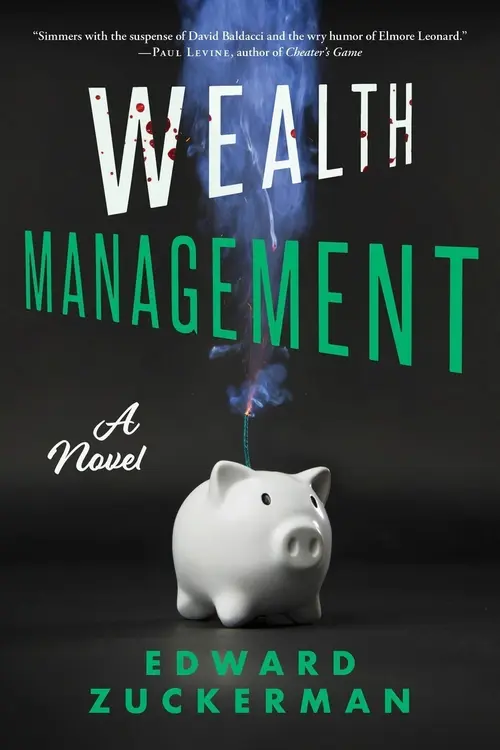
Front Cover
Half-Title Page

Also by the author
Also by the author:
The Day After World War III: The U.S. Government’s Plans for Surviving a Nuclear War
Small Fortunes: Two Guys in Pursuit of the American Dream
Title Page
Copyright Page
Copyright © 2022 by Edward Zuckerman
All rights reserved. No part of this book may be reproduced in any manner without the express written consent of the publisher, except in the case of brief excerpts in critical reviews or articles. All inquiries should be addressed to Arcade Publishing, 307 West 36th Street, 11th Floor, New York, NY 10018.
This is a work of fiction. Names, places, characters, and incidents are either the products of the author’s imagination or are used fictitiously.
Arcade Publishing books may be purchased in bulk at special discounts for sales promotion, corporate gifts, fund-raising, or educational purposes. Special editions can also be created to specifications. For details, contact the Special Sales Department, Arcade Publishing, 307 West 36th Street, 11th Floor, New York, NY 10018 or [email protected].
Arcade Publishing® and Arcade CrimeWise® are registered trademarks of Skyhorse Publishing, Inc.®, a Delaware corporation.
10 9 8 7 6 5 4 3 2 1
Library of Congress Cataloging-in-Publication Data is available on file.
Cover design by Erin Seaward-Hiatt
ISBN: 978-1-956763-05-8
Ebook ISBN: 978-1-956763-11-9
Printed in the United States of America
Dedication
For Mike Rosenbaum, who never got around to writing his
And, of course, for Margot and Molly Jane
Prologue (2017)
PROLOGUE (2017)
Bashir
BASHIR
It sounded like a lawn mower, but Bashir didn’t know that, because he had never seen a lawn mower or, for that matter, a lawn. Nevertheless, by a second or two, he heard it first. He stopped and looked up, shielding his eyes from the fierce midday sun, while the others continued running in and out of the small brick building, smiling in a manic way, carrying the sacks of cash. American dollars. Crusader money, but highly valued, even in the Caliphate. Even more now that they were in retreat.
It must have been brought to the bank office in this regional trading center from the vaults of Mosul, before Mosul fell, for safekeeping. And then what? Simply forgotten? Well, not by everybody. Now Mosul, along with most of the Caliphate, was back in the hands of the Rafidha, but someone knew, and orders reached their commander, and last night Bashir and the others were dispatched from their camp to the north. Bashir’s brothers were dead, and his father had disowned him, and his wife had disappeared one night, sneaking across the desert with the baby, but Bashir was still loyal, fighting for god. And if he wasn’t, if he ever stopped, what would he go back to? He had nothing behind him, only the promise of paradise ahead.
They were in three Toyota pickups. A dozen men with AK-47s and a heavy machine gun mounted on the bed of one of the trucks, the other beds left empty to leave room for the money.
The bank manager had not been cooperative. Now he lay next to a mound of goat droppings by the side of the road, blood still running from the gash in his throat, turning the sand black.
It was Hazim, tossing a sack into the bed of the lead pickup, who heard the sound next. He had been in the struggle longer, and he knew what the sound was, and he shouted to the others, and those who heard him ran to the trucks, their hands full or empty, and leapt into the cabs or onto the beds on top of the sacks. Hazim started the engine of his vehicle and put it in gear and stomped on the gas, spraying gravel as the truck surged forward, but it got no farther than two meters before a Hellfire missile from the Predator drone struck, just where the windshield met the hood, and the Toyota and Hazim exploded in a fierce hot ball of flame and metal and dirt. Now everyone was at the remaining trucks, some in the cabs, some on the beds, some hanging on to door handles, running or being dragged. Bashir was sprawled in a truck bed on bags of dollars when the second Toyota exploded. He couldn’t see who was driving the one he was riding on, but whoever it was accelerated violently, swerving off the road onto packed dirt, heading for a concrete bridge over a dry riverbed to hide beneath. The truck bounced through a gully and Bashir tumbled sideways. He grabbed a side panel to avoid falling out and looked back, toward the bank, where he saw someone who might have been Nasruddin, their team leader, the most devout, who monitored the others’ prayers, sprawled on the ground, not moving, his clothes on fire. He saw scattered metal junk that had once been Toyotas. He saw ragged sleeves on arms detached from bodies.
And, looking up, he saw flocks of hundred-dollar bills, burning and spinning, more than he could count, pirouetting in the crystal desert air.
Part One
PART ONE
Philatelists
PHILATELISTS
Lot 74 opened at two hundred Swiss francs, a screen displaying the equivalents in dollars, euros, pounds sterling, and yuan, these beneath a giant blown-up photo of the lot. Which was a postage stamp, an old postage stamp, just like the seventy-three lots that had preceded it and the 212 that were to follow. This one, dated 1893, was from the Niger Coast Protectorate and bore a picture of Queen Victoria, looking solemn and remote and wearing white lacy headgear that looked sort of bridal, although Rafe was sure that wasn’t the intention, that it was more likely some sort of crown equivalent. Rafe wondered what indigenous residents of the Niger Coast Protectorate in 1893 would have made of that image, of the old white woman (their queen? their empress?) who was “protecting” them from what, France? Assuming the locals had ever seen these stamps of their British overlords. Did they ever make their way from villages and fields to a post office? (Were there post offices on the Niger Coast, wherever that was, exactly, in 1893?) To whom would they mail a letter?
Rafe’s mind returned to the twenty-first century, the one he lived in, which was odd enough. He looked around the room again—a grand reception hall in a hotel on the Quai du Mont-Blanc, blond wood walls and crystal chandeliers. Probably the site of many weddings, elegant Swiss marrying elegant Swiss. Today the room was filled with folding chairs mostly occupied by men whose own weddings were far in the past, if they were married, and, if they weren’t, well at least they had their stamp collections to keep them company. Rafe guessed he was the youngest person in the room by forty years. He wondered if he would take up stamp collecting when he was seventy. He didn’t think so.
The Niger Coast stamp sold for three hundred Swiss francs and Rafe didn’t care. Neither, apparently, did the overweight man with the ambitious combover sitting three rows in front of Rafe, who had a good view of the man at an oblique angle, which he’d accomplished by some minor chair shuffling. The man had not raised his paddle to bid. He had bid so far on just three lots—an old Chinese stamp picturing a writhing dragon, a ragged specimen from British Guiana that looked like it would shred if you breathed on it, and a scorched stamped envelope that had been on the Hindenburg when it exploded. The only thing these lots had in common was their prices. High. In his copy of the glossy illustrated auction catalogue, Rafe circled every lot the man had won and noted his winning bids—18,000 Swiss francs, 68,000, 22,000.
Now here came an old American stamp with a picture of an early automobile in the center. It was, per the catalogue, an “invert”—the automobile had been printed upside down relative to the stamp’s frame. Presale estimate: 70,000 francs. Just the kind of thing the man might bid on for his unlikely crashed zeppelin-Chinese-British Guyanese stamp collection. And the man did, and he won it bang on the nose—70,000 francs.
Rafe bid on the next lot. He was at a stamp auction after all, it wouldn’t look right if he didn’t occasionally bid on a stamp. It was something from the Kingdom of Hawaii, on an envelope, with an estimate of eight thousand francs. Like the Niger Coast Protectorate issue, it featured a queen, this one called Kaleleonalani. Her look was as glum as Victoria’s. Is this what royalty did to people? Uneasy lies the head?
The lot opened at 3,500 francs, well below its estimate. Rafe bid the next increment—4,000. Then waited for someone to bid 4,500, at which point he could gracefully bow out.
No one did.
The auctioneer, over sixty but aging nicely with a grand head of hair and a peppy blue suit, looked around, surprised, or feigning surprise. “Personne?” Nobody? Apparently not. “C’est très bon marché.” So cheap. Still nothing. Shit, thought Rafe.
The auctioneer began his countdown: Quatre mille, une fois . . . quatre mille, deux fois . . .
The auctioneer’s hammer hovered over its pad. What would the auction house do if he failed to pay? Rafe didn’t want to find out. He had registered with his real name.
And then, thank god, Quatre-cinq. The bid came in a faint voice from behind Rafe. An old man in an ancient blazer leaning forward onto a walker. Maybe he’d just woken up. Rafe wanted to kiss him. The auctioneer looked at Rafe. Did monsieur wish to raise his bid? Monsieur pretended to consider. Monsieur concluded his deliberation and shook his head. Queen Kaleleonalani sold for 4,500. The man with the walker nodded, satisfied. The overweight man with the combover, apparently done for the day, stood up and headed for the door.
Rafe waited ten seconds, then stood and followed him out.
Harvard Club
HARVARD CLUB
Catherine was still getting used to the Genevan don’t walk signals. Back in the States, when Don’t Walk started flashing, you could still start across the street without a thought. You had plenty of time. You could finish applying your lipstick. You could crawl. But here in Geneva, even though this was relatively easygoing Suisse Romande, not German-speaking Switzerland (which is more German than Germany), the don’t walk signals didn’t take any shit. If you were in the street when they flashed, you ran. If you were on the curb, you stayed on the curb. Or risked being run down when the signal stopped flashing and cross traffic got a green, which would happen in about two seconds.
Which Catherine figured was long enough. She’d been on the diving team at Cornell not that many years before. She was still in good shape. She didn’t like to stand and wait. And she needed a drink. So as she reached the curb and the don’t-walk started flashing, she ran.

Rafe and Majid looked toward the sound of the honking. “Is that Catherine?” said Rafe. They had a clear view of the street from where they were standing, the terrace of a hotel bar adorned with a sign welcoming members of the Harvard Business School Club of Switzerland, a well-dressed mob of ambition and prosperity grabbing shrimp and paté from passing servers. “Who else?” said Majid. He hadn’t seen Rafe since Cambridge, where they’d been friends or, at least, friendly acquaintances. Rafe Sassaman was a casually privileged American, or that’s how he had appeared to Majid. Harvard was awash with casually privileged Americans, but Rafe’s casualness seemed less of a mask over insecurity and competitiveness than that of most of their classmates. Also, Rafe had seemed interested in the fact that Majid was from Dubai, although not enough to stay in touch after they graduated. But then today, here he was, popping up in Geneva, giving Majid an enthusiastic greeting, offering to buy him a drink and then even remembering to ask whether Majid still didn’t partake. Now Rafe swirled a bourbon on the rocks and Majid held a Sprite, an homage to the Muslim observances he mostly didn’t observe.
“She’s here?” Rafe asked.
“Yes,” said Majid. “At a private bank. Didn’t you know?” Didn’t he? That would be good.
They both watched as Catherine leapfrogged a braking Citroën.
“No,” Rafe said. “I didn’t.”
Ah, thought Majid. “Ah,” he said, sipping his Sprite. “So you haven’t been in touch? I would have thought . . . I mean, back in Cambridge, you and she . . .”
Had been fucking like rabbits.
“She holds a grudge,” Rafe said.
“She does? Shouldn’t her fiancé have been the one with a grudge?”
“Oh. Right. Him.”
“What was his name?” Majid said.
Rafe shrugged. “Chester? Hector?”
“Rafe?”
And there she was. Catherine, maneuvering through the crowded bar, looking at him, surprised, but not to the exclusion of keeping an eye out for a waiter with a tray of drinks.
“Catherine. Yes. Hi. Wow. Long time.” Rafe took her in. It had been five years. The only change he saw was a lessening of a softness in her face she’d had when she was twenty-four. Now sharper lines, a more elegant beauty.
“Yeah. Wow.” Her wow in a lower tone than his. “What are you doing here?”
Where to begin? Rafe thought. The answer: Don’t.
“Right now, being cross-examined by Majid. He’s out of control, never could hold his Sprite.”
“He’s still funny,” Majid said. Rafe had always been a joker. The smartest clown at Harvard Business School. Admittedly not a place with a lot of competition for the title.
Catherine furrowed her brow, which could have meant concern, or skepticism, or that the sun was in her eyes. It was setting over France, just across the border.
“That was always a matter of opinion,” she said. “You thought he was funny, Majid.”
She still scanned the room for a waiter. “What are you doing here?” she said again.
“Business,” Rafe said. “I’ve got a little startup wealth management firm. I’m prospecting . . .”
He paused for a moment, seeing Catherine looking at him, waiting for him to go on. Her eyes. Sometimes they hadn’t made it from the doorway to the bed. When was the last time he had sex on the floor? Jesus.
“. . . for prospects,” he finished. Not exactly brilliant, he had to admit.
“Wealth management? So you’ll be competing with Majid?”
“I think there’s room for more than one wealth management firm in Switzerland.”
“At the moment,” said Majid, “there are six hundred eighteen.” Reminding them that he was still there. Catherine and Rafe turned to him. “That’s how many are registered. With FINMA,” he said.
Rafe turned back to Catherine. “Always did know his facts. Teacher’s pet.”
“Hey,” Majid said, mock offended. “High honors.” Catherine was still looking at Rafe.
“What’s your firm called? Where’s it set up?” she asked.
“I just got here a couple of weeks ago. It’s early days. In flux.” Weak, Rafe thought. But at least better than “prospecting for prospects.” His story needed work. “Hey, let me get you a drink. Vodka martini, up, twist?”
They watched Rafe move away through the crowd. “He’s new in Europe,” Majid said. “He’ll ask for a martini and get straight vermouth.”
“Fifty-fifty,” Catherine said.
Majid looked at her, trying to read her. Never easy.
“What you said . . . about him competing with me . . .”
“In business,” she said. “He . . . Cambridge is ancient history.” And her arm moved, lightly brushing Majid’s hand, possibly on purpose, as they both watched Rafe heading to the bar.
Italy
ITALY
Majid stared at his computer screen, willing it to change what it displayed.
It didn’t change.
What he saw shouldn’t be, it couldn’t be.
It still didn’t change.
“You’re overreacting,” said Ron.
Ronald Haywood Harrison Mayfield, second cousin to the earl of something, about 500th in line to the British throne, was Majid’s partner in Sterling Wealth Management, which had been established eighteen months before in a small but tastefully appointed office on the Quai des Bergues, near where the Rhône flowed into the lake. The two had met on a flight from Heathrow to Dubai, Majid flying there to visit his family, Ron going ostensibly to attend a tennis tournament but actually to take a break from his. Majid felt his career was moving too slowly on the bond desk of a Wall Street firm; Ron was looking for something to do that wasn’t in England. Geneva suited them both, Majid for its abundance of people with money, Ron for its comfortable distance from Sussex.
The office furnishings had been purchased by Ron, who had brought capital into the firm from his relatives in England (who had not been grief-stricken to see him move away). He had a degree in business studies from the University of London but generally deferred to Majid’s financial expertise, which made life easier for both of them. Majid might have brought capital from his relatives in the Emirates but asking them would only have given them another chance to ask why he didn’t return home for good. With his Harvard MBA, he might have worked in the central bank or the sovereign wealth fund, and “work” could have meant actual work or anything he wanted. His brother had a position in the state tourism authority to which he diligently devoted about six hours a week, unless he needed those hours to tend to his stable of racing falcons.
Majid didn’t look up from the screen. He only shook his head.
“You’re not overreacting?” said Ron. He had a round face with puffy cheeks. Sometimes he looked twelve.
“Tomorrow’s Friday,” Majid said.
Ron looked hard at the screen. Did it say there somewhere that tomorrow wasn’t Friday? No, it said that the German prime minister had come out in opposition to the Italian bailout, which meant the European Central Bank would follow suit, which meant things looked grim for Italy.
“So?” said Ron.
“MIB options expire at 9:05 a.m.”
“MIB? The Italian index?”
Majid nodded.
Ron’s cheeks deflated. He said, tone flat, “You bought calls?”
Majid nodded. Buying calls was a bet that the index would go up. They would be a total loss if the index went down.
“How much did you bet?”
Majid didn’t answer.
Ron corrected himself. “How much did we bet?” Tone no longer flat.
“The bailout was happening.” Majid said. “It was the only logical move. Our returns are under two percent. People could do as well investing in Beanie Babies. We need to show results. We need to get on the map.”
“On the map,” said Ron. “Bloody marvelous. How . . . much . . . did . . . we . . . bet?”
Majid didn’t answer. Which was worse than answering.
“Unhedged?” said Ron.
Majid nodded.
“For fuck’s sake,” said Ron. “We’re called a fucking hedge fund!”
“I didn’t want to limit our upside.”
“Brilliant,” said Ron. “Fucking brilliant.” He rubbed his nose with his right hand and slumped into a chair. “So, tomorrow morning, at 9:05?”
Majid finally turned and looked at him. “We’re fucked.”
“So . . . if any of our clients should want to redeem . . .”
“We need more capital.”
“Under the circumstances,” Ron said firmly, as firmly as he ever said anything, “I’m not inclined to go back to my uncles.”
“I know,” said Majid. “I’m working on it.”
Pleski
PLESKI
The glassed-in room at the Holborn Bank was called “the fishbowl,” a name that had two explanations. One was the obvious one that its glass walls made it transparent, so that anyone in the adjacent reception area could see in. The other was that it was where the bank’s “relationship managers” met current and potential clients—the fish.
Catherine was meeting there with a not particularly pleasant fish named Stanley Pleski. He was in his early fifties and pudgy, with a futile combover and suits that should have fit better, considering what he paid for them. Catherine thought he was repulsive, but he had ten million dollars invested with Holborn, under Catherine’s guidance. He was her fish. Today he was pulling on the line.
Half of his investment with Holborn, five million dollars, he had put, on the bank’s advice, on Catherine’s advice, into low-priced shares of a company called Kemper Media that owned a chain of struggling newspapers in the midwestern United States. It had seemed like a good idea at the time. The bank’s analysts had predicted, and Catherine had proceeded to advise Pleski, that Kemper Media was ripe for a takeover (to be followed by dismemberment), and in fact a takeover bid had come, from a media conglomerate called Plenum, the consummation of which would yield Pleski a handsome profit. But the deal had not been consummated, at least not yet, and it should have been.
“The offer expires next week,” Pleski said, which of course Catherine knew, and he knew she knew, which Catherine restrained herself from pointing out. “Plenum will renew it,” she said, “if it comes to that. They know the delay is a temporary situation.” She was sitting across a polished mahogany table from Pleski. The chairs were rich and comfortable. Her dress was pale blue, which was said to be a calming color.
Pleski was not calmed. “Temporary? You sure? You want to tell that to my five million dollars sitting in the stock of a dead company walking?”
Which Catherine chose to take as a rhetorical question. “Kemper Media is family-controlled,” she said. “Selling a company like that, it’s always an emotional issue.”
The Story Continues on BooksBarbecue!
Enjoyed this preview? ❤️ Do not stop here!
Read the complete book free online → 🔗
Continue reading now on BooksBarbecue and discover every page!
Love reading? Bookmark BooksBarbecue.com for more amazing books!
Happy Reading!