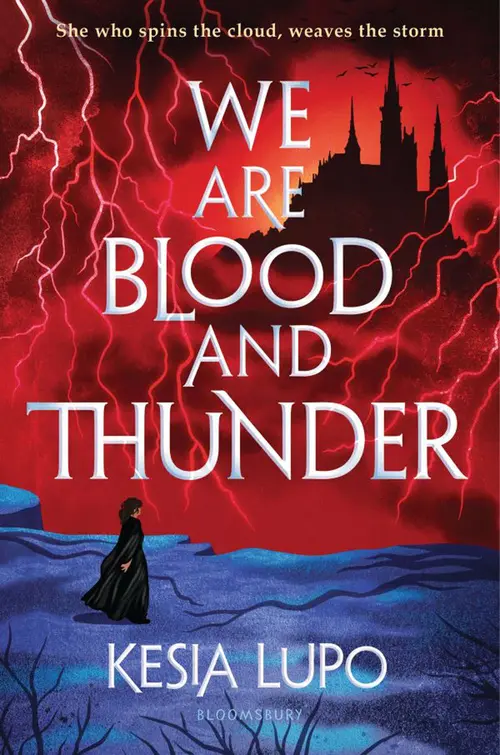
We Are Blood and Thunder
To Jeff
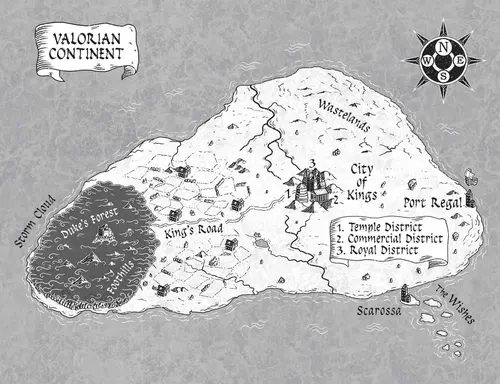
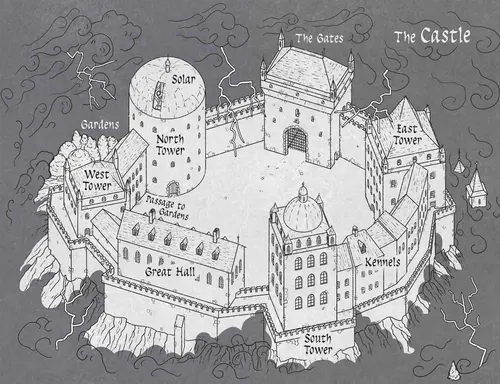
In the Year of Kings 554, the mountain city-state of Duke’s Forest was beset by a mysterious vapor. It started out as little more than a few wisps of gray cloud, emanating bafflingly from the earth of the lower town, ruining the townsfolk’s garden crops. But gradually, month by month, it grew—vapor became mist, and mist became fog, and the fog, eventually, became a storm cloud.
Inside the cloud, a traveler could expect to encounter flashes of light and rumbling noises, sudden gusts and squalls of thin, poisonous rain that stung bare skin. And sometimes, like the eye of a storm, the cloud appeared to sleep—as still and immutable as the mountain itself.
In the first two years, trade was crippled, domestic animals sickened, the rose gardens of the upper town were ruined—yet the cloud, insatiable, crept uphill toward the castle at the mountain’s summit. By the start of the third year, the mountain was swallowed up entirely … and that’s when the Pestilence came.
At the start of the fourth year, the Duke shut and chained the city gates, declaring a state of quarantine. After six years, the people of Duke’s Forest, ravaged by disease, cut off from the outside world, and shrouded from the sky, had sunk into isolation and despair.
Duke’s Forest: A History
PROLOGUE
A Cryptling
Before the storm cloud
Lena swept the last of the dust into her sack and stood up tall, wiping a grimy hand across her forehead. Her brass lantern flickered across the crypt’s rough-hewn walls as Hunter slunk past, a twitching rat hanging from his jaws. He dropped it and purred at her, before savaging the poor creature’s torso. The largest mouser prowling the crypts, Hunter was vicious, ginger, and apparently immortal. For the hundredth time, Lena wondered why he’d picked her bed in which to sleep, leaving dubious gifts of rodents and birds at its foot.
Lena tied the dust sack shut and hoisted it over her shoulder, casting one last look at the empty, fresh-polished sarcophagus where the body would be laid in the morning for its last rites, the Descent. Her stomach twisted, and she swallowed hard as bile rose in her throat. Earlier in the afternoon, she’d been allowed to watch while Mortician Vigo prepared the body in one of the special rooms beneath the gardens. She had managed—but only by digging her nails hard into her palms—to stop herself from fainting.
The dead man’s Ancestors lay all around, stretching into darkness. Now attuned to the scent of the morticians’ special preserving ointments, Lena picked out sharp herbal smells beneath the ever-present musk of her world. The tomb itself was relatively small, and while noble families had the luxury of individual sarcophagi, the stonemason’s family—like most others—had cut long, body-shaped niches into the walls, one over another, or shared two bodies to a resting place. Husband with wife. Sister with brother. Baby with mother.
Each body’s empty eye sockets had been sewn open, their eyes replaced with smooth rocks painted as eyes, or sometimes glittering gemstones. Mortician Vigo said that the Ancestors were sleeping, but Lena didn’t think so. They were staring at the ceiling, at the floors of the living world above. Waiting.
Waiting for what?
A chill ran down her spine. She touched her forehead, lips, and heart in the old sign of reverence. When she’d been very little, the Ancestors had frightened her—she’d had nightmares about the staring stone eyes, about the way the older corpses’ flesh and skin were shrunken and leathery but their hair as thick and lustrous as the day of death. How, from certain angles, even the oldest of the Ancestors looked like living people lying in the dark. But now she was eleven, almost a grown-up, and she wasn’t afraid of anything.
Hunter mewed, and Lena nearly jumped out of her skin. I’m not afraid of anything, she reminded herself firmly, calming her racing heart.
“All right—let’s go,” she whispered to the cat, after a deep breath. “It’s a long walk back.”
She tried not to hurry as she started down the passages under the upper town, leading to the network of small cellars beneath the castle that the cryptlings called home. You weren’t meant to hurry—it wasn’t respectful, Mortician Vigo said. Hunter weaved through her legs, in and out of the lantern light, very nearly tripping her up.
For a time, everything was quiet and ordinary, the only sounds the occasional scuttle of a rat, or the snap of one of the mousetraps Lena had set out on her way down—the cryptlings and the cats were supposed to keep the vermin at bay. But as she drew farther through the cobwebbed passages, she started to hear something strange … a voice. It grew louder gradually: a low, rhythmic murmur, drifting from somewhere up ahead.
Lena frowned and stopped. Who else might be down here in the dead of night? As far as she knew, the stonemason’s was the only funeral tomorrow, and she was the only cryptling on duty. No one else was allowed down here.
Suddenly she was frightened. She flicked off her lantern and stood in the dark for a few moments. She didn’t like the thought of being seen—didn’t like the way people’s eyes settled on her, on the black mark on her cheek. She felt Hunter slide past her legs, hurrying ahead impatiently, as she stood listening in the quiet. The voice carried on—distant and musical. A sad song, perhaps … or a poem. But Lena couldn’t make out the words. She wondered if they were in another language.
She continued down the familiar passages in darkness, trailing her fingers along the wall, her feet silent in the padded canvas slippers they had to wear in the crypts. The voice grew closer, louder, as she neared the passages she knew were directly beneath the castle itself, where the noble Ancestors and their households were interred. But she saw nothing—and after a time, the voice stopped.
Her heart beat faster. Somehow the silence and darkness were more unnerving now that she knew someone, somewhere, was sharing them with her. And that’s when she saw it: the flicker of light. She clutched tightly the iron handle of her lantern and her dust sack, half convincing herself to run. Cold sweat broke out across the back of her neck.
At first, she wondered if it was a trick of her eyes in the dark—she’d known it to happen before, green-purple shapes blooming like strange flowers, disappearing, and re-forming at a blink. But this was real, she saw, as it grew closer—a clumsy, winding speck of light, fluttering on and off, bright, then dim. A … butterfly?
She watched, her heart hammering. She’d never felt so terribly alert, every sense sharp, nearly painful.
The creature was made of metal—filigree wings, a smooth brass body. It landed on the edge of a sarcophagus nearby, its wings gently rising and falling, rising and falling, like the breath of a tiny animal.
It was beautiful.
Lena set down her things and stepped closer. The light emanating from the creature’s body was flickering, like a sputtering candle. She reached out to touch it … but hesitated, fingers outstretched.
All the rules Vigo had ever told her ran through her mind at once, like a flock of startled birds. Don’t reveal your face aboveground. Don’t touch anybody, especially anybody who’s not a cryptling. Don’t touch the Ancestors, except as your duties demand. Don’t touch the grave goods. Don’t touch anything. To other people, Lena, you are dirty. Everything you touch is sullied.
And yet … she’d never seen anything so beautiful. Lena stopped thinking. She reached out and cupped the butterfly in her hands. She felt its delicate legs like feathers on her palms. It was incredibly light and made a faint whirring sound like a watch as its wings fluttered weakly.
Suddenly its little light extinguished and the crypt was plunged into darkness. Lena shivered. The creature was silent and still, the slight warmth quickly fading from its body, as if it had never been.
Is it broken?
She waited a few moments more, her heart in her mouth. Somewhere she could hear hurried footsteps, a voice calling—but if they were searching for the butterfly, they were moving in the wrong direction, some way off to her left. Lena opened her palms and ran her fingers along the butterfly’s body. Its wings were fully outstretched, and she liked the feel of the filigree patterns against her fingertips. It was strangely soothing.
But the butterfly didn’t belong to her. She should drop it here and go home.
Even though her mind had decided, her body didn’t move. She shouldn’t take it, should she? She couldn’t. If anyone found out she had removed anything from the crypts, she’d be in trouble. Even if she hadn’t found it on a body, it was still grave goods. Who would believe her when she said it had been flying toward her, as if it had chosen her, as if it had wanted her to take it?
Somehow it didn’t matter: the determination was already hardening in her heart. She wasn’t allowed to have things of her own: even her clothes were shared hand-me-downs, her soft shoes worn thin by other cryptlings’ feet. And aboveground, she knew, the un-Marked children of the upper town had rooms filled with toys and trinkets—and even clothes that only they had worn. Except for the dark birthmark on her cheek, she wasn’t any different from them. So why shouldn’t she have the butterfly? She felt her breath quicken. It was only one thing. Such a small thing. She’d keep it secret, of course. She’d never tell a soul. It would be something hers and hers alone—her only possession. Was that so much to ask?
Lena slipped the metal creature into the inside pocket of her habit, picked up her lantern and sack, and continued on through the tunnels.
ONE
The Hounds
Sixth year of the storm cloud
Lena ran until her lungs felt close to bursting, her feet thumping, sliding on the steep cobblestone road, down the peak of the city toward the walls and the forest beyond.
The Justice’s words rang loud in her ears.
You have been found guilty of magecraft.
The storm cloud was all-encompassing, a thick, poisonous gauze clinging to her clothes, obscuring her path.
I sentence you to die.
Islands of muffled light trembled in the gloom—a lit window here, a patch of fading sunlight there. Her feet thumped into grayness, invisible.
The hounds will eat your flesh.
She could hear them—howling, growling. Had they finished off Vigo? Or had they grown tired of his old body, and were they now lusting after hers? He’d bought her time, but it was all for nothing. Tears stung her eyes as she pushed herself faster.
Your bones will lie bare under the sky, banished from the sacred crypts.
She could never outrun them. Nobody could. At seventeen, she would be far from the youngest to fall under the hounds’ vicious teeth; you only had to see the chewed-up remains at the foot of the city walls to know that. But there was a chance—just a chance. She had to try.
Your soul will never join the Ancestors, will never feast on the glories of ages past, will never guide the fates.
Lena found herself down in the lowest tier of the city. The fog was thicker here. She stumbled to a halt, suddenly unable to breathe, a crushing pain in her side. Pulling up the neck of her habit to cover her mouth and nose, she felt tears welling behind the glass of her shield-eyes.
You will be dead, in this world and the next.
A howl broke the gloom, then a chorus of howls, swiftly followed by frenzied barking; the hounds were gaining. No time to cry. She turned and ran, harder than ever, hobnailed boots clacking against the pavement.
Soon the city walls loomed above, and a small bone crunched under her foot. She felt sick, but pressed on around the curve of the wall, desperately scanning the base where the dark stone met the bone-littered ground. The gates had been locked for two years, bolted with broad beams of oak, ivy grown over the rusted locks—but nearby … Vigo had told her…
Lena scanned the rotted undergrowth for the outline of the old rosebush—and found it, her heart no more than a hollow, fluttering thing in the back of her throat. She could so easily have missed it altogether, a tangle of bare thorns almost lost among the skeletal remains of its neighbors. Parting the branches with her thick leather gloves, she spotted a slight dip in the earth. So small.
I used it as a child, he’d said, in the few moments they’d had together before the hounds. I would slip out into the forest to play when I was supposed to be at my lessons. It was before my … deformity.
She’d shaken her head wordlessly, clutching at his old arthritic hands, the hands that had first picked her up from the steps down to the cryptling cellars when she was a baby, wailing into the dawn. She’d been crying again then.
Lena, I cannot run. But you might just be fast and small enough to escape.
It was her only chance.
Lena threw herself to the ground as the howls behind her grew in intensity—along with the clink and scratch of claws on the cobblestones. She pressed herself under the bush, the old thorny stems snagging at her habit and showering her with rot, and scrabbled into the musty darkness beneath the wall. Curling her fingers as best she could into the damp soil, Lena pulled herself forward, wriggling until her feet were almost concealed under the rosebush, the weight of the great thick wall, dark and cold and ancient, bearing down over her head.
The gap was tight, her lungs constricting as she forced her shoulders farther, her arms outstretched. She thought she could feel a wisp of air from the other side—but it was then that a bark came from close quarters, followed by a frenzy of growls, a snapping of teeth. Something closed around the tough leather heel of her boot; a surprising strength pulled her backward. Panic fueled her. Reaching up, she gripped the wall’s slick underside with clawed hands. Her shield-eyes snagged on a root, the leather strap snapping. She let them fall, kicked out hard, and redoubled her efforts, squirming frantically under the wall until she could see the light filtering through the other side. She squeezed her shoulders forward and, with more difficulty, her hips, ripping the coarse material of her habit. By this time, she had begun to sob—but somehow she forced her way out.
Lena staggered to her feet, half falling into the forest. Her heart plummeted as she absorbed the sight confronting her. The forest was a picture of decay, the trees visibly withering. A gray residue veiled their bark and occasionally bumped outward in a strange fungus. The storm cloud was as thick as it was within the walls of the city, flashing and rumbling between the trees. She thought of her shield-eyes, fallen under the wall—but where she had crawled, the hounds could surely follow; she couldn’t risk retrieving them. She ran instead, stumbling over roots, slipping on wet leaves. Here and there, a rotted trunk had fallen across the path, or a branch half snapped from a larger tree threatened her head.
Gradually, the howls and barks faded altogether, but it was a long time before Lena allowed herself to be certain she had not been followed—perhaps the dogs, penned for so long within the city walls, had been spooked by the alien scents and noises of the forest. Or perhaps the houndmaster had assumed her dead and called them off, or perhaps he’d feared losing them forever among the trees, as so many travelers had been lost before. In any case, she was painfully grateful. She slowed down, rubbed her stinging eyes, and caught her breath. She rested her hands on her knees for a moment, her heartbeat slowing—and then she reached for the brass butterfly she kept in the pocket of her robe. It was as big as the palm of her hand, warm from her body. Tracing the delicate filigree of its wings, she felt her breathing slow.
Whenever she held the butterfly, she remembered how she had felt the night she’d found it—or rather, the night it had found her. She had felt wanted. Calm. Secure in the knowledge that she was worth something, because she had something of worth.
Out of the corner of her eye she saw a shape—a human shape, hunched at the foot of a tree. Her stomach convulsed and she ducked behind a rotten tangle of undergrowth, pressing her hand against her mouth to stifle a rising scream. But the figure didn’t appear to have noticed her. The cloud shifted, alternately revealing and concealing a long cloak, brown boots, large leather gloves. So still, so quiet, his hooded head resting on his chest. Sleeping? But she saw no movement, not a twitch, no rise and fall of breath. Slowly, Lena realized the man was dead.
She slipped the butterfly into her pocket, stood up, and walked toward him, her whole body still trembling—but gradually calming as she approached the corpse. She wasn’t afraid of the dead—not unless they … She shook her head, not wanting to think about it. No, it was the living who frightened her.
She crouched, examined a blade dropped near the body glinting in the faint evening light filtering through cloud and trees. It was a short dagger, the hilt twined with a dragon motif in silver, its eye set with a green gem. Hardly thinking, she picked it up, slid it carefully into her belt. As she moved on, she realized the man had been resting at the edge of a small clearing. And she saw another body. A woman, her back turned to Lena, marked by her perfectly preserved, long red hair, splayed in the mud. And another—a man curled up under his cloak by the blackened remains of a fire. Without meaning to, she glimpsed his face, decayed and ghastly.
These bodies had been here for a long time. Had they been trying to reach the city? They were strangers, surely. What had killed them?
She didn’t want to wait to find out.
She returned to the narrow path and carried on at a stumbling run.
After a time, it grew so late that she could barely distinguish the trees from the darknesses in between—but soon she began to see other things, shapes in the fog twisting into suggestions of hands, eyes, mouths. She blinked, rubbing her face and cursing the loss of her shield-eyes. No one in Duke’s Forest would step outside with their eyes unprotected—the toxic storm cloud caused visions if they were exposed for too long. Every now and then, larger shapes loomed from between the trees, and she could not prevent herself from starting backward before they dissipated, even though she knew they weren’t real.
She imagined the strangers’ bodies in the clearing moving, rising up, following her. Don’t. Think. But despite her stern thoughts, and the exhaustion screaming at her to stop, she quickened her pace.
Eventually, Lena could continue no longer. Her legs gave out, and she felt her fingers burrow into the mossy mulch of the forest floor. The hallucinations were worsening. She knew she was vulnerable out here—to real threats—if she wasn’t able to run. She remembered Vigo’s tales of the giant snakes and wild boar that infested the wood and screwed her eyes shut against a wave of terror. She took a deep breath. She needed her wits now more than ever.
But the forest stretched in all directions, and she had long lost the road—how would she escape? And even if she were to find her way out, what fate could a girl like her expect in the wider world? She felt for the birthmark on her cheek, several shades darker than the brown of her skin. Even the people of Duke’s Forest had regarded cryptlings—marked out by their various deformities—with a mixture of disgust and begrudging respect for their duties. Vigo had said the gods were cruel, their followers toying with dangerous magic. What would they make of her? What did they do to Marked people outside Duke’s Forest?
Would they try to execute her too?
Lena felt a sickly chill spread from her throat to her stomach as she considered the most terrible possibility of all: What if the storm cloud had swallowed everything, leaving the city of Duke’s Forest the lonely center of the universe? What if those people had been trying to reach Duke’s Forest to save themselves?
The Story Continues on BooksBarbecue!
Enjoyed this preview? ❤️ Do not stop here!
Read the complete book free online → 🔗
Continue reading now on BooksBarbecue and discover every page!
Love reading? Bookmark BooksBarbecue.com for more amazing books!
Happy Reading!