Ward
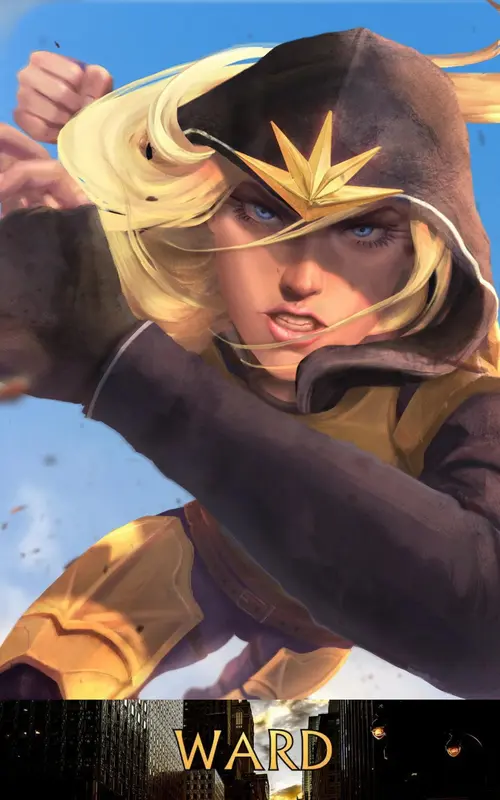
Daybreak 1.1
It was a second chance for humanity as a whole, and they’d gone and screwed it up from the start by coloring the city gold, of all colors.
The skyline was a half-and-half mix of skyscrapers and buildings in progress. The latter were skeletons of tall buildings in the process of being filled in and put together, and hazard signs, tarps, the materials that made up the countless cranes and the painted letters on steel girders were all in bright yellows. The completed skyscrapers were paneled with mirrored or reflective glass that were tinted in that same hue. All put together, the light that bounced off of the city and reached skyward gave the clouds linings that were gold, not silver.
It was such a fucking shame that it had to be the case, intentional or not.
My phone was buzzing with texts. I pulled it from my skirt pocket and looked while I walked.
Parental Unit 1:
BBQ tonight with everyone
My house
Can you come?
I glanced around to make sure I wasn’t going to walk into anyone, then stepped off the sidewalk, into a gap between two display windows that bowed out and forward. In front of me, an assortment of people walked. People in business clothes walked briskly, while some elderly people meandered. A whole herd of kids were hurrying off to school.
I typed out my reply.
Me:
That’s short notice
Parental Unit 1:
Michael is swinging by
There has been talk of everyone getting together.
It seemed worth trying to arrange
If you can’t come that’s okay I understand
Me:
If I didn’t come, would be because of work. New semester & lots to do. Might come very late
Parental Unit 1:
Spur of moment thing that is almost pulled together
Only missing you
Not to guilt you ha ha
Ha ha. She never liked using shorthand like ‘lol’.
No. No guilt at all, Mom.
Parental Unit 1:
Come if you can
Will save you dessert just in case
My typed reply was interrupted by a crash. The stride of every person on the sidewalk in front of me and every person on the other side of the street was interrupted, as they stopped, heads turning.
I put the phone away, the message half finished. The impact had been at the nearest intersection, where a smaller road cut through one of the downtown areas. I had to push through the bystanders closest to the scene to get there, and I could hear the victim’s wail of distress before I was halfway through.
A car accident. There were no injuries, and I couldn’t see blood. Nothing suggested that anyone had died. Not that anyone would have guessed by the sounds the man was making.
A teenager stood outside her car, the front corner and passenger-side mirror trashed. She’d hit one of the pillars that lined the street.
An older man was doubled over, but he was on the far side of the pillar, not a location that suggested he could have been hit. He was elderly, with gray hair that still had color in it. Two people had already drawn close to him, supporting him while he knelt, rocking slightly in place. The sound he made was the heartbroken, strained sound that people made when they couldn’t even draw in a full breath.
Such shitty, shitty bad luck, that he’d been here when the collision happened.
‘Pillar’ was the wrong word, but the right word felt wrong. ‘Monument’ implied something huge, but it was barely taller than I was, maybe three feet across at the base, tapering to two feet across at the top. Plaques were recessed into three of the four faces—the fourth had come free and fallen after the collision. Each plaque bore an etching of a face, a name, a date of birth, a date of death, a message.
I looked down the length of the one-lane road. There were as many pillars as there were trees, and there were a lot of trees, enough that the sunlight that peeked past them was dappled. This pillar was one of what had to be over a thousand that had been set throughout the city by now, punctuating quaint streets and surrounding parks. Places that were nice.
They were part of an initiative by an independent cape, a hero turned rogue, helping out.
There could easily be a thousand more of these pillars before the year was over, that number repeated every year thereafter, and if that work continued for another fifty or a hundred years, there wouldn’t be a pillar for one percent of the people we’d lost. Not even if ‘we’ were just the people who hailed from the northeastern U.S.
The girl who’d been driving the car had a thousand-yard stare as she faced down the small crowd. She looked like she’d just hit a real person and reality was sinking in.
The wailing stopped. People were consoling the old man, some shooting hard looks at the girl who didn’t seem to be registering much of anything.
“Hey,” I called out.
She didn’t seem to register that I was talking to her, as she stared at the lower portion of the pillar that had crumbled, stone chunks broken away, cracks webbing across the surface.
“Are you okay?” I asked her.
She nodded, said, “I’m so sorry.”
The old man looked up at her.
People in the crowd were staring, apparently angry on the old man’s behalf. One hapless teenager and thirty or forty very upset people.
“Listen,” I told her. “Stay close by, okay? I’m sure someone in the crowd there is calling for help—”
Someone in the crowd raised a hand to get my attention. They had a phone to their ear.
“—They’re calling for help. They’ll be here shortly. Don’t go anywhere, you can explain what happened, alright?”
That seemed to get through to her. She nodded again, retreating to her car, apparently to sit in the front seat. Good. That was handled.
Until she stopped at the door, turned around, and addressed the old man and the crowd, “I’m really goddamn sorry I broke your thing.”
The grieving man rose to his feet, stepping forward at the same time. He pulled away from the supporting hands of the people around him, his face contorting.
I stepped in his way, my arm out. He pushed forward, and I caught him in a half-hug with one arm, stopping him. He reached out and tried to push me aside, and I caught his arm.
He was a guy, but he was an elderly guy. It wasn’t much of a contest. The moment he met resistance, he sagged, and I did what I could to keep him from outright collapsing as he slowly sank to his knees again, sobbing openly.
I took the opportunity to turn him a fraction so he wouldn’t be looking at the girl or the pillar as he knelt there.
In the background, that girl seemed to flounder in shock, useless, not sure what to do with herself in the face of this moment of violent grief. She looked at me, but I didn’t want to say anything that might agitate the man I was dealing with. She looked to the crowd, and she saw only angry stares.
I wasn’t sure what she’d seen, if it was a motion from someone, a particular emotion on a particular face, but she found the reason to get moving again, getting into the car, slamming the door behind her. The man I was holding jumped at the sound.
The man stopped resisting altogether. It had been a fast enough change in attitude that I had to wonder at what he would have done if I hadn’t intervened. Shouted in her face? Grabbed her? Would he have lashed out and struck the girl? If he would’ve gone so far as to use violence, would it have been relentless, requiring people to pull him off, or would he have stopped the moment he was interrupted?
I gradually relaxed my hold on him.
The crowd, too, seemed to realize that the situation had mostly de-escalated. The girl was in her car, the old man wasn’t an apparent danger to himself or others so long as I was here. That was enough for the assembled group to start breaking up.
I stepped back, hands partially raised in case he started forward again, and to enable me to act if he seemed like he might fall. I couldn’t just say the pillar would get fixed, or that things would be okay. The old man hadn’t shed tears for the pillar.
I didn’t want to say ‘sorry’, and echo the kid in the car.
I almost asked if there was anyone I could call. I stopped myself when I realized the answer could be no.
“How about we get away from here?” I asked, keeping my voice soft. “We can go grab a coffee or tea, and you and I can talk.”
The man looked at me, as if just now realizing there was a person right next to him.
“It’s got to be better than violence,” I said.
“I don’t—I’m not violent,” he said, sounding very small.
The heads of the crowd turned in reaction to something outside my field of view, and the old man’s head turned as well.
Behind me, it seemed. A man in costume. It was a good outfit, too, more in the dollars that had been put into it than in terms of looks, but that was personal opinion. Partial discs of metal seemed to intersect his body, forming a look where he looked like a blender caught mid-whirl, axe blades and metal rings jutting from his breastplate, armguards, leg armor, and even his face, with blades running along one brow and cheekbone to frame one eye.
There were heavier blades at his hands and feet, such that it looked like he shouldn’t be able to walk or even stand without difficulty. As it was, he had one end of his long-handled axe resting on the ground, the length of it bowing beneath his weight as he perched on it, one arm outstretched to one side, hand gripping the head. He was crouching on the thing while it rested at a diagonal, in a way that looked like he’d wipe out if the end of the weapon lost traction on the roadtop.
Fuck me. Not what we needed right now.
The old man started to stand. I helped him.
“Can I do anything to help?” he asked.
“I don’t think so,” I said. “Minor accident, we’re just waiting for cops to come and assess things, take numbers.”
I was barely done speaking when someone in the crowd said, “We don’t need you.”
I watched him glance over the small crowd, looking for the person who had spoken. He kept looking out for the speaker as he told us, “There’s some police on their way. With all the reconstruction and the lower priority, they’re trying to get through the traffic right now.”
“That’s good to know,” I said. “Thank you.”
He nodded. He looked deeply disturbed by the one comment he’d heard. I caught a glimpse of the emblem on his sleeve. A badge, not a personal symbol or icon, but part of the team he belonged to. Advance Guard. They were a team with an agenda to push. The world had ended, and they were pushing hard for a better and different tomorrow.
I could respect that.
I could also cringe inwardly at the fact that our superhero here was implicitly sporting a ‘move forward’ ideology when that was the last thing this old man probably wanted to hear with a freshly reopened emotional wound. Time and place. Unfortunately, because of the team emblem the cape had on his breast—a stylized figure holding a shield shaped like a greater-than symbol, the guy represented that ideology every time, in every place.
He walked over to the car, still watching the crowd, and he exchanged a few words with the girl in the driver’s seat. I was glad for that, at least. I had my hands full with the old guy and nobody else was stepping up to do it.
The cape stepped away from the car, looked at me and the old man. “He’s okay?”
“The pillar. It’s for his—” I started, looking at the plate on the pillar for a clue.
“Son. My son,” the man said.
“My condolences,” the hero said.
The man tensed. They were words that made it worse, not better, somehow.
“Go,” someone in the crowd said. A different person than the last. “We’re fine.”
The people that had been splintering away were holding position now. I could see the hostility. The summer heat was holding out through the start of September, making things just a little more uncomfortable, tempers a little shorter.
“Yeah,” the hero said, more to himself.
It put me in mind of a scene from the history books and the grainy old news footage of an event from the mid-80s. Back in the day, when the superheroes could be counted on the fingers of both hands, there had been a riot over a sports match. The anger and chaos had outweighed the respect the rioters had for the hero that had stepped in. Someone had struck out with a blunt object and hit the hero. He’d died before he reached the hospital. We’d called him the second cape after Scion, but he might well have been the first, after all.
Did I think that would happen here? No. Too small a group, the emotions were different, there wasn’t enough chaos.
Still, the general setpieces were here. The barely restrained emotion. The lack of care. The ill-timed intervention of the man in costume. The lack of respect in particular was in play. For Vikare, it had been because so many people hadn’t truly believed the powers were real, and he had apparently held back to avoid scaring people.
For this cape from Advance Guard, it was the opposite. He’d gone all out, we’d gone all out. Capes still hadn’t been able to stop the world from ending.
We were back at the beginning in so many ways.
“Yeah,” the hero said again. He seemed to wrestle with what he was going to say next before deciding on, “I’m going to go.”
I wanted there to be people in the crowd who spoke up. I wanted there to be other things besides this sentiment of hostility and rejection. For this guy and for all the rest of us. Were there any people who wanted to say something positive?
Nobody. Or if there was anyone, they were afraid to speak out against the herd. I didn’t want to leave it like this.
“Nice response time,” I said.
He turned my way and raised an eyebrow.
“You showed up quick. It was impressive.”
He nodded, studying me as if trying to find the catch. “It’s what I do.”
I wanted to say something more, but I didn’t want to push my luck. It would have been nice if he’d been less dismissive when I was throwing him a bone.
“Take care,” he said. “Cops are on their way. I’ll go let them know what’s up.”
“Thanks,” I said. “You take care too.”
He stepped down from the pole of his battleaxe and set foot on the road. Pavement splashed as if he’d stepped in a puddle. More splashed and rippled as he moved his axe in a circle around him.
When he took a step and moved, it was faster than I could track. I could see the splash that followed behind, a cresting wave that quickly settled, leaving only a faint wavy pattern in the road as it dissipated.
I’d spoken against the herd. I tried not to pay too much attention to them or give them any excuse to push back against me, instead turning my attention to the old man.
“I’m offering tea or coffee, my treat. We can talk it out, or talk about something else entirely,” I told him. “As soon as the police are done.”
He still looked like he was carrying that fresh pain, in expression and posture. He flinched some as he looked at his son’s memorial pillar. He gave the girl in the car a hard look, then seemed to let the anger out, sagging.
She was in the driver’s seat, both hands and forehead on the wheel.
“No,” he said. “You’ll have some place to be. I shouldn’t keep you more than I have. I’ll be fine.”
“Work,” I said. “They wouldn’t fire me, especially if I explained. I’d get in trouble, maybe, but I wouldn’t mind much. Job is… a seven out of ten fit.”
“Seventy percent is a lot better than some are getting,” the man said. “Keep that job. I’ll manage now.”
I glanced at the girl in the car. She had barely moved.
“You’ll leave her alone?” I asked.
The old man heaved out a sigh.
“She’s a kid who made a stupid mistake,” I said, in case he was trying to come to a decision. “You don’t have to forgive her, but you can’t go and hurt her or anything.”
“I wouldn’t have…” he said, and he didn’t finish the sentence. Because he might have, or because he didn’t know what he wouldn’t have done.
“Yeah,” I said. “That’s good.”
“Go. Work. Don’t let me keep you,” he said. “I’ll be straight with the police there.”
“I’ll stick around for the cops and then duck out.”
The police cars had appeared at the edge of the block, but with traffic on the narrow road slowed by the girl’s car, they’d stopped there. The cars couldn’t progress, but the police were getting out.
One officer went to talk to the girl, another to the old man. I waited around a minute, then gave a statement and my info.
As in most things having to do with law or bureaucracy, it took longer than it should have, for a relatively simple process. I hurried to the high school once they were done with me, and I arrived rather late.
High school.
We still weren’t at the point where we had nice lawns and yards. This schoolyard was no exception. We had grass and fields, yes, but it was coarse and the ground beneath wasn’t usually landscaped. The area was large with large trees left untouched in the corners, chain link fence separating the field from the roads on two sides, the grade school formed the third boundary to the west, and the high school formed the fourth boundary to the north. The ground was uneven, more hilly than flat, and there were still large stones here and there, and a seemingly out of place play structure for the grade schoolers.
It was an odd thing. So often, nature was transplanted into a city, and it was new and inauthentic, made overly neat. Trees, lawns, flowers. Here, the nature was rough and unpolished, the city itself new and somewhat artificial in how overly tidy it was, untouched by time or elements.
A sports field in the middle section separated the grade schoolers’ area from the theater. It was a stage in the old Roman style, slabs of stone set into the ground like stairs, stepping down as they got closer to the stage, where the platform sat.
Hundreds of students had gathered on the stone seats, and more stood around the top edge of the theater, watching and listening. They were our survivors, our next generation. Not so different from the crowd I’d had to deflect earlier. A third of them still wore the very simple clothes that were handed out with supplies in the tent cities. Some had even taken to strategically ripping and dressing up those clothes. I didn’t fault them for it. It was hot.
A speaker carried the voice to those of us on the top edge.
The teachers of the school were on the stage, but they weren’t speaking. It was a series of community leaders and volunteers instead.
“…And I make that a guarantee to you,” a man in an orange vest was saying. “If you take those credentials, bring good shoes and work clothes, and if you don’t screw around, you can walk into any lot and you can be working within the hour and get your pay by that day’s end. Good pay. You can do whatever you want, after school, but you’ll always have this as a fallback, you’ll have the security of being able to walk into a lot and have a job waiting for you. We can always use more hands.”
Not enough seats at this school either. High school was and might well continue to be a half-day thing. The people on the stage were telling the kids their other options for the other half of the day.
I spotted Gilpatrick on the stage. He wore a black t-shirt and gray pants with boots, and in the summer heat he was sweating a fair amount. He had no hair on his head, but he had a five o’clock shadow well before five o’clock, bushy eyebrows and thick hair on thick forearms. Everyone else looked like they were trying to make their best pitch, in dressing nice and wearing smiles. Gilpatrick looked like he was trying to scare his prospects away.
Some of the non-prospects were standing around the upper edge, looking down at the new students and the stage. Most were senior students who’d picked what they’d do with their half-days last year, now waiting to induct the others. Some were siblings of those seniors, or younger friends. Others were like me, miscellaneous staff for miscellaneous roles.
I joined them.
“We wondered if you’d bailed,” Jasper said. He was very much a teenager, with acne, thin chin-hair and black hair that had had product in it, that had turned spiky from sweat.
“Delayed by a car accident.”
“Everyone’s okay?” he asked.
“Yep.” Insofar as anyone is okay. “Has Gil done his five pounds of gun thing? I was kind of looking forward to it, it’s so corny.”
“I think he’s saving it for the deeper explanation later. He mostly talked about how he was going to make it his objective to make people quit, he isn’t going to pay anyone, job prospects suck, he’s going to make people march in the heat and the cold for miles while carrying unreasonable burdens. The ‘five pounds’ speech isn’t bad, you know. It gets through to the kids,” Jasper said. For all that he was defending the speech, he smirked a bit.
The Story Continues on BooksBarbecue!
Enjoyed this preview? ❤️ Do not stop here!
Read the complete book free online → 🔗
Continue reading now on BooksBarbecue and discover every page!
Love reading? Bookmark BooksBarbecue.com for more amazing books!
Happy Reading!