Chapters (36)
- Title Page
- Chapter One. Sandra and Bose
- Chapter Two. Turk Findley’s Story
- Chapter Three. Sandra and Bose
- Chapter Four. Treya’s Story / Allison’s Story
- Chapter Five. Sandra and Bose
- Chapter Six. Turk Findley’s Story
- Chapter Seven. Sandra and Bose
- Chapter Eight. Allison’s Story
- Chapter Nine. Sandra and Bose
- Chapter Ten. Turk’s Story
- Chapter Eleven. Sandra and Bose
- Chapter Twelve. Turk’s Story
- Chapter Thirteen. Sandra and Bose
- Chapter Fourteen. Turk’s Story
- Chapter Fifteen. Sandra and Bose
- Chapter Sixteen. Turk’s Story
- Chapter Seventeen. Sandra and Bose
- Chapter Eighteen. Allison’s Story
- Chapter Nineteen. Sandra and Bose
- Chapter Twenty. Turk’s Story
- Chapter Twenty-One. Sandra and Bose
- Chapter Twenty-Two. Allison’s Story
- Chapter Twenty-Three. Sandra and Bose
- Chapter Twenty-Four. Turk’s Story
- Chapter Twenty-Five. Sandra and Bose
- Chapter Twenty-Six. Allison’s Story
- Chapter Twenty-Seven. Sandra and Bose
- Chapter Twenty-Eight. Allison’s Story
- Chapter Twenty-Nine. Sandra and Bose
- Chapter Thirty. Turk’s Story
- Chapter Thirty-One. Sandra
- Chapter Thirty-Two. Isaac’s Story / Orrin’s Story / The Sum of All Paths
- Acknowledgments
- By Robert Charles Wilson from Tom Doherty Associates
- Copyright
A trace of a smile returned to his face, but it was bitter. “If I can’t leave, I might be able to hide. I’ve been trying to create a protected space inside the Network. Not for my body but for my self. I mean to try. But the Hypotheticals are very powerful. And the Coryphaeus … the Coryphaeus is insane.”
* * *
The Coryphaeus is insane.
As Treya I hadn’t given the Coryphaeus much thought. Few of us did. The Coryphaeus was an abstraction, a name for the processors that quietly and invisibly mediated between Network and node. Our teachers had shown us a diagram to explain it:
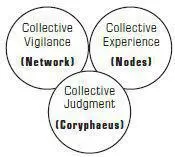
—and that was as much as we had ever wanted or needed to know. The system was stable, self-protecting, self-perpetuating, and it had worked flawlessly for five centuries. What could it mean, then, to say that the Coryphaeus had gone mad?
The problem was the Voxish prophecies. Our founders had written them into the Coryphaeus as unalterable axioms—embedded truths, permanently exempt from debate or revision. That hadn’t mattered when the rapture of the Hypotheticals was a distant goal toward which we moved in gradual increments. But now we had come to the blunt end of the question. Prophecy had collided with reality, and the obvious inference—that the prophecies might have been mistaken—was a possibility the Coryphaeus was forbidden to consider.
That conflict was being played out in the surveillance and infrastructure systems that bound together our lives and our technology; it was being played out in the limbic interfaces and private emotions of everyone who wore a node. “What makes it especially dangerous,” Isaac said, “is that we can’t predict the result. The most likely outcome is an asymptotic trend toward self-destructive behavior in both the organic and inanimate aspects of the system.” He added, “It’s already happening … more quickly than I anticipated.”
I asked him what he meant, then wished I hadn’t.
“The end of Vox is days away. That means there’s no need for a surplus food supply. Or surplus people, if they’re not a willing part of the process.” He looked away, as if he couldn’t bear to meet our eyes. “The Coryphaeus is killing the last of the Farmers.”
* * *
I refused to believe it until I had seen evidence. As soon as Isaac left I rode vertical transit to one of the high towers and found a panoramic window. It was night, but the sky was unusually clear and the moon was bright on the northern horizon.
The Farmers had lived in the hollow spaces under the outlying islands of the Vox archipelago. They had numbered about thirty thousand souls before the rebellion—fewer, but at least half that many, after.
Now: none.
The out-islands were sinking. The Coryphaeus had cut them loose from the central island and opened their ancient accessways to the sea.