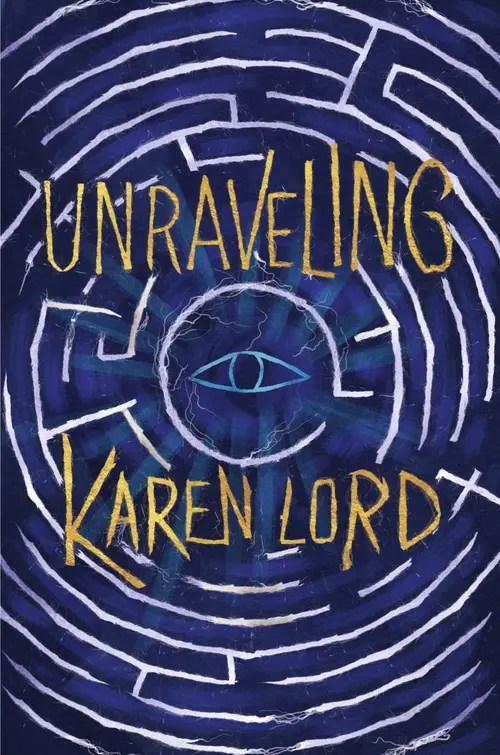
Unraveling
Cover
Dedication
For all who seek redemption.
BOOK I

NIGHTMARE

CHAPTER ONE
A chorus of tree frogs trilled in the damp, velvet darkness, wide awake and relentless as they spoke their authority over the nocturnal world. The village of Makendha slowly marked the hours to midnight with a quieting of laughter and argument, a dimming and darkening, and a staccato punctuation of ending sounds—the shutting of doors, the dropping of shoes, and the weighty hush of a house empty of talk but filled with dreaming.
One house kept vigil with a single glowing window. Behind the curtains of pale ivory gauze, gilded by the light of an oil lamp, an age-old scene was unfolding: a mother of the village sitting at the kitchen table, interrogating her adult son about his life, his loves, and his future. Because the mother was Paama, a woman known for quiet strength and infinite patience, the conversation was calm and loving rather than sharp and resentful. Because the son was Yao, also known as Chance, one of the undying who had become human more by accident than design, questions that involved love and the future were difficult to answer. Such is the lot of mortals who birth myth and legend in the midst of the mundane.
“At last you come to visit your old mother.” Strong, patient, but not at all above a little emotional manipulation.
Chance, occasionally called Yao, smiled fondly. “I have been busy. You know that, Maa.”
“Your trickster brother is the wanderer, not you. Why so vague about what you are doing? Who is she, this woman that you are working for?”
“I don’t keep secrets from you, Maa; you know that. But sometimes things are simply incomplete.”
She studied him in the lamplight. “I will try to understand. I know you have always been unique.”
“Unique? You had two of us,” Chance reminded her teasingly. “Two undying ones turned human for the privilege of being your sons.”
Paama shook her head. “Silly boy. I would have to be very old and dotish to forget what your brother is, but you . . . you are something beyond even him.”
A mother always knows her child. Chance did not dwell on those times when he had been a capricious otherworldly creature rather than a dutiful human son. And yet . . . there were days when he remembered as vividly as nightmare the moment when Patience, his elder and superior and as much a mother as an undying one could be, took him and unraveled his essence, all but unmaking him to make him human. Growing up Paama’s son had been a long, slow awakening from near oblivion to deep self-knowledge. With Paama as his mother and the Trickster as his brother, mortal life was not hard—it was even sweet. And yet it felt like it wasn’t enough.
Sometimes things are incomplete.
The beginning of one person’s tale may be for another a middle . . . or an end.
All these finished and unfinished tales, with neither krik nor krak to bookend them, make a story and, more than a story, a history.
Paama took up the teapot, poured for herself, and offered with a gesture to refresh his half-full, cooling cup. He answered with a shake of the head and his hand over the rim. “I must stay awake. I have somewhere to be later tonight.”
“Vague again,” his mother chided. “Don’t act as if I don’t know you. Give me something. A name.”
Chance pondered. He knew that his mother worried about him, perhaps even more than she worried about his brother, although she would never say so. She had the same concerns as other ordinary parents. Was he happy? Was he prospering? Was there someone to take care of him when she was gone?
“A name?” he mused. “Very well. Her name is Miranda.”
—
It was three in the afternoon at the Crossing Bar, a watering hole famed for its proximity to the Courts of Justice, and Miranda Ecouvo was discovering, to her deep dismay, that the day was not improving.
“Murder by numbers,” said Khabir Lucknor, her boss.
“Playing doctor,” countered Fernando Cavel, her colleague.
“Reverse hangman,” Khabir riposted cheerfully.
They looked at her with anticipation, waiting for her to add to the game. She gave a blank stare in reply and drained her drink. Bad enough to be depressed without dealing with their dubious, macabre humor as well.
“Well,” said Fernando, huffing the word out on a big breath to break the tense silence. “We all have our ways of dealing with the stress. Bartender? Another one of these right here.” He leaned over, his body one long, skinny curve sheltering a neat arrangement of empty shot glasses, and waved a finger to get the man’s attention.
“Smoke?” Khabir said hopefully, but Miranda stayed silent. “Another drink?” He was the opposite of Fernando—not fat, but slightly rounded with affluence. He had no favorite drink but kept to a varied range of mood-altering chemicals, used in moderation. He was the consummate professional. In time Fernando would match up to him.
“No,” she said at last. “I should go.”
—
Four hundred meters of twisting alleys and uneven cobblestones led from the Courts of Justice to that convenient drinking stop. Eight hundred and forty of straight avenue, broad sidewalks, and level flagstones went from there to Lucknor & Associates. It was an easy route for most. City professionals of a certain age learned how to be drunk at four in the afternoon and not look it. Miranda still lacked that skill, so she kept her head down and her steps brisk, hoping that would carry her the distance without mishap. She got safely to the main door of Lucknor & Associates, safely inside, and safely, if not steadily, up the curving stairs. Her steps slowed, but she kept her face stern and made it past the receptionist with only a nod. Once inside her office, she stumbled slightly while trying to reach for her chair but managed to sit with dignified grace. She took off her shoes, put her feet on her desk, and drank two cups of sweet lemongrass tea from her flask. Near her heels, near enough for her to kick if she merely straightened a knee, her briefcase lay where she had thrown it. She looked at it with increasing disgust as sobriety slowly returned.
She picked up the phone, dialed, and waited.
“Hello, Miranda. It’s a little busy here.” The words were rushed, distracted. In the background, a recorded voice spoke in a charming professional lilt. “Like many ancient walled settlements on the continental coast, the City has a history that dates back to—”
“I wish I were an ancient walled settlement,” Miranda said. “All that bombardment and danger in the past, nothing but serene meditation in the present, and only a little crumbling at the edges to look forward to in the future.”
“Are you drunk?” the live voice asked in a low, suspicious murmur, clearly trying not to be overheard.
“I have been drinking with Fernando and Khabir,” Miranda replied with dignified precision. “The case is over.”
There was a pause during which Miranda thought she could hear the sound of a long, sympathetic exhalation.
“I’ll get home early, put some soup on.”
“Thanks, Kieran,” Miranda said, trying not to weep at the expected kindness. She swallowed and hung up quickly. Three quick breaths, and she had the composure for another call, this one internal.
“Lucknor here.” His speech remained unslurred, but then again, he had the experience.
“Khabir?”
“Yes, m’dear?”
“I’m going home.” On another day she would have asked.
“Yes,” Khabir replied simply. “I believe I am too.”
“Call Fernando’s wife. He’s still drinking at the bar. He shouldn’t drive.”
“I’ll take him home.” That was fine. Khabir had a chauffeur, befitting his station as head of the firm.
When the call ended, she sat for a while, gazing blank-faced at the briefcase. She muttered:
“All roads lead to the city at sunrise.
All roads lead from the city at sunset.
And I, who live in the heart of the city,
must suffer teeming days and lonely nights,
surfeited and starved on humanity.”
It was terrible how tired she was, how much in need of a good bawling cry she was. And there was still the report to write. She dragged herself up and gathered herself for the day’s last bit of professional pretense: the walk home.
The City could be beautiful at twilight, when the sky was still bright with gold and purple but the sea and land were dark and the sounding waves invisible as you went along the boardwalk. But early morning was lovely too, because the sun was still low and golden and kind, and you could lean carefully over the rope railings and look at the old cannons poking out of their recesses, thick-painted against the salt spray, never to fire again. When it was high tide, the waves smacked hard enough that you might have a good excuse for a salt-wet face when you straightened up. That was half the journey, the boardwalk.
The rest was less picturesque and consisted mainly of dodging traffic in the most tangled and congested thoroughfares of the City. Worse, it required alertness, an alertness that Miranda might feign but did not have. She wavered for a moment on the sidewalk, dashed to a central island between two lanes, and waited. It was the usual zoo: big omnibuses; nimbly buzzing scooters steered by risk-embracing students; small, fast cars driven by impatient young men; and large luxury cars with chauffeurs in front and sleek, comfortable bosses in the back. All were departing, as was expected of those who were not Freemen of the City, a privilege that neither wealth nor fame could buy. Miranda felt a wave of unwarranted pride for the accident of birth that had led to her ownership of the little town house overlooking the bay, not quite at the heart of the City but close enough.
A space appeared in the line of traffic. Miranda began to step out, and in that moment she saw something so shocking that a pulse of adrenaline overrode the remaining blur of alcohol, sharpened her awareness and immobilized her completely.
A woman appeared at her left hand. She was wearing the same clothes as Miranda, which was bad enough, and the same face, which was unconscionable. The strange twin smiled at her—a quick, reassuring smile—and then, while Miranda stood frozen in disbelief, she ran deliberately into the path of an oncoming omnibus.
—
It was midnight in Makendha, and two figures were in conversation near the well. This was a common enough scene except for the time of night and the nature of the individuals. They were similar enough in size to stand comfortably side by side, but after that all resemblance ended. One mimicked humanity in both attitude and attire, but his ordinary white cotton tunic and trousers, so like a peasant farmer’s, contrasted with his fantastical bluish purple skin. The other made no effort to appear human at all, remaining a blur of wings and eyes spinning through a multidimensional topography accessible only to immortals and theoretical physicists.
“We are sure you understand why we called you in to handle this situation,” said the angel. “It is the question of the human element in conjunction with the undying element. You are reputed to be an expert.”
The undying one, son of Paama, who sometimes allowed himself to be called Chance, looked uncomfortable. “Awkward. Very awkward. I would prefer if you dealt with it at your level, but I suppose you have your reasons.”
“Yes,” said the angel. “We do.”
It could have been a rebuke, a reassurance, or simply a mild joke. It was not only the tone that was ambiguous; the double meaning inherent in the angelic plural added another layer of intent and interpretation. Chance found that some angels, particularly those who were closer to the human world, accepted the limits of communication and enjoyed being inscrutable. Still, being inscrutable to him, given his far greater capacity for understanding, was something of a nose tweak.
“Uriel will take over from us,” the angel continued. “It is their department, after all. Furthermore, they are a little easier on mortal eyes. And—just a warning—watch out for the Other Side. They are unusually invested in this. We think they are intrigued.”
A rare expression of worry crossed Chance’s face. “You do not expect me to—”
“No, not at all. Only be aware. Be careful. It can be hard to tell us apart. You know what it can be like among the undying ones. We are not so different from you.”
Chance gave them a disbelieving look.
“It is only a difference in scope,” the angel explained.
They flashed, fluttered, and vanished abruptly, having said all that was needed. Chance raised his eyebrows in instinctive surprise. Farewells were such a human habit, but one to which he had grown too accustomed. He shook off his feeling of foreboding and concentrated on the details of his duty, a trick that required him to focus all of his attention on a point in the present so that the probabilities would emerge clearly. What he saw made him smile. He understood why the angel had been so teasingly secretive.
“Is it that sort of time already?” he mused, the human idiom rolling off the tip of his tongue as easily as a line from childhood memory or a phrase from a future assured.
He knew where to go; the old sense of duty was like a compass, taking him to the opportune point in the paisley-patterned tapestry of space and time, avoiding that straight thread that was his human life. The City was his destination, a place well known to him in its incarnations as war fortress, pirate refuge, and living museum. He emerged beside an intersection that was tangled in a writhing snarl of human and mechanical travel trails. No one noted him, but he was alert, searching for a figure that would be so familiar.
There she was! Miranda!
CHAPTER TWO
Chance lacked any tendency toward volatile emotion in his present frame, but there was enough in him to feel as if his breath should catch or his heart should skip. He shook off the somatic memory and moved forward, keeping his eyes fixed on her as she stood waiting at the crossing, her shoulders tense with the weight of her briefcase and other matters, her head moving stiffly as she glanced nervously from left to right to assess the traffic.
Best to stay unseen, grab her, and take her away; there would be time for explanations afterward. He stood behind her, prepared to gently encircle her—
Her head snapped around in shock; not his fault, he had not even touched her yet. Someone had come up beside them while he had been intent on approaching her, someone whose features gave him a similar shock. He had to choose quickly, and so he seized the one who was in front of him, catching her as she turned away from her double, cowering, closing her eyes and putting her fists over her ears. Chance had no time to see what became of the other. He was too busy tearing open the fabric behind him and dragging them both down into the colorless, half-lit environment of between-worlds. It was a clumsy transition, but he had been too startled for his usual elegance. Instead of screaming, Miranda craned her neck back to look at him with dazed, reproachful confusion as they fell through cloud.
Chance tried his best to look harmless and apologetic. “I’m sorry. I just do as I’m told. This won’t hurt at all, but it takes a little time.”
Miranda gasped and gave a faint, incredulous whisper. “I know you . . .”
“Of course you do.” He smiled, put a finger to his lips, and let her go.
She screamed and fell faster, eddies of mist trailing from her limbs as she snatched and kicked out. He paused to close the breach, then followed her into daylight, blue sky and green grass. Miranda lay on her back where she had fallen, still winded and wheezing from the sudden impact, but he knew she was unharmed. Nothing could hurt her in this place.
He sat next to her and began to talk quickly. “That was amazing! I’ve never seen that before. I didn’t even know humans could do that. I can’t.”
“What?” Miranda replied weakly.
“Being truly, actually beside yourself. That’s nearly impossible. Even I can’t be two places at the same time. I don’t suppose you know how you did it?”
Miranda’s expression slowly transformed from bemusement to horror. Very likely, Chance thought with sympathy, she was absorbing the possibility that she had gone mad.
“No!”
“Of course, of course,” he said soothingly. “I don’t mean to babble, but you see, I was told to pick you up and bring you back, and I didn’t expect to see two of you. I hope I got the right one—ah, yes.”
He motioned to her right hand, which was gripping the briefcase as if it were her sole anchor to reality.
“There it is. That’s what we need.”
He got up, extending his hand to her. She cautiously took it and let him help her to her feet.
“You’ll probably be more comfortable if you have a name to call me. Chance will do. Naturally you’ll have some questions. I’ll lead you to the answers, if you’ll allow me.”
Miranda looked around. They were standing on a hill overlooking a landscape of half-tamed country with irregular fields and woods, and somewhere out of sight there was the sound of water running. There were dragonflies and butterflies about, birds in the sky, and grazing animals in the distance. There was no evidence of roads, buildings, or anything constructed by human hands. Chance had made it a very peaceful setting— purposely so—and he felt a little bit of triumph when he saw her shoulders relax.
“Do I have a choice?” she asked him, her tone whimsical rather than sarcastic. A good sign.
He smiled. “Always.”
They walked uphill in silence for a while. Eventually he pointed ahead to a large figure seated beneath a sheltering pavilion. The form appeared human-shaped even to his eyes, but the strangely diminished surroundings betrayed the fact that it was at least four times larger than the norm. A fierce, androgynous beauty marked the nonhuman face that, though strong, showed no emotion, neither joy nor sorrow. The bronze-and-gold skin glowed with near-painful intensity, as did the bright white cloud of hair and the white cloth that wrapped about the waist and poured over a shoulder with a fall that was smoother than silk, heavier than wool. The surrounding air sizzled and shimmered with a variety of colors, the light fracturing and fragmenting against some unseen border and giving the impression of overhanging wings, wings of stained glass come alive.
Chance held Miranda’s right hand firmly in case she bolted, but she continued to walk forward, though with a dazed and disbelieving expression. At last the angel turned and looked at her, and she fell to her knees with an inarticulate gasp of terror and awe.
Chance tried to hold her up, distressed at her reaction, and chided the angel. “Can’t you be a little gentler, Uriel? She’s already had a lot to take in.”
Uriel spoke mildly, as if to compensate for their overwhelming appearance. “Stand up, Miranda.”
It did not help. Shivering, overcome, Miranda was not even able to look up. Uriel sighed, then gently clasped Miranda’s left arm between two huge fingers and a massive thumb. With a gentle tug, they set her on her feet. Miranda briefly grasped one of the fingers as it withdrew and stared in wonder at her hand, tiny like a newborn’s wrapped around a parent’s finger.
“Your briefcase,” said the angel. “Don’t let go of it.”
The oddly pragmatic request woke Miranda from her daze, and she looked instead at the brown leather, scratched and worn, that represented her own familiar world in this strange place.
“I . . . I won’t,” she managed to answer. “But, why—”
The angel interrupted her, anticipating. “You are here because we are detaining a man on the path to immortality.”
Miranda shook her head, perplexed, and Chance smiled, understanding her puzzlement. Like a triple echo, the words have detained and will detain vibrated through the statement.
“All that he is and all that he has done is within that briefcase,” Uriel continued.
Miranda understood at last and frowned. “But then why didn’t you stop him?” she asked.
“That was/is/will be your task, and his.” Uriel inclined their head to Chance, who bowed in acknowledgment. “We are here only to observe.”
“And to impress upon us the seriousness of the task,” Chance added dryly.
“And that,” agreed Uriel, calm as ever.
“What do I have to do?” Miranda asked. Her expression was somewhere between wonder and worry at the unexpected assignment.
The Story Continues on BooksBarbecue!
Enjoyed this preview? ❤️ Do not stop here!
Read the complete book free online → 🔗
Continue reading now on BooksBarbecue and discover every page!
Love reading? Bookmark BooksBarbecue.com for more amazing books!
Happy Reading!