Under the Wave at Waimea
Chapters (54)
Cover
Copyright
TO SHEILA, ‘o ko‘u alaka‘i
Copyright © 2021 by Paul Theroux
All rights reserved. No part of this book may be used or reproduced in any manner whatsoever without written permission except in the case of brief quotations embodied in critical articles and reviews. For information, address HarperCollins Publishers, 195 Broadway, New York, NY 10007.
marinerbooks.com
Library of Congress Cataloging-in-Publication Data
Names: Theroux, Paul, author.
Title: Under the wave at Waimea / Paul Theroux.
Description: Boston : Houghton Mifflin Harcourt, 2021.
Identifiers: LCCN 2020039154 (print) | LCCN 2020039155 (ebook) | ISBN 9780358446286 (hardcover) | ISBN 9780358450344 | ISBN 9780358450504 | ISBN 9780358446385 (ebook)
Subjects: GSAFD: Mystery fiction. | LCGFT: Novels.
Classification: LCC PS3570.H4 U53 2021 (print) | LCC PS3570.H4 (ebook) | DDC 813/.54—dc23
v2.0821
Cover design by Mark Robinson
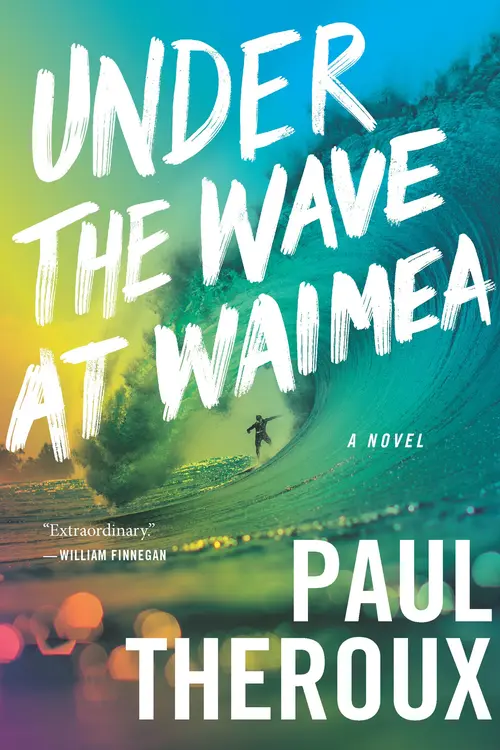
Cover image © Zak Noyle
Author photograph © Steve McCurry
Lines from “Not Waving But Drowning” by Stevie Smith, from Collected Poems of Stevie Smith, copyright © 1957 by Stevie Smith. Reprinted by permission of New Directions Publishing Corp. and Faber and Faber Ltd.
Epigraph
Out of the water I am nothing.
–DUKE KAHANAMOKU, legendary Hawaiian surfer
Part I
Under the Wave at Waimea
1
The Island of No Bad Days
The one wild story that everyone believed about Joe Sharkey was not true, but this was often the case with big-wave riders. It was told he had eaten magic mushrooms on a day declared Condition Black and dropped left down a forty-five-foot wave one midnight under the white light of a full moon at Waimea Bay, the wave freaked with clawed rags of blue foam. He smashed his board on the inside break called Pinballs and, and unable to make it to shore against the riptide, he swam five miles up the coast, where he was found in the morning, hallucinating on the sand. More proof that he was a hero; that he surfed like a rat on acid.
His being found on the beach at dawn near Banzai Pipeline was a fact, and he’d taken LSD, not mushrooms. But so much of the rest of his life had been outrageous, and sometimes heroic, glowing with sensuous happiness, that his fellow surfers never questioned whether the wave had been a monster, or if he’d been on it, or broken his board, or swum alone to Pipeline, nor did they accuse him in pidgin of bulai—lying. Sharkey had shown himself the equal of the best of them. When he’d first been asked about the Waimea story, he’d been young—eager to make an impression, and prone to embellish. In time he learned that exaggeration was always a side effect of fame and fiction a feature of every surfer’s reputation, the yearning to be a dog off its leash.