Under the Italian Sun
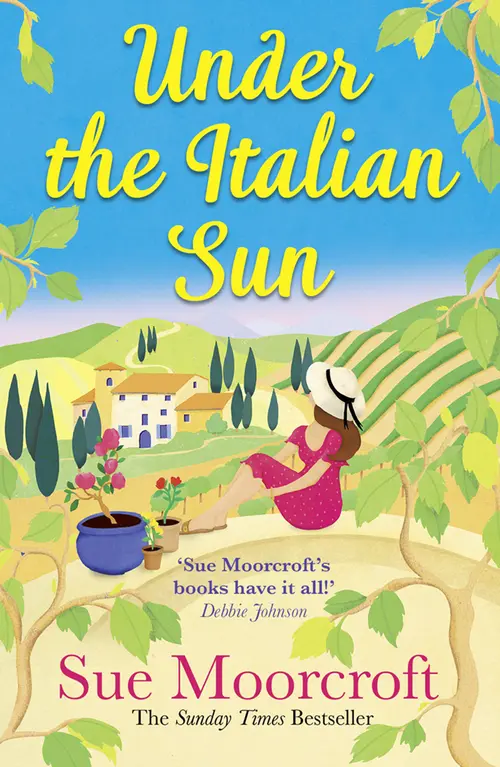
Cover
Dedication
To the readers joining me on this escape to a rocky plateau above a sun-drenched valley in Italy. Our journey begins on page one.
Chapter One
Zia Chalmers backed out from the storage space on all fours, dragging a cracked brown suitcase. ‘Ouch!’ She rubbed her burning scalp where she’d caught her ponytail on the frame of the tiny access door. ‘One of the benefits of an attic flat is the eaves storage. You just have to be size zero to access it.’
Ursula, lounging on the carpet of Zia’s spare room – currently Ursula’s room – peered at the suitcase. ‘How long’s it been there?’
‘Six years, since Gran died. I should have sorted through it then but I was twenty-four and felt too young to be left alone in the world, let alone clear Gran and Pap’s bungalow ready for sale.’ A perfunctory swipe at the dust then Zia sprang the suitcase’s old-fashioned clasps with a phut! The hinges groaned as she threw back the lid and paused to absorb buff folders jammed beside faded red document wallets. A blue and white quilted beach bag took up one corner. She patted it. ‘I found this on top of a wardrobe. It’s full of Mum’s letters but reading them felt intrusive so I stuck it in here.’
Ursula frowned down at the jumble. ‘Will looking through this stuff upset you?’
Zia shrugged. ‘Maybe, but if I want clues about my father it’s the only place I can think of to look.’ She toyed absently with the beach bag’s zipper. ‘Gran and Pap always denied knowing his name. It wasn’t a popular subject because they didn’t like Mum being a single mother and a “free spirit”, as Gran called her. We visited them in Spain when I was a kid but I think they were duty visits for Mum. Shame, because Gran and Pap were wonderful after she died.’ She blinked away the memory of her shocked ten-year-old self clinging to Gran.
Ursula laughed. ‘They might have had old-fashioned values but your Gran was mischievous and kind and Pap was really smiley. I loved going home from uni with you on the holidays. It made my homesickness a bit better.’ Ursula’s own family was back in Ireland. She’d come to England for her degree and stayed. Zia’s closest friend, Ursula was as blonde as Zia was dark, a beanpole where Zia was curvy, an arty and unconventional tattoo artist whereas Zia had a corporate client relationships role in asset finance. Nevertheless, they found the same things funny, loved the same books and movies and completely got each other. When Ursula and her husband Stephan hit a rocky patch, Zia had instantly offered Ursula somewhere to stay.
Zia thought wistfully of tall, bony Gran with salt and pepper hair drawn neatly back and Pap’s blue eyes and shock of silver hair. ‘When I first went to live with them Pap showed me how to make a sort of whistle from cow parsley stems. It made a rude noise and he said it was called a keck-fart but not to say so in front of Gran. Then she saw it and said, “Has Pap made you a keck-fart?” It was the only thing that made me laugh that summer.’ She touched the folders, dry and smooth, filling the room with a comforting smell of old paper. ‘I probably kept way too much of their stuff.’
Ursula slid her tattooed arm – she had one inked and one clean – around Zia’s shoulders. ‘But you loved them.’
Zia nodded jerkily. ‘Gran and Pap gave up their life in Spain when Mum fell off that ladder and got her head injury.’ Zia remembered the clatter and the shriek of pain. Mum staggering to her feet inexplicably angry and disorientated, then violently sick. In quick succession had come the neighbours, the ambulance, and the end of Vicky Chalmer’s life and Zia’s childhood as she knew it.
Ursula planted a consoling, lipstick-scented kiss on her cheek. ‘If you find your daddy you might find a whole other family just waiting to welcome you.’
‘Living relatives might be nice but you know that’s not why I’m interested in finding out who he is.’ Zia stared at the mountain of old paperwork as if it might magically form itself into the key to her life.
Ursula sighed. ‘I know. You’re after an Italian passport, Zia-Lucia Costa Chalmers. Jeez, we might even find out why you have that mouthful of a name.’
Zia managed a smile. ‘You know the story Gran told me – my dad was from Italy and a lady called Lucia Costa had once been kind to my mother. When I began to learn Italian and pointed out that Zia means “aunt” she just shrugged.’ She sighed. ‘When I asked other questions, she said she only wanted to concentrate on the happy memories. I didn’t persist in case it made her sad. Mum was thirty-five when I was born and by the time they took me on Gran was seventy-five and Pap seventy-seven.’ Zia climbed to her feet, rubbing stiff knees. ‘Ouch. Let’s take this lot through to the dining table.’
She heaved the cracked brown suitcase along the hallway of her airy Brighton flat. At the top of what once had been a Georgian town house the apartment gazed over the gardens of New Steine and the flowing silver figures of the AIDS monument. All the buildings had been converted into apartments or boutique hotels and most wore gracious pastel colours, though one was a jolly turquoise. Her tall sash windows opened onto a balcony with curlicued black railings. If she glanced right, she could watch the sea switch from blue to grey and to the left ran busy, bustling St James’s Street. She adored her home, a gem in trendy, quirky Brighton on England’s south coast, and thought Gran and Pap would approve of her selling their bungalow to buy it.
Ursula settled her long limbs at the table near the white marble fire surround. OK. What are we looking for?’
Zia pulled out the first few document wallets. ‘Anything that might lead to filling in the blank on my birth certificate where my father’s name ought to be. If he really was Italian it would be the easiest route to Italian citizenship.’
‘But you said anyone can apply for Italian residency,’ Ursula objected, pushing back the lock of blonde hair that dangled perpetually over one eye.
‘That’s right. Residency first, then maybe citizenship after a few years. It’s just that those applications will stand miles more chance of success if I can prove I have an Italian parent or grandparent.’ She pulled a face. ‘If dear McPherson & Partners had been obliging enough to make me redundant before Brexit I could have easily tried living in Italy – and I’d have avoided the relationship with Brendon.’
Sadly, her three months with Brendon, though they’d begun promisingly with flying sparks of attraction in the euphoria of a New Year’s celebration, had ended with his infidelity, particularly insulting as it had always been him trying to rush her into commitment. She’d been stupid to get involved with him; not only had he been a work colleague at the time but he was also the best friend of Stephan, Ursula’s husband. The latter fact had created an expectation that the two couples were a foursome and in the same place on the commitment scale. The former … Zia had always assumed that colleagues who dated kept their relationship out of the workplace but Brendon had been open about them sleeping together. She hadn’t enjoyed being exposed to nudge-nudge-wink-wink office gossip.
Then McPherson & Partners made staff cuts of which Zia was a casualty, while Brendon hung on to his job. When, hot on the heels of that disappointment, Brendon had cheated, Zia ended things – and there had been a ripple of relief beneath her shocked humiliation. Next, a drunken exploit of Ursula’s had prompted Stephan to demand their marriage was put ‘on a break’.
Horrible as both Ursula’s problems and Zia’s redundancy had been, at least Zia was no longer tripping over Brendon.
‘But Brendon’s still calling you,’ Ursula observed now. ‘Any chance of a reconciliation?’
Zia wrinkled her nose. ‘No, I was having doubts about us before he got caught in the act. He says he’s sorry but I suspect he’s only after forgiveness so he can feel better about himself. Unfortunately, I don’t find cheating easy to forgive. I only stay polite to him because if you and Stephan get back together, we’ll end up back in the same friendship group.’
Ursula sighed mournfully. ‘Don’t know if that will happen either.’ Her second sigh was longer and more mournful than the first. ‘I would have chucked myself into Devil’s Dyke without your shoulder to cry on these past couple of months. I’ll so miss you if you go away. You’re my rock.’
Perturbed by Ursula’s frequent descents into woefulness since her marriage hit trouble, Zia hesitated, chest tightening at Ursula’s anxious expression. Her friend’s emotional state was a worry. Ursula had scarcely come out of her room when she’d first moved in, until an understanding doctor and a little medication – plus a heap of TLC from Zia – had persuaded her that life was worth living. Privately, Zia cursed Stephan for refusing to attend couples’ counselling. Instead he occupied the marital home like the moral high ground, dishing out judgement on his sorrowful wife. ‘It’s not even definite that I’m going,’ she hastened to reassure her. ‘Maybe I’ve romanticised my whole history into something it’s not. Perhaps Lucia Costa was Mum’s midwife so she named me after her. My dad might have just worked at the local Italian restaurant and Gran assumed his nationality from that.’
Ursula’s forehead remained crumpled. ‘But you look Italian with your golden skin and shiny dark hair. I bet we discover your dad’s an Italian millionaire. He’ll spirit you off to his empire in Rome and it’ll be Ferraris and Armani all the way.’
Zia rolled her eyes. ‘Ha. More likely I’ll spend a bit of my redundancy payout on a holiday in Sorrento. You can come too.’
‘It’s a deal,’ replied Ursula, but without the grin Zia had hoped for.
They flicked through files in silence for several minutes. Then Ursula managed a half-laugh. ‘This seems to be correspondence relating to your grandparents selling their Spanish house. There’s a letter about the buyer asking for a price reduction and someone’s written, “Fat chance!” at the bottom.’
‘Gran, I expect.’ Zia giggled, taking the paperwork to see for herself.
Ursula jumped to her feet. ‘I wish I could be as don’t-mess-with-me as she was. Want coffee?’ She headed for the kitchen while Zia steeled herself not to put the correspondence in the ‘keep’ pile just because Gran had written a pithy comment on it. Outside the windows, gulls swooped like kites, crying out as if to tempt her into the bright May afternoon.
Ursula returned with two steaming coffee mugs then, turning back to the paperwork, happened on a folder of school reports, which actually made her laugh aloud. ‘Listen to this teacher’s comment: “Once we established who was in charge of Class 10, Victoria and I got on well.” And, “Victoria Chalmers is more interested in decorating the cover of her maths book than adding work to its pages.” She did tap dancing. Look at all these certificates.’
Zia craned to study the faded colours on thick card. ‘Were teachers too stuffy in those days to call her Vicky? No one ever called her Victoria.’ She picked up another folder and opened it. ‘Here’s a second batch of reports. She must have got loads. “Victoria Chalmers has settled well in Year Seven and is working hard.” Maybe she liked senior school better than primary. And water had become her thing because this folder’s full of swimming certificates.’ A large buff envelope caught her eye. It was marked in her gran’s careful cursive handwriting: Vicky. Her laughter faded and her heart misstepped as she picked it up. ‘I know what’s in this – Mum’s birth and death certificates.’
‘Aw, Zia.’ Ursula’s eyes filled with sympathy as Zia withdrew a long piece of stiff, crested paper from the envelope and unfolded it. Navy blue handwriting over red watermarking declared Victoria Chalmers to have been born in The Royal Exeter and Devon Hospital in April 1956 to Joyce Mary Chalmers and Alfred John Chalmers. The writing blurred before Zia’s eyes. ‘I was cheated of a lovely mum; always smiling, always busy with whatever house she was doing up. Telling me we were moving – again.’
‘But doing up properties was the way she made her living,’ Ursula excused the absent Vicky, though her voice oozed sympathy.
‘Yeah. But I attended five different primary schools before I moved in with Gran and Pap.’ Zia blew her nose and read from the death certificate, dated July 2001. ‘Victoria Chalmers died of traumatic subarachnoid haemorrhage, or, in normal language, a bleed on the brain.’ Carefully, she refolded the certificates, slid them into the envelope and placed it on the ‘keep’ pile.
The afternoon drew on, the sun moving behind the building so that the vivid colours of the garden outside dulled, though it didn’t stop people from parking themselves on benches to eat a snack or consult a phone. Finally, Ursula stretched and yawned. ‘That’s every folder checked and there’s not a hint of anything to do with your dad. I think you need to look through those letters of your mammy’s. Maybe she talked about him with her friends.’ Ursula only used words like ‘mammy’ for effect or when she went home to her big cheerful family near Dublin.
‘I suppose so.’ Slowly, Zia pulled the beach bag from the otherwise empty suitcase. The white areas were slightly grey, the blue faded. She remembered discovering it, right at the back of the wardrobe top, as if retrieved from Zia’s mum’s things when she died and then forgotten.
Slowly, she slid open the zip and took out a sheaf of letters, spilling them across the oak table. Her fingertips wandered over envelopes: blue, pink, white and buff. Inside each was either lined writing pad paper or occasionally decorated sheets; paper that had lain undisturbed for more than twenty years. Zia felt tingly and comforted, all at once. ‘Some people might say I’m intruding. But suddenly I feel almost as if I’m going to meet her again. I deserve a chance to know her better, don’t I?’
‘Of course you do,’ Ursula approved.
‘I’ll sort them into some kind of order first.’ Zia spent the next fifteen minutes flipping through envelopes while Ursula switched on a couple of lamps against the encroaching evening then vanished into the kitchen, returning after some clattering about. ‘I’ve stuck chicken and jacket spuds in the oven.’
‘Mm,’ Zia answered absently, her attention still on the old letters spread out like tarot cards in front of her. ‘There are lots of letters from Gran and Pap and some from friends. The earliest’s dated December 1991. I’d been born the previous October and we’d just moved from Devon to Northamptonshire. The letters continue as we move to Bedfordshire and Huntingdonshire.’ She neatened the rows.
Ursula resumed her seat, picked up the bag and peered inside. ‘Is this empty?’
Absently, Zia nodded, pausing to prepare to poke her nose into her mum’s life. ‘It’s quite nice that everyone wrote to each other in those days.’
Ursula pulled a brown envelope from a pocket in the beach bag. ‘Here’s another envelope but there’s nothing written on it.’
Zia continued her own line of thought. ‘No one will ever find a bag of our letters, will they? We’re all emails and WhatsApp. It’ll just vanish. It’s a pity. Maybe that’s why people keep journals.’ When Ursula didn’t answer, she glanced up.
Mouth half open, Ursula was clutching a piece of paper in each hand, eyes enormous. ‘Oh!’ Her voice was breathy with alarm as she stared at them. ‘Oh, Zia!’
Zia craned, but couldn’t see what was making Ursula look as if she’d just discovered her bank account had been emptied. ‘What on earth’s up?’
Slowly, hazel eyes glittering oddly, Ursula turned the two pieces of paper and laid them before Zia. ‘These are birth and death certificates for Victoria Chalmers, too. But the dates are different.’
‘Different to … the other lot? How can they be?’ Zia stared at the two documents. Heart thumping, she tried to take in the words unknown registrars had written in flowing fountain pen, forcing her reluctant brain to accept the evidence in front of her eyes.
Ursula was right.
Here were a separate set of birth and death certificates for Victoria Chalmers. With trembling fingers, she dug out the certificates she’d examined earlier and laid them alongside. Ursula shifted her chair closer so she could compare them, too. From the kitchen the oven timer pinged, insistent in the silence, but neither woman answered its summons.
Zia moistened dry lips. ‘I can’t believe what I’m seeing. There were two Victoria Chalmers, both born in Devon. Mum died in 2001, in Cambridgeshire, aged forty-five. The other died in Exmouth in 1991, when she was eighteen.’ She scrabbled for the folders of school reports and certificates and examined them with fresh eyes. ‘I didn’t notice before but these are from different periods! What the hell?’
Ursula’s voice was thin and uncertain. ‘So, your mum was seventeen when the other Victoria was born.’ She propped her chin on her hand.
The oven timer continued to ping in counterpoint to the gull’s plaintive calls but Zia heard the shush-shush of her heartbeat louder than both. As spooked as a child at a horror film, she had to force her breathing to be even. ‘Could the second Victoria have been my sister, or half-sister? One Mum gave up for adoption, maybe, because she was too young to cope? That might explain why the baby was registered with the same name as Mum – the adoptive family chooses the baby a new name anyway, don’t they, and the adopted baby gets a new birth certificate?’
‘I don’t know. But …’ Ursula arched her brows at Zia. ‘The second Victoria might not be your sister. Could she be … your mum?’
‘No,’ Zia whispered. ‘That can’t be. Why would Mum hide the fact my real mother had died? Why would Gran and Pap?’ Ignored, the timer stopped pinging of its own accord.
‘Same goes if she was your sister,’ Ursula pointed out. ‘The letters might give us clues.’
Silently, they gazed at the stack of envelopes. Tentatively, Zia reached for the topmost and unfolded it, recognising the bold, black, sprawling handwriting. ‘From Gran.’ She swallowed a lump at the sight of the flimsy air mail writing paper that had winged its way from near Valencia in Spain.
14th December 1991
Dear Vicky,
How are you? How is Zia-Lucia? Are you coping with her?
Zia paused. ‘It’s a bit weird to see baby me being discussed.’ She returned to the letter.
Your father and I think we’d better come back to live in England and give you and Zia-Lucia some support. We can’t imagine how you feel with poor darling Tori gone. How terrible it all is. Oh, darlingest darling, we grieve for you and with you! You’ve always gone your way but won’t you let us help you this time? Can’t we weather this together? We all loved Tori.
Zia swallowed. ‘Gran used to call me “darlingest darling”, too.’ Had she loved the unknown Tori enough to call her the same? It gave her a twirly feeling to think it.
Ursula interrupted with the eagerness she usually reserved for solving sudoku. ‘But 1991’s the year the second Victoria died. Tori must be her – it’s another short name for Victoria. I’ll bet your mum was known as Vicky and this younger Victoria as Tori.’
Zia considered, stretching cramped legs beneath the table. ‘Makes sense. Obviously, she was in touch with Mum at the time of her death and Gran and Pap too. That doesn’t work with the adopted-baby idea – unless she’d traced Mum, of course, and either the adoptive parents hadn’t given her a new name or she wasn’t using it.’
Ursula looked intrigued. ‘I wonder who her birth father was.’
Zia tried to laugh but it caught in her throat. ‘My past seems littered with mystery fathers.’ She started on the next letter. The handwriting was different. ‘Pap’s written this one.’ They read it together.
3rd January 1992
Dear Vicky,
From your last letter it seems you don’t want Mum and me to come back but we are worried about you. I’m going to be honest – we think what you’re doing is crazy and sooner or later you’ll have a lot of explaining to do. It’s not too late to reconsider.
Zia skimmed the rest of the letter, ‘Then there’s a load of stuff about Pap’s garden and Gran teaching Spanish to new ex-pats. But what do you think Mum would’ve had to explain about? It’s like one of those games where you get clues in fragments.’
The next letter was dated a couple of weeks later and Gran had taken up her pen again, beginning with anxious enquiries.
The Story Continues on BooksBarbecue!
Enjoyed this preview? ❤️ Do not stop here!
Read the complete book free online → 🔗
Continue reading now on BooksBarbecue and discover every page!
Love reading? Bookmark BooksBarbecue.com for more amazing books!
Happy Reading!