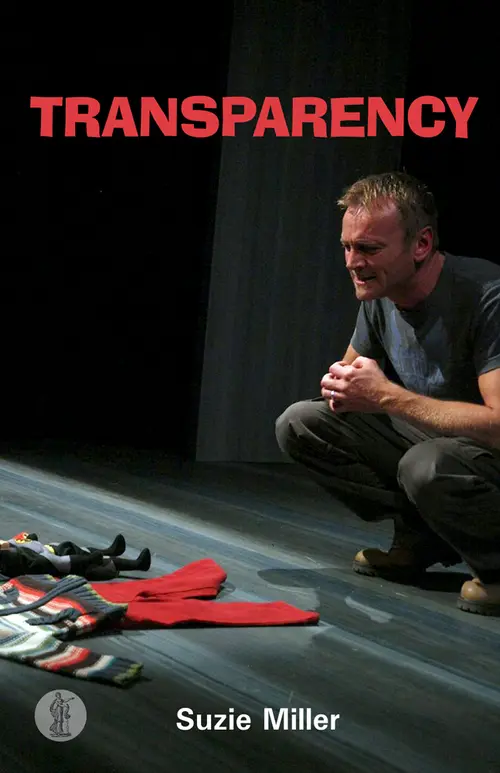
Transparency
Playwright’s Biography

Suzie Miller is a multi award-winning playwright, was writer in residence at Sydney’s Griffin Theatre 2012, has worked with international directors in five countries and twice been attached to the National Theatre in London with her work developed at the NT Studio development unit. Miller’s works include Caress/Ache (developed at National Theatre, London, premiering at the new Eternity Playhouse Sydney in 2014); June (atyp with Legs on the Wall); Dust (Black Swan Theatre Company). Driving Into Walls (Perth International Arts Festival 2012 with Barking Gecko Theatre Company, touring to Sydney Opera House then UK in 2013); The Sacrifice Zone (Toronto with Theatre Gargantua in 2012 and 2013); In the Heart of Darby Park (Oran Mor Theatre, Glasgow in 2013); Transparency (premiered with Ransom Theatre, Belfast in 2009); Sold (London’s Theatre 503 in 2011); Reasonable Doubt (Edinburgh Fringe Festival and NY Fringe Festival in 2008); All the Blood and All the Water (Riverside Theatre); Cross Sections (TRS and Sydney Opera House); Confused Sea Conditions (Philadelphia US April 2009; Sydney 2008); Flight/Fright Mode (Edinburgh Festival 2009, New Theatre, Sydney 2009; London’s Southwark Playhouse 2011).
In 2012 Miller was on creative attachment, working with Robert Lepage and Ex Machina in Quebec City on Playing Cards.
Miller’s awards include the 2008 National Kit Denton Fellowship for writing with courage; shortlisted 2010 and 2005 Australian Writers Guild Award for drama; shortlisted Griffin Award 2009; winner Inscription 2009; and 2006; mentored by Edward Albee 2009; winner 2008 New York Fringe Festival ‘Overall Excellence Award for Outstanding Playwriting’ and 2005 winner Theatrelab award.
For the wonderful Robert, Gabriel and Sasha
INTRODUCTION
When I first read Transparency I was sure that the playwright, Suzie Miller, had taken some artistic license in fashioning a riveting, multi-level ‘who-dunnit’ type story. It seemed unfathomable to me that someone could be forced to pay for a childhood crime, albeit horrific, for the rest of their lives through an enforced and effective removal of their past. This seemed to me a punishment that far outweighed the crime. But I was quick to learn that this is indeed a reality for some individuals who, like Simon, Miller’s protagonist, have committed the ultimate crime as children.
This element of ‘discovery’ of a new and very bleak world was one of the reasons I selected Transparency to be the Seymour Centre’s first full-produced theatre production. As part of the University of Sydney it seemed appropriate that our self-produced productions fed into the University’s culture of informed enquiry, of asking important questions. And Miller’s play is filled with questions.
Transparency asks us to consider, in detail, how to appropriately rehabilitate those who commit terrible crimes as children. Simon, like others and most notably those who murdered James Bulger, on release from prison must live a life under a new identity to protect his future, those around him and his family from his past. Yet in Act One as Simon, in anguish, begs his counselor for permission to tell the truth to his wife, we see his pain and wonder if this process of rehabilitation is the right one.
Simon’s journey through the play is not unlike that of John Proctor in Arthur’s Miller’s classic, The Crucible. For Proctor the prospect of losing his name, of contributing to a fundamental lie is a bridge too far and he chooses death as the preferable alternative. In Transparency, Simon has been forced to live a lie for many years and whilst his truth is one many would not want revealed, his inner torment can still be attributed to the pain of living a kind of rootless, nameless life. In Suzie Miller’s play Simon carries forward the fundamental question posed in The Crucible and, indeed, the hero’s journey in many classics. The question of, who am I ?
At the end of Transparency, as in The Crucible, both characters achieve a sense of being cleansed through adhering, ultimately, to truth. In Arthur Miller’s play we have no doubt that this action was the right thing for Proctor to do; as Elizabeth says, ‘He have his goodness now. God forbid I take it from him!’ However, in Transparency questions remain, leaving the audience in a kind of limbo. We are unsure how his wife, Jessica, will ultimately deal with Simon’s truth and the future for Simon is not easy to see. Yet this ambiguity is one of the plays strengths. Ultimately Suzie Miller asks the audience, at the end of the play, to sit with the dilemma and ask ourselves, what would we do in the same circumstance? Given the contemporary nature of the story this leads to the next question: are we as a responsible society actually attempting to rehabilitate individuals such as Simon or simply condemning them to a life sentence?
Indeed Transparency is a play of questions.
It is also about betrayal and retribution.
I was surprised that in one of the early performances, an audience member placed the greatest betrayal not on Simon for keeping the woman he loves unaware of his criminal past, but on Jessica for attempting to open Simon’s private suitcase—a bag that may contain some clues to his increasingly difficult behaviour. Jessica is on a mission to almost force her husband to be more ‘open’ despite his protestations. Her gut tells her that something is deeply wrong and she is prepared to go against his wishes to prove herself right. This small transgression, for some, was seen as more deceitful than Simon’s far more complex lie. Indeed, many felt that Simon was the most transparent or honest of all the characters in the play.
Lies and betrayal extend throughout the fabric of Miller’s other characters: Camille, Simon’s co-worker, is trapped in an unsatisfactory marriage but rather than face the prospect of divorce she takes a lover, betraying her husband and child, and creating an ever-increasing web of lies.
Of course, Jessica experiences the greatest betrayal when she finally learns her husband’s truth. And this was another reason I wanted to do the play. When we reach the final scenes where, inevitably, we must hear the full details of Simon’s crime, Miller’s language becomes more disconnected, tangential, visceral and poetic. Most audiences felt the dilemma in the gut, as Jessica does, defying a logical, analytical response. The play reaches a kind of emotion-filled horror where the language helps us empathise with Jessica’s desire to physically hurt Simon and to embrace him at the same time. I was equally confronted by these sections when I first read them and felt that the complex issues that Miller’s language raised were good reason to produce the work.
Lachlan, Camille’s husband, takes swift retribution ending his marriage with Camille and taking their child with him. Simon’s ultimate retribution is somewhat left in the air. We know the retribution he has suffered as part of his sentence but his exact punishment from Jessica and from the wider community remains uncertain—though we know that it could mean a return to prison. Once again Miller turns the ultimate question on us, the audience, asking if, perhaps, this man has suffered enough—questions again.
Producing and directing Transparency was enormously satisfying because it is a play that provokes discussion—audiences were captivated and sometimes appalled, but wanted to talk about it afterwards. Points of view varied wildly. Some were adamant that Jessica had no choice but to leave him, endorsing what Andy, Simon’s pragmatic counselor, states early in the play as a major threat: if you tell her, she’ll leave. Others, like me, liked to believe that it was possible that their love was strong enough to somehow steer a course through the betrayal. After all, all Simon has done is tell the truth and it cannot get any worse.
And so, lastly, the play is also about trust: what we choose to tell in a relationship and what not to tell; about the risks we take in confessing truth to those we love—and the trust we must have in them to continue loving us for who we truly are.
Timothy Jones
April 2013
Timothy Jones is Artistic Director and General Manager of the Seymour Centre, Sydney.
Transparency was first produced by the Ransom Theatre Company at the Old Museum Arts Centre (OMAC) Theatre, Belfast, Northern Ireland on 26 September 2009, with the following cast:
| SIMON | Richard Dormer |
| JESSICA | Dorothea Myer-Bennett |
| CAMILLE | Abigal McGibbon |
| LACHLAN | Richard Clements |
| ANDY | Alexandra Ford |
All other roles were played by the company.
Director, Rachel O’Riordan
Assistant Director, Patsy Hughes
Designer, Stuart Marshall
Lighting Designer, James Whiteside
Sound Designer, Ashley Martin-Smyth
Stage Manager / Production Manager, Lisa-Marie Cooke
Transparency was first produced in Australia by The Seymour Centre at the York Thetre, Seymour Centre, Sydney, on 1 September 2011, with the following cast:
| SIMON | Glenn Hazeldine |
| JESSICA | Amy Matthews |
| CAMILLE | Anna Lise Phillips |
| LACHLAN | Ed Wightman |
| ANDY | Celia Ireland |
Director, Tim Jones
Designer, Stephen Curtis
Lighting Designer, Verity Hampson
Sound Designer, Jeremy Silver
Stage Manager, Katrina McKenzie
PLAYWRIGHT’S NOTES
While writing any play requires a grappling with humanity, the research for Transparency shook me to the core. Talking to perpetrators, victims and the families of victims meant I was up close and personal to crimes that were for me deeply disturbing. During this confronting process it became impossible not to be outraged by hideous deeds as well as deeply confused with how a child could commit them. Were they born with some evil trait or did something go terribly wrong? While the narrative of Transparency explores these issues through the personal lives of characters, I found it interesting to meditate on the nature of rehabilitation and punishment. Should child criminals be considered forever dangerous or is there hope? What can we trust and what is too great a risk?
Indeed issues of trust and love are interwoven with elements of crime and punishment, and I found myself also questioning: are secrets sometimes better left alone amidst love or is the need for disclosure somehow an act of true intimacy? Do you have to know everything about your lover to maintain your love, and can you ever really know another person entirely anyway?
THANK YOU
I owe a debt of gratitude to the following people and organisations: Robert, Gabriel and Sasha Beech-Jones, Andrew Denton, the Kit Denton Fellowship Award, Tim Jones, Rachel O’Riordan, Timothy Daly, Camilla Rountree, Caleb Lewis, the National Theatre in London, the cast of the National Theatre read, the Seymour Centre, the University of Sydney, Paul O’Beirne and Currency Press, Ransom Theatre UK, Riverside Theatre Australia, and the entire casts of the premier productions. I would also like to thank Hilary Bonney, Lisa Cahill, Rochelle Zurnamer, Celia Ireland, Lucy Bell, Hilary Bell, Karen O’Connell, Rick Goldberg, Julia Pincus, Ian Learmonth, Heather Mitchell, the entire Miller family and the wonderful friends I have who continuously support me in both my theatre career and my life generally.
CHARACTERS
SIMON, works for the National Parks and Wildlife.
JESSICA, married to Simon. Fast, arty, unconventional. Works as a radiography technician at the town hospital.
CAMILLE, Simon’s co-worker. Married to Lachlan. She has a two-year-old son, Angus.
LACHLAN, married to Camille. Father to Angus.
ANDY, a government-appointed psychologist.
SETTING
The action takes place in a small town situated near a national park. This story is set over a Christmas period. Should it be staged in the northern hemisphere the author permits appropriate weather conditions to be changed where they are mentioned in the script.
A NOTE ON THE TEXT
A backslash [ /] at the end of a line of dialogue indicates the following line immediately runs after this line.
A backslash [ /] within the dialogue indicates the next line of dialogue begins, running over or drowning out the remainder of the original line.
An em-dash [—] indicates an unfinished throught, or a moment in which a character doesn’t voice their thought. It can also be an interrupted unfinished thought.
ACKNOWLEDGEMENTS
This play has been developed by the National Theatre in London culminating in an industry read in 2009. It has been further developed by Ransom Theatre (new writing theatre) in Belfast. The playwright acknowledges the generous support of the Kit Denton Fellowship awarded for Writing with Courage (2008) for the development of this work; and Playwriting Australia for funds to travel to the National Theatre and Ransom Theatre for the development. The playwright also acknowledges dramaturgy by Timothy Daly and Rachel O’Riordan. O’Riordan has been fundamental to the writing of this work.
Production Photos
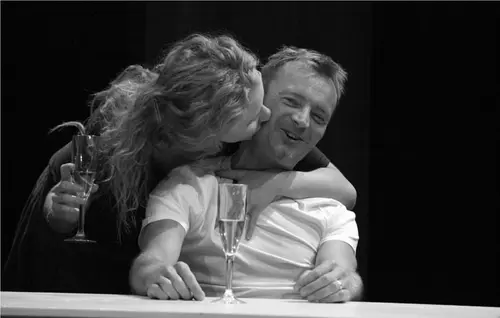
Dorothea Myer-Bennett as Jessica and Richard Dormer as Simon in the 2009 Ransom Theatre production. (Photo: Rosie Mac Photography.)
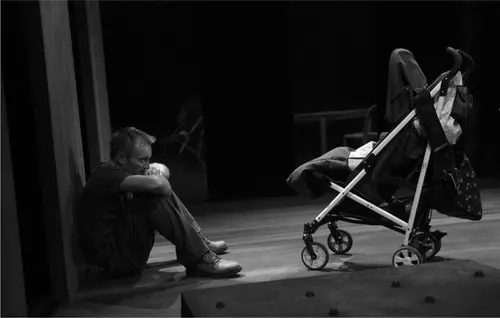
Richard Dormer as Simon in the 2009 Ransom Theatre production. (Photo: Rosie Mac Photography.)
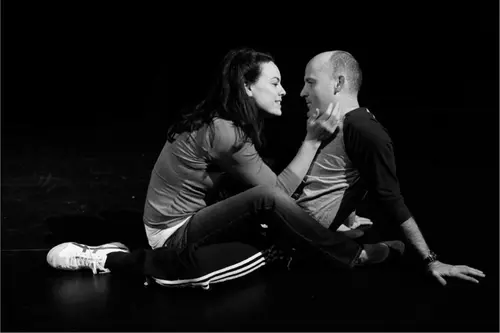
Amy Mathews as Jessica and Glenn Hazeldine as Simon in the 2011 Seymour Centre production. (Photo: Helen White.)
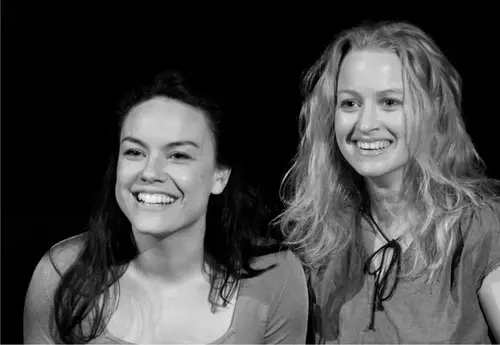
Amy Mathews as Jessica and Anna Lise Phillips as Camille in the 2011 Seymour Centre production. (Photo: Helen White.)
ACT ONE
SCENE ONE
An evening in December.
Lead up to Christmas.
Simon and Jessica’s place.
A large X-ray collage covers the wall.
Lights up on a radio, illuminated on a kitchen benchtop.
A retro formica table in the centre of the kitchen.
A radio plays sexy music in the background.
SIMON and JESSICA are up against the kitchen wall, in a heated sexual moment.
JESSICA: God I love your arms.
And I love your neck.
And I love your cock.
Silence as they move together.
And I love your name.
I love your beautiful fucking name.
SIMON:—
JESSICA: A name like honey.
Sticky.
Burnt honey.
SIMON:—
JESSICA: I want our babies to have your name, our name!
SIMON traces her face, her neck.
SIMON: You’re so beautiful Jess.
She laughs and lets him look over her lovingly, hungrily.
How did I ever get so lucky?
JESSICA: [teasing] Indeed?
They get hotter.
And hotter.
Have to—
Be quick—
Lachlan and Camille will be here soon—
SIMON groans.
You love them.
SIMON: I see Camille every day at work.
JESSICA: They’re our best friends.
SIMON: I just want you.
JESSICA: I just want your arms!
SIMON: [teasing] So you fell in love with me because of my arms?
JESSICA: No, because of your name.
Saw your beautiful name on the list.
First thing I loved!
SIMON stops briefly.
SIMON: What if I was called… Tobias?
JESSICA: [joking, flirting] I’d be fucking Tobias right now!
SIMON: Jesus Jess.
JESSICA: As long as he had your arms, your neck, your cock!
Your fucking arms.
SIMON is disconcerted, and hesitates.
Hey.
Idiot.
It’s not just—
It’s you.
The all of you.
He stares at her, transfixed.
We would make a beautiful baby.
SIMON:—
JESSICA: [playfully] Try saying ‘Yes Jess, one day we will make a beautiful baby’.
She kisses him passionately.
The energy becomes more intense.
Hotter.
They’ll be here soon.
JESSICA takes his hands and holds her own above her head.
SIMON snatches them down and tries to be gentle, romantic.
JESSICA is more urgent, more demanding, with whispered encouragement.
She resists SIMON’s gentleness and insists with her body on ramping up the energy, repeatedly trying to get him to hold her against the wall.
God I love you.
SIMON: I love you.
She grabs him and takes him to the floor /table where her desire for him to do things her way is obvious from her insistent actions.
He doesn’t at first but then as things hot up, he starts to follow her lead.
JESSICA: [she puts her hands and arms back coquettishly] Hold me so I can’t get my arms down.
No not like that.
Tighter.
SIMON does so, taking control
JESSICA enjoys the feeling of being held down, wants to lose herself to it.
SIMON:—
JESSICA: That’s it.
SIMON holds her down, putting his weight against her.
He starts to sexually lose himself, starts to enjoy it.
Harder. Restrain me honey.
He looks into her face and pulls away suddenly.
Drops hold of her, and leaves her lying on the table /floor.
JESSICA is dishevelled, confused.
SIMON: No. I can’t.
Awkward moment but then JESSICA tickles him. SIMON pulls away.
Don’t. Please don’t.
JESSICA: What?
Beat.
Hold me baby, hold me tightly.
[Teasing] Mr Simon Font-aine. Font-aine. Fontaine.
SIMON: Don’t. Don’t. And stop the name stuff.
JESSICA:—?
SIMON: I don’t hold people down.
I don’t do ‘restraint’.
JESSICA laughs, thinking this is part of the game.
She goes to grab him and pull him down.
He pushes her away.
This is not negotiable.
She is shocked and confused.
Awkwardness.
She tries to cover herself up.
You think I want to hurt you?
JESSICA: [hotly and defensively] No.
It was just play.
God.
SIMON:—
They both start to put on their clothes.
JESSICA starts to clean up the kitchen.
Starts to cry.
SIMON: Jess.
Please—
She won’t look at him.
I’m sorry.
Don’t cry.
Please don’t cry.
JESSICA: It’s humiliating.
He tries to embrace her but she resists.
By this stage they are both fully dressed.
An awkward silence.
SIMON: Tell me why.
Restraining you.
You think I’d want—?
To you?
JESSICA: Because I asked you to.
Because we can.
Because I feel safe.
Because it’s you.
Silence.
In the silence there is a connectedness between them.
A short time passes before the voice over interrupts this silence.
CAMILLE: [voiceover] Hello.
It’s us!
Beat.
JESSICA: Door’s open.
JESSICA wipes her eyes.
SIMON and JESSICA are forced to change the mood as CAMILLE enters, carrying a bottle of champagne.
CAMILLE: Lachlan’s carrying the sleeping child to your bedroom.
JESSICA: Yes.
Good idea.
Beat.
CAMILLE: Champagne!
SIMON takes it from her.
CAMILLE: For the celebration.
SIMON: Wow champagne. Thanks Camille.
Beat.
LACHLAN enters. SIMON is pouring drinks and handing them out.
LACHLAN: He’s out like a light!
SIMON: [nodding] Lachlan.
LACHLAN: Hi Simon!
LACHLAN is struck by the huge collage on the wall. He whistles.
So here it is?
JESSICA: Here it is!
LACHLAN studies the wall.
LACHLAN: So which bits are you,
And which bits are Simon?
CAMILLE: Jesus Lachlan it doesn’t matter.
JESSICA: It’s random.
That’s the point—a merging of us!
[To SIMON] Happy First Anniversary babe.
SIMON looks over at her.
LACHLAN: Um. Jess you know I think you’re amazing—
But I just. Don’t.
I don’t get it.
CAMILLE: There’s nothing to get.
It’s a [She makes air inverted commas] ‘collage’.
LACHLAN: I know that!
CAMILLE: Jess is a radi-og-rapher! /
LACHLAN: Yeah. Duh!
CAMILLE: [laughing] ‘Duh’! I haven’t heard that word in ages!
JESSICA: It’s—
Kind of our story, isn’t it, Simon?
SIMON: We met over / my broken arm.
CAMILLE: Your broken arm.
And the way he looked at her /
JESSICA: Broke my heart open!
LACHLAN: How’d you break it?
JESSICA: My heart!? /
LACHLAN: His arm.
CAMILLE: Lachlan loves detail.
JESSICA: Sign of a competent journalist.
LACHLAN: [to CAMILLE] Yes.
Thanks Jess.
JESSICA: I X-rayed both his arms.
The broken one and the healthy one. /
SIMON: I couldn’t understand why!
JESSICA: I wanted to keep you there longer!
CAMILLE: [sarcastically] Romantic.
LACHLAN: Come on. It is!
You love it Camille, admit it.
She looks at him as he moves towards the collage.
Is this Simon’s leg?
JESSICA: No, that’s my femur, and his tibia, and look—
That’s the rib area around my heart.
Spine.
And that’s my bottom!
LACHLAN: And a beautiful X-rayed bottom it is too.
SIMON: Just scans herself at work,
when she’s bored.
CAMILLE: Jesus!
JESSICA: All the technicians do!
LACHLAN: Is it safe?
I mean if you’re trying for a baby.
SIMON: We’re not.
LACHLAN: But I thought—
JESSICA stops him with a look.
Silence. LACHLAN changes the subject.
Uh… I’ve been assigned that missing toddler story.
JESSICA: Shit.
CAMILLE: How old is he?
LACHLAN: Just two. Denis Pritchard.
JESSICA: They still haven’t found him?
SIMON: A missing child?
LACHLAN: You haven’t heard?
SIMON shakes his head.
JESSICA: There’s a huge search.
LACHLAN: Cops are all over it.
JESSICA: How does a kid go missing here?
LACHLAN: They think he might have wandered off into the bush,
Or that someone might have snatched him.
JESSICA: It’s so awful.
CAMILLE: [to SIMON] If the police don’t find him by Friday Matt will have us both working on the weekend
LACHLAN: This weekend?
CAMILLE:—
LACHLAN: Matt’s pushing his luck
CAMILLE: If I’m needed I’m needed, Lachlan.
LACHLAN: [sarcastically] Hmm.
JESSICA: Camille you sound like my husband.
LACHLAN: The job is everything! /
CAMILLE: Come on it’s a missing child. /
JESSICA: God it’s so hot out there!
He’ll be so dehydrated.
LACHLAN: They have to find him within 96 hours or I don’t know—
CAMILLE: Which is why if we’re called in to work /
JESSICA: Oh God… ?
CAMILLE: It’s so secluded in the bush.
No-one would even hear him out there.
SIMON: [loudly] Please.
Beat.
Can we talk about something else?
JESSICA: Why would the mother leave him alone in the garden?
Even for five minutes.
CAMILLE: Any parent could. /
LACHLAN: I wouldn’t.
A slightly awkward moment.
[Gently] And neither would you, darling.
CAMILLE: I might have!
JESSICA: It must be awful for you
Reporting on it, thinking about it
With Angus nearly the same age and /
LACHLAN: He was playing in the studio
While I read the police reports on air!
JESSICA: [shuddering] How do you cope?
LACHLAN: Well it would be quite nice to have my wife home on the weekends.
Uncomfortable silence.
LACHLAN looks at a bruise on SIMON’s arm.
Nasty bruise there Simon.
SIMON pulls away his arm.
SIMON: I did it playing squash
JESSICA: [to SIMON] You should take Lachie to squash with you and Andy.
SIMON: Lachlan doesn’t play squash.
LACHLAN: Well not yet.
CAMILLE: Lachie can pretty much do anything he puts his mind to.
LACHLAN: Thanks honey.
The Story Continues on BooksBarbecue!
Enjoyed this preview? ❤️ Do not stop here!
Read the complete book free online → 🔗
Continue reading now on BooksBarbecue and discover every page!
Love reading? Bookmark BooksBarbecue.com for more amazing books!
Happy Reading!