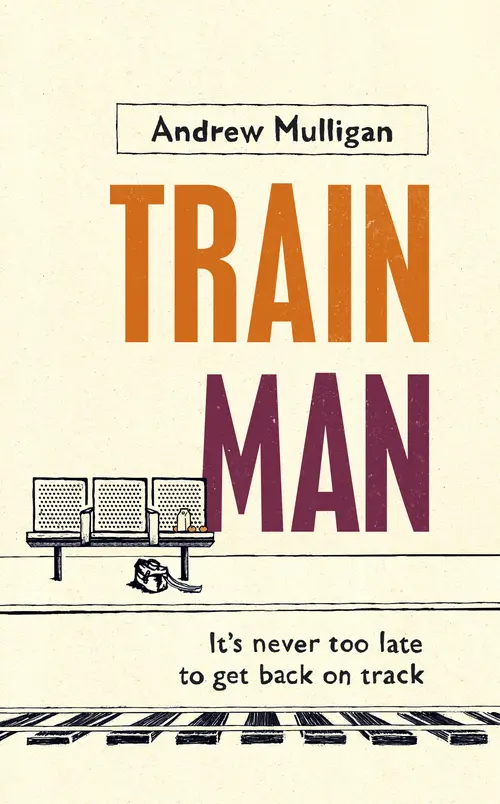
Train Man
COVER

ABOUT THE AUTHOR
Andrew Mulligan was born in 1962 and brought up in London. He worked as a theatre director for ten years before travels in Asia prompted him to retrain as a teacher. Having taught in India, Brazil, Vietnam and the Philippines he returned to the UK and now writes full time. He is best known as a children’s author; his novel Trash (2010) has been published in thirty-two languages. He also writes radio plays and film scripts. Train Man is his first adult novel: ‘What was the starting point? I’m afraid it was when a colleague did the unthinkable, and all I could think about was what might have saved him.’
DEDICATION
To Max
GOING NORTH
1
The first choice to be made concerned the 09.46.
The 09.46 meant no changes, whilst the 10.13 involved two – and deciding which one to take was a dilemma Michael had faced before because the two trains could be so very different. What made him anxious was the lack of control: you never knew what the 09.46 would be until it rolled up to the platform, and the type of stock made all the difference. The rail company had a tendency to switch the carriages, and the ones that Michael liked – which were roomy, with tables – were all too often replaced by those used for the commuter services. That meant no tables at all, and a lot less legroom. If things got busy you could end up squeezed against the window hardly able to move your elbows, and he so didn’t want to be trapped like that on this particular morning.
He wanted space, and he wanted to think.
If a commuter-style train turned up at 09.46 he would wait on the platform, and take the later service. There was flexibility after all: he needed to be in Crewe for the 14.41. If he missed it, the through-trains were hourly, so he wouldn’t be stuck.
He smiled. Was he always so particular about trains? The answer to that was an emphatic ‘no’, but he had been trying to learn from experience. He’d been making so many journeys over the last few months, taking advantage of off-peak tickets that sold in advance for next to nothing. As a result, he’d become very familiar with the different levels of comfort on different services.
There was a tannoy above his head, and it came to life even as he looked up at it.
‘We are sorry,’ it said, ‘but the 09.46 service from Southampton will have no catering facilities today.’
You could hear the hesitations as a computer patched in the particular time and place. The apologies were pre-recorded, of course, the phrases selected for the constant stream of cancellations and adjustments.
‘We are sorry for the inconvenience this will cause to your journey.’
Michael found he was smiling more broadly.
He had mouthed the words, giving the word ‘sorry’ the same heavy emphasis as the earnest announcer. Why would there be no catering services? It was because the trains had indeed been switched, which meant the person who wheeled the refreshment trolley would not be able to get along the narrower aisle of the replacement carriages. What would that person do now? Was he or she assigned to some other train, or did it mean that he or she had been advised to stay at home? The ticket price would be the same for Michael despite the absence of refreshments. There would be no refund, and no contingency plan – the train operator wouldn’t scramble emergency rations in a cool-box. You’d be left hungry and thirsty, all the way to Gloucester. He glanced at a woman sitting at the end of the bench.
‘Are you on the next one?’ he said.
She was wearing tiny headphones, and had to remove them.
‘I’m sorry?’ she said.
‘I was wondering if you were on the Great Malvern service. The 09.46 as it was meant to be.’
‘Yes.’
‘I got this train last month, and it wasn’t on time.’
‘Oh, they never are.’
Michael laughed.
‘You wonder they don’t change the timetables,’ he said. ‘If they simply changed the 46 to 56 they’d be so much closer. I suggested that on one of their customer feedback forms. Have you ever filled one of those in?’
The woman was smiling back. ‘I really wouldn’t bother,’ she said.
‘I’m still waiting for the reply,’ said Michael. ‘I’m an important customer, apparently. My opinions are very important to them, but they haven’t quite got round to getting back to me yet. You know there’s no catering service today?’
The woman shook her head. ‘I never use it,’ she said.
‘I do, when I can. For fear they’ll do away with it. You could say I’m trying to encourage them, but you can’t encourage someone who keeps letting you down.’
She held the earbuds in her fingers, getting ready to reinsert them.
‘Where are you heading?’ said Michael – and there was a pause.
‘Cheltenham.’
‘Oh,’ said Michael. ‘A lovely town.’
‘My daughter lives there.’
‘Lucky her. Lucky you, in fact, because—’
‘She was a student there, and never quite left.’
‘Really?’
Michael nodded, remembering a postcard he’d seen of some fine-looking square, with bright, flowering gardens. He had a feeling that had been Cheltenham, or Bath – or somewhere similar.
‘Why would she want to?’ he said, quickly. ‘There are worse places to live than Cheltenham. I had a bite to eat there years ago, and there’s the most lovely tea room. Not that I spend all my time thinking about refreshments.’
He smiled, and the woman simply looked at him.
‘Or trains, for that matter. It’s not a hobby, but I suppose I’ve come to resent paying a lot of money for a cup of undrinkable coffee. The kind that… you know, if you were blindfolded, you’d genuinely wonder what it was in the cup. It’s incredible how easy people find it to make bad coffee, and I don’t know if it’s because they don’t use enough, or if the blend is a… a cheap one. I think you can store it for too long, of course – that’s when it just goes stale. I used to work for the council, and you had to make sure it was fresh, because if you didn’t use it up, you really noticed the difference. In the quality, I mean.’
‘I don’t drink it,’ said the woman.
‘You’re more of a tea person, are you?’
‘A what, sorry?’
‘You’re more into teas, are you? If you want a hot drink, you prefer tea.’
‘I don’t drink tea, either. I cut out all caffeinated drinks a few years ago, and I feel much better for it.’
‘Good for you. I keep meaning to, or trying to.’
‘It’s blood pressure.’
‘Yes, that’s the worry. That is the worry. I went for one of those Health MOTs a little while ago – they were organising them through my local library. They said that my chief weakness, or… vulnerability, I should say, was blood pressure. If I could work to get the blood pressure down a bit, then… I’d have got the MOT, so to speak. They don’t give you a certificate as such, it’s just a printout and you can take it along to your GP if you want to follow anything up. A free service – I thought it was a really good idea.’
The woman nodded, but said nothing.
Michael remembered the young man who had interviewed him, though it hadn’t actually been ‘a little while ago’ – it had been seven months previously, in February – just before Valentine’s Day. A section of the library had been cordoned off, and there were two chairs and a small table. The man conducting the interview had been almost half his age – no more than twenty-five – and he was a fitness instructor on loan from the leisure centre, with the loveliest manners. The whole thing had taken less than an hour. In that time Michael had learned that the man had only recently changed jobs, having worked before in a department store, selling beds – a role that hadn’t suited him at all. He’d become increasingly frustrated.
Michael went to speak again, but the woman was pressing the little headphones back into her ears.
He closed his mouth, and thought about Javed.
Javed was the young man’s name, and he’d told Michael that his frustration had led to him having a bad diet. He’d put on weight, reaching nineteen stone – then he’d managed to shed five in ten weeks by going to what they called a body-modelling centre, which was much more intensive than an everyday gym. Michael remembered the details because he’d been so impressed by Javed’s courtesy, and confidence. He’d been confident enough to take blood from Michael’s finger. Then he’d been confident enough to give him advice, despite the fact that Michael was a total stranger, and so much older.
‘And I lied,’ he said quietly.
The woman didn’t hear him. If she was aware that Michael had spoken she was pretending not to be. He was relieved, of course, for he was finding that now and then words, or short sentences, just slipped out like a soft belch. It was a kind of dribbling, and he tried to be careful, but one thought led to another and he could end up sliding sideways, or backwards. Wasn’t it during the so-called Health MOT that he had made his decision? Yes, it was – he knew it was, though he’d been trundling towards it for months.
In that chair, talking to Javed, he had realised something terribly important, and had emerged knowing that he had to act quickly, and dismantle the thing he’d been accidentally constructing for the last three and a half years. He was going to make a huge change in his own life, and Amy’s – both their present and future were to be transformed. He went straight to a café, to reflect on the consequences, but he knew the decision was made and it was simply a question of making the call, or writing the letter. He could absolutely not get married, for the whole thing was wrong – he’d been faking everything. He’d been trying and failing, so how could he imprison a woman in marriage, even if they were just seven weeks from the wedding, with Valentine’s Day just round the corner? Even if it seemed unstoppable, it could and had to be stopped.
He could not marry her, and more than anything else in the world, he wanted not to marry her. The woman frightened him, and he had spent the last however long it was pretending that wasn’t the case. Married life was too frightening, and he simply didn’t love her.
She had given every impression of accepting the pretence. He had lied to her, and to the twenty-five-year-old health professional, too, whose name was not Javed, in fact, but Jared with an ‘r’. Not that his life was tangled with Jared’s, of course, because they hadn’t invested in anything except an hour of irretrievable time. But he had lied, nonetheless, about how much he drank. He had lied about his intention to get an expensive bicycle, too.
He had no money – how would he buy a new bicycle?
The young man had seemed impressed, though, and they’d spent two minutes at least talking about road-bikes versus hybrids – the weight, the gears, the tread – and he talked on, trying not to think about Amy and what she would do. Perhaps she would sigh with relief, and shake her head.
‘Do you know, I’d reached just the same conclusion?’ she might say – and they would hold each other.
‘Thank you for being honest, Michael.’
‘No,’ he’d reply. ‘Thank you. We can still be friends, can’t we?’
‘Always, Michael – of course. I will always think of you as my best, best friend.’
‘I am that, Amy. I will try to be.’
Alternatively, she might stand there blank-faced, unable to speak. She might simply fail to comprehend the silent collapse of all those plans, so lovingly and painstakingly made. She had dry lips, and he could see the words that would inevitably form on them.
‘What do you mean? Why?’
Those were the words she would have to use. There were no others, really. They would precede more violent ones, of course, but she would spend the first few moments floundering. She would lean on the little breakfast-bar, and he could see her thin wrists holding up her almost skeletal frame – the frame he’d embraced and held against his own, and tried so hard to need.
‘You lied to yourself,’ said Michael very quietly. He went to stand up, but at that moment there was another announcement.
‘The 09.46 to Great Malvern,’ said the voice, ‘is delayed by twelve minutes. We are sorry for the inconvenience this will cause.’
They were sorry again.
Michael looked at the woman he had been talking to, and smiled. She was attending to her phone, and didn’t look up – the headphones were still in her ears. A small suitcase sat at her feet, and she was dressed in several layers, because it was a cold September day with rain forecast.
He had only a small, grey shoulder bag.
You lie to yourself, he thought. You don’t believe your own lies, but you hope they might come true – or perhaps they simply distract you. You had a good enough bike, because it was Amy’s brother who’d lent it to you. Why did you tell Jared you wanted a hybrid?
Jared had believed him.
Jared had nodded in an encouraging way, and Michael had looked at him, trying to imagine how he’d carried nineteen stone when he now looked so healthy and muscular – as he had to for the job he did. You wouldn’t be employed in a leisure-centre gym if you were overweight, and yet that could never be a stated reason for rejection. The employer couldn’t say, ‘Sorry, Jared – you’re way too fat to work here.’ That wouldn’t be allowed, though it would be the truth. ‘You can’t walk round in shorts and vest, man! – you’ll set a bad example. We need thin people, so you’re not on the team: we’re not picking you.’
Michael found he was smiling again, because the sun was trying to break through and suddenly summer showed every sign of returning. The woman next to him would soon have to remove a layer.
Jared had lost weight, and shown real interest in Michael’s lifestyle. For most of the hour Michael’s habits had been his only focus. He had felt almost tearfully grateful as he left the library, for the wedding had been out there on the horizon for so long, swaying like a tornado. It had been a smudge in the air coming slowly closer, until he could feel the temperature changing and the wind on his face. He had to deal with it, somehow: three and a half years of fiction had to be confronted. The wedding could not happen, and all the investment… it was blasted away as the dreaming came to an abrupt and sudden end. He’d got off the train, as it were: he’d turned back. Having said yes, he was about to say no – and everything would stop.
He had written to her the same afternoon: Dear Amy.
He wrote on an old laptop, and then printed the document in the library’s study section, horrified by the devastation a single sheet of paper was likely to cause. Would the pain turn into relief? It would do, in the end, because he was only confirming feelings she must have shared. They didn’t know each other: they’d spent the years not getting to know one another. She couldn’t know him, if only because she had no idea what he was about to do, and if she hadn’t anticipated the letter then that proved the point: they were strangers.
They were strangers, and he had come to dread being with her. She was a good person, and he was a liar. They had worked on the whole nonsense together, planning and smiling – and what did it take to smash it all down? Twenty minutes of typing.
Amy, he wrote. There is no gentle way of saying this so let me at least be clear, so that there is no doubt. I cannot go through with our wedding, and I want to end the relationship because I am not good enough, or certain enough, or happy enough for you.
She had called him that evening, but whether she had found the letter in the morning or later he didn’t know. He didn’t take the call. He turned his phone off, until he’d had two large glasses of wine – and then he called her back.
Her brother answered, and said simply, ‘What are you doing?’
Michael was in his flat, sitting on the bed.
‘Matt,’ he said. ‘Can I speak to Amy?’
‘To say what?’
‘She’s been calling me.’
‘I’ve been calling you. We want to know if what you’ve written is true. If you’re serious.’
‘I’m serious,’ said Michael. ‘It’s all true and I’m afraid I am serious. Can I speak to her?’
‘No.’
There was a silence.
‘You are such a shit,’ said Matthew – and he spoke so quietly that Michael had to press the phone to his ear, and hold his breath. He thought he might have misheard, for he could hear another voice in the background.
‘Pardon?’ he said.
‘You’re a total shit,’ said Matthew.
That’s when Amy took the phone, and Michael knew then that she hadn’t anticipated the letter in any way at all. At once, he panicked. If she hadn’t seen it coming, then perhaps her love for him was real? Perhaps they should be getting married. Perhaps he was wrong, and they did have something worth preserving. Maybe they had more than most people, and everything he couldn’t feel or fake was about to burst into flourishing, nourishing life? He held his ground, though.
‘Yes,’ he said. ‘I know.’
He had nodded, and he nodded on the platform bench – because Matt was right. Matt would have been sitting in his sister’s kitchen, most likely – the two-bedroomed house that Michael had moved into for a little while, and then out of. He shuttled between her place and his own, so he left clothes and personal items there – items he would never see again, because she would get rid of them.
Had that been malicious, or appropriate? Because he had always contributed to the gas and electricity bills. He didn’t help with the water or council tax for some reason, but he had bought things and invested in the relationship that way – even though he had to be so careful with his dwindling, disappearing stack of money. He had less money than she realised, which was another lie: he’d always avoided admitting just how dangerously poor he was.
He had lied about how he came to lose his job.
He had misled her about the loss of his first house, though he couldn’t blame the council for that – that had been his own stupidity. He’d lent money to his brother, who’d failed to pay him back: when the council let him go, the mortgage was suddenly unaffordable. He’d sold up. He’d bought the flat, but now that was unaffordable too – which was one reason why he couldn’t keep changing his mind and getting off the train.
No, to tell Amy the truth would have left him weak – and he couldn’t do it because he’d made so many bad decisions. It was easier to pretend, so he pretended to be not affluent, but comfortable, paying for a new toaster and a fancy microwave, and – using one of the credit cards he should have cut into pieces years ago – he even bought her a bigger television.
Why had he done that when he hardly watched television?
It was really for Amy’s youngest daughter, as a way of persuading her to join them downstairs in the evenings, when all she wanted was to stay in her room. He had paid for the carpets to be cleaned, and he’d picked up a succession of plumber’s bills when the boiler stopped working. ‘Helping out’ was what he called it.
‘You’ve got to let me help out,’ he’d say.
‘You’re not rich,’ said Amy. ‘You’ve got your own place, too.’
He still had it, just about. He had a key to the front door, and a second to his own tiny upstairs hall which led to the one bedroom, which was all he needed as he had no children, and no old friends who rang to say they were passing, could he put them up? A guest room would have been just another fiction, and Amy was the last of his too-many fictions, or so he hoped: he would learn his lesson. Matt had called him a shit, twice – but that was a word from the playground, and it didn’t even scratch the skin. Amy’s words cut deeper, and he had to stand there with his ear to the phone as they sliced and burned.
‘How have you kept it going?’ she said. ‘For so long?’
Her voice had a deeper register than normal, as if she’d spent the afternoon shouting or crying. He was about to reply, when her voice suddenly got louder and it was as if the woman’s mouth was right up against his ear, forcing the words inside like little stones. ‘How, Michael? How have you let it get this far? Is this your…?’
She paused.
‘Is this what you like to do? Because…’
‘No,’ said Michael.
‘How serious are you? About… cancelling? Is this – what? Is this you postponing, or saying you want some time? What are you doing?’
‘No, Amy. Listen—’
The Story Continues on BooksBarbecue!
Enjoyed this preview? ❤️ Do not stop here!
Read the complete book free online → 🔗
Continue reading now on BooksBarbecue and discover every page!
Love reading? Bookmark BooksBarbecue.com for more amazing books!
Happy Reading!