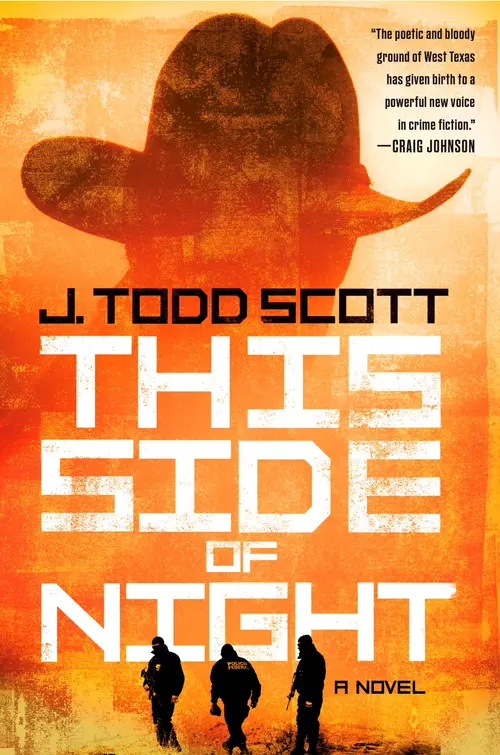
This Side of Night
Cover
ALSO BY J. TODD SCOTT
The Far Empty
High White Sun
Dedication
For Mom and Dad
Sorry it took so long.
Epigraph
Lo malo de la muerte no ha de ser más que la prima noche.
The only bad part of death must be the first night.
—JUAN RAMÓN JIMÉNEZ
PROLOGUE
NOCHE
I
CHAYO & NEVA
When they shot Castel in the face, Chayo knew they were going to kill them all.
Castel had just pulled off his dirty T-shirt and was waving it over his shaved head, screaming they were students, normalistas, all unarmed, when the shot rang out. It was a high sound, clear and cutting, nothing like Chayo had ever heard before.
A church bell ringing.
Castel looked surprised, staring upward into the softening sky, when he fell.
Moments before, he’d stepped off the bus right into the burning bright headlights of the municipal police truck that had blocked their way. Chayo had marveled at how pale Castel was in those lights, his skin smooth and perfect and shiny like a new peso. How small and thin he looked, too, though he was three years older and ready to graduate. His glasses had sat crooked on his face as he yelled, big old ones his abuelo might have worn, and they were just as shiny as his skin, reflecting everything and nothing at all, since beyond that circled glow the intersection—the whole of the world—was nothing but shadows. Shadows so deep that the men surrounding them were only the barest hints of secret movement.
It was like the night itself was sweating, breathing hard: black lungs and an open, swallowing mouth.
Chayo knew that some of those men circling them in the dark wore uniforms, their faces covered with bandannas or old shirts, in shame and fear, and that unlike the normalistas, all of them were armed.
Everyone was then yelling, warnings and names that made no sense. All these policía or men pretending to be so, and the students they threatened.
At the next intersection, so far away it was like looking up to the moon, a red streetlight blinked on and off.
On and off.
A heart beating.
Despite the calming words of their own driver, when the other truck had first appeared, Chayo and Castel and some of the older students—Ernesto, Iker, Juan Pablo—had been angry and eager to pile out of the bus and confront it, make it get out of their way. But it was Neva who’d held him back, her small hand trembling yet holding his tight. Whispering, “No, please,” begging him with her eyes to stay, so that when he looked down into those eyes that for weeks had been making his heart trip and stumble—always tying his tongue—he’d hesitated.
He’d sat back down. For her . . . for them both.
And he wasn’t the only one, not after Iker—with his round, pockmarked face pressed against the window—had called out that the truck was empty anyway. Abandonado. Its driver having quickly vanished into the dark to join the swiftly circling shadows, the truck left idling in the intersection.
Only its lights alive, pointed at them like cold, staring eyes. Seeing nothing.
Ojos de los muertos.
Holding Neva’s hand, feeling her heartbeat in his fingers, Chayo had thought he could hear the empty truck’s radio still chattering to itself, ghostly voices from far away. A mouthful of static. Fantasmas whispering in the hot night and the empty air, murmuring about them: two busloads of young students, trapped in the street.
So it was Castel alone who’d stepped down from the bus to face the truck, calling out to the rest of them still huddled on the bus—all those like Chayo who’d sat back down, afraid:
“. . . It’s nothing, we’ll push it out of the way. Have heart!”
¡Tener corazón!
Castel, who was going to teach in Chiquero later in the year, who liked navelina oranges more than anyone Chayo had ever known.
Castel, from Meoqui, who also wanted to be a poet, someday.
Castel, who had never listened to anyone about anything and made everything an argument, smiling as he did so, the gap between his two front teeth far too wide.
Castel, who took off his shirt to wave wildly in front of him.
Un pequeño torero.
Only Castel . . . whose voice was far too big for that small, exposed body.
Surrounded by light.
Naked.
“We are unarmed. Who do you think you are? The night cannot hide you! We see all of you.”
¡Los vemos a todos ustedes!
But Chayo couldn’t see anything, not really. The night was too dark. It had become this living thing, with its black lungs and beating red streetlight heart and hot, open mouth.
And . . .
Ojos de los muertos.
The night had come alive to swallow them whole and make them disappear.
Or Chayo hadn’t wanted to see, as Neva buried her face in his arm, turning them both away . . .
. . . when the shooting began.
Leaving Castel alone in that pooled light, looking up into the night sky, searching for that mysterious church bell they’d all heard and Chayo would never forget.
Castel, still calling out, “It’s okay. No fear, my friends. They’re shooting in the air.”
But they weren’t.
—
THEY’D TAKEN THE BUSES two hours earlier outside Ojinaga, bargaining with the drivers until they’d agreed to take the thirty-five students of the Escuela Normal Rural Librado Rivera to Chihuahua City. It was the way of things, a practice that had been going on for as long as the rural schools had existed. With no funding from the government, the normalistas—all teachers-in-training for Mexico’s most remote farming areas—had become accustomed to making deals with local bus and van drivers, borrowing and begging and offering them food and lodging and what little money they had in exchange for help. Sometimes it was easy, sometimes not, but they took the buses all the time to visit the remote schools they would eventually be responsible for or to pick up supplies . . . and of course, to go to protests. On this occasion they were going to Chihuahua City to join other normalistas in a great rally against government corruption. Next fall they’d need them again to make their way to Mexico City itself, to commemorate the 1968 massacre of students and civilians by government security forces in Tlatelolco, in the great Plaza de las Tres Culturas. They’d sing and draw chalk outlines of the dead and bleed fake blood on scribbled doves.
Carry signs and chant.
“¡Yo no estaba allí, pero no voy a olvidar!” I wasn’t there, but I won’t forget!
Again, it was the way of things. All the normalistas were going to be teachers, but most were activists, too, at heart. They loved their country and wanted better for it.
Chayo, a first-year, along with Castel and Juan Pablo and Batista, was responsible for getting the buses for the trip to Chihuahua. They found the first at Calle Segunda, near Federal Highway 16. The bus had been empty and the driver had been lighthearted. A big man, round and ruddy as the navelinas Castel liked so much (so Chayo called him “Naranja”), drinking two warm Cokes and eating an empanada his wife had made; laughing easily at Juan Pablo’s jokes. He told dirty stories of his own youth and they all liked him. They found the second on Calle del Pacífico, but this one had been less enthusiastic. He already had paying passengers, a handful of old abuelas and teenagers no older than the normalistas themselves, and only agreed to their request if he could first drop them at the bus station and then talk with his dispatch.
He had to make arrangements for the rest of his shift and have the tires checked for such a long trip.
He didn’t tell jokes or laugh. He was as thin as the other driver was fat, with a pinched and sour face (so he became “Limón”), and sparse hair too small for his head. It looked painted on, badly colored like a child’s drawing. Juan Pablo made a joke about it, and although Chayo had tried hard not to laugh, he joined in with the others until the driver stared at them all, glaring, as if counting or memorizing their faces.
At the station, Limón got off his bus and spoke for a long time to a security guard. An hour passed, and no one seemed to look at the tires. Instead, Limón made calls from a small cell phone, one after another, pacing back and forth and smoking four or five cigarettes—taking so long it made Chayo nervous—until he finally returned.
That was the only time he smiled at them, as he stepped back up onto the bus. He grinned wide to reveal dirty yellow teeth, winking in slow motion in the last of the late-afternoon light, as if they were all just sharing another of Juan Pablo’s jokes.
But no one else knew what the joke was.
And then they were rolling down the dusty road to join Batista, who waited with the first bus.
—
NEVA WAS BATISTA’S YOUNGER COUSIN, and she was not a normalista.
She went to the Catholic school in Ojinaga, but proudly told Chayo the first time she saw him she didn’t believe in God, laughing out loud as she said it, twining her tiny wooden rosary around her fingers. She claimed she’d believe in God when He did something good for her, and He hadn’t done a damn thing yet. Chayo wasn’t sure if she meant that or not. She was small and dark, always in motion like a delicate bird, and everything made her laugh. She’d gotten an iPhone for her quince the year before and loved all other things americano: music and pop stars and bands that Chayo had never heard of. She talked endlessly about television shows and movies, and sometimes Chayo tried to find out about them so he could understand all the things that seemed so important to her, to truly understand her. Most afternoons after school she’d change into a small T-shirt and put on some bright makeup and then appear with a carload of other laughing and smoking girls outside Librado Rivera, supposedly to visit Batista and bring him food and other things, although she somehow always ended up talking to Chayo, too, who felt tall and strange and awkward around her in those moments, as if he were put together from mismatched wood and old nails. He wanted to be funny like her friends, or like Juan Pablo, but he didn’t know any jokes, and oftentimes said nothing at all.
Smiling like a fool as she circled him in cigarette smoke, humming melodies to her songs.
They once walked together along the dirt road by the school, near the fields the normalistas had worked so hard to plant, and for each song she sang, he pointed out for her a different plant, tree, or flower: the dahlias and the lechuguilla and the guayule. The candelilla and the drooping molina and bright red splash of ocotillo. He showed her the sideways S of a rattlesnake’s passage drawn in the dust, and pointed out the difference between the footsteps of a mule deer and a javelina. He told her that at one time jaguars had hunted these areas, but they were long gone, or no one had seen one in such a long time that it was much the same thing. She asked where he was from, and although he was embarrassed, he told her anyway—near Blanco—and when she admitted she did not know that place, he said no one did.
And then she had laughed, though he wasn’t trying to be funny, and it was still the most beautiful sound in the world. She even put her hand on his arm—for a heartbeat—to let him know she meant no harm.
It was the first time he’d felt those fingers on his bare, tanned skin, and although he was ashamed of how filthy he was from the fields, he couldn’t shy away from that slight brush of fingertips . . . letting her touch work all the way through him. Right into his blood and bone. For hours after she was gone he’d still felt that brief contact—heavy and hot and beating in time with his heart—leaving him both happy and terrified that he would always feel it.
That it would never go away, or worse, never come again.
It wasn’t just that touch, but also what she’d said: how she’d smiled and put her head next to his as if they were sharing a secret, sharing one breath, and whispered that she liked his seriousness. He’d wanted so badly then to tell her that she was beautiful—the most beautiful thing he’d ever seen—but she’d already pulled her hand back from his arm, dancing away down the sunlit road, taking all his words and breath and heart away with her.
—
NEVA DIDN’T WANT TO CHANGE THE WORLD, she wanted to leave it.
She talked about it all the time: going over the Río Bravo to Los Estados Unidos to stay with familia she had in Dallas or Houston (Chayo could never remember which). In two years she planned to leave Ojinaga for good, or so she promised, and get a job and see the americano bands that she loved and shop in the stores that she’d read about. She believed trying to change things in México was as silly as trying to move a mountain, and when Chayo once told her that such a thing could be done, one rock at a time, she’d said maybe, maybe, but that would take too damn long and she had too many other things to do. Plus, rocks were sharp and heavy, and she didn’t want to hurt herself. She pretended not to care with such practiced ease that she almost believed it herself, but Chayo knew better. She was afraid of what change demanded, of its high cost. In the past few years everyone had lost someone, something, to the narcos and their corruption and a government that had no will to stop either. Everyone had a story, as many stories as all the songs she sang.
She was right; she just didn’t want to get hurt.
—
SO HE WAS SURPRISED when they returned to Naranja’s bus to find her there waiting with Batista and the other normalistas. He thought at first she’d only come to see them off, but no, she was going with them. She needed to see for herself what all the fuss was about, take some pictures on her iPhone, and share her grand adventure with her friends. She even leaned in close to him (not as close as that day on the road, but close enough) and said maybe she’d carry a rock or two of her own, a couple of the lighter ones. Her eyes were bright and shining and forever, and he knew then that he’d carry her all the way to Chihuahua City and back in his arms, if he had to. He wanted her to come more than he’d ever wanted anything in his whole life, so it was good there was no talking her out of it anyway.
She marched onto Naranja’s bus with a smile on her face and Chayo had no choice but to follow her.
—
“IT’S OKAY. No fear, my friends. They’re shooting in the air.” Castel was waving his shirt, about to adjust his now crooked glasses, when his face disappeared.
Chayo saw that clearly.
It was there and then it was gone, only a reddish mist left hanging in the air like a bloody thumbprint. Shattered glasses falling to the ground. Then Castel himself was gone, too, all of him, as if he had never been; vanishing completely. The night that had been stalking them took him just like that, just like a pouncing jaguar. Juan Pablo shouted, pointing at the place where Castel had been standing, as another bullet came through an open window and punched him in the throat. He looked down at his hands, opening and closing them like he was trying to hold on to something he couldn’t see, before falling backward into his seat. His steaming blood hit Iker in the face, who screamed and scrambled to wipe it off, but not before three fingers of his frantic left hand were clipped off by another passing bullet. Then the whole bus was filled with them: bullets from every direction, like heavy bugs battering at the inside of a glass lamp, each as big as the pale leopard moths Chayo had collected in jars as a boy. The normalistas began screaming and throwing themselves down between the seats and on the floor to escape them.
Chayo saw the driver Naranja stand, his great bulk eclipsing the light from the truck in front of them. It was like he was lit from within, the tips of his hair burnished by light. He waved his fat arms as if waving the bullets away, trying to shield a boy Chayo did not know well, until the funny and brave bus driver took one, two, three bullets in the stomach and chest and the bus’s windshield buckled, flecking his falling body with glass.
An hour earlier he’d been eating an empanada and laughing with them.
Él sólo murió por nosotros.
No . . . no . . . we killed him.
Limón had already abandoned his bus, leaving Naranja’s pinned between the other two vehicles. Both buses were under heavy fire now, bullets ricocheting off their metal skin, hot sparks dancing in the air. Glass was breaking and blown tires were groaning like old men. Normalistas were crawling over one another and fleeing the buses, making a wild run across the intersection, some waving cell phones in the air, either trying to make calls or film what was happening to them. But they were only beacons, as bright and telling as flashlights, and the men hidden in the shadows used them to track the fleeing students over the dark streets.
Chayo saw one after another go down, their phones left bouncing across the pavement.
And that’s when he knew they were going to kill them all. He didn’t know why, or what crime they had committed, but now that the shooting had started, it couldn’t end without all of them dead. Dead and buried and rotting somewhere in a deep hole, piled on top of each other and covered in dirt or sand or trash or shit. The men out there would see to that.
They had to, to bury the shame of what they’d done.
This night would never end until it swallowed them all.
Neva was screaming, both his name and Batista’s, and this time it was he who grabbed her hand, holding it tight. He told her over all the noise that it was going to be okay, that he would get her out of there no matter what. Nothing would happen to her.
She looked into his face and he saw that she believed him.
A bullet gently moved the air, nearly kissed his face. Like soft wings against his skin. It reminded him of Neva’s touch, that very first touch.
These are only moths like those I used to catch in Blanco. They cannot hurt me.
Nada me puede hacer daño.
He told her to stay low and behind him, to move only when he moved. If he fell, she was to keep running and not look back. He couldn’t help himself and quickly kissed her between the eyes and whispered that he loved her, but he wasn’t sure she heard him, and that was okay. At least he’d said the words, finally releasing them. Their weight would no longer burden him or slow him down and he would not die with them heavy on his lips.
Voy a volar por los dos de nosotros.
He squeezed her hand again, not to hold her back as she had done for him, but to let her know it was finally time to run. To run and never stop.
To fly. Para volar.
And they did.
II
Juan Abrego Carrión kissed his little Zita and thought about murder.
Death. Muerte.
The Story Continues on BooksBarbecue!
Enjoyed this preview? ❤️ Do not stop here!
Read the complete book free online → 🔗
Continue reading now on BooksBarbecue and discover every page!
Love reading? Bookmark BooksBarbecue.com for more amazing books!
Happy Reading!