The Year the Maps Changed
Cover
Title Page
This is a work of fiction. All central characters are fictional, and any resemblance to actual persons is entirely coincidental. In order to provide the story with a context, real names of places are used as well as some significant historical events. A number of high-profile people are also referred to, but there is no suggestion that the events described concerning the fictional characters ever occurred.
This fictional story takes place in the Kulin Nation and is set on the lands of the Boon Wurrung people. The Boon Wurrung are the traditional people and custodians of these lands, from the Werribee River to Wilsons Promontory. I pay respect to their elders and acknowledge this land was taken by force and that the First Nations have never ceded sovereignty to their lands and waters.
Dedication
For Mum and Dad, and Omi too.
I love you.
Epigraph
We are volcanoes.
When we women offer our experience as our truth, as human truth, all the maps change.
There are new mountains.
URSULA K. LE GUIN
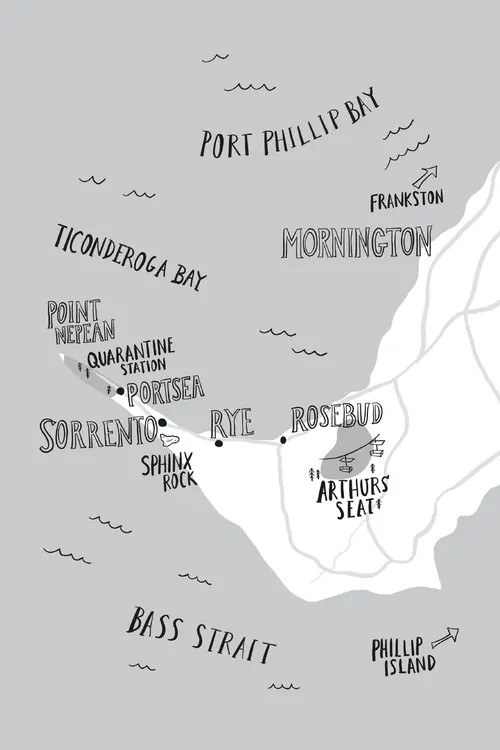
Map
Prologue
Maps lie.
Or at least, they don’t always tell the truth. They’re like us humans that way.
Mr. Khouri would say it’s because they can’t show us everything about a place or the people in it. Maps don’t tell you about the ownership, genealogy, or history of an area. A map doesn’t even really tell you where to begin or end—those ones with “Start Here” and “X Marks the Spot” are just that way in movies, or kids’ menu coloring placemats. Really it’s up to us—the people who live within the borders—to keep the truth and know the way.
And lately I’ve been thinking that it doesn’t matter so much where you end up, if you can’t remember how you got there in the first place. Like my pop would say: it’s not the destination, it’s the journey.
Remembering is like retracing my steps. There are so many different trails to this story and it’s hard to know which one to take. But I need to lay down a way to see everything that happened this past year: the war, Nora, Operation Safe Haven, and the baby we couldn’t keep.
I was eleven when everything started and twelve by the end. But that’s another way that maps don’t tell the whole truth—because it felt like the distance I traveled was a lot further than that.
1
Memories Like Mountains
Arthurs Seat is the highest point of this mountain range here. It’s named that because it looks like someplace else—it’s got nothing to do with King Arthur and the Knights of the Round Table, like I’d always hoped.
Last year we learned that the Boon Wurrung people called the mountain Wonga and held corroborees—sacred dance ceremonies—lower down on the slopes called Wango—probably about where the parking lot is now.
From the very top of Arthurs Seat, you can see clear across the Mornington Peninsula, where we live, and over the whole bowl of Port Phillip Bay, from the tip of Point Nepean to the silver city of Melbourne winking in the distance. But if you want to go to Arthurs Seat and see all of that, you have to take the chairlift.
Luca first took me there when I was six, the year my mom died.
I was obsessed with great heights back then. I nearly gave everyone a heart attack one day when I crawled out of our neighbor Jed Trần’s bedroom window and onto the slanted shingle roof. I was too chicken to go to the edge like I thought I wanted to, so I ended up sitting somewhere between the gutter and the window, like a flung Frisbee, until Pop called Luca to come and get me.
After Luca roared up on his police motorbike, he went and got the Trầns’ old ladder from the garage while Pop kept calling to me from down below, telling me to stay put.
I could hear Jed’s mom, Vi, somewhere inside too. She was giving her son an earful for letting me climb out there, and for not having the good sense to come get her the second he saw what I was up to.
By the time Luca finally crawled out to me, I was heaving my guts up with tears, but it wasn’t because I was scared. It was hearing Jed’s mother yell at him like that and remembering that mine never would again.
Well, Luca got me down and proved that fathers can yell at reckless children just as well as mothers can. Then he asked me what I’d been trying to achieve in the first place.
“I wanted to see her,” I said.
“See who, Freddo? Maria?” He shook his head. “Your mama?”
I nodded.
“Heaven’s right there.” Then I pointed at the sky, that big endless thing. “I just wanted to see her again.” Because that was all anyone said to me in those days: she was in heaven now, safe and sound and looking down on me.
I still remember the feel of Luca’s polyester police shirt, and how it ended up smelling like salt and his aftershave once I’d cried into it for what felt like a decade. He explained a few things to me then, about heaven being more of an idea and less of a place, much less one you can climb to. But then he said trying to get a little closer to her wasn’t such a bad idea. I’d just gone about it all the wrong way.
Luca took the rest of the day off. He told Pop that he was going to take me someplace special. “Our own little corner of heaven.”
And then he did—the chairlift on the Arthurs Seat summit. The metal double chairs had a little canopy like an umbrella up top. They’d swing you down this 950-meter-long cable, starting 314 meters above sea level (the numbers were all written on warning signs at the ticket booth), with nothing for protection but a skinny metal bar across your lap as you went diagonally down the mountain.
And the view from up there . . . it’s really something else. I remember thinking that I could touch the tops of trees with the soles of my shoes if I just swung my legs enough. And I remember knowing that my mom would have loved it up there with us.
Luca guessed what I was thinking. “Your pop says Maria used to love riding on this when she was younger.” And then he kind of muttered, “But probably not quite this young.”
It was true I was young for the ride. I think the lift operator had been a little nervous to let me on, but since Luca was still in uniform he’d sold us tickets and let us go anyway. I think Luca had been worried, too, because he’d kept one of his big hands on the collar of my dress the whole way, and I could hear him gulping when my swinging legs made the chair sway.
I was no closer to heaven that day and I’m not so sure I even believe in it now—the place or the idea—but I felt closer to Mom. And every year since, when Luca and I made our annual trek to the summit, I felt like I got closer still. We’d talk about Mom while we were up there, just the two of us, in a way that we couldn’t with our feet planted firmly on the ground.
At least, that’s how it used to be.
I have decided that memories are a little like mountains. You need to hike to the top and get some height—what Mr. Khouri calls perspective—so you can look down at how far you’ve come, and see all the people and choices that make up the map of your life.
2
The Greater the Height
On the second to last Tuesday of the school holidays in January 1999 (in Australia, our holiday vacation extends through the whole month of January), we were snaking our way up the mountain: me, Luca, Anika, and Sam. And even though I must’ve made that climb a dozen times, I still got a little green around the gills, as Pop liked to say, when we lurched around corners. My stomach would go one way while the car went the other.
At least now that I was older I remembered to look straight ahead and not out the window as we went higher and higher up, because watching the drop always made my stomach heave. Don’t ask me why, but I felt safer in those metal chairs swinging down the mountain than in a car as it hugged the bends.
Sam didn’t know not to look, and I didn’t bother telling him. He was sitting behind Luca, who was driving, with his face practically kissing the window while both hands clutched the door handle. From where I sat behind Anika, I could see she was holding her handle the same way, knuckles popping.
“How are we all doing?” Luca asked.
“Good! Great! Are we nearly there?” Anika did not sound excited.
She’s Luca’s girlfriend, but he doesn’t call her that. He’d say Anika was his “partner,” like they’re working on a school project together or riding around in his police car.
Sam is her son from her first marriage and he was ten when everything started—one year younger than me. He and Anika look like copies of each other. They have these dark-green eyes and pretty, long lashes, plus they both wear glasses. Only their hair is different—his is a short mop of dark-brown ringlets, and Anika’s is long and springy-curly.
I look like my mom, too, or at least that’s what Pop reckons—and he’d know, since he was her dad. I’m tall for my age and lanky, with blue eyes and floppy, fair hair with bangs. I even have light-brown freckles just like she did. Luca says they’re like connect-the-dots on our noses.
We took another bend and I watched Luca reach over the center console and give Anika’s leg a pat. He put his hand back on the wheel and said, “Just think about the view from the top—it’ll all be worth it, right, Freddo?”
“Right. So worth it.” But my voice sounded dry and crumbling, like a first-try pancake. Luca caught me in the rearview mirror and raised his eyebrows as though to say, Play nice, be polite.
Ever since Anika and Sam moved in with us two months ago, Luca has kept telling me to be on my best behavior. He’d say I had to mind my manners and be extra polite and welcoming because we’re a family now. Which really didn’t sound like any family I’d ever been a part of. It wasn’t the way we used to be, when it was just Pop, Luca, and me. And even though I can barely remember the time before I was three—which is how old I was when Mom and Luca married—I was also pretty sure it wasn’t that way when it was just Pop, Mom, and me either.
Anika tried to turn around and look at us kids, but her seat belt locked so she could only look at Sam, who was still staring out the window. “Are you getting excited, babe?”
He ignored her question. “How high up are we?” he asked, his words fogging the window.
“You should ask Fred! Her class came here last year on a field trip, isn’t that right, Freddo?” Anika tried to look at me, but I just saw the side of her face and one of her cheeks bulging in a smile.
I hated the way Anika tried all my nicknames on for size. She still hadn’t settled on one yet, and part of me just wanted to tell her to call me Winifred, but Luca might think that was impolite.
I was named after my nan—Pop’s wife—who I never met. Fred is Pop’s nickname for me, Freddo is Luca’s, and Winnie was Mom’s. I once asked Pop why they couldn’t stick to one name for me, and he said he didn’t know, but maybe they all wanted to have little pieces of me, all to themselves. Lately I’d been wondering what piece Mom took with her when she died, and I’d been thinking about the Winnie I would have been if she hadn’t. It was something I wanted to talk about with Luca, when we were 314 meters above sea level.
Sam pulled me out of my thoughts by repeating his question. “So, how high up are we?” He turned away from the window to frown at me. “Do you even know?”
“I can’t remember,” I muttered, and went back to looking at the safe scenery of granite ahead.
Last year, Mr. Khouri had shown us a map of the area. It was full of lines and lines and lines wrapping around each other. He explained that it was a topographic map, and those lines were contours—a way to represent a three-dimensional surface on a flat piece of paper. He showed us how to read the lines to find valleys and hills, and how steep the slopes were; the smaller the circle, the greater the height. Around Arthurs Seat were all these tight circles and lines, and he asked our class what they reminded us of.
“Yes, Winifred?” Mr. Khouri had said, like he couldn’t believe how quickly I’d put up my hand.
“Like . . . fingerprints?”
“That’s exactly right!” And then Mr. Khouri smiled. Full-on, full-blown beamed. At me. “That’s correct, Winifred! Place is as much a part of your identity as your fingerprint or DNA. Little disturbances around where you live have these ripple effects that spread out and out and out into the lives of everyone, and everything around you.”
Mr. Khouri was right about those disturbances. They started rippling that day we went driving up the mountain, and then kept spreading—and lately I’ve been thinking that maybe they’re still going, even now.
It was the kind of morning where the sky was the same color as Port Phillip Bay; the whole world was blue on blue. And from the Arthurs Seat summit you could even see white sailboats bobbing in the water.
But as soon as we pulled into the parking lot, Anika jumped out and dashed to the toilets saying she thought she was going to be sick. Luca had followed her, and then came back to stand with us kids by the stone wall of the lookout.
“She’ll be right, just those bends took her by surprise,” he said.
Sam was playing with one of the coin-operated standing binoculars, gripping both sides and making rat-a-tat-tat-tat-tat and brrrrrp! sounds, like he was in a shoot-’em-up game at Timezone.
When Anika finally wandered over to us, her face was as white as those sailboats, her glasses were all steamed, and she’d tied her hair up into a messy bun.
“Hey, guys, I’m so sorry—that’s not a very fun way to start our day.”
Luca reached for her hand and squeezed it, and then they smiled at each other. Sam kept gunning boats behind us, and I rolled my eyes—which of course Luca caught and frowned at me for.
“I don’t think I’ve got it in me to do the chairlift either,” Anika said.
Sam stopped gunning and turned around, frowning hard at his mom. “But you promised!” he whined and pushed his slipping glasses back up his nose.
I tried not to smirk.
“I know, babe, and I’m sorry. But I’m just not up for it today.”
Sam opened his mouth, about to whine more, but Anika cut him off. “Let Fred and her dad do one trip together, then when they come back Luca will do another one with you, okay?”
I looked away when Anika said that. She cleared her throat and said quietly to Sam, “Let Luca and Fred have their time together first, okay?”
“Well, wait a minute,” Luca said and held a hand up. “I’ve had plenty of goes on this thing—and this is Sam’s first time, so why don’t the two of you just ride together?”
Luca was looking at me when he said it, and I could see it all right there in his eyes—asking for one big happy family. Play nice. Be polite. I nodded my head and shrugged, then felt Luca’s hand land on my shoulder, squeezing as he said, “Good girl, Freddo.”
I showed Sam how to get onto the chairlift and lowered the thin metal safety bar across our laps. We waved to Anika and Luca as they watched us sail over the parking lot, and then we cleared the trees and took in the view of the whole peninsula—the dips and valleys, towns with houses like little boxes, and the long stretches of sand hugging the water. Our town was down there somewhere to the left of us too: Sorrento.
If you looked at a map of where we live, you’d see that the Mornington Peninsula is shaped like a fatter version of Italy—a Blundstone boot instead of a fancy high heel—and instead of kicking Sicily, we’re putting the boot into the Bellarine Peninsula. In class last year, we learned that our town, on the toe of the boot, was named after the town Sorrento in Southern Italy (another place that got its name because it looked like someplace else).
I pointed this out to Sam but I didn’t know if he was really listening. After a while there wasn’t much left to say.
The seats in front of us were all full and we kept passing couples to the right of us making their way back up the mountain. I turned around a little to see that behind us was full up too.
“Don’t do that!” Sam yelped.
I sat back around and looked at him. “Do what?”
“Make us move around. Stop it!”
I noticed his hands were gripping the steel bar in front of him, knuckles popping just like Anika’s had been in the car on the way up.
“Are you okay?”
He closed his eyes. “Just stop moving so much!”
I sat back and tried to be still, even with my legs hanging out and dangling a hundred meters in the air. I listened to Sam take shuddery, shaky breaths beside me and watched his knuckles turn whiter on the safety bar.
“Why do you and Luca do this every year anyway?” he asked.
I looked over and saw his eyes were still shut behind his round, red glasses, so I couldn’t just shrug his question away. “I was sad one day and he brought me here, and it didn’t make everything better but it was . . . okay.” I shook my head. “So now he always takes me in the last weeks of the Christmas school holidays—just the two of us.”
I wondered if Sam could hear the hurt behind my words, but he didn’t seem to.
“Kinda like how my dad takes me to his first game of cricket every year,” he said.
I’d met Sam’s dad a few times in the last eight months since Anika and Luca had become a couple. His name was Ian and he seemed nice enough, except he lived all the way on the other side of the city and didn’t come down very often to see Sam. He hadn’t even been to visit since Anika and Sam moved in with us, and now he was away over the holidays with his new wife. They’d sent Sam a present from Queensland, but it arrived two weeks after Christmas—one of those Super Soakers. Sam had seemed disappointed. I think he’d been expecting something different, or else just wanted his dad to be there to give it to him in person.
Our chair was coming to the end of the downward loop, speeding up a little as the cable wrapped around a steel pole and pulley at the bottom of the mountain. A few people in front of us were hopping off there, maybe to go and explore along one of the hiking trails, but most people were like us, staying on and making their way back up.
Sam opened his eyes when we got to the bottom, and one of the chairlift attendants nodded at us when I didn’t make a move to lift the safety bar and get off.
Instead our chair started making the climb back up, and that’s when Sam said, “You’re lucky that Luca does this with you.” He took a shaky little breath. This part was scarier: climbing higher and higher up with your back to the plummeting view.
Sam kept talking, even as he closed his eyes again. “I mean, it’s not like Luca has to do this kinda stuff, since he’s not . . .”
He didn’t finish but he didn’t need to. When Anika and Luca started dating, the dad thing was one of the first that Sam asked me about. Or rather, told me about.
“Luca’s not your dad, obviously,” he’d said one evening when the parents had lumped us together after dinner. Like sticking us in the living room with old board games and no TV was going to make us fast friends.
I’d glared at him, and his face went tomato red—right to the tips of his earlobes.
He had meant that Luca and I look nothing alike. Luca’s father was Italian, and he married Luca’s mother when he migrated to England, before they decided to settle in Australia, where Luca was born. I never met Luca’s parents, because they died before he married Mom. I’ve seen photos: he looks a lot like his father with the same kind, dark eyes. Luca is also tall but broad, with dark, olive skin and he wears his black hair in a policeman’s buzz cut.
“I just mean he’s not, like, your actual dad—right?”
The Story Continues on BooksBarbecue!
Enjoyed this preview? ❤️ Do not stop here!
Read the complete book free online → 🔗
Continue reading now on BooksBarbecue and discover every page!
Love reading? Bookmark BooksBarbecue.com for more amazing books!
Happy Reading!