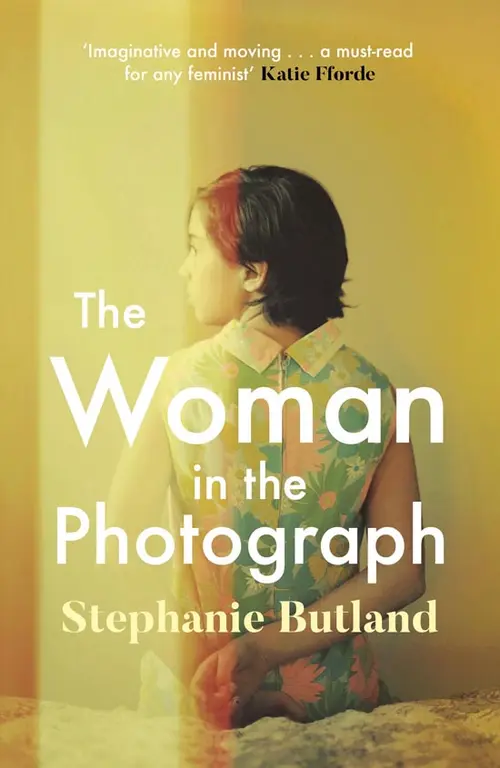
The Woman in the Photograph
Cover
Praise for the previous work of
Praise for the previous work of

‘Burns fiercely with love and hurt. A quirky, rare and beautiful novel’
LINDA GREEN
‘Utterly engaging from the first line to the last . . . impossible to put down’
KATIE FFORDE
‘Brave and beautifully written’
ZOË FOLBIGG
‘Beautifully written and atmospheric’
TRACY REES
‘Wonderful . . . beautiful’
AYISHA MALIK
‘A beautiful, touching, moving, sweet treat of a book. Sad, intriguing, cleverly plotted, sometimes shocking, compelling read . . . I absolutely loved it’
JANE WENHAM-JONES
‘I loved it so much . . . the thing that most struck me was the sheer human-ness . . . It rang incredibly true’
SHELLEY HARRIS
‘A unique, beautiful novel that cleverly builds to a heart-stopping climax’
TRACY BUCHANAN
‘Lost for Words is that rare thing . . . a warm, wise and funny tale of our times with a dark and shocking twist . . . guaranteed to keep readers on the edge of their seats’
LANCASHIRE EVENING POST
‘An enchanting read that will make you shed tears of sadness and joy in equal measure’
WOMAN’S OWN
‘Brave, intuitive, incredibly grounded and funny . . . A clever book that is unputdownable’
CANDIS MAGAZINE
‘An engaging read with a relatable and realistic heroine’
THE LADY
‘Oh, wow. Just . . . wow . . . Butland has created such an unforgettable character . . . Poignant, heartwarming, and totally unforgettable; Lost for Words is the soul-searching, exceptional novel that I have been waiting for’
THE WRITING GARNET
‘Brimming with hope, drama, friendship, love, and new beginnings and I read this book from cover to cover in one evening. This book is stunning and special and everyone should read it as soon as possible’
BOOKS OF ALL KINDS
‘Oh how I adored this book. I loved everything about it . . . Simply beautiful’
FROM FIRST PAGE TO LAST
‘Lost for Words is a compelling and lovely read that will warm your heart and leave you with a smile on your face . . . definitely do not miss out on this one!’
A SPOONFUL OF HAPPY ENDINGS
Dedication
For Dad, who taught me about photography, and that I can do anything
Epigraph
‘What makes photography a strange invention is that its primary raw materials are light and time.’
Understanding a Photograph, John Berger
24 April 2018
24 April 2018
The Photographers’ Gallery, Ramillies Street, London
Seeing the photograph will be a shock.
It always is. Even though she is the one who took it.
Veronica leans against the wall opposite the gallery entrance, braces herself, and turns her eyes to the poster. The no-nonsense font declares: ‘Women in their Power: Veronica Moon and Second Wave Feminism: 26 April—26 August 2018’. Two days from now. Vee reads the words until they cease any sense they were making, and then she makes herself look at the image. Doing it here, publicly, with cyclists skimming through her field of vision and grimy London noise all around, makes her feel half-disappeared already.
The feelings have never changed, even if the memory is long gone. Love and loss and ache and sheer flaming rage at everything that was taken from her in the moment that she pressed the button that opened and closed the shutter faster than a final blink. Vee is top-full of it all, still, even after all of these years.
Leonie, the woman she loved as she has loved no one else in her seventy years, glowers from the frame. Her heavy brow, half-closed eyes, great arc of a nose, all suit being enlarged to poster size. Leonie always knew that she deserved more space than the world gave her. The black and white image looks contemporary after thirty years, as the novelty of colour and fuss in photography has come into fashion and gone again.
Veronica can, if she tries, admire this as a photograph. All of her craft is here: the way she managed the light, chose the angle, created a portrait that is both greater than Leonie and the very essence of her, distilled to an almost unbearable likeness. But there are good reasons why she avoids it. It was the moment of the two greatest losses of her life.
Even now, when she should be facing everything, resolving everything, when her eyes should be taking in all that they can before it’s too late, she cannot bear to look at this image for long.
Whether Vee likes it or not, it’s what she will be remembered for. Though if she had been a war photographer, she would have been congratulated. If she had been a man, come to that. Unflinching, they would have said. Bold. Uncompromising. Veronica, by virtue of being a woman: heartless, ambitious, unfeeling, selfish. Career over.
Part 1: Subject
Part 1: Subject
First, forget all you think you know about the camera being a neutral object, a benign, unlying eye, watching and capturing everything without judging or deciding. That’s what the world wants you to think.
In the hands of a true photographer, a camera can be clever, wily, sharp, cutting; it can be consoling, healing or divisive; it can be smart. It should definitely be smart. At least as smart as the person who is holding it. And if that person is a woman, she will know already how to pay attention, to watch the world around her for signs and clues to what she needs to be careful of.
Every time you press the shutter, you are making a choice about where to look, and what you are choosing to show, or to remember. You are creating a history.
Veronica Moon, Women in Photographs (unpublished)
‘Postman at the Picket Line’
Veronica Moon
Exhibition Section: Early Days
Camera: Nikon F1
Film: Kodak, 200 ASA
First published: This Month magazine, 1968
Welcome to Veronica Moon’s world: quietly subversive, women-centred, and not afraid to allow the viewer to deduce the story behind the image.
This photograph was taken at the picket line at the Ford Dagenham strike of 1968. Female machinists had walked out in protest at being paid less than their male counterparts for equivalent skilled work. Moon had just arrived at the site when the postman came to deliver the mail; in this photograph, she captures the moment when he decides not to cross the picket line and turns back, cheered by the striking machinists. Notice how the focus of the photograph is not the postal worker himself, who is caught leaving the shot, only his shoulder and bag visible. Rather, Moon draws the watcher’s eye to the three women in the foreground of the photograph, the interplay between their bodies, arms linked, and the tilt of their heads as they laugh. The image is reminiscent of Land Girl publicity posters and seaside holiday snaps, and connects to our ideas of women as sisters, united and formidable.
The women here are strong, good-humoured and full of purpose; the camera’s view is steady and honest. Behind the trio of faces the photograph focuses on, you’ll see another group of women; the one on the far right is the second wave feminist and writer Leonie Barratt, a long-term associate and close personal friend of Moon.
This early photograph bears many of the trademarks of Moon’s later work. The focus is sharp: as with her later portraits, there is no desire to hide flaws or soften images. The photographer draws our attention to the faces of her subjects by positioning them a third of the way down the frame. And there is nothing static or posed about this photograph. It is a moment captured that would otherwise have been lost.
This is the first of Moon’s images to have been published in the UK national press, when it appeared to accompany a column by Leonie Barratt in This Month magazine, in July 1968. This Month was published from 1962 to 1986 and published a range of reviews, features and columns, with a readership of 250,000 at its peak. It could be seen as the first photograph of Moon’s feminist career. Many of the photographs that Moon took previously while working at the Colchester Echo do feature women, but these are in traditional roles – at coffee mornings and charity events. Moon was assigned these jobs while her male colleagues were given news and sports stories to cover; she went to Dagenham on her day off, having been refused permission to attend as an official photograph by the Echo’s editor.
In 1968:
• Harold Wilson was Prime Minister of Great Britain
• In the USA, Senator Robert (Bobby) F Kennedy and Martin Luther King were assassinated within three weeks of each other
• The Beatles had two number one chart singles in the UK with ‘Lady Madonna’ and ‘Hey Jude’
• Enoch Powell made his notorious ‘Rivers of Blood’ speech
• The TV show Dad’s Army was first screened
• A demonstration in London’s Grosvenor Square against US involvement in the Vietnam War ended in violence and mass arrests
• the Abortion Act 1967 came into effect, legalising abortion on a number of grounds
• Agatha Christie’s novel By the Pricking of My Thumbs was published
• The film Rosemary’s Baby was released
• The iconic photograph ‘Earthrise’ was taken when the Apollo 8 spacecraft orbited the moon
And the female machinists at the Ford Dagenham car plant went on strike because they believed their skilled work should be appropriately rewarded, and they should be paid at the same rate as men doing equivalent grade jobs. Veronica Moon went to take a look.
15 June 1968
15 June 1968
‘WHAT ARE YOU SIGHING ABOUT now, Dad?’ Veronica’s father, Stanley, reads the Daily Mirror less for news and more as a starting point for discussion.
‘I’m all for equal rights but this is going too far. Listen. “Thousands of car workers will be laid off next week unless 187 women sewing-machinists call off a strike for more pay.” ’
‘You ain’t really for equal rights, then, are you?’ Vee has her kit spread out on the dining table, and she’s checking and cleaning each part in turn: camera body, lenses, filters, strap, the case she carries it all in. When she presses the shutter and winds on, the sound always seems synchronised with the beat of her heart.
‘I am. But it ain’t an equal situation, now, is it, Veronica?’ He leans forward in his armchair, crumpling the newspaper into his lap, and says, ‘The women will only be working for pin money. The men who get laid off – they’re the ones putting bread on the table. And their wives will have something to say if they come home with nothing.’
‘I thought I might go down, later in the week. I’ve got my day off on Thursday.’
‘Bob isn’t sending you to cover it, then?’
‘It’s a bit out of our way, and anyway, Bob wouldn’t send me. He’d send George. I just get the jobs George don’t want.’ A jumble sale to raise money for the Spastics’ Society was the highlight of last week.
When Vee got a start as a junior photographer at the Colchester Echo she knew she was lucky, and she knew she would have to work her way up. (Not least because she suspected that her dad had probably twisted Bob’s arm to get her the job in the first place. The two of them were at school together. Veronica hasn’t asked if that swung it for her, because she really, really doesn’t want to know.)
Stanley gets out of his chair. ‘Well. That allotment ain’t going to weed itself.’
‘That’s for sure,’ Vee says.
‘It’s a nice day. But you’ll be shutting yourself under the stairs, will you?’
Vee smiles. ‘What else would I be doing?’
Stanley shakes his head. ‘This will all have to change once you’re married, you know, treasure. Barry won’t want you sneaking round here every Saturday afternoon.’
‘Barry doesn’t mind, Dad. And anyway, the wedding won’t be for a few years yet.’
‘Your mother was only nineteen when we got married.’ It’s eleven years since she died, but the hollowness of loss is still great enough to make a short, hard moment for them both before they look at each other and sort of smile in acknowledgement that she is gone, they are not, and they are the only two people in the world who could ever understand, precisely, what that means.
‘Will you bring some rhubarb? We can have it for afters, tomorrow.’
Stewed rhubarb and condensed milk is her dad’s idea of heaven.
Stanley nods, takes his hat from the stand by the door, and he’s gone.
*
Almost as soon as Vee had managed to get a camera of her own, when she was fifteen, thanks to savings and a birthday and Christmas present combined, she realised that she’d never be able to afford to have her films developed, so she set about learning how to do it herself. The novelty of her makeshift darkroom under the stairs, the sour/sharp smells and the eerie light, has yet to wear off.
Vee can still remember the first time she saw a photographer at work. It was at a cousin’s wedding. Vee was a seven-year-old bridesmaid, in shell pink with a little white knitted cardigan, pink silk roses to hold, and borrowed satin shoes with scrunched-up handkerchiefs in the toes to make them fit. Every picture of her from that day shows her staring into the camera. She remembers how much she wanted to know what was happening under that cloth the photographer was hiding in. When she wasn’t in the photographs she stood behind the tripod, listening to the clicks and winding sounds of the camera at work. When the photograph album was shown – cousin Betty had married up in the world, there was no one in the family who had had a proper album before – Veronica saw how the adults used the photos to relive the day. They commented on this hat and those flowers, what a shame it was about the weather and how handsome Betty’s husband was. That man, under the cloth, with a button and a handle to wind, had quietly made the shape of their memories.
She didn’t understand it in those terms at the time, of course. She just knew she wanted a camera like other children wanted a pogo-stick.
Now she and Barry are engaged, and he’s keen for them to spend all of their spare time together, she still pleads for her Saturday afternoons. Once Dad started inviting him to the football, that got a bit easier. On match days, she can join them in their local pub afterwards, commiserate or celebrate, head on to the pictures or to Barry’s mum and dad’s for tea. She finds it easier to be polite, to talk about Z-Cars and Harold Wilson, and other things she isn’t much interested in, if she has spent a few hours in her cramped, impossible-to-stand-upright-in darkroom, lit by its red light bulb, watching her images develop as they float below the surface of a chemical bath. Feeling her soul’s happiness as she does what she has wanted, above everything, to do since cousin Betty’s wedding day.
20 June 1968
20 June 1968
VERONICA MOON HAS NEVER BEEN to a picket line before.
‘Don’t do anything I wouldn’t do,’ Dad said, as he waved her off this morning. He had checked the tyres on their shared Ford Anglia, as though the hour and a half from Colchester to Dagenham was some kind of epic journey. Still, it’s probably the longest drive she has ever done on her own.
‘Funny thing to do on your day off,’ had been Barry’s comment, but Barry’s job isn’t his hobby, so of course he wouldn’t understand. Vee hates that he calls photography her ‘hobby’, but she can’t think of a better word. It’s her passion, really, but when she said that to him he laughed and said, no it wasn’t, he was.
And now, here she is. Actually where the action is, for once.
The papers yesterday reported that Ford are losing more than a million pounds a day because of the strike. The Secretary of State is involved. All the way, in the car, Vee has been thinking about what she would find when she arrived. She thought she would be able to see the world changing, and that she could be the one to chronicle it. She’s been drawn back, again and again, to Bill Eppridge’s photograph of the dying Bobby Kennedy. She feels the shock of the event, of course she does: she’s crowded round the papers, the television, with everyone else as the impact has been discussed, all over the world. But when she looks at the image of the man on the floor, the blood, the young man cradling his head, she feels something else, too. Or rather, she imagines – imagines she was the one in the Ambassador Hotel in LA when the bullets were fired. Would she have had the presence of mind to take those photographs? She thinks so. She just needs to get herself to places where history is happening.
The picket-line women are in flat shoes and mini-dresses, arms bare to the sun, tiny and bright against the metal gates, the grimy brick of the factory building glowering over them. Vee wishes she hadn’t dressed the way she always does for work. Her knee-length skirt is sticky with static against her stockings. Her jacket, so handy with the pockets for film cases and spare lenses, is weighing her down, and she can’t take it off because she knows she has sweated through the blouse beneath it. She feels old-fashioned, out of touch. Why doesn’t she have a mini-dress? Why is she sleeping in rollers? And why on earth are hair and clothes what she is thinking of now?
Maybe this is what the world changing looks like. It’s not as dramatic as what happened in Grosvenor Square or the protests in Paris, but it could still be part of a change. As her dad says, nothing lasts forever.
She takes a closer look at the banners. They are painted or coloured in, made with careful attention to detail, letters equal height and the spacing of the wording considered. ‘No Deal Till You Recognise Our Skill’ reads one banner. ‘Unequal Pay Is Sex Discrimination’, reads another. ‘We Want Sexual Equality’ says a third. These women are organised and they mean what they say. Vee inhales and straightens her spine. This is change, all right. She needs to teach herself to see it.
Behind the banners, women chatter and laugh. Someone is handing round sandwiches. Well, there isn’t really any reason why something like this shouldn’t feel like a picnic. However serious it is.
She looks around, for a leader to introduce herself to. There’s no one obviously in charge; but then she recognises one of the women from the press coverage.
‘Hello,’ Vee says, ‘I’m Veronica Moon. I wonder if you’d mind if I took some photographs? Of the picket line?’
‘Be our guest,’ the woman says, ‘it’s nice of you to ask. The blokes don’t. Where you from?’
Vee takes the lens cap off the Nikon F1 that she still can’t believe is hers, although technically, it isn’t, until she’s finished paying Dad back for it, out of her wages. ‘Colchester. The Echo. But I’m not here officially. It’s my day off. I came just to see, really.’
The woman nods. ‘There’s been a few of those. Especially women. Do you get paid the same as the blokes?’
Vee thinks about George, who behaves as though she should be paying him for the privilege of working under him, and the male journalists who barely tolerate her, the secretaries who’ve done their best to make her feel welcome. She’s a fish out of water, really. No, it’s not that. She’s a fish that the other fish refuse to make a space for. She would swim as fast, if she could. ‘I don’t think so,’ she says.
‘No surprises there,’ says someone else, and Vee nods – she doesn’t trust herself to speak, suddenly, feeling the enormity of what she is up against and, at the same time, the possibility that is offered here, for all women. She takes photographs of the gathered strikers, the banners; drops to her knee and changes to a wide-angle lens so that she can capture the size of the factory behind them, how it both dwarfs them and creates a dull background to their light and power.
What if this isn’t as simple as another strike, interesting because it has women at its heart this time? What if what is happening here is – connected? Part of the same power in the world that means she has to be grateful for being ‘a woman in a man’s world’, that her married friends look down on her and talk about meals for their husbands as though housekeeping is a vocation? ‘Women’s lib’ is an easy joke in Vee’s world; she remembers Barry’s dad laughing about it getting out of hand, when he did the washing up at Christmas. Barry’s mum laughed back and said if that was the case she wouldn’t bother washing her hair. But what if women’s lib is more than men pulling their weight? What if it could be about genuine equality? What if Vee could be judged on her merit? What if no one cared whether she was a woman or a man and only cared about the work she did? The rhythm of her blood accelerates at the thought of it: she feels it in her temples and her wrists, at her throat. She nods her thanks to the women, stands, and takes a breath and she tells herself what she always tells herself when she feels overwhelmed or out of her depth: do your job, Veronica. Do your job and do your best.
She’s changing back to a standard lens when she hears something behind her: a woman’s voice raised in a catcall, laughter. She turns to see a postman.
‘I go on holiday and miss all the action,’ he says, ‘this is the famous picket line, is it, girls?’
‘Equal pay for equal work,’ says a short, short-haired, bright-blonde woman, ‘you ain’t going to argue with that, are you?’
The Story Continues on BooksBarbecue!
Enjoyed this preview? ❤️ Do not stop here!
Read the complete book free online → 🔗
Continue reading now on BooksBarbecue and discover every page!
Love reading? Bookmark BooksBarbecue.com for more amazing books!
Happy Reading!