The Wilderness
Cover
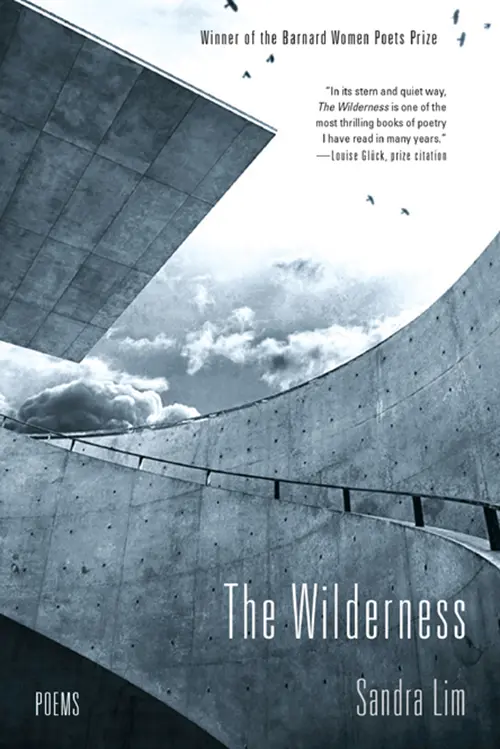
Title
THE
WILDERNESS
POEMS
SANDRA
LIM

W. W. NORTON & COMPANY NEW YORK LONDON
Adjusting type size may change line breaks. Landscape mode may help to preserve line breaks.
The world was like a faraway planet to which
I could never return. I thought what a fine place it was, full of things that people can look into and enjoy.
—HOLLY (SISSY SPACEK), BADLANDS
Pioneering is not feeling well.
—JOHN BERRYMAN, HOMAGE TO MISTRESS BRADSTREET
The greater the spirit, the greater the beast.
—JEWISH-DUTCH PROVERB
1
1
SMALL CONTAINER, FURY
Rembrandt paints his carcass of beef.
You see a little blood near the poppies
and don’t think of detachment.
Humbert and his girl are driving across America.
One has a thirst so unslakeable, one walks
right into the river.
How exciting spring is! and how errant,
holding out love and death
like a platter of the daintiest cakes.
As I do my work, I think, let me topple,
wear thin. Let the world eat me, but
then, let the world sob, not me.
SNOWDROPS
Spring comes forward as a late-winter confection, and I cannot decide if it advances a philosophy of meekness or daring.
This year’s snowdrops: is it that they are spare, and have a slightly fraught lucidity, or are they proof that pain, too, can be ornate?
Even a propped skull is human nature. And its humor is monstrous, rich with an existence that owes nothing to anyone.
Fat little pearls against the ice, battering softly, try even fewer qualities—
To say that you love someone or something to death is to hover around the draw of irrevocability.
More faith is asked of us, a trained imagination against the ice-white.
HUMAN INTEREST STORY
Snow would have been breaking the drifts that day, on a mild mood.
My father was boarding at the home of a missionary couple in Seoul, getting by on books and the radio and cheap noodles.
His older brother hanged himself that winter in Pusan. They would say afterward that it was a plain death, funded by bad numbers, some selfishness, unusual cold.
Think of a needle dropped into the sea.
He had a pleasantly objective feeling about himself that morning, as the early sky gently ripped into red. He thought about Business English, the truth of money.
Across town, a diary opened. And there were the white, cooling coals in barrels.
There was a pretty young wife and one serious boy and one very quiet girl. They awakened one day to a new planet, where the spaces between people appeared slightly widened.
Maybe you can’t penetrate events with reportage, but facts have a sly, unanswerable texture that appears social.
To relieve ourselves of open-ended narrative, we read into the winter stars all evening. There are just stars and stars and stars.
We know what it’s like to fall in love and be disassembled, but we still want to pull death right off the bodies of one another.
These were spectacular nights, said my father. They were full of philosophy and political theory, noisy reversals, French movies.
The romantic grace we comprehend sits with ease in the real world; it is almost nothing.
Now he is carrion, stitched forever in the cramp of a trial.
No one can evict us from books! he used to say, running through astonishment at full speed.
AMOR FATI
Inside every world there is another world trying to get out,
and there is something in you that would like to discount this world.
The stars could rise in darkness over heartbreaking coasts,
and you would not know if you were ruining your life or beginning a real one.
You could claim professional fondness for the world around you;
the pictures would dissolve under the paint coming alive,
and you would only feel a phantom skip of the heart, absorbed so in the colors.
Your disbelief is a later novel emerging in the long, long shadow of an earlier one—
is this the great world, which is whatever is the case?
The sustained helplessness you feel in the long emptiness of days is matched
by the new suspiciousness and wrath you wake to each morning.
Isn’t this a relationship with your death, too, to fall in love with your inscrutable life?
Your teeth fill with cavities. There is always unearned happiness for some,
and the criminal feeling of solitude. Always, everyone lies about his life.
THE VANISHING WORLD
It’s said that people tend to believe God believes what they believe.
When I was young I loved to get up before every dawn of the world, still sweetly baffled by the possibility of unbelief.
Perhaps grace is not so poor a thing that it can’t also appear in this instance like a new definition of luck,
akin to tiny blossoms out of cactus thorns in spring, their loneliness crushing your lungs.
Isn’t everything sloughed from the same star? What is believable and possible, what is acceptable and what is nothing?
Caught between the old and new year, why do you think that the old will be famous for its pain, the new from the liberation from pain?
Some kind of belief still runs off me in strings;
to enjoy the clarifying effect of participation without remainder may be the most mysterious thing.
When I come to the right place, I believe I’ll paint a door on it and walk right through.
NATURE MORTE
You are given two things today, one is an angry nail in your side;
Changing what you are able to sense is the second thing you are gifted.
Nature is always a referred existence, writes Emerson, never a presence.
Who knows where the time goes, sings Sandy Denny. Who can bear to hear it?
One reaches the moment when one loses words—in the pastoral, in the cosmic?
Think about the scars on the planets, & how patient those stars seem to be.
I am painting the natural landscape with my eyes closed today. It is like writing
A poem with all the cross-outs left in; an expression like never thought I’d see the day.
Nature that begins with unknowable & ends with more monotonous hills.
Today, I want to be the country-fried philosophe or a Hudson River School painting.
When this life is over, describe to me how its concave & convex forms are & are not.
We live amid surfaces, writes Emerson, & the true art of life is to skate well on them.
WILDLIFE
I can see draughty stars drift
inside my skull.
Roots and boles and boughs and leaves
press at the backs of my eyes.
A spider rambles inside my body and
scuttles out of my mouth.
This suit is an agony.
Black flies from the creek fall into my teacup—
keep one eye on the world, they say.
ABOVE US ARE THE LAST LIGHTS
planting something within us
that also represents death for the
taking at every turn;
greeting the season
all coated in soft silver
with a strong handshake;
loving and hating,
those buttons done up all the way
to the top of your sweater.
WINTERING
The stars gave up their deep drifting and touched bottom.
No clouds toppled across the snow wilderness.
No gloom-dark tree-glitter winding and twining its silks.
Blankness, egg-quiet.
The level sprawl of the world drew away tinily, in every direction.
Afternoons remained unknown to each other.
Yet loss keeps thudding past my house, telling me I’m not done.
My hearts, still leaping like rats.
2
2
VER NOVUM
First day of spring—
it’s maintaining, calling, shining.
Probably it hurts its business a little.
/
She sings in response:
What strokes my abdomen, titillates my fur?
My coils sweeten, all tensed and set.
The season is a burst harp.
/
Soirs, evenings. And yet it has some afternoon in it as well.
I don’t need much more than this to fall in love.
/
Reading deeply had incarnadined her cheeks.
/
Maytime! My mint going out of its mind,
my garlic groaning quietly.
I feel like a complete change of circumstances.
/
This time of year challenges you
like a little magician
fanning the day’s cards
brusquely in your face.
Pick a card, any card.
Change the flesh into word.
That word may sound broken into:
you can hear life beating
on its fiery way within it, brutalities
and banalities going about their custom.
/
It was like an oar going into water, gliding.
You could hear the clatter of the stars
coming out, like falling stones
in spring rain, remote from theology.
/
She sits down to dinner
in a casual trattoria,
surrounded by Dionysian big cats,
her racy expat friends.
She sets down a brisk narrative of her life
in loony detail and Taurean pleasure.
She used to sit and cry, thinking about it,
loving it no less.
The spectacle is not discouraging!
The way she beholds it has the sin of pride.
/
April and March, overcurious about sex,
thump against the screen door.
Lovelessness in these months
seems a travesty,
like wigs in sherbet colors, too loud against
the season’s paradisal light.
/
Snowdrops looking tatty.
They don’t feel the threat
that I would feel.
/
Investigating his wish to die,
he goes to a teaching hospital.
The puppet feels the hand at times,
wildflowers, their underneath.
/
The season lays palely
on a white platter,
its calm faded eye looks
far beyond us.
We sense our own claims
shrinking.
/
For fear of the winter’s teeth,
the spring queen had them pulled.
Now it cannot chew,
it must subsist on slop.
Now its face has no mouth,
and its hair never saw scissors.
The queen folds her mind over it,
as if discovering a new crystal.
/
If word can become flesh,
now leaning its forehead against cool glass,
now discovering a passion
for Thomas Hardy,
can’t it be the spur that coaxes
out the strangest beast
within the beast, the spirit?
/
The cat in heat is
in the grip of a new idea:
she barks!
/
The sense of the season is pursued through
its reprimands: crocuses and pansies,
snowdrop, scilla, a Tête-à-Tête
daffodil. Tulips, peonies,
azaleas, and hyacinths.
Jack-in-the-pulpit.
/
Affection chains thy tender days.
Candles burning into their tins.
/
In the spring the quinces
/
Like a water-flower dropped
in a glass of water,
spring grows—
/
at times meaning
the world, its fan of pages;
other times, only conscious
of something turning.
/
The grip of solitude—
/
All my wet trees, breathing happily
/
From half-dark to half-dark,
I read autumn poems in spring.
Buson writes about stepping
on his dead wife’s comb
in their dark bedroom.
In fact, she outlived him by thirty-one years.
The chill from that comb, and the snap
of eros and solitude and imagining,
all in flower.
/
Threes conclude into ones,
as in the Christian mysteries.
Grief brought to numbers cannot be so fierce.
/
What is the heart of the problem?
The flaring March lily subverts
all our emotional gourmandizing,
like a serene, inviolable erotomane
cupping its ear to listen to our true secrets.
/
The explorer with his walleye
and fading map peers into the distance.
He is so far from where he started,
and wasn’t this the point?
To have the cookbook turn
into parable, or vice versa,
it didn’t matter. Now, it was as if
he were a new pair of scissors
biting into a clean sheet of paper.
Rupture, instead of continuity.
He wills his eyeball into place
and walks boldly into the conditions.
/
The heart’s best trick?
For the one and only spring you will be given this year,
let your happiness crawl all over the floors.
/
Spate of thundershowers in spring.
It has an intellectual appeal,
pointing to nothing.
/
Now the coldness merely asks you
to tear your life apart
and begin again.
Pilgrim, throw it away, make it larger.
/
Spring, which says it’s never been unfaithful,
mixing insult and provocation.
RITE OF SPRING
Dimmed summer. The fortune-teller reads
my palm in the humid dark.
That spring I could not be whole.
Feeling atonal and unconciliatory,
I went to see The Rite of Spring.
I went to see what art in general is about
and what people are really like.
I wanted to watch the shape
of a movement,
the trajectory of a body as it makes
the shapes that it will in a limited ambit,
revolving around an implied center.
The young virgin dances herself to death
to bring forth
the flowering of spring.
Free-verse rhythms,
ritualized, vivid decisions of actions.
I went to see what people are really like
in a thousand human ways.
All these gestures from life, deformed
to suit a more open, imagined music.
She won’t make an affirmation
or a negation of my destiny,
but it’s good for business, the way she eats
through the score of a life and keeps me
hypnotized by the future destination.
I watch the fortune-teller as I watch
an absorbing movie:
I just want to know what happens.
ENVOI: LAZARUS
Lazarus woke to the miracle of no longer fearing failure.
He lifted his two sides from the ground as he tried
To speak, one part gathering darkness, one part humming.
When he walked out, he glimpsed a world never tried.
At the crucial point, there is yet more than one way
Of proceeding, but it seldom appears that way.
3
3
THE NEW WORLD
The world we see never is the world that is: the senseless morning light cuts its white eyes open.
What is the lecture of the darkest pines, the way they hang their stillness against us?
If I beggar myself for love, do I move from night into more night?
If I swallow a mouthful of ground glass, do I not slip past languages?
Thunderous wakefulness is ceaseless needles through the casing.
There are only the living and the dead: roses climbing a battered trellis. A caterpillar turns its hard black goggles upon the cold meat of me.
Drinking wholly from the world remains dark argument, hardly moral.
To be living in the feast sweetens my idea of death, its foreknowledge and its art.
Affliction, make yourself a scar upon my house and count the ways.
CERTAINTY
Edward Taylor was a frontier minister who wrote a prolific amount of devotional poetry. The poems are full of deep piety, learned and quiet, but sometimes an errant wildness runs under the seams of his words.
It’s said that he wrote poetic meditations to put himself in the correct spiritual state for his communion with Christ.
I imagine the task swallowing him each time, moving its own patient way like snowmelt. A poem may hold the unwieldy pieces of the earth together with a whole heart; a poem may cut that heart to lace.
His first wife, Elizabeth Fitch, bore eight children; five died in infancy. Taylor wrote more and more sermons and poems.
Sometimes a conceit makes itself necessary in the safety of the impasse between word and world. And make my Soule thy holy Spoole to bee, writes Taylor.
His parishioners were called to worship in the wilderness with a beat of a drum, amid cold plants, the night coming on, undelivered ashes of stars.
Flocks take to the sky at dusk. I have wondered if the parishioners counted the days.
As in: Did they ever travel past the corrective of the afterworld to stand in the strong spine of rivers? According to Taylor: In Heaven soaring up, I dropt an Eare On Earth: and oh! sweet Melody!
—(Or weren’t there deranged cries in the wilderness, too?)
Taylor’s trust appears both adamantine and vulnerable, like the slow plan of the flowering grass or torn, stilled clouds.
Alone in his study, he writes down some dimensions—
I’m but a Flesh and Blood bag, Oh!
Consider the strange and riotous interior, through which so many nameless things fly.
As weeds continue to idle their tails, leaves molder right on time. In the rafters of the sky, a pristine star shines with unassailability. It can’t be taught a thing.
The wilderness: I cannot get around the back of it.
SELVA ANTICA
What dreams! Those forests!
—SAMUEL BECKETT, ENDGAME
It was a way to think
in the unearthly openness of time.
You stepped away from this world
so that you could consider it from afar.
Did the moon still appear cold and indifferent?
Did a human sound seem singular?
You only remember that there was nothing
to eat in this wilderness,
so that by the time spring came, in generation and decay,
it was not abstract enough for you—
In your want you conjured more blankness,
a prodigious emptiness, the fair schoolroom
of the sky. Paradise would be paper-white,
a way to ease into this nothingness.
GARDEN QUARREL
1. The Change
There was something theatrical in the air,
like the coming of a circus.
I don’t know, the world seemed a dummy run
after that dawn-cold snake.
I realized life could be
like the nest of some tremendous bird.
I was always a religious bitch,
all prolepsis and superstition.
2. Reason Is But Choosing
Eve ate the apple
she tasted the snake
Adam ate Eve
he tasted the apple
Their hunger
had the grandeur
of a famine
A tristesse
falls upon the scene
like a light rainfall
There is something mysterious
about lyric poetry
The long glare walls
of evening
were constructed in a spirit of play
Adam’s a tragédien
Eve opens and closes her legs like a book
No one is waiting for life to begin
Their tears eventually
turn back into
the leaves of the tree
3. Snake
The snake says it needs a tree, so here is a tree.
It says, make the tree stir its tops and play
their emerald lights. I do. I slide the clouds
off the sun for good measure.
Two nights it has lain in wait, this figure with no arms.
Now it approaches the shimmering lights in the tree,
studies the glassy dullness of the couple.
They don’t know yet that they are alive.
The snake tells her to take her thumb out of
her mouth; a soul needs the presence
of desire. It says it’s worth dying to understand
the conditions under which figure, tree, man,
or woman might smash. She moves toward
the moral impunity of the apple. I ease it from its branch,
so that it is snake-low. She eats it carefully,
inspecting the potential of the snake with each bite.
CERTAINTY
Perhaps you can tell children that the world is always a more beautiful place than you can suppose,
and then you release them into their future, the black row of trees in the distance.
She died suddenly in midwinter, in the same bed in which her husband died years earlier; it still sagged on his side. Her second husband remained in Japan with his first family.
She used to say, what my three girls do when they are on their own is unimaginable to me.
My mother is the middle daughter, a garden of inaudible tunes. The four of them lived in a mean house in Seoul.
One yellowing picture of my grandmother remains, and her face turns away from the camera, as the rabbit senses the hound;
she was said to be a solitary eater, an inner thing. What did she promise the world that she wasn’t able to make good on?
A child who abruptly feels the frontiers of experience assert themselves in her: at the funeral my mother cries so hard she can’t feel her hands for days,
it explains how she scratches herself raw, meaningless.
You have always believed these are your themes: fate, the negative pleasures of dipping oneself in acid.
You think it will rescue you from your simplicity, remarks my mother from the doorway, but art is never the ace in the hole.
I am not a stupid child. I am not even a child any longer, with her hesitant, then terrible certainty, that loss is tragic, not only pointless.
When she is lonely, my mother cooks; and when she is happy, she knows to hide it.
FALL
Each night, the same dream: I’m an odd Victorian mansion
in a field of wheat. And I’m either waiting for the field
to catch fire or the hearse of love to pull up to the manse.
Don’t wake me. In daylight, my mother talks of brideliness
as a measure of time: in a kind of flower, a narrative of ascension.
I intimate some sort of border is being discussed,
but I can’t concentrate for the sake of all the beautiful things
claiming my attentions in the tawny fields.
There, a blankness without meanness, such as one finds
in a naked sea with all its fundamental majesty.
CHEVAL SOMBRE
From time to time, I like to learn a severe truth about a familiar deception: a beautiful watch lying new in its case.
A precise, coruscating luxury,
The future arrives under the sign of its own negation.
A curious traversal of tenses, le dernier cri, and so
The hope of even seeing you again is slipping.
I’m so shaken, I act calmly for the rest of the afternoon:
At last I shall see my hunger for meaning go free.
The world could be like a faraway planet to which I declare,
Free at last: I shall see my hunger for meaning go.
I’m so shaken, I act calmly for the rest of the afternoon;
The hope of even seeing you again is slipping.
A curious traversal of tenses, le dernier cri, and so
The future arrives under the sign of its own negation.
A precise, coruscating luxury:
A beautiful watch lying new in its case. I like to learn a familiar truth about a severe deception from time to time.
ENVOI: ORPHEUS
I say the look back
was coldness mixed with longing.
Afterward,
he could finally think.
Many have imagined
what the song must have sounded like:
Not language breaking.
Not how safe it is to be gone.
But the world
seeping in so quickly.
For a moment,
world arranges itself around artist.
The wine of annihilation rises within
him, a new acuteness.
Elsewhere, a disappointed lover mutilates
another tree with the departed’s initials,
restored to disinterested making.
THE CONCERT
My best friend says I wake up in the morning
and rage.
—Do I? I ask her, incredulous.
I see myself as a mild, hemmed-in sort of person.
—You rage, she says. You rage against:
a. a.m. snow
b. the dilemma of the soul
c. your fate
d. all varieties of longing
And here I have always wanted to be as cold and ferocious as a star.
But if I rage, let me make my voice its capacious forest.
Let it be the melancholy that comedy is meant to overcome!
/
Portnoy says that underneath their skirts girls all have cunts.
There’s mine,
cheerful, au fond, in its ineffable femininity.
It lights my privacy,
endorses
the faintly guilty air of my naturalness.
The unenactable idea is that we all have souls.
Next to a soul,
the body’s curious reticence obtains.
I can wag my lower self gladder and gladder,
but my soul, it wants
to stay up, write through the night.
If you press the hollow of my throat, my soul pulls a face.
/
in the hour, the music, of a.m. snow,
in the constellation of sleep, anti-sleep, and the wintry mix—
the sweet council of snow’s philosophical flights.
The Story Continues on BooksBarbecue!
Enjoyed this preview? ❤️ Do not stop here!
Read the complete book free online → 🔗
Continue reading now on BooksBarbecue and discover every page!
Love reading? Bookmark BooksBarbecue.com for more amazing books!
Happy Reading!