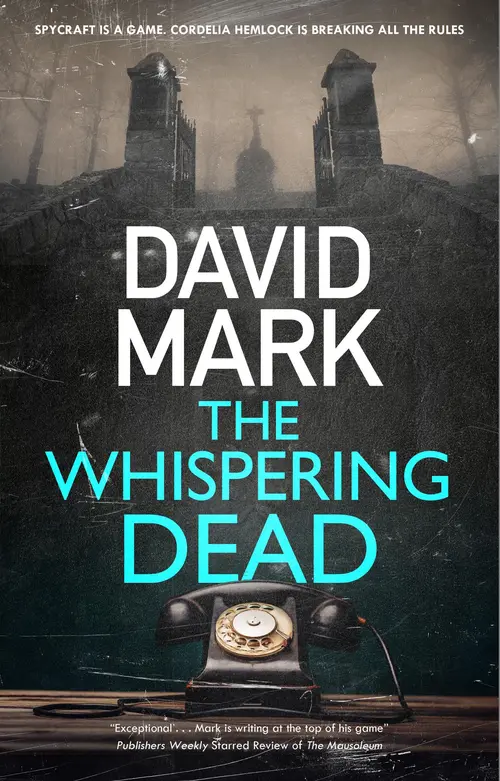
The Whispering Dead
Cover
Also by David Mark
Novels
THE ZEALOT’S BONES (as D.M. Mark)
THE MAUSOLEUM (aka THE BURYING GROUND) *
A RUSH OF BLOOD *
BORROWED TIME *
BLOOD MONEY
INTO THE WOODS
SUSPICIOUS MINDS *
CAGES *
GRAVE OF THE GOBLINS
ANATOMY OF A HERETIC
THE WHISPERING DEAD *
The DS Aector McAvoy series
DARK WINTER
ORIGINAL SKIN
SORROW BOUND
TAKING PITY
DEAD PRETTY
CRUEL MERCY
SCORCHED EARTH
COLD BONES
PAST LIFE *
BLIND JUSTICE *
* available from Severn House
THE WHISPERING DEAD
David Mark

Dedication
For Phyllis and Milly
AUTHOR’S NOTE
Some of the events outlined in this novel actually happened. Most of them didn’t. I’ll trust you to work out which is which. I rather hope you’re wrong.
Epigraph
Spies cannot be usefully employed without a certain intuitive sagacity.
They cannot be properly managed without benevolence and straightforwardness.
Without subtle ingenuity of mind, one cannot make certain of the truth of their reports.
Be subtle! be subtle! and use your spies for every kind of business.
If a secret piece of news is divulged by a spy before the time is ripe, he must be put to death together with the man to whom the secret was told.
Sun Tzu, 544–496 BC
PROLOGUE
Browndown Beach, Gosport, Hampshire
March 11, 1968
The sea’s a joyless grey, cloudy as milk. There’s no line where water meets sky, just a smudge as the slow-moving sea merges softly into low, cloud-coiled sky. Drizzle greases the stones on this shingly, isolated beach; a near-invisible rain suspended in the chill air, misting a horizon the colour of unbaked clay.
A young woman is sitting on the sea wall, gazing at nothing. She’s as colourless and unremarkable as the emptiness into which she stares. Such appearance marks a change in philosophy and deportment; a transformation of sorts – a butterfly worming back into its muted cocoon. She is capable of extravaganza, of genuine visual spectacle; adept at clothing herself in gaudy hues and luxurious modes, splendid in short skirts, vivid nails; big earrings, big hair. She favours plum-coloured berets and large sunglasses, calf-hugging platform boots and bangles that clank as she swigs her brandy and lemonade. But here, now, she is equally comfortable in her monochrome anonymity. Were she to sit still long enough, she fancies she could pass for a stone.
She shifts position, ignoring the throbbing pain in her ribs. She’s getting good at disregarding pain. She didn’t even wince when she applied the blusher to her bruised cheek; her knuckles prodding her tender flesh as she worked her kohl around the contours of her strikingly blue eyes.
She’s an attractive woman. Knows it too. She’s in her mid-twenties. Mouse-brown hair recently chopped into an unremarkable bob. The salt air and the sea spray has undone her ministrations with the brush and wet strands cling to her pale face. She wears wellington boots beneath her long corduroy skirt. Wears a man’s shirt and a tatty leather jacket, three sizes too big. There’s a paperback book on the damp stone beside her. It’s dog-eared and well-thumbed. She would say the same about herself, if prompted. She has a wicked tongue, does Cordelia Hemlock. The nuns used to tell her that as they did God’s work on her buttocks and back. So did the silly boys she dallied with at university, though it was said in a spirit of grateful esteem rather than chastisement.
She’s smoking. She doesn’t really enjoy cigarettes but she’s gotten into the habit and has convinced herself that it calms her nerves and that she’s entitled to do what she wants. Her son hated the smell of cigarettes and used to forcibly try and pull them from her mouth. She stopped for him. Stopped most of the things she did for pleasure. And then he died and the icy fires of grief consumed her from within and without and it had seemed absurd to deny herself something that might, if she were lucky, hasten her own descent towards the grave.
She has been sitting here for almost an hour. She has a thermos of hot coffee in the satchel at her feet but has yet to open it. Her wrist is badly sprained and she cannot work up the enthusiasm to further aggravate it by untwisting the lid. She’s been through a lot these past weeks. She’s learning her trade. They’re showing her the ropes. They’re putting her through her paces. Retired sergeant majors are teaching her how to shoot a pistol and whereabouts to thrust her blade if called upon to put an enemy beyond return. She has been thrown around as if she were a scarecrow. Big, broad-shouldered, ruby-playing types have kicked her legs out from under her and struck her beneath the jaw with the heel of their hands. She has had her head yanked back with a fistful of hair and dirty water poured into her gaping mouth and nose, hands pinioned at her back, eyes round and blind and popping as questions were whispered in her ear by a man who smelled of American cigarettes and bourbon. She hasn’t yielded yet. Her group has already lost three members, dismissed for giving in, giving up, giving themselves away. Cordelia is now the only woman left in the intake. Even if she wanted to she knows she can’t give up now. Can’t quit. She feels a responsibility to her sex. People have spent a lot of time telling her what she can and can’t do and she’s never taken any notice of their opinions. She’s not going to start now. She has serious doubts about her own suitability for the role but she has the sense to keep them to herself. She’s started this and she’ll finish it – even if doing so means a career to which she is hideously ill-suited. She fancies that she’ll make a rather good spy. She just isn’t sure whether, in so doing, she will be making the world better or worse. Her moral and political philosophies lean more towards the subversive than the state-sanctioned. She dabbled with Communism at university. She’s marched for women’s rights and wrote letters to foreign governments urging them to alter foreign policy or at the very least, remove themselves from Vietnam. She’s not remotely patriotic. How can a person be proud of being born in a particular country? It’s not as if they have any choice. She doesn’t mourn the death of the Empire and cannot understand those who wish to once again paint the maps of the world in glorious pink. In truth, she finds the whole business of international espionage faintly ridiculous. It all seems to come down to stealing secrets, and she can’t help feeling that a secret isn’t even interesting until somebody else knows about it. Nevertheless, she’ll see it through. She’s clever and tough and dogged and can’t think what the hell else to do with herself for the next fifty years. She’s been given an opportunity, a reward for her small part in unmasking a killer, and the idea of returning home to the big empty house in the Borders fills her with the kind of dismay that the grey sky and opaque seas seem to be trying to mirror. The only thing she misses about home is her best friend, Felicity. She writes to her often though she rarely posts the letters. She can only be truly honest with herself when writing to Flick, and true honesty is something that is going to be denied her if she continues down this path. So she writes what she thinks and what she feels and then she burns them in the grate and watches the ghosts of spilled words climb blackly, greasily, into the haze of cigarette smoke that swirls in the low roof of the barrack room where she is quartered.
Cordelia doesn’t turn her head when she becomes aware of the man to her left. She uses her peripheral vision as she has been taught. She’s surprised at how close to her he has managed to get without her noticing. This is a shingle beach. The sea wall is to her back. He must have made barely a sound as he approached. She examines him from the feet up. He’s shoeless. He’s got socks on and they’re thick with damp sand. He must have approached her through the sand dunes. He wears baggy blue suit trousers, shiny at the knees and with three different crease lines poorly ironed into the shins, giving the seam the appearance of an abandoned pleat. He wears an unfashionable raincoat, fastened to the very top. A woollen hat, the sort that might appear in a comic as a gift from a half-blind aunt, is pulled down over his ears. It’s a garish clash of blue-and-white zigzags, entirely without any discernible pattern or form. He wears thick glasses, their lenses speckled with rain. He’s not even close to being handsome, but there’s an absurdly confident smile on his face as he stands there, shoes in his hand, and waits for her to give him her attention.
‘Can I help you?’ she asks, turning her head and glaring at him with hard eyes.
He makes a face, pretending to look distressed. ‘Good Lord, Hinny, is that where the nickname came from? The Basilisk. Well played. If we could weaponize that quality we’d have won the war by next Tuesday.’
Cordelia licks her lips. Takes her time. Lets the moment stretch out like a cat in front of the fire. She has to fight the urge to smile. She doesn’t know whether she’s passed or failed but she feels as though she’s achieved something simply by spotting him before he was close enough to hit her with his shoe. She finds herself curiously beguiled by the odd little man, though she’d be hard pressed to explain why. He has a Rumpelstiltskin look about him – a sense that he could play the happy imp up until the moment he tore himself in two out of anger. She’s certainly not alarmed at having her nickname relayed to her by a stranger. She knows that such encounters are part of her training. She’s been followed by active agents and tasked with losing them on hectic London streets. She’s had to make spur-of-the-moment decisions about whether or not to proceed with simulated dead-letter drops based on her own instincts as to whether she is being observed.
‘Hinny?’ she asks, at last.
‘The Geordie twang,’ he says, rummaging in his coat and producing his cigarettes. He lights up and observes her through a cloud of blue-grey smoke. He doesn’t seem compelled to say anything else.
‘Will you be joining me?’ she asks, making room on the sea wall. ‘Room for one more.’
‘I won’t, if it’s all the same,’ he says, with a look of genuine apology. ‘Takes an age for me to get myself properly situated and once I start walking I prefer to remain upright. I don’t so much walk as fall down over a considerable distance. It’s a controlled totter.’
Cordelia permits herself a smile. ‘I didn’t hear you approaching,’ she confides. ‘Is that a mark against me?’
‘You spotted me before I got close enough to do anything outlandish.’ He shrugs. ‘I’d call that a win. All a bit silly, isn’t it? All this simulation and dissembling, this learning how to lie. Good God, the whole organization is made up of public schoolboys and they learn how to dissemble at the teat. One must never show emotional honesty, you realize that, yes? Not a whiff of humanity. Otherwise, how the devil can you be expected to lead? How can one make decisions about what is good for people if you are beset by those God-awful feelings every moment.’
Cordelia isn’t sure how to reply. He seems genuine in his contempt for the upper classes and yet his own accent is pure old Etonian.
‘You’re reading Orwell,’ he says, with a genuine grin of approval. ‘My my, what a splendid find you are. True subversive literature within a spit of Fort Monckton. I can’t decide whether you don’t give a damn or just want to be seen as somebody who doesn’t give a damn. Or perhaps you’re too guileless to realize it might not be the wisest choice of reading material when your every spit and cough is being pored over by men who want you to fail. Either way, with the Geordie accent and the steel blue eyes, you really are a discovery. I feel like Sir Joseph Banks poking around Botany Bay.’
Cordelia lights herself a cigarette while she considers her response. ‘That’s a very odd way to compliment somebody.’
‘And a compliment it is, my dear,’ he says, nodding vigorously. ‘I’m one of the troublemakers, if you were wondering. You might hear my name from time to time. A face-card. Jack of Clubs, let’s call it that. Have you got to the hierarchies yet? Basic structures? Oh, I shan’t spoil it for you. They do like to do things in the correct order and in their own good time. Suffice to say, I always have a little poke around in the heads of the new recruits. It’s incredible what one might find. I had such a good feeling about you when I saw the file. Bastard child, born to an unstable mother in ’42, father unknown, convent educated and bloody clever. Scholarship student. Grammar school. Up to Nuffield, Oxford, in ’62. Abandoned your studies when you fell in love. Wife of one Cranham Hemlock, civil servant. Your son, Stefan – meningitis, wasn’t it? I’m truly sorry for your loss.’
Cordelia doesn’t let her change of mood show in her face. Inside, she feels as though all the blood in her body has turned to smoke. She feels as though her face is a sponge full of tears, just waiting to spill down her bruised cheeks. But she doesn’t let it show. She’s very good at not letting it show.
‘Seems odd that a woman as beguiling as yourself should marry a gentleman of such astoundingly homosexual persuasion,’ he says, with a little shake of the head. ‘I’m not a romantic, I’ll leave that to the French, but I should imagine that it causes one or two problems from time to time. Still, least said, soonest mended, as they say. And you have done rather well out of the arrangement. That’s the establishment, for you – everybody knows, but nobody lets on.’
‘He’s not part of this,’ says Cordelia, coolly. ‘Cranham doesn’t even know. If you think I got special treatment because of who I’m married to …’
‘Whom, my dear,’ he corrects her, with a smile. ‘Gosh, you become even more of a coal miner’s daughter when you’re cross, don’t you? And please, do accept my apologies if I implied that you were being given special treatment. I very much doubt that Cranham would spot a trainee spy if it sat on his face and started reading Tolstoy. No, have no fear on that score, my dear. I’m more than aware of what you’ve done. Mind sharp as a razor, that’s what your instructors say. They fear your political affiliations, of course. You’re not, shall we say, one of us. The whiff of the socialist about you, and they’ll never understand that a whiff of socialism falls well short of a love of communism. I’m a firm believer that we need a few more like you.’
‘And what am I?’ asks Cordelia, grinding out her cigarette. She feels combative, irritated, unsure whether she’s being tested or teased.
‘I believe the popular phrase used by your apparent betters is “lebbage”. Latin, of a sort. Think hoi-polloi. The great unwashed. The masses.’ He clicks his fingers as if searching for the right word. ‘The poor.’
‘I heard “Plebian” a lot at university,’ she says, with a slight smile. ‘I heard “slattern” a lot too.’
‘I don’t doubt it. Terrifying to them, I shouldn’t wonder. They wouldn’t know what to make of a girl like you.’
‘A woman, you mean,’ she replies, with a twitch of her lips.
‘Touché,’ he replies, and stoops, holding his side, to pick up a rock that has caught his attention. He turns it over and over as if checking it for something and then wrinkles his nose, throwing it away. He winces a little, as if the action has pained him.
‘Not what you were hoping?’ asks Cordelia. She feels an inexplicable warmth towards this man. There’s something oddly genuine about him; as if he can play any role required of him without ever really changing his fundamentals. She envies him. Wonders if, should everything go the way she’d like it to, she will be able to maintain who she truly is.
‘It will be hard for you, Cordelia,’ he says, the smile fading as he looks into her eyes; a sudden intensity about him. ‘They won’t want you to do well. They won’t ever trust you. They don’t trust me and I’m one of them. I have feelings, you see. I actually believe we have certain moral imperatives. I have this bizarre notion that in a world where we are no longer a true power, we can at least be influential. We could, for example, fight the good fight. We could help people regardless of political affiliation. It’s a fanciful notion but in you, in people who care about decency first and queen and country second, I see something that breathes on the dying embers of my optimism.’
‘The dying embers of your optimism?’ repeats Cordelia, with a grin. ‘Jesus, Hinny, you’ve got quite the turn of phrase. You’re a poet and ya divvent know it.’
He laughs properly, head back, delighted with her sudden thrust of Geordie. She does her best to hide the accent but he’s right – it creeps back when she’s angry or drunk or in love, and she’s one or all three most of the time. She can’t help thinking that she’ll make a rather ridiculous spy. She likes people. Feels awful if she hurts somebody’s feelings. Thinks the government is both too big and too small and sees nothing about capitalism to suggest that it’s any better than the alternative. She’s doing this because she’s been given the chance and because she doesn’t like to waste an opportunity.
‘I’m Walt,’ he says, with a twirl of his hand and an exaggerated bow. ‘You can dig around and ask the questions and see if I’m somebody you’d like to get to know. I have no romantic interests in you, before you worry – quite the eunuch below the waist. Never had much interest in any of that silly sticky business. Incidentally, I have to fill in a rather inane report stating when and where you saw me following you and how you responded to my knowledge of your record, so if there’s anything you’d like it to say, just tell me and I’ll fit it in to my conclusions.’
‘How long have you been watching me?’ she asks, and behind him she sees the thick block of clouds reassemble themselves like shifting tectonic plates.
‘Don’t trouble yourself,’ he shrugs. ‘I think you’re rather marvellous. My opinion counts for quite a lot, as it happens, and this little chat has only served to reassure me that you are exactly what I’m looking for. I have a few ideas, you see. Here and there, bits and bobs – put your hand in the bran tub and pull out the cliché of your choice. Suffice to say, there may come a time when I need to know who’s on the side of the angels, and who … well, let’s just say, those who aren’t.’
‘I’m a bit confused,’ says Cordelia. ‘I don’t even know if this is right for me. I don’t agree with half of what we seem to do. It’s not exactly glamorous, is it? And look at the mistakes we’ve made. Nobody ever seems to answer a question properly. I mean, is there any point to any of it? Intelligence, counter-intelligence, stealing secrets, selling secrets, finding out who’s selling to who and whether what they’re selling is worth the price. It’s just, I don’t know, I suppose that I had it in my mind that the people who knew these things, who made the big decisions – I thought they’d be a bit more …’
The Story Continues on BooksBarbecue!
Enjoyed this preview? ❤️ Do not stop here!
Read the complete book free online → 🔗
Continue reading now on BooksBarbecue and discover every page!
Love reading? Bookmark BooksBarbecue.com for more amazing books!
Happy Reading!