The Voyage
Cover
ACCLAIM FOR PHILIP CAPUTO’S
The Voyage
“It’s impossible to put this book down.”
—The Atlanta Journal-Constitution
“Caputo’s prose is a pleasure.… That the ending satisfies so completely … is surely the novel’s greatest triumph, adding layers of intriguing meaning to the already rich adventure story that forms the core of The Voyage.”
—Chicago Tribune
“The Voyage is a vivid, engaging page-turner that shows Caputo at the top of his craft—instructive for writers and just plain fun for readers.”
—Providence Sunday Journal
“Rarely does so complex a narrative strategy read so smoothly. As a maritime yarn, as a tragic family story, as a spiritual journey, as a moral tale, and as storyteller’s magic, this novel succeeds on every level. It is both a pleasure to read and a delight to recommend.”
—Daniel Hocutt, Richmond Times-Dispatch
“The Voyage is a thoroughly engrossing and satisfying read.”
—The Denver Post
“The old-fashioned adventure yarn … is alive and well in the capable hands of Philip Caputo.… The Voyage is easily his most successful book.”
—The Newark Star-Ledger
“A coming of age epic, which is at once adventure, mystery and the family memoir as fiction.”
—The Hartford Courant
“Caputo is known for novels at once action driven and cerebral, his books keep the reader entertained as well as provoked.… [He] is a conjurer of rich atmosphere; he knows the sea and sailing. But he also knows the ways of building finely shaded characters. Readers will find all of his talents on display here.”
—Booklist
“A compelling novel that offers both rousing adventure and penetrating insight into the mystery that is family.”
—Library Journal
“A pungent tale of perilous maritime adventure … scrupulously researched, strongly imagined, and painstakingly hammered together: those who plunge headlong into its dark waters will not soon forget the experience.”
—Kirkus Reviews
About the Author
PHILIP CAPUTO
The Voyage
Philip Caputo lives in Norwalk, Connecticut. Born in Chicago, he graduated from Loyola University and was a foreign correspondent for the Chicago Tribune in Italy, the Soviet Union, the Middle East, and Vietnam. He is the author of eight books, including A Rumor of War, Horn of Africa, Indian Country, and Exiles.
Other Books by This Author
ALSO BY PHILIP CAPUTO
A Rumor of War
Horn of Africa
DelCorso’s Gallery
Indian Country
Means of Escape
Equation for Evil
Exiles
Title Page

Copyright
FIRST VINTAGE CONTEMPORARIES EDITION, NOVEMBER 2000
Copyright © 1999 by Philip Caputo
All rights reserved under International and Pan-American
Copyright Conventions. Published in the United States by
Vintage Books, a division of Random House, Inc., New
York, and simultaneously in Canada by Random House
of Canada Limited, Toronto. Originally published in
the United States by Alfred A. Knopf, a division of
Random House, Inc., New York, in 1999.
Vintage is a registered trademark and Vintage Contemporaries
and colophon are trademarks of Random House, Inc.
The Library of Congress has cataloged the
Knopf edition as follows:
Caputo, Philip.
The voyage / by Philip Caputo. —1st ed.
p. cm.
I. Title
PS3553.A625V69 1999
813’.54 — DC21
99-23568
eISBN: 978-0-307-56103-9
Author photograph © Stephen Ellis
v3.1_r2
Dedication
FOR JOHN PEYTON WARE
Born June 20, 1921. Crossed the bar, March 30, 1999.
All the tempestuous passions of mankind’s young days, the love of loot and the love of glory, the love of adventure and the love of danger, with the great love of the unknown and vast dreams of dominion and power, have passed like images reflected from a mirror, leaving no record upon the mysterious face of the sea. Impenetrable and heartless, the sea has given nothing of itself to the suitors for its precarious favours. Unlike the earth, it cannot be subjugated at any cost of patience and toil. For all its fascination that has lured so many to a violent death, its immensity has never been loved as the mountains, the plains, the desert itself, have been loved.
JOSEPH CONRAD
Part One
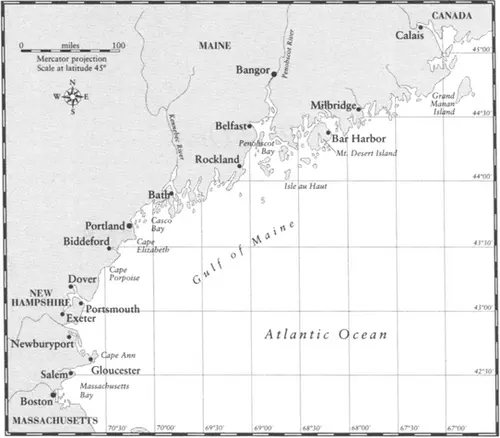
THE BAYS OF MAINE
1
THE SEA was gray that morning, and as smooth as the surface of an eye. Eastward, the edge of the earth had been brought miles closer to shore by a fog that had drifted in during the night as far as the mouth of the bay. There it stopped, neither advancing nor retreating, and the out islands and all that lay around them and beyond them were held in a windowless dungeon of vapor. From the dock in front of his family’s house on the mainland, Nathaniel could not see even a suggestion of the islands’ spruce steeples; nor of the granite plinths and ledges that usually showed through the trees. Forest and rock seemed to have been dissolved, made one with the mist that also cloaked the lighthouses and the tall crucifixes of the stone drogers, waiting at anchor or at the quarry wharves for the fog to lift and a fair wind to bear them down the long roads of the ocean to Boston, with paving blocks or a carved hero’s pedestal, to Charleston with Corinthian pillars to glorify a city hall, to New York with polished slabs to face the new buildings rising into the skies of the new century. He knew the ships were there because he heard their bells, clanging five seconds each minute to mark their anchorages. Other sounds were mixed in with the bells, and he listened like a blind man at a discordant symphony, identifying each thing and its location by the noise it made. That shrill piping—the steam ferry that serviced the islands. That sad, lost bleat—a doryman cranking his handheld horn. That di-tonal moan far off—a lighthouse …
He thought it curious how the fog held in one place, as if an invisible wall were blocking it from coming ashore. Over his head was a cloudless sky and sunlight, out there murk. The division between the realms of the clear and the obscured was as sharp as the bifurcation in a half-moon, and he wondered what caused it. A sudden change in water temperature? In air temperature? In both? It was hard to tell the difference between air and water, what with the two elements merging seamlessly into the whiteness that erased the horizon, and the sky the same color as the dead calm sea. His father’s two-masted schooner, moored offshore near an exposed ledge, made a vivid, perfect copy of itself in the polished plane of water, only upside down. Nathaniel pulled his oilskin from his seabag, folded it to make a cushion, then squatted, braced his elbows inside his spread knees, and turned himself and the world topsy-turvy. Now the sea became the heavens and the heavens a waveless sea, while the schooner and the ledge and the cormorants perched atop the ledge appeared as reflections of their reflections. Topsy-turvy he and the world remained, until the illusion was spoiled by two harbor seals that surfaced astern of the schooner and sent ripples shoreward in sleek undulations, like the luffing of a satin sail. The reflections of rock, birds, and boat swayed and shuddered, testifying to what was object and what was image, to what was sky and what was ocean. Gravity, that most unambiguous of the world’s forces, also would not be deceived; blood rushed to Nathaniel’s head and told him which way was up.
He lowered his legs slowly and stood and laid his hand against a piling to steady himself. The water below, with the reflections of snail-encrusted pilings angling off into the depths, wasn’t gray, as in the distance, but adamant green, and as cold as it looked. Cold enough even in early summer to kill a man in no more than fifteen or twenty minutes. His father, that nearly infallible authority on all things maritime, had seen it happen years ago, when a sailor on his ship fell from a yardarm and was plucked out less than a quarter of an hour later, bluefaced and as dead as Julius Caesar. Nathaniel watched the seals swimming along in their blubbery insulation, dark heads throwing off sparkles of pearlescent light. Then, in a synchronized arching of glossy backs, they dove out of sight. He put the oilskin back into the seabag, which had his first name inked on it to distinguish it from his brothers’, and sat down and dropped it into the dory. She was twelve feet long, with white lapstrake, and her rail, oars, and thwarts gleamed under new coats of varnish.
The dock shook. He turned to see his father, face darkened by the shadow of a wide-brimmed straw hat, carrying a crate of dry stores. His shirtsleeves were rolled up to the elbows and his muscles, straining under freckled skin covered by fine, cinnamon hairs, still had the look of knotted whips. A young man’s muscles. But was a young man’s strength still in them? There was more gray than ginger in his beard, and half the hair under that hat was gone now, Closer to a grandfather than to a father in age—fifty-six this year, Nathaniel thought, and got to his feet and went to take the crate. Cyrus waved him off with a movement of his head and carried it the rest of the way, setting it down alongside the piling to which the dory’s painter was tied with a bowline.
“What were you doing?” he said. He was breathing hard, as if he had run down from the house, and Nathaniel saw that his face had not been darkened by the hat brim but by the color that rose in it from an excess of sun or exertion, or whenever he was angry: the color of an earthenware platter, a shade so close to his beard’s, before it had begun turning silver, that the distinction between flesh and hair had been hard to see from far away.
“Putting my personals aboard, sir.”
“Looked to me like you were standing on your head.”
There was a faint note of disapproval in his father’s voice, and Nathaniel felt himself blush.
“Oh, that. Just an exercise. A friend of mine at school told me that he’d read that the Hindoos of India stand on their heads all the time and that it’s very good for you.”
Cyrus stared critically with his good eye, frosty as winter seasmoke, while the left eye, its stilled pupil cocked off-center, seemed to stare over Nathaniel’s right shoulder. It was always disconcerting, this being looked at directly and indirectly at the same time.
“If the way those Hindoos live is an example, don’t reckon putting your head where your feet oughtta be is of any benefit.”
“No, sir.”
He had wanted to say, What do you know about the way Hindoos live? You’ve never been to India, because he now could look straight into Cyrus’s sighted eye, as well as wear his shirts, and the parity in stature and bulk had opened up the possibility that he might be his father’s match in other ways. Sometimes, he imagined himself challenging the old man to wrestle, or to put on the gloves and go a round or two—fantasies both thrilling and frightening that had begun to grow in him in the past year, right along with the whiskers, sprouting from his chin and upper lip, and with the new inches in his height and the new muscle slabbed onto his ribs and shoulders, beard and inches wondrous gifts from nature, while the weight was more the fruit of his own husbandry: He exercised with the dumbbells ordered from the Sears Roebuck catalog last Christmas, played football and boxed at Andover because he’d read that boxing and football had transformed the vice president from a sickly kid into the hero who led the charge up San Juan Hill. Not that Nathaniel had ever been sickly or a weakling; he was in training for the moment, which he was sure awaited him somewhere in the future, when he would be called upon to lead a charge in war. Or to rescue people from a burning building. Or to capture a gang of Chinese bandits, as Frank Merriwell had done in the last issue of Tip Top Weekly. When the moment came, he wanted to make sure he was fit and tough and equal to the task.
“Intend to stand there all day?”
“Sir?”
Cyrus dropped his gaze to the crate wherein sacks of flour and coffee lay atop tins of beef, pears, and beans. Nathaniel eased down the ladder into the dory. The thwart, wet with dew, chilled his bare feet, and he felt a residual tackiness in the coats of spar varnish. He reached up and took the crate and stowed it forward.
“Y’know, we ought to build a floating dock like the Williamses,” he said. “Then we could step into this dory, no matter what the tide. It would make things a lot easier.”
“Reckon it might. But I never have believed that easier is necessarily better. ‘We glory in tribulations also, knowing that tribulation worketh patience, and patience experience, and experience, hope.’ ”
“Romans?”
“Five, three through five. In the original, ‘experience’ would have meant ‘character.’ Therefore, it is through tribulation …”
“Yes, sir, I understand,” said Nathaniel, meaning that he understood his father’s interpretation; he did not understand how a floating dock could spare him tribulation sufficient to be harmful to his character.
“Those stores there and whatever your brothers bring down will be the last of it. Bottom of the incoming in …” Cyrus withdrew from the pocket of his canvas trousers the tarnished watch he’d used to time his logs when he was wrecking in the Florida Keys. “About an hour.” A quick glance seaward, as if he did not entirely trust the timepiece and was compelled to check the tide to verify that it and the instrument were in agreement.
“We should catch the start of the ebb,” said Nathaniel, “Need some wind, though.”
“Wind there’ll be,” the father forecast, and with such confidence that the son expected the first puff to spring up that very moment.
“Eliot and I were talking. We seem to be taking a lot more than usual.” Nathaniel motioned at the crate. “Enough to last the four of us a lot longer than a week or ten days.”
“That’s what you figure, is it?” his father said, and then nothing more. He stood sidelit by the sun, legs spread, hands under his braces and resting on his chest.
“Mind me asking if you’re planning a longer cruise than usual?”
“And if I am?”
Nathaniel rose on tiptoe and, ignoring the ladder, threw his forearms onto the dock and heaved himself back up in a single, fluid movement.
“With Mother not feeling well, we thought …”
“Your mother’s fine.”
“Yes, sir. But she’s been gone two weeks.”
“Told you and your brothers that I got a wire from Dr. Matthews, didn’t I? Nothing serious.”
“So we’ll be cruising longer than a week, then? That’s all right with us.”
“It’s all right with you three,” said Cyrus, with a derisive huff. “It had better be all right. I’m going to get Eliot and Drew to shake a leg. Sure you’ve got all your personals?”
“Yes. How about your seabag? I could bring it down for you.”
“Won’t be necessary, Nat.”
He watched his father go up toward the house, walking as if he were carrying a seabag: a heaviness in his old nimble sailorman’s gait, a slump to his shoulders—too slight to be noticed by those who didn’t know him well, but obvious to those who did. These changes in stride and posture, like his short-windedness, had come about very recently, appearing simultaneously with changes in his manner: an air of distant preoccupation, pensive silences at the dinner table, and something else that had come to share tenancy with the ferocity that was the hallmark of his temperament. Nathaniel could not give a name to it. A melancholy? A somberness? Maybe there was no single word for that hint of something autumnal, like the first yellowing of September leaves. He acted like a man with a broken heart, sometimes. Not that Nathaniel knew much about broken hearts, beyond what he had read in novels, beyond the disturbing ache that afflicted his own heart whenever he saw Constance Williams in her new Gibson girl hairstyle and the lace-collared blouses that she now filled out in a womanly way. He couldn’t imagine his father with a broken heart, in any case—there were people who would question if the man had one to break.
He sat down to wait and gazed at the schooner, and she affected him the way a beautiful building or landscape affects a lover of architecture or art. There was nothing fancy or exotic about her; her lines were elegant simplicity itself. She was sturdy enough for blue water work, yet she was agile and quick in stays, for a full-keeled vessel, and she gave an impression of lightness and buoyancy, as if she were ribbed with the airy bones of a gull or frigate bird. She had been christened Double Eagle the year before Nathaniel was born. Built in the Story shipyards in Essex as a miniature Gloucesterman, she was forty-six feet overall, thirty-eight on the waterline, and as swift as a vessel that length could be: last year, homeward bound from Canada in a gale, she had topped nine knots. Even at rest, she seemed to be in motion. Nathaniel loved her dark green hull, accented by white sheerstrake, sweeping back like a giant egret feather from the gilded ivy carved in her bow; loved as well the Euclidian shapes her stays and shrouds drew against the sky, the symmetry of her Sitka masts, varnished to a glossy butternut.
This year, she sparkled as perhaps she hadn’t since her launching. At the end of May, with the boys out of school and the family settled into the Maine house for the summer, Cyrus decreed that Double Eagle was to be overhauled, stem to stern, topmasts to keel. He set Nathaniel and his brothers to work in Potter’s boatyard in Blue Hill harbor, where the schooner had been hauled for the winter. They scraped, sanded, and repainted her bottom with two coats of red copper. They recaulked her seams, their ears plugged with cotton against the mallets’ thuds, because they didn’t want their hearing damaged, like the professional caulkers down in the Essex yards—men who could not answer to their own names except when shouted to from a yard or two away. When the caulking was done, the brothers examined the standing rigging and the running gear, and long-spliced new line into worn spots in the main and main-peak halyards, burned Irish pennants off the jib and staysail sheets, and coated whipping thread in candlewax and finished the sheets’ bitter ends with sailmaker’s whips. They found too much white powder on the anchor cable, bought a new one at Potter’s chandlery, charging it off to their father’s account, and then shackled it to the chain. They spread the sails on the ground—all seven plus a spare jib—and inspected each for mildew and frayed stitching, ever mindful of the admonition Cyrus had driven home to them over and over: “A sailor can no more hide his sins from the sea than a killer can hide the stain of murder from God. You cut corners, leave something done halfway to right, say to yourselves, ‘Ah, that’s good enough,’ and the sea will find you out, boys, and she’ll be a different god from the God of our fathers, because she’ll show no mercy, nor forgiveness either.”
Each day’s work began about an hour after breakfast, when Tom Dailey dropped them off at the yard with their lunch buckets, and ended around four in the afternoon, when Dailey returned with the wagon to drive them back to Mingulay in time to wash up for dinner, promptly, unfailingly served at six. Their father had given them a list of tasks, written in his crabbed hand on three ruled sheets of paper, and they checked off each item methodically. Was the rudder sound? The steering cables? Were there signs of rot above or below decks? They did not find any and hadn’t expected to: Double Eagle had been framed in white oak and her hull planked in Dade County pine, brought all the way up from Florida—a wood as rot-resistant as steel and almost as hard, so hard it sometimes bent nails and broke drill bits.
The Story Continues on BooksBarbecue!
Enjoyed this preview? ❤️ Do not stop here!
Read the complete book free online → 🔗
Continue reading now on BooksBarbecue and discover every page!
Love reading? Bookmark BooksBarbecue.com for more amazing books!
Happy Reading!