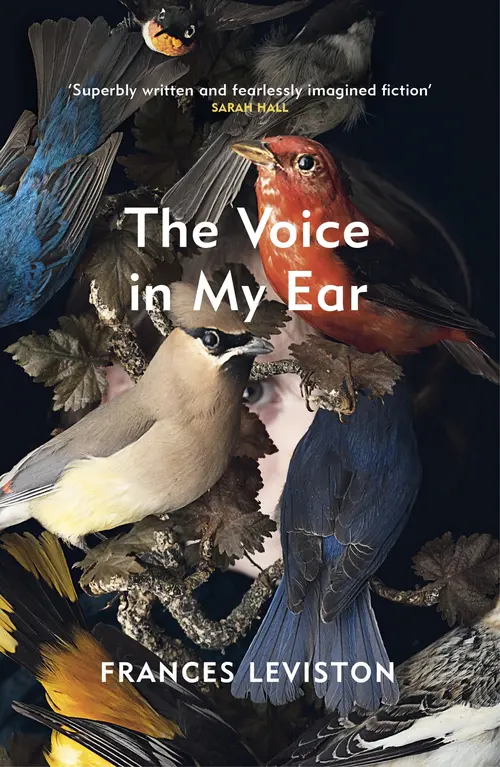
The Voice in My Ear
COVER

ABOUT THE AUTHOR
Frances Leviston is the author of two collections of poetry: Public Dream, shortlisted for the T. S. Eliot Prize, the Forward Prize for Best First Collection and the Jerwood-Aldeburgh First Collection Prize; and Disinformation, shortlisted for the Dylan Thomas Prize. In 2015 she was shortlisted for the BBC Short Story Award. She lives in Durham and is a lecturer in creative writing at the University of Manchester.
DEDICATION
For Paul
THE VOICE IN MY EAR
The first production team have gone to an awards ceremony in King’s Cross, the anchor to the Portland with foetal distress. This is Claire’s big break. She takes her mark, and feels the hiss of the open channel flood her head.
—Sixty seconds.
Sprayed ends of hair shine and shake in her peripheral vision. A soft brush whisks across her nose, a roller across her lapels. The earpiece feeds her the end of the buffering ads, Maybelline and Dolmio, then a trailer for a costume drama, before the continuity announcer begins: ‘And now, standing in …’
—Ten seconds to air. Eight. Seven.
Her hands are cold, her feet on another planet. She looks squarely down the autocue and reads, ‘GOOD EVENING. I’M CLAIRE ASHBY.
‘TONIGHT: AS CONSPIRACY CHARGES AGAINST FORMER GOVERNMENT COMMUNICATIONS DIRECTORS ARE UPHELD AT THE COURT OF APPEALS, WE ASK WHICH OF THE SUTHERLAND ENQUIRY’S RECOMMENDATIONS HAVE BEEN IMPLEMENTED, AND WHAT THIS MEANS FOR THE FREEDOM OF THE PRESS.
‘BUT FIRST: RELIEF AS THE LONGEST AND MOST EXPENSIVE STRIKE IN SOUTH AFRICAN HISTORY COMES TO AN END – FOR NOW – WITH A DEAL PROMISING PLATINUM MINERS A THREE THOUSAND RAND PAY RAISE OVER THREE YEARS. BUT AT WHAT COST TO LONG-TERM JOB SECURITY, AND WHAT COST TO THE ANC?’
She pictures the white Meccano rigging and dove-coloured silos of the Anglo-American platinum mine on the B-roll that is now being cued. She cut it herself that morning.
‘Almost two years ago,’ the voiceover begins, ‘this mine in Marikana …’
Her ears pop. She wiggles her toes inside the hard shoes. She’s done it, the first bit, and now she is huge and triumphant, a carnival queen on her float of light.
—New positions. Camera three ready.
The next angle jumps up on the monitor. She watches herself enter the frame and settle behind the desk. Now the studio guests come in, stepping over cables, broaching the circle of lights. The first of them, a woman, only four or five years older than Claire, tall and heavy-bosomed in a tailored blue dress, offers a handshake that is nothing more than a touch of palms, then sits and stares up at the rig. Some kind of childish torpor keeps forcing her to smother huge yawns.
‘Look at Claire,’ says the woman acting up as floor manager. ‘Look at each other. Don’t look down the camera, just pretend it’s not there.’
The male guest is wearing a shirt in a mushy colour, bad for TV. He clasps Claire’s hand in a damp grip and says, ‘You must be as nervous as me. I mean – I don’t mean …’
Sweat glistens on his forehead. The make-up girl powders it away, obliterating freckles, revealing that without them his face does not make sense. The woman in the blue dress refuses to be powdered: just refuses, with the flat of her hand. Her skin is so clear and dewy that Claire wonders if she’s pregnant.
A crackle. —Back to you in ten, nine, eight …
On the screen Claire sees the school photo looming behind her shoulder, long face, red hair. She pokes the earpiece, then straightens up and sets her shoulders as the text begins to scroll.
‘THE DEATH OF TEENAGER BEVERLEY PARKER HAS LED TO RENEWED CALLS FOR THE SOCIAL MEDIA ACTIVITIES OF ADULTS WHO WORK WITH CHILDREN TO BE MORE CLOSELY REGULATED. BEVERLEY TOOK HER OWN LIFE LAST FRIDAY AT HER FAMILY HOME IN BIRMINGHAM, JUST THREE MONTHS AFTER THE CONVICTION OF HER FORMER PHYSICS TEACHER NEAL RICHARDS ON CHARGES OF SEXUAL ACTIVITY WITH A CHILD. IT WAS REVEALED DURING THE TRIAL THAT IN ADDITION TO HAVING SEX WITH THE FIFTEEN-YEAR-OLD ON MULTIPLE OCCASIONS, RICHARDS HAD BEEN SENDING HER UP TO A DOZEN MESSAGES A DAY VIA TEXT AND ON SOCIAL MEDIA WEBSITES. THE COUPLE CONTINUED TO WRITE LETTERS TO EACH OTHER EVEN AFTER HE HAD BEEN ARRESTED.
‘CAROLINE LOVELL,’ Claire says, turning to the woman in the blue dress, ‘your organisation Mothers of the Innocent has been one of the loudest voices calling for increased regulation. What exactly do you want to see happen?’
As if she runs purely off the energy of live television, Caroline springs to life, all lassitude gone.
‘What we don’t want to see,’ she says, ‘are any more cases like the tragic case of Beverley Parker, a young girl taken advantage of systematically by her teacher over a number of months, a shocking sequence of events, which has now ended with young Beverley taking her own life. What we are proposing is that schools insist on all contact between teachers and pupils taking place through school systems only, where it can be properly tracked—’
‘That isn’t the case already?’
‘No, it’s not, not clearly enough. Everyone agrees that social media contact with pupils isn’t a good idea, but teachers are simply trusted to use their own judgement. What we want to see, and what we believe the British public would like to see, are much clearer boundaries about what’s appropriate, so that everyone knows right from wrong—’
‘But Richards did know it was wrong,’ Claire says, glancing at her notes, ‘he admitted as much in court, so how would that—’
‘Boundaries don’t exist simply for criminals, they exist for victims, too: they help victims know that what’s happening is unacceptable. We want all pupils to be aware that social media is off limits. When I talk to people about this, most of them can’t believe the law hasn’t already taken a firmer stance.’
‘Rob Dowling,’ Claire says, ‘is Caroline Lovell right? Does the British Teaching Association agree that we need more regulation?’
Rob is already nodding. ‘The issues Caroline’s raising are very important, and of course we must do everything we can to ensure that teachers do know the boundaries, that they respect the boundaries, especially on social media—’
‘You should be doing that already,’ Caroline says.
‘Well, if you just listen—’
‘—I am listening—’
‘—you’ll know that is what we’re doing, and we won’t stop looking for ways to improve teacher training, but the fact is—’
‘The fact is not enough care is taken to make sure girls like Beverley aren’t exploited—’
‘Let me assure you,’ Rob says, flushing, ‘a great deal of care is taken. The vast majority of teachers are decent people, responsible, caring people, who absolutely know the difference between right and wrong, and are doing their best to deal with, not just the dangers, but also the opportunities new technology has created. Educators cannot be held solely responsible for these kinds—’
‘Who else do we blame? The pupils?’
‘Absolutely not, but there are other factors in play.’
‘Such as what?’ asks Claire.
‘We all know,’ Rob says, turning gratefully towards her, ‘that teachers are chronically overworked and underpaid. What we need are more realistic workloads that would ensure all pupils receive the right kind of attention. The answer isn’t to force more regulation on teachers, to give them yet another thing to feel anxious about, but instead to trust teachers to—’
‘Trust them?’ Caroline says. ‘I’m sorry, but Neal Richards was trusted, and look what he did with that. Trust is the problem here. You have to recognise the special position you occupy, and accept that there simply has to be a greater burden of accountability because of—’
‘—but that doesn’t benefit the pupils—’
‘It would have benefited Beverley Parker. It would have benefited Beverley’s parents, who are grieving the loss of their daughter, and are actually now pressing for manslaughter charges against Neal Richards, that’s how completely they feel he betrayed the trust placed in him.’
This is what pundits require, Claire thinks: absolute belief in whatever they are saying, even from a standing start. The marvellous capacity to self-convince. No one masters such a role cynically, despite what people think. Cynicism can be pried up around the edges. Only the faithful endure.
‘And what about parents?’ she asks. ‘Since you’ve raised them. Where do they come in?’
‘Claire,’ says Caroline, swivelling towards her, ‘the parents I represent for Mothers of the Innocent – and they’re not just mothers, by the way, they’re loving fathers as well – these parents are extremely concerned—’
‘Everyone’s concerned. But what responsibility do parents have for ensuring this kind of thing doesn’t happen to their child?’
‘Well, I’m not sure I understand the question, because I don’t see how parents are in any way to blame for the fact that paedophiles and abusers get into the education—’
‘No, we can’t blame parents for that,’ Claire says, ‘they’ve got nothing to do with hiring teachers—’
‘Parents are not to blame,’ Rob nods.
‘—but still they must bear some responsibility, mustn’t they, as parents, somewhere along the line? Isn’t that what parents are for?’
‘I don’t see your logic,’ Caroline says. ‘If I take my child to the zoo, and she gets mauled by a tiger, is that my fault? No, it’s not my fault: it’s the zoo’s fault, it’s the zookeeper’s fault. That’s just common sense.’
‘Yes,’ Rob says, ‘and let’s keep in mind here, the tragic exploitation of this young girl was a freak occurrence, and is not—’
‘But Caroline,’ Claire says, ‘your zoo metaphor, how does it apply in this case? Because we’ve been told several times, by the school, by the media, even by you, that Beverley was a vulnerable young girl, that she was preyed upon because she was vulnerable – because of something in her personality or her circumstances, something about her – and that’s not what tigers do, is it?’
‘Tigers,’ Caroline says, ‘and obviously that’s a metaphor, tigers are predators, they eat babies’ – Rob nods vigorously at this – ‘they attack babies and young children, not adults who can fend for themselves—’
‘Well, I’m not sure that’s true,’ says Claire, ‘but even so, that would be based on physical size, not psychological issues, wouldn’t it? And yet Beverley was emotionally vulnerable, you’ve said, psychologically vulnerable—’
‘Yes—’
—Stay on topic. You’re wandering off.
‘—and you said her vulnerability had something to do with the situation in which she found herself—’
‘Yes,’ Caroline says, ‘generally we find it’s the vulnerable children, the isolated girls, that abusers are drawn towards. Schools should be doing more—’
‘So they’re vulnerable, they’re isolated’ – Claire is counting off the points on her fingers – ‘they’re maybe less aware of boundaries than other children, they maybe have fewer people to confide in—’
‘Yes, that’s right, that’s what we tend to find—’
‘—and yet you want me to believe that parents bear no responsibility at all for their children being in that vulnerable state, which they are in before the abuser even arrives on the scene?’
—Claire, you’re way off. Get back on the schools.
Caroline hesitates. ‘All children are vulnerable,’ she says, making parallel lines with her hands, ‘all children are innocent, and all of them should be protected.’
‘But isn’t it true that some children are more vulnerable than others?’ Claire asks. ‘Isn’t that what you’ve just said? It seems to me’ – she pokes the earpiece again – ‘that you’re asking very tough questions of Rob and the teachers he represents, and asking tough questions of schools and other institutions, but you’re not questioning the institution you represent, which is the family, which is mothers, and fathers. What role do parents play in a child’s abuse?’
—Claire—
‘I don’t think,’ Caroline says, half-laughing, ‘I don’t think you can say that parents play a role in abuse—’
‘You can’t?’
—what the fuck are you doing?
‘—since parents are the victims of abusers as well as the children they abuse—’
‘Really? Parents are victims?’
‘Of course they are,’ Caroline says, and Claire sees the colour is high in her cheeks, burning through the minimally made-up sheen.
‘I think what Caroline’s saying,’ Rob ventures, sounding almost gallant, ‘is that parents are affected too, by the responsibility—’
‘No, she’s not, she’s saying that parents bear no responsibility whatsoever.’
‘Absolutely not, and I resent the implication—’
‘Then tell us, because it’s still not clear, where you do stand on the issue of parents. They’re responsible, but they’re not responsible. Am I understanding you right?’
—Shut it down, or we’re cutting—
She hooks the earpiece out. Caroline huffs a laugh and says, ‘I think it’s appalling that the media wants to villainise parents. I was asked here to talk about the role that schools play in cases like the tragic case of Birmingham, of Beverley, what happened to her, that’s what my organisation is concerned about, so I don’t really see—’
‘You don’t see the link between what happens at home and what happens at school?’
‘Yes, but—’
‘Yes, but what?’
‘You can’t blame parents for abuse committed by teachers! It’s morally indefensible! They’ve already been destroyed by what’s happened – they already feel guilty beyond belief – trying to put that on them too, that’s appalling—’
‘But why feel guilty if they’ve done nothing wrong?’
‘Because they were supposed to protect their child!’
‘Exactly,’ says Claire, leaning forward now, ‘exactly, and they f—’
BRODERIE ANGLAISE
I was not maid of honour, not even a bridesmaid, but I was dutifully invited, and for this I needed something suitable to wear, something that would signal my grasp of the occasion as well as my transcendence of it; but no matter where I looked – and I spent hours looking – the dress did not exist. No shop possessed it. There is no point explaining now exactly what I had in mind. The details in themselves do not matter, except to say this dress should accommodate my chest without looking matronly or profane; that it should upstage the bridal gown without appearing to do so; and that I was not exactly conscious of these obstinate stipulations, but clicked through the rails of department stores in an agitated dream, like someone brainwashed to accomplish a murder without their consent.
My solution, in the end, was to make the dress myself. At university, I had done quite a lot of sewing. Gemma, one of my housemates, owned a little sewing machine she taught me how to use, though she hardly used it herself. I would run up silly costumes for my friends for Halloween, and basic items for me. ‘Run up’ was a phrase of my mother’s, one I tried not to use, not out loud at least, though it was stuck firmly to the walls of my mind, like the Blu Tack I had used in my rented room, the greasy little coins from which cost me my deposit. But since I had come back to my parents’ house the previous summer, the sewing kit had stayed packed away, along with all the items it helped me manufacture. I didn’t want to talk about it; I didn’t want my mother to know.
Little by little, then, I decided I would make the dress in secret, and pretend it was vintage: my mother’s side of the family did not approve of second-hand shopping, and Candice was her niece, her younger sister Amanda’s child. My hopeless lunch-break expeditions down the high street became quiet pilgrimages to haberdashery departments, in which I kept my head down, moving quietly among the middle-aged and elderly ladies rattling their knuckles through trays of beads, drawing no more attention than I could help, and asking no questions in case I brought an avalanche of answers down on my head.
Many fabrics presented themselves, and I chose as carefully as I could, avoiding jersey, silk and satin because they would be too difficult to work with, and linen because it would crease. Some bolts of beautiful patterned cotton I put back because I would not be able to make their bold edges join in any logical progression at the seams, or so I told myself, though I think I also quailed at the prospect of them drawing Candice’s wedding guests’ eyes towards me in the way they had drawn my own.
After a few trips, I had amassed in my bedroom three metres of broderie anglaise, two kinds of thread, a roll of greaseproof paper, a pattern and a roll of calico for practising with, which, along with the sewing kit I dug out from the bottom of the wardrobe, should have been everything I was going to need. Everything, that is, but the sewing machine.
Gemma lived two hundred miles away, and we had not spoken since our final exams. I knew nobody else except my mother who owned a machine. Buying one of my own would have been prohibitively expensive: I was temping as a secretary at the time, work which somehow contrived to pay slightly less than minimum wage, and what I didn’t surrender in room and board to my parents was digging me out of an overdraft the bank kept threatening to dissolve. Even if I could have got my hands on my own machine, they were terribly noisy, which left me the same problems I would face if I chose to use my mother’s: namely, finding a time when I could sew without detection.
As I mulled this problem over, I was not idle: I did as much as I could behind closed doors, in my bedroom, which had barely changed in my three years away, except that a chest emptied of clothes had been removed to my brother’s room. This gave me more space to spread my materials out. I measured myself several times with a floppy fabric tape measure: bust and waist, hips and shoulders. I cut greaseproof panels and tacked them together, then calico panels, and slipped the rig gingerly over my head, warming to the tiny adjustable demands of my ambition, while downstairs my mother cooked dinners from which I excused myself, or watched one of the police dramas she liked so much, and my brother lay lost in the violent immersive dreams of his video games.
Candice and her mother, my Auntie Manda, were often round at our house, ostensibly for the purposes of wedding planning, but also to bask in my mother’s envy (the whole marriage business ran on envy, it seemed to me, like a car running on fumes). If I left my door ajar, which I could safely do when there was company downstairs, I could clearly hear them talking above the hiss and snip of the scissors.
‘I went to that bakery you told me about,’ Candice might say, addressing my mother, who for someone professing not to like cake had been surprisingly full of suggestions, ‘and we tried a few samples, didn’t we, but the quality just wasn’t that good.’
‘Much too sweet,’ Auntie Manda would agree, sounding faintly offended. ‘Really sickly.’
‘Well, I thought that might be the case,’ my mother would say. ‘I’ve seen some very good things from there, and some not so good, and I thought it might be worth trying, at least, but I thought probably, probably it wouldn’t be exactly what you were after.’
‘No, it wasn’t what we were after,’ Auntie Manda would affirm. ‘But then we tried the place that Susan suggested, and you liked that one a lot, didn’t you, love?’
‘I really liked that one,’ Candice said, drawing out the vowels.
‘They did the most beautiful icing,’ Auntie Manda said. ‘Really beautiful. And the sponge was very moist.’
‘Well, that’s what you want, isn’t it,’ my mother said. ‘There’s nothing worse than dry cake that’s too sweet. I’m not a fan of cake, but I know you don’t want that.’
‘How can you not like cake?’ Candice exclaimed. ‘These cakes were beautiful. You’ve got to have a piece at the wedding.’
So it went, the horse-trading of preference and information, with my mother rubbed sore between her sister and her niece until it was time for them to hurry away for another appointment, another opportunity to exhibit their harassment and good fortune, at which point my mother would be able to wash her hands of the whole thing; and although she was reluctant to do this – she wanted, more than anything, I think, to be right at the centre of the wedding – she could at least draw strength from her freedom.
‘Lovely to see you,’ she would say, trailing them down the hall. ‘We’ll talk tomorrow. Gosh, you’ve got so much to do. I don’t envy you all that, I really don’t. It’s a bit like someone else’s baby for me. I get to play with her for a while, but then I can give her back!’
They laughed at this – they always laughed – knowing full well that my mother would never have given the baby back if she did not have to. Then their laughter mutated into cries of farewell before the closing door cut them off; and although my mother stood on the near side of this door, her own cries always cut off at exactly the same moment. Then, before she could turn and climb the stairs, I would shut my own door as well. If this seems cruel, I can only say that my mother’s weakness in the presence of her sister and her niece filled me not with pity but annoyance – I could not understand why she endured it. What did she think was going to change?
The Story Continues on BooksBarbecue!
Enjoyed this preview? ❤️ Do not stop here!
Read the complete book free online → 🔗
Continue reading now on BooksBarbecue and discover every page!
Love reading? Bookmark BooksBarbecue.com for more amazing books!
Happy Reading!