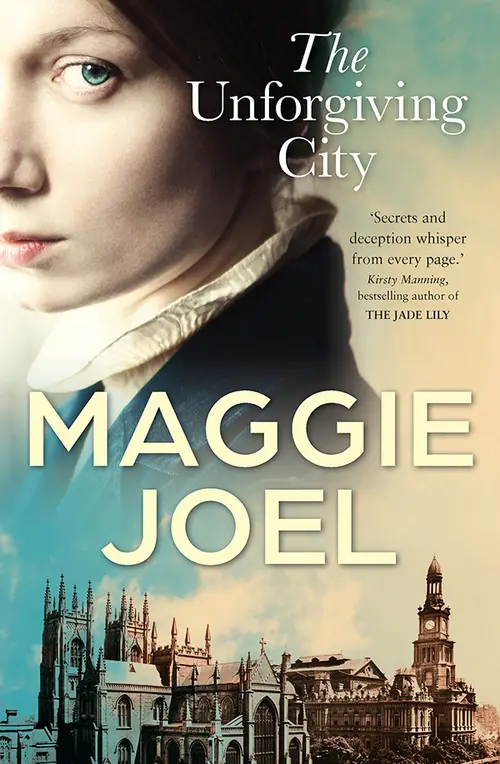
The Unforgiving City
COVER PAGE
PRAISE
PRAISE FOR MAGGIE JOEL
The Past and Other Lies
‘Joel is particularly good at depicting the kind of small, casual cruelties family members can inflict on one another.’ Sydney Morning Herald
The Second-Last Woman in England
‘The mesmerising story crackles with atmosphere and delivers some great twists.’ Australian Women’s Weekly
Half the World in Winter
‘Maggie Joel explores the way human fates as well as fictional plots can turn dramatically on a small and fleeting thing … a page-turner full of detail and colour.’ Sydney Morning Herald
‘If you like a robust period drama, with the occasional dash of dark humour, then you will love this.’ Daily Telegraph
The Safest Place in London
‘Maggie Joel’s The Safest Place in London is a beautifully written exploration of desperation and hope in a time of war. The novel captures the essence of the era with subtlety and style, while the shifting new world pushes characters to extreme lengths. A remarkable story of family, survival and how one decision can change lives for better or worse.’ Jane Harper, bestselling author of The Dry
The Unforgiving City
‘Maggie Joel plunges the reader into the brutal heart of Federation, taking us beyond the silk curtains of lawmaking. She holds us in the harsh Sydney streets as characters—and indeed an entire country—scramble for a sure footing. Secrets and deception whisper from every page of The Unforgiving City and force us all to question what it means to be a united country, but also … how far are you prepared to stretch your heart to forgive someone?’ Kirsty Manning, bestselling author of The Jade Lily
ABOUT THE AUTHOR
Maggie Joel has had four novels published. The first, The Past and Other Lies, was published to critical acclaim in Australia in 2009 and in the United States in 2013. Her second novel, The Second-Last Woman in England, was published in Australia in 2010, in the United States in 2011 and in the United Kingdom in 2013. This book was awarded the 2011 Fellowship of Australian Writers’ Christina Stead Award for Fiction. Maggie’s third novel, Half the World in Winter, was published in 2014 and in the United Kingdom in 2015. Her fourth novel, The Safest Place in London, was published in 2016.
NOTE
The author acknowledges Aboriginal and Torres Strait Islander peoples as the traditional custodians of our land—Australia—and acknowledges the Gadigal people of the Eora Nation as the traditional custodians of this place we now call Sydney.
CHAPTER ONE: THE NOBLE LEGACY
CHAPTER ONE
THE NOBLE LEGACY
Evening had come already, a June evening in the final winter of the century and the rain had not let up for a week. In Macquarie Street and College Street and Phillip Street the leaves lay in great damp, decaying piles, which was odd, the trees native to the colony being chiefly evergreens, but the settlers had brought their trees with them (or how would they know it was autumn, if the leaves did not turn brown and fall from the trees?). In nearby Hyde Park (for the settlers had brought their parks with them too) the wide avenue, along which in more clement weather elegant couples strolled, ran with torrents of rainwater and soon became impassable.
At a municipal hall a mile or two to the west of the city a meeting was in progress. At the doorway of the hall young women in neat white blouses and wide-brimmed straw hats quite unsuited to the weather handed out ribbons emblazoned in large bold letters with the words FEDERATION YES! Because it was wet, and because every man to whom they handed a ribbon was wet too, the ink on the ribbons ran and everyone’s hands turned black, but still the men took the ribbons, because the women were young and ardent and the men wished to be obliging. Already a quantity of the ribbons had found their way onto the floor of the hall and had turned to a sodden mass beneath the men’s boots and the legs of the chairs.
The hall was a functional one, distempered rather than panelled, a place of betterment and learning and, until the Methodist Hall was completed, of theological dissent too, where chairs and tables could be stacked and folded away to make room for dancing and music. This evening the chairs were in rows and the piano, a Charles Stieff upright that had not been tuned since the Queen’s Jubilee, had been pushed into a corner beneath a dust cloth. At one end of the hall was a raised dais, above which a banner proclaimed in the same large bold letters as the ribbons—only this time a foot high—ONE PEOPLE, ONE DESTINY, ONE FLAG. And here was the flag—snowy white with a pretty blue cross on it and the Union Jack stuck up high in the top left-hand corner—a thing hastily fashioned and poorly manufactured in the manner of a flag not yet officially adopted and likely to be changed at a moment’s notice once votes were cast and counted.
For a great bill had been proposed, and in twenty days the colony would vote and this time it would vote Yes. Nothing barring a catastrophe could stop it now. True, the very same thing had been declared the year before and the people of New South Wales had decided Federation was not for them. But a year later, with a newer bill—a better bill!—the fears that had sunk the vote a year earlier were appeased. Nothing barring a catastrophe, they said.
And so the hall was full, or if not quite full then certainly half full. Upwards of fifty or sixty men, and some women too, had made the journey on such a dreadful night to hear what the gentlemen from parliament and their own local aldermen had to say. They already knew how they would vote, but it was a thing, was it not, the men from the parliament coming out to your suburb, to your local hall? And on a night like this.
On the dais a row of uncomfortable folding wooden chairs held the by-no-means-slight figures of the mayor, various councillors and aldermen, one or two of the more important local businessmen and the Hon. Alasdair Dunlevy MLA, the only member of the Legislative Assembly to have braved the downpour and made it to the meeting. But one member was better than none, and Mr Dunlevy cut an impressive figure in a black tailcoat and pinstriped trousers, a tall man in a tall black silk hat, powerfully built; a man barely contained by a tightly buttoned silver-and-black-striped waistcoat and a pale grey Ascot tie at his neck. Above the tie was a smooth, clean-shaven face that spurned the whiskers doggedly retained by the more senior members of the Assembly, a face that said it had nothing to hide, that said here is the future and it has no beard!
Alasdair Dunlevy stood at the lectern and surveyed the crowded hall. He knew these men, knew what was in their heads, knew—more importantly—what was in their hearts, understood their fears, their hopes, their prejudices, and this understanding calmed him, it filled him up, it made him powerful. His fingers gripped the lectern’s smooth wooden edges, not to steady himself, but as a man does who sees an opportunity and who seizes it with both hands. The mayor, a man whose name Dunlevy had already forgotten, had spoken—trite platitudes and dry clichés for the most part—as had a councillor and one or two of the notable local businessmen, but it was not until Alasdair began his speech that the men sat forward and nodded their heads and shouted their approval, for he had shown them a vision of what their nation might be:
‘You have heard my reasons, gentlemen, and I will summarise them for you. Federation will remove these absurd custom barriers between the colonies. It will mean a uniform railway gauge and new railways traversing our continent; it will finally open up the interior for settlement. Settlement for Australians—for Federation is the only possible way of preserving Australia for the white races. It will engender confidence in British investors. It will mean improved defences. For make no mistake, gentlemen—’ and here Alasdair paused just long enough to allow each man in the room to lean an inch closer ‘—should there be a European war, disunion would mean disaster for Australia.’
And they all, to a man, liked what they heard.
Well, perhaps not to a man. Alasdair spotted the fellow a moment before he spoke:
‘We cannot trust ’em! We all know we cannot trust the Victorians.’
The speaker, a storekeeper or an artisan in shabby Sunday best, jumped to his feet and a chorus of voices followed him, agreeing or not, and some of the other men now also got excitedly to their feet and their wives pulled them down again to their seats.
Mr Dunlevy held up his hand, but before he could reply the heckler, red-faced and sweating despite the cool night, spoke again:
‘If you believe the Victorians will willingly give up a federal parliament—not once they have got their hands on it—and let us build a brand-new capital someplace else, you are a fool!’
‘They want Ballarat for the capital—the Premier hisself admitted it!’ called out a man in a bowler hat standing towards the back of the room. A further chorus of calls followed and some applause, a fair amount of derision too, but the tenor of the meeting had changed.
For the man had a point—could the Victorians be trusted? And, yes, the Premier had indeed said that about Ballarat, for all that it had been an unwise and unpropitious thing for him to concede.
A ripple swept through the hall, and the mood that a moment earlier had been one of high-minded camaraderie infused with a heady dose of patriotism now became something else entirely.
‘He’s right—how can we trust ’em?’
‘S’not just parliament—they want to take our money and put it in their own coffers and leave nothing for us!’
‘What’s the good of a Federation anyway? We managed for a hundred and ten years without one, why d’we need one now?’
And, yes, the arithmetic was wrong (for it was actually a hundred and eleven years), but the point was made and it was greedily swallowed up, for ill forebodings are more easily gorged on than fair ones. On the dais the mayor and his councillors shifted in their chairs. Their frustration at the ill-informed truculence of their fellow citizens—whose opinions seemed to them belligerently dogged and also, somehow, fleetingly changeable—was clear.
Or it was clear to Alasdair, and the smile he allowed himself was wry, for if they anticipated this crowd—indeed, any crowd—to be rational and consistent, then they had fundamentally misunderstood their fellow men.
And so he stood, unruffled, at the lectern. He smiled. He waited. He had brought no notes with him to the meeting. His tailcoat and waistcoat had been designed in Italy. This silk top hat cost more than the collected wardrobes of every man present. This was not his first such meeting nor indeed his tenth. He had lost count of the number of Federation meetings he had attended and, the human mind being what it is, and men being essentially the same whether they be at Bondi Beach or Emu Plains or any point between, the same questions came up. Oh, patriotism and slogans and flags were all very well, but what it all boiled down to was that men feared change.
And so he smiled, he waited for a pause, and when it came he seized it:
‘Gentlemen …’ (And, yes, there were women in the audience, but none of them had questioned the Federation, had they? None of them had questioned his sound reasoning. Besides, none of them had the vote.) ‘I understand your concerns. Indeed, I have shared them. New South Wales has always been a champion of free trade, and you want assurances it will remain so, that our Federation tariff policy will not be based on protectionism. Gentlemen, I can make that assurance. There is nothing in this draft constitution to suggest it. You are concerned about losing out—you worry that customs collected from your pockets will go into a central government coffer. Worse, that we in New South Wales will find ourselves subsidising our poorer cousins in the other smaller, struggling economies—’
‘Too right! Those South Australians, Tasmanians and Western Australians want to bleed us dry!’
‘—and that is why Mr Braddon inserted his clause into our bill which provides an assurance to us that customs revenue will be returned to each state for the first ten years. And that is why Mr Braddon assures us that there will be a new federal capital—a brand-new city!—and it is to be built not in Victoria, not in Tasmania, not in South Australia, but here in our own New South Wales!’
‘But a hundred miles away!’
‘Yes, a hundred miles away!’ (Alasdair pounded the lectern.) ‘And what is that in our country which is two thousand miles across? Our city, which has grown to half a million souls in less than a hundred years, will stretch out to the north and to the south and to the west to cover that hundred miles in less than a century!’
A cheer followed this prediction, as it generally did.
‘Before it is completed, this new federal capital will be part of our western suburbs!’
This brought another cheer and some laughter.
‘Gentlemen, look to the other brave new nations of the world that have embraced federalism: Argentina, Canada, Switzerland, the United States—’
‘And look what happened there—they all but wiped ’emselves out in a bloody great civil war!’
Alasdair smiled and released both hands from their grip on the lectern, holding them before him, palms upwards. Someone always mentioned the American war.
‘Our nation will be created out of peace not out of war. This, gentlemen, will be our legacy. And is it not a sweet and noble legacy to leave our children and our children’s children? Does it not stir the blood to know that we here today, and at the polling booth on the twentieth of June, will make history?’
The red-faced man made some reply to this, but as the hall had erupted into applause and loud cheers his reply was lost.
The speeches were over. A show of hands was called: those for Federation and those against, the result being not quite unanimous but surely a clear majority in favour. The mayor beamed and his councillors congratulated each other with vigorous handshakes and jocular slaps on the back.
Alasdair Dunlevy shook every hand that was offered to him, making a point of greeting each member of the council and all the aldermen and the irritating little shopkeeper who had spoken out against him, and keeping one eye on the door and his fob watch and on his secretary, who lingered near the stage with their coats and umbrellas making hurry-up gestures, and on the photographer from the local paper who, surely, was going to ask for a picture?—yes, here was the fellow now—and striking just the right pose as the flash went off. Time for another? Yes, certainly—this time with the minister in the centre. And if the glow of victory had begun already to dissipate, it was only because Alasdair had been here at this very same hall with these very same men a year ago, almost to the day, and the mood that evening had been buoyant, celebratory, just as it was tonight, and a few days later they had lost the referendum.

Outside the rain continued to fall. Evening had become night.
A short carriage ride east of the city lay the inlet of Elizabeth Bay. Here the straight lines to which men aspired and which they had largely achieved in other parts of the city were abandoned. One road led directly down to the water, it was true, but the rest followed their own path, twisting and snaking and turning back on themselves seemingly on a whim. To live in Elizabeth Bay was to be forever climbing and descending, so the horses that pulled the carriages, the tradesmen’s drays and the hansom cabs that stepped lightly elsewhere, here laboured and strained and lost their footing. This was a shoreline still in the process of being tamed, where retaining walls and waterside parks and mooring for pleasure craft vied with sheer cliffs and rocky escarpments and scrub, where the newly built villas overlooking the bay perched tentatively, not quite yet master of the landscape.
On one of the newly paved streets was a row of villas made of honey-coloured sandstone, built in the Italianate style—with slate roofs and bay windows and cast-iron balustrading—by a team of Italian stonemasons brought to the colony at some expense. The new villas all had names, but they were not the Berwicks or Amblesides or Windermeres of a hundred other merchants’ houses that imagined a homesickness for a mother country most had never visited; these houses were named for the men who had built them, for the men who had bought the land and subdivided it, and for the politicians who had smoothed the passage of development. (One or two even echoed the ancient names the people of the Eora nation had once used, names cut down and made palatable to the European tongue, but these were very much the minority.) The new villas had bathrooms, they had running water and the new electric lighting. One or two subscribed to the telephone service. They were houses for the new century, built in the dying months of the old one.
Inside one of these houses a maid moved from room to room lighting fires, drawing curtains, trimming wicks—for the house still retained a handful of kerosene lamps and the maid avoided, where she could, the new electric lights. This house was named Yarran, a Jewish-sounding name, perhaps, though more likely a corruption of Yarrandabby, the old Gadigal name for the headland, though it had been many years since an elder had stood on this headland and uttered its name.
Her tasks completed, the maid—whose name was Alice Nimrod—went silently upstairs to the room of her mistress.
She was a slight figure, insubstantial—not in height, for she was as tall as anyone in the house, taller than some, but in presence. She had worked five years in the large, newly built house, though she was not yet twenty, and she moved warily in the manner of one who dwells in another person’s house.
Tonight her head was very full. She had got through the work of the day in fits and starts, hurrying over some tasks, lingering over others, her fingers moving restlessly, as restlessly as the thoughts in her head, and sometimes spoiling her work so that she must start afresh. Her throat was full too, she found now, full of strange words that she dared not utter and had not thought ever to utter in her life before. Yet the words fought to come out.
How full her head was!
At the top of the stairs Alice Nimrod stopped and turned about. She had no business to be here, and a maid in a place she had no business to be was in a precarious position. She walked the short distance along the landing and paused at her mistress’s bedroom door, her hand raised to knock.
But she did not knock. Her hand fell to her side. She closed her eyes.
Inside the room rain lashed the window.
Eleanor Dunlevy looked up from her journal. It was already quite dark outside. The curtains had not yet been drawn, and in the window she saw only the darkness of the night and her own face made indistinct by the rivers of water on the pane. The face was very white in the strange light, and featureless, the eyes blank, obscured by the little round-framed spectacles that she had recently been obliged to adopt. Her husband, a man with his nose always in a newspaper or an official document of some description and who was five years her senior, did not require such aids to his vision. She pulled the spectacles off. They were attached to a little chain about her neck and she let them fall to her chest. She had not yet told her husband she wore them, spent her evenings staring unseeing at the blurred pages of her novel until he retired to bed.
Outside leaves swirled and stuck to the pane, held fast by the force of the wind before being swept away into oblivion, and now Eleanor could make out two bright points of light in the darkness, which she thought must be the distant pilot lights of some vessel negotiating the safety of the harbour, but they turned out to be the unblinking yellow eyes of a possum wrapped around a branch of the Moreton Bay fig outside her window.
She took up her spectacles and reviewed what she had written in her journal:
Blanche wore a feathered piece on her head, ostrich, one presumes—
Her eyes moved down the page.
… the turbot was a rather odd colour though no one remarked on it … R. made some fatuous observation about the Prem. that amused everyone—not A., of course, who cannot afford to mock the P.!
The Story Continues on BooksBarbecue!
Enjoyed this preview? ❤️ Do not stop here!
Read the complete book free online → 🔗
Continue reading now on BooksBarbecue and discover every page!
Love reading? Bookmark BooksBarbecue.com for more amazing books!
Happy Reading!