The Taking of Jake Livingston
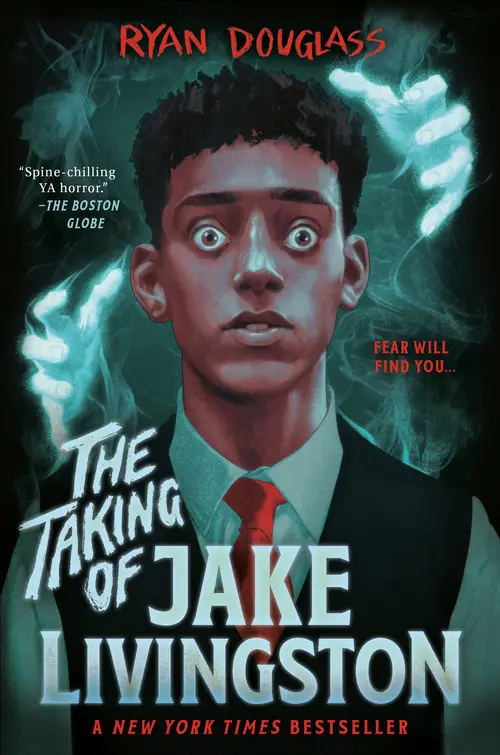
Cover
Praise for
The Taking of
Jake Livingston
A 2022 ALA Rainbow Book List Pick
A 2021 Black Caucus American Library Association Best of the Best Booklist Pick
A 2021 Tor.com Young Adult Science Fiction, Fantasy, and Horror Best Book Pick

“Spine-chilling YA horror.”
—The Boston Globe
“This book is absolutely incredible, chilling, and a must-read.”
—BuzzFeed
★ “An exceptional blend of genres—horror, mystery, thriller and contemporary—that brilliantly captures how Jake, a Black gay teen medium, copes with the varying kinds of violence threatening him . . . Douglass creates a clever and effective parallel between what Jake can’t control—racism and how his body is perceived, a toxic father, an irresponsible brother, his mother’s expectations—and his fight against Sawyer. The story builds to a rewardingly chilling and sentimental climax, as Jake must look deep within himself for the power to break the cycles of harm entrapping him . . . An extraordinarily crafted exploration of agency during Black gay teenhood.”
—Shelf Awareness, starred review
“A teenage version of Get Out, and you will not be disappointed . . . Douglass looks at race and trauma and death with a comical and horror-esque twist.”
—The Root
“Crucial social commentary and insight into the ways discrimination can isolate and depress young adults. Lush and emotive prose chronicles Jake’s journey . . . Spooky, atmospheric, and layered.”
—Kirkus Reviews
“There are many layers to navigate in this fast-paced trip to and from the world of the dead, including identity, violent and sexual traumas, and the stigma of mental illness, all with a supernatural and often gory twist . . . Ultimately, this is a satisfying addition to the supernatural horror section.”
—The Bulletin of the Center for Children’s Books
“YA readers looking for thrills and chills this summer will find them here.”
—Brightly
“Captures the pain of navigating teenagerhood when no one around you sees the world the way you do . . . A quick, worthwhile read that manages to pack a lot of dark themes into a tight space.”
—The Young Folks
“Chilling, edgy . . . spooky and layered . . . A wonderful genre-meld . . . This is an excellent debut.”
—Cinelinx
“Racial and sexuality themes undercut this gripping novel where a teen is haunted by the repercussions of his own sixth sense.”
—Cultured Vultures
“A unique and terrifying world built on tension and ghosts.”
—The Seattle Times
“This YA debut from Ryan Douglass is a mix of genres—horror, mystery, thriller, and contemporary—that explores how a Black gay teen medium copes with the various kinds of violence that threaten him.”
—Culturess
“Tackl[ing] mental illness, rejection, and loneliness . . . this novel takes a hard look at brutality in many forms, racism, homophobia, and consequences of the choices that we make.”
—School Library Journal, review of the audiobook
Dedication
For everyone fighting a silent battle.
Jake
I’d hate to be that kid who died in PE class.
Steven Woodbead never saw it coming. He was body-rolling to a trap song when the javelin hit his skull.
He died on the spot. Went splat in the grass, with the javelin sticking out of his forehead like the sword of King Arthur. According to St. Clair lore, a few people were screaming “LOOK OUT!” even as his hand unraveled like the legs of a dead crab and his portable speaker rolled slowly from his grip. Woodbead is dead, but I can still see him, bursting into light when the javelin lands.
Steven is deader than dead, and he died before I was even born. His PE uniform—white crop top and blue shorts—doesn’t match the all-red uniforms we wear today and definitely wouldn’t be considered “normal” by the academy’s current standards. Any dude wearing a shirt that doesn’t cover his belly button would have their face shoved into an unflushed toilet. So I assume Steven died in the eighties. All I can see is the moment his soul split from his body—when his shirt knifed open and firecrackers burst like bees from his chest. His body dispersed in a siege of glowing embers, disintegrating into the air around the rugby post. There’s this moment afterward when that spot is silent, and at first I wondered if that was his final loop, if Steven had finally passed on. But then he pixelates back into shape, short shorts to retro windbreaker. His smile is empty, his eyes are white, and he’s dancing all over again.
“Jake!” Grady’s voice whistles through the air like a firework behind me. “Wait up!”
Can’t talk right now. Too busy watching Woodbead blow up, hoping he’ll be done with that awful business soon. In the year I’ve been at this school, I’ve noticed his body parts slowly fading. Three fingers of his left hand have already dissolved, and his right leg ends just below the knee.
The ancient brick castle of my school fades into view. We’re passing the tennis courts and running toward the start line, where the wide steps lead back to campus. Turning the corner ahead of us are our top athletes—Chad Roberts and Laura Pearson, who, in their all-red uniforms, look like moving blood cells with pale appendages.
“Jake!” Grady falls in line next to me, head all sweaty. “Um, earth to Jake?”
“Oh. Hi, Grady.”
He’s the only friend I have here, for better or worse. He’s three inches shorter than me, with a white face and bushy orange hair. “You trying to ditch me, man? I’ve been calling you for twenty minutes!”
“Have you?”
“You’re always so damned zoned out.”
Our voices are pitched so differently. Mine is subdued and so quiet you can barely hear it. His is nasal and shrill—too loud to tune out.
Our friendship never really settled in—it’s actually a long-lasting accident, which started at the courtyard tables last year, when he invited himself to sit next to me. I was reading. He asked me what I was reading. My solitude ended, and I’ve never gotten it back.
A whistle shrieks from the field. Coach Kelly’s got his blue eyes set on me. His neck is stiff, and the bill of his hat hides the top half of his face. He’s pumping his arms in slow motion, pantomiming proper running. It’s so condescending.
I hate it here. Every time we run warm-up laps it’s like there’s a BLACK KID sign blinking above my head like a firetruck light, alerting the coaches of my whereabouts on the track. They are always keeping their eyes on me. Most days I want to run off this campus, find shelter in the woods, and spend a few years not being perceived, just to recover from the trauma of being hyper-visible.
And most days? I can’t figure out what I hate more: seeing the dead or being the one Black eleventh grader at St. Clair Prep.

I change into my uniform in the stall of the second-floor bathroom. Here is the best place to escape from all the shirt thrashing and butt slapping of the boys’ the locker room. Covering the walls are stickers for clubs I will never be a part of. Varsity Crew, Math League, St. Clair Democrats, St. Clair Republicans. They’re all slapped over each other like each club is competing for dominance, forming a big psychedelic collage of red, white, and blue. All surrounding a doodle of Mr. Krabs, captioned Krabs is one thicc bih.
The stall door clacks behind me as I approach a sink mirror—one of three hung on a blue wall of ceramic tiles. All that it shows me is that I’m not much to look at.
On my way out of the bathroom, I hear my brother shouting.
“Give me back my shit, man!”
The hallway traffic is buzzing like a chaos of katydids. Jocks, band geeks, and loners all wear the same navy-blue blazers, sucking all the culture out of the place. You can only tell who’s in what clique by the clusters that form in front of lockers and by the fact that jocks wear their blazers open.
My brother doesn’t wear the blazer at all. He wears whatever he wants. I stop walking when I see him arguing with my chem teacher, Mr. Shaw, on the landing past the glass at the end of the hall.
Mr. Shaw is holding my brother’s snapback out of reach. “No hats in the building. It is against the dress code.”
“It’s not a hat! It’s a headband. Show me where the dress code says no headbands, bruh.”
Benji is five-eleven, but Mr. Shaw is a giant at six-five and can hold the hat higher than most people. His jacket sleeve forms a curtain that hangs over Benji’s face as Benji jumps up to grab it.
It’s a loud and humiliating sight, which would be worse if people actually knew that we were brothers. You couldn’t guess it because Benji’s heavy like a linebacker, with a warm beige skin tone and a smooth wave pattern. I’m two inches shorter, skinny as a pole, with golden-brown skin and two different hair textures—nappy on the sides, curly on top.
Mr. Shaw is guiding Benji in the direction of the principal’s office as I slip into my first class. Benji’s arguing the whole time, not letting it go, asserting his right to dress how he wants. Sometimes I wish I could be like him—more in charge of myself.Instead, I’m silent all the time.
When Mom used to ask me what I learned in school, I couldn’t tell her. I still couldn’t, because it’s hard to pay attention when you live in hiding at the back of the classroom.
Dead world appears around me like a subaquatic wasteland of lost matter—failed tests, rusty trophies, dismembered trumpets, and ripped baseballs. Lost memories floating through the walls, over everybody’s heads, and out the other side. The phantoms blur together in a drone of chaos I’ve trained myself to ignore. That guy in the tweed vest who breaks the school chair over another dude’s neck in chemistry. That awkward moment in econ when a car crashes through the wall and just sits there with phantom bricks like visual static on its windshield, obscuring the bloody person inside. The lights blink so bright they block the board.
I wanted classes only on the second floor to avoid proximity to roads. And the third floor is too high, because the ghosts up there jump out of windows.
I am always focused on drawing. My notebooks are filled with demented sketches that normal people would call weird. Robots with spider legs and worms crawling out of eyeballs. Eyeballs with giant bellies. A boy with a bloated, bleeding heart for a head.
The final bell brings me home. The glockenspiel does its ding dong ding thing, and my eyes waken to my second reality—the one where ceiling lights blast through ghosts so hard I can barely see them. And the world is replaced by kids who don’t know my name.
I live in Atlanta, but not really. Clark City is too far out for the train to come, unless it’s one of those freight trains crawling slowly down the tracks and forcing cars to wait five minutes for it. Clark City’s half Black, a quarter white, and a quarter blend of Congolese, Eritrean, Afghan, and Vietnamese. Food trucks offer our most convenient eateries—Benton Bell’s wing truck and Strong Island Caribbean Café. Houses hide behind trees, their windows boarded, roofs slogged down in moisture. Construction workers tear projects down and put more corporate things up—car dealerships and gas stations. The breaking and building never ends.
There is no crosswalk to my subdivision, so I jaywalk when the timing feels right, making it across the street just in time for a car to rip through the fog behind me, thrashing my back with cool air.
Blue lights flash in the distance, up the curve to my house, and there’s caution tape stretched across a driveway. The police are talking to my neighbors—the Mooneys, I think. Their home is a plantation-style thing with a wraparound fence, dripping with fake cobwebs for Halloween. Also: fake graves in the lawn.
The middle-aged couple in navy-blue suits are lonely. They hug each other in the driveway. Her head is in his neck, and he’s staring into space. A field of indigo light curls off their heads, forming a smoky field with chunks of matter like planet waste—ice and dust and tiny rocks all melting into a living thing.
A pair of ghouls hovers over them, dipping their emaciated gray heads down to suck the smoke through their spiky teeth, slit nostrils, and eyeless eyes.
Their business is none of mine. I keep pushing to my house.
There’s a ringing from somewhere. No . . . screaming? Screaming and begging.
“Wait! Stop, WAIT!”
Must be coming from behind an open window, or dead world. I hear voices from the second world, like the voices that called out to warn Steven a javelin was on its way to kill him. These voices are always in distress. Sometimes they warn; sometimes they plead.
I’m cold suddenly. Summer always ends late down here, but it’s officially over now, and the wind is not warm anymore. A gust of it blasts my beanie off my head, and I spin to catch it, finding myself face-to-face with a rib cage. A rib cage like . . . a giant rotisserie chicken stripped of meat.
No nipples; a stretched, long neck; and a giant head, alien-shaped, with gaping holes in place of eyes. The ghoul obscures everything behind it, but if I reached out to touch it, my hand would fade through its body. They’re not real. They only look like they are.
I turn, and it follows me, like a zombie hobbling after its meal. Then I’m running up my driveway, suddenly unconvinced that it can’t actually touch me. I know what I’ve read about the creatures, and what my medium mentor, Ms. Josette, has taught me—They can’t hurt you, because they can’t touch you.
So why does the ground shake when they walk, rattling the street pebbles? Why do the asphalt cracks look strained under their footsteps? The hatchbacks and minivans parked on the street seem worried a storm will destroy them.
The creature’s horrible shadow falls over me, sinking my stomach into no-man’s-land.
I’m not the one grieving, so I’d be of no interest to the leeches of dead world. They tend to avoid happy people, instead latching on to the most sullen, tragic person in the room. I’ve only ever grieved my dog, Appa, who died of heart failure two years ago. My family’s mostly alive, except for my grandfather, who died six months before I was born. I don’t think I’ll ever see my dad again, but he’s still alive out there.
Now there’s laughter—children’s laughter—and the pop of a gun.
Something terrible happened in my neighbors’ house.
It’s getting cold too fast, like the entire winter is dropping here and now. A shadow comes down like a blanket of ice as I search my four pockets—slacks and hoodie.
Where are my keys?
There are moments when it controls me. The shadows, the darkness. Moments where I become dizzy, undefined, just a floater like the failed tests in my classrooms.
But I know my porch—a column of white balusters. I know my front door—dead bolt and handle that you push down to get inside. A freezing wind sweeps under my hoodie, pulling me backward. I tilt my way into the house and click the door shut.
The TV’s playing from the living room. Somehow. Mom’s out of town.
“Benji?” I call.
No answer.
The air is cold inside, and the light is so dim that even the earth-tone prints on the wall have lost their luster.
Around the entryway, I find the TV on Channel 2 News.
“We have to put a stop to gun violence. How many more people have to die?”
There’s a headline with a picture of my neighbor—the son of the weeping couple.
Matteo Mooney, Survivor of Heritage High Shooting, Found Dead in Home
Oh my God . . .
Matteo is . . . dead?
I don’t know anybody in the neighborhood, but I did notice when Matteo moved in. Him and Mr. Mooney forced a sofa through the door. Matteo was shirtless, the shirt tucked into his back pocket. The neighbors were all spying on his sweaty jock body, his shapely pecs. The sun was a hot bubble swelling over Clark City, and the humidity made me take off my own shirt, open the window, and put the fan in it. I watched Matteo come in and out of the house, wondering how much I’d have to lift to get so big. I wanted so badly to grow over my collarbones and elbows.
I sink into the couch leather.
I remember the school shooting. The Heritage killer sent a shock wave through all of Atlanta. Everyone was paranoid because one of those things had come so close to home.
I watch a clip of Matteo speaking at a podium. It’s dated a year ago, right after the shooting. Cameras flash on the tears in his eyes as he looks out over an outdoor audience. “How many more of our friends do we have to lose before we say ‘enough is enough’? There are demons out there who just want the world to burn. And we have to come together to make sure they can’t get the weapons to harm us.”
It cuts away. Matteo’s face appears side by side with the shooter who attacked his school.
Sawyer Doon. Yes, the menace with the straight blond hair and blue eyes.
The news anchors reappear, their faces molds of fake sadness. “Heartfelt words from Matteo Mooney. May he rest in peace. Our thoughts and prayers are with the Mooney family. The cause of death is currently unknown.”
I turn off the TV and stand up, staring at nothing. I guess a ghost came and turned it on when I was gone.
Murder. In my neighborhood. Matteo was like . . . eighteen? Nineteen?
I slog up to my room, and the house begins to feel heavy and too silent around me, like someone is here, something will jump out.
No one’s here. I’m in my room, turning my book bag upside down. Textbooks, pens, and worksheets fall free in a frenzy on my mattress.
I lift the blinds and watch the blue house at the end of the street. Police lights reflect in the second-story windows.
Strange. I never thought the richest kid in our community would be the one to die.
I collapse on the mattress and watch the globelike light fixture.
The final daylight surrenders to the dark trap of night. Ecto-mist creeps at my periphery, snakelike and sinister.
It’s the matter that eats ghosts as the seasons turn, nibbling on their fading bodies, burrowing inside of them like termites. It’s what makes all loops end, eventually. It’s everywhere and nowhere at once, coating the carpet, thickening the air with glittering fibers.
It’s always seeping in through the vents, the plumbing stacks, and cracks in the plaster like carbon monoxide, here to asphyx-iate me in my sleep.
Sawyer
October 9
Dear Diary,
Don’t know why the doctor made me do this, or who I’m even supposed to be talking to. It’s too dark in the shed to even see what I’m writing. So there’s no way to make sense of what I’m thinking. The lantern only shows me the center of the page. What I wrote before doesn’t matter. What I write next won’t either.
“Sawyer! Sawyer! Sawyer!”
Have you ever heard your name called so much that you wanted to die?
Momma must hate me. Made the doctors release me from Hapeville before I could promise Tom I’d never try to kill myself again. So I don’t know if I will try again. She took me out of there a week ago because it embarrassed her to have a kid at a treatment center. I know from what Annie told me when we got home, when Momma was out of earshot: “Are you sure you’re okay? Because you know they wanted to keep you in there and Momma made ’em let you go.”
I pictured all Momma’s coworkers at the diner judging her for not being able to answer the question “How’s your son doing?”
This outhouse-turned-shed-turned-haven was where my dad kept his power tools. Momma hasn’t touched it since he ditched us last September. She always asks me if I tried to off myself because he left. I think she gives him too much power.
The pine trees are so long they sneak through the crescent at the top of the door. The wallpaper in my cell at the clinic felt just as three-dimensional and murky, and I guess it reminds me of there, that place that felt more like home than here. Something about a hospital gown, a public bed, a tall dark man named Tom talking to me twice a day. He had beautiful bones in his face.
“Sawyer! Sawyer! Sawyer!” You should hear my mom yelling right now.
No one past the forest will know she’s shouting. But it will annoy the shit out of my sister, who’s probably in her room, writing in her own diary or messaging her mean friends.
Momma always asks me if she’s a good mother. I don’t know what to tell her.
She only ever started cooking for me after I tried to hang myself. She makes more sandwiches than necessary and refrigerates them for the next day, so they aren’t as good when I eat them.
“SAWYER, are you out there? Please come inside and eat!”
The Story Continues on BooksBarbecue!
Enjoyed this preview? ❤️ Do not stop here!
Read the complete book free online → 🔗
Continue reading now on BooksBarbecue and discover every page!
Love reading? Bookmark BooksBarbecue.com for more amazing books!
Happy Reading!