The Stoning
Cover Page
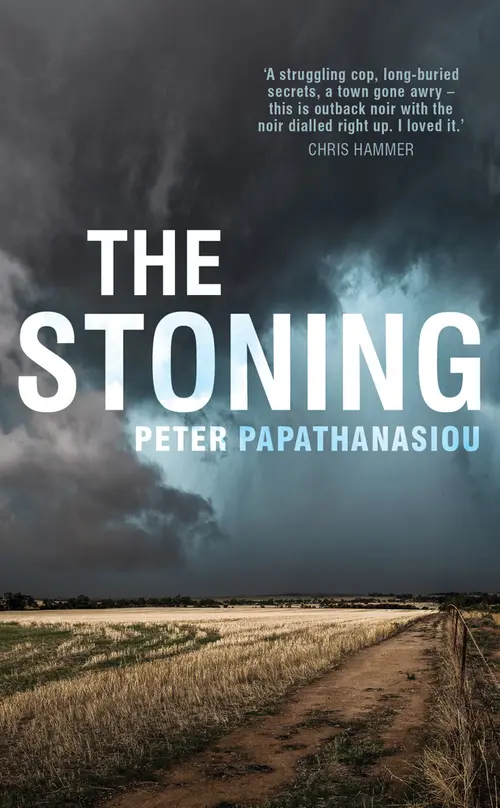
THE STONING
Title Page
Dedication
For my children, with love and gratitude
SHE WAS BEING pushed now, her body folded in on itself, crammed into a shopping trolley with a wonky wheel, her face crosshatched by the hard wire frame. Shreds of her skirt hung beneath the trolley, together with hanks of her sandy blonde hair. Wet and sweaty and matted, they left a light trail of droplets that quickly evaporated on the warm bitumen.
With each passing metre, her body sank lower into the trolley, limp, taking the shape of the metal frame. A pair of white headlights appeared at the end of the next street. In response, the trolley was stopped in the middle of the road. Then it sped up, going twice as fast, until it reached the gutter, its wheels sticking, unable to climb the high concrete. The ute revved its eight cylinders, a deep mechanical growl echoing across the night. It closed in, only swerving at the last minute before thundering away.
Finding the nearest footpath ramp, the trolley was returned to normal speed, passing Saint Matthew’s and the adjoining cemetery with its faded headstones and waist-high grass. The tinderbox trees drooped along Glenmore Road, heavy with excess oil. Their glassy green leaves hung like safety matches in the hot night air, scratching precariously against each other. A pale blue mist of eucalyptus obscured the stars above, a new moon cloaking the land in darkness.
The trolley was pushed further. Its home was normally at the northern end of town, at the Cobb Friendly Grocer. Not that it had been there in months; these were free-range trolleys, available to transport beer or trash or people. Its hard plastic wheels clunked along each corrugated square in the footpath, jolting and sending a light shockwave through her body at regular intervals.
The trolley was paused again before accelerating, rattling, shaking, picking up even more speed as its swivel wheels flicked erratically, left and right, left and right. They were soon passing the ex-services club, the cenotaph and the war memorial, inscribed with the names of those who fought and died, the unassuming digger with his slouch hat and gun.
The final destination was downhill, a gentle roll to the eastern end of King Street. The oval was there, peaceful and quiet. Footy in the winter, cricket in summer. The dilapidated wooden grandstand was where teenagers conceived children and spread diseases.
The trolley was eased up on final approach before suddenly being released, left to its own momentum as the earth fell away. It floated forwards and rotated sideways before it ran aground and tipped over at the end of the concrete footpath leading up to the oval. She fell hard, landing on her face, twisting her neck, a mess of arms and legs and yellow hair. Her thin cotton skirt lifted around her waist, exposing her pale thighs.
The crash startled a mob of kangaroos feeding on the grass. They had loped into town at dusk, thick tails skipping across the hot asphalt. The roos sought relief from the dry yellow plains that surrounded the town, going in search of the slightly less yellow grass of the sportsground. Both were home to nests of brown snakes by day, drawn to the heat of a constant sun. The local base hospital never had enough antivenom.
Grabbed by her hair, tensed tight like twine, she was dragged across the grass, her skirt tearing, briefs around her knees. As if sensing that something unusual was happening, the roos scattered, hopping this way and that. They were hungry, thirsty and, as a consequence, aggressive. They had overcome their fear of humans but remained feral; they lashed out at passers-by, dogs and dog walkers and drunks, boxing claws and firing kicks. But not tonight.
The sound of a second car approaching interrupted proceedings. The lack of a fast-revving engine indicated it was either a lost out-of-towner or local police vehicle on routine patrol. Flashing blue lights confirmed the latter, but the knee-high grass obscured the oval, and the occupants saw nothing more than a discarded shopping trolley on its side, wheels static. The car kept going, the neon blue disappearing, and the night again falling dark and silent.
Heavy footsteps were soon around her ears, hands again on her hair, pulling it backwards, dragging her limp body further east. They were leaving the oval, heading for the copse of gum trees behind the scoreboard. Dry sheets of sharp bark clawed at her skin, leaving dark-red whiplashes across her milky white back. The next sound was her spine crunching against one of the thick trunks as she was moved into position and fixed with a thick roll of gaffer tape around her shoulders, breasts, wrists, torso, thighs, ankles.
She was left there for some time – several minutes. Ample opportunity for her to be found if it hadn’t been such a late hour or desolate part of town. She hung there, strung like a puppet. Something started crawling up her leg.
The wind picked up. It blew the crusty hair from her eyes and rippled the long green curtains of leaves on the hunched willows beside the creek bed. Running parallel to the oval, the creek hadn’t held moisture in years.
A darkened hand touched her face, caressed it gently. Then the blade of a long machete knife, shiny and cold, pressed against her cheek, its diamond-sharp point trailing down to her neck.
Stepping away, the silhouette disappeared into the darkness. When it reappeared, it came closer, at speed, with its arm cocked back, before extending and releasing.
The first stone flew through the air, caved in her forehead and smashed the frontal bone.
Chapter 1
Chapter 1
OLD IDA JONES was on her way to steal her morning paper from the bundle left outside the newsagent. She carried her own penknife that she wielded with precision to cut the plastic packing strip and claim her daily prize. A sharpened cricket stump doubled as a walking stick and protection from local wildlife, human or otherwise.
She used the stump to poke the body at first, in case someone was playing an elaborate prank. The cloud of blowflies around the head suggested differently, but Ida’s eyesight was failing, and experience had taught her to be suspicious of everything in Cobb, to always second guess. Inert bodies lying on park benches or under trees were not an uncommon sight at first light. But those bodies moaned or snored, their brains addled with booze and drugs, and they weren’t taped to a tree and caked in black blood.
Of course, Ida recognised the face, even with all those wounds, and knew the woman’s identity immediately. In such a tiny flyspeck of a town, it was impossible for her not to.
Ida walked home as fast as her arthritic legs and cricket stump could carry her. She dialled Sergeant Bill Fyfe’s direct number on her landline, blurted out her horror, hung up, consulted her address book and kept dialling.
‘CHRIST,’ WAS ALL Fyfe said as he rolled out of bed, sleep deprivation whittled under his eyes. His wife grunted and went back to sleep.
Fyfe worked fast. When old Ida knew something, the whole town knew it, word spreading like an infection.
He dressed and rang the station as he exited by the rear fly-screen door, rusted, half off its hinges. He wasn’t sure if anyone would answer. His team often wasn’t there.
The cop shop phone rang out. Fyfe swore and tried a second time. Turning left into Eyre Street, he was just about to hang up and try the two-way. Mobiles had variable reception in Cobb. But then, Sparrow answered.
‘The hell’s going on there?’
The constable coughed. ‘Sorry, boss. Ol’ Geoff was here again.’
‘Not more bloody stolen chickens…’
‘Yair. You know how he goes on.’
‘Well enough faffing about, son. Is anyone else there?’
‘Nah. The old coot’s gone now.’
‘I meant us. Police.’
‘Nah, just me.’
‘Lock up, then. Meet me in five at the Crapp. Bring the gear.’
‘What gear? Me boots? We kicking the footy around?’
There was a pause.
‘We got a body.’
The sports oval came into view. Fyfe parked on a drunken angle and as close to the log fencing as possible. Stepping out of the car, he moved his sunglasses onto his bald head and surveyed the scene. Aside from a laughing kookaburra high in the branches, the Alfred Crapp Reserve appeared empty. Fyfe saw the overturned shopping trolley and shallow trench in the long grass leading to the oval. Careful to avoid the fresh trail, he followed it to the large gum. He had to shoo away a big mob of roos that had gathered around the tree, sniffing at the ground. They were reluctant to leave, as if protective of the body. A long Bowie knife was stabbed into the trunk about a metre off the ground, a twisted roll of tape by its base. Bloodied stones were scattered everywhere, ranging in size from tangerines to cantaloupes. A foul smell hung in the air like a presence.
Fyfe wiped his dry mouth. He approached with trepidation, fear rising in his throat like nausea. Steeling himself, he warily lifted her chin.
‘Oh, Molly. Fuck.’
The scene was just as Ida had described. Those were the details she was now circulating through Cobb, one gruesome phone call at a time. Fyfe stepped back from the body, from the gobbets of flesh littering the ground. Sighing, he withdrew the tobacco tin from his breast pocket and began to chew.
Sparrow arrived, hands on hips, unlit smoke in mouth. He saw Fyfe’s face, now heart-attack red. ‘Jesus,’ the young constable said, ‘what’s with all the rocks everywhere? Was she —?’
‘Hey! Didn’t you hear me earlier, son? You got rocks in your head, son? I said no faffing about. Get on with it. We ain’t got all day here.’
‘Alright, alright, keep yer pants on. Did you ID the body?’
‘I already know who it is.’
Sparrow unzipped his black duffel bag and began removing equipment.
Fyfe took notes. ‘Ambulance?’ he asked.
‘An hour or so.’
‘An hour…? Christ. Photos, fast.’
Sparrow snapped like a paparazzo while Fyfe continued to chew, spit and scribble. He regularly looked over his shoulder to scan the perimeter of the oval. His ears pricked whenever he heard a noise, but it was invariably the same cackling kookaburra, mocking his efforts from up high.
Without warning, Sparrow gagged.
Fyfe looked up from his sketch to see the young constable bent over, coughing. ‘You okay?’
Sparrow spat, nodded, spat again. ‘It’s the sight, not the smell. Medieval shit.’
‘Biblical, actually.’
‘Boss, you don’t reckon…?’
‘Look, probably. But not now. Reckon later. You finished?’
‘Yair.’ Sparrow closed the camera and walked away, spitting.
‘Good, get the baggies.’
The constable retrieved two garbage bags and handed one to his sergeant. After snapping on bright purple rubber gloves, they picked up all the rocks and tape. Fyfe had to wrestle the tree for the knife.
‘Right, got it all?’ he breathed. ‘Let’s get the f —’
The sound of voices cut Fyfe off. They were approaching from the north and getting louder, closer. He gestured at Sparrow to go deal with them.
Sparrow trotted off, weaving his way through the gums like his ancestors had, moving silently across the fallen bark to the space where the creek refused to run. Fyfe looked around for a place to sit; finding none, he eased himself achingly onto the dry ground. Sucking thoughtfully on a long blade of grass, he watched a flock of mynas roam the oval, introduced pests looking for trouble, flexing their feathered muscle. Above, sulphur-crested cockatoos spiralled high on the morning’s thermals with barely a flicker of their wings. The sun was impossibly white now, its early yellow glow intensified until it lost all colour, the mercury rising a degree a minute.
Sparrow reappeared. ‘Just a coupla teenagers.’
‘Wait here.’ Fyfe stood, knees cracking. ‘I’ll grab the tarp from my car. Cancel the ambo.’
He retrieved the big blue sheet. He’d only just rinsed it clean the previous day, using it to transport drunks found by the roadside.
Fyfe and Sparrow cut her down carefully and slid the plastic tarp under her body. They lifted it with zero effort, her slim frame about the same weight as the tarp. When she was in place in the back of Fyfe’s four-wheel drive, Sparrow returned for the shopping trolley.
‘See you at the station,’ Fyfe said, turning his steering wheel in the direction of the hospital. ‘Lock the doors. Don’t do anythin’ yet, ya hear? Nuthin’. Wait till I get there.’
Sparrow nodded. ‘I’ll inform her next of kin, though.’
‘Yeah, do that. But only that.’
‘Okay.’ Sparrow waited a beat, then added, ‘There’s gonna be trouble, eh…’
‘Yeah, I know.’
Fyfe drove to Cobb Base Hospital and parked in his discreet spot reserved for drop-offs. After he rang the buzzer, it was some time before the heavy double doors swung open. An orderly, an Aboriginal elder, stepped forward, tugging on his matted grey beard, pushing a gurney. He coughed into his hand and flicked a cigarette butt over Fyfe’s shoulder.
Words weren’t needed. Both men knew the drill. Fyfe led the orderly to his car, and together they loaded the tarp onto the gurney. The elder handed Fyfe a clipboard and pen, and lit another smoke to wait for the paperwork. The sergeant’s handwriting was illegible, but the orderly cared little. He tossed the clipboard onto the tarp with no regard and wheeled the gurney back inside.
Fyfe went home to shower. The water around his feet turned a murky brown. He shaved and changed into a fresh shirt. He drank strong black instant, the bitter brew burning his mouth. Persistent grinding had worn down his teeth to nubs. His wife remained snoring.
The streets were deserted as he drove to the station just after lunch. It was a calm that felt distinctly uneasy, knife-edged. Sparrow was right. With word spreading and the temperature rising, trouble lay ahead.
Fyfe took to his office with the blinds drawn and air conditioner on full bore. He received a brief call on his direct line, barked into the mouthpiece and hung up. He passed the afternoon playing solitaire and drinking whisky anaesthetic. Out front, an answering machine with a dry bureaucratic voice screened all other calls. In the tearoom, Sparrow detailed the morning’s grisly find to Constable Kerr, and they began comparing theories.
The afternoon slipped by without incident. Fyfe fell asleep in his weathered office chair, as per schedule. Sparrow informed the next of kin, filed a report, stored the evidence in the dedicated room, and rejoined Kerr in the tearoom. They chewed long black strips of emu jerky and discussed the relative merits of stun guns versus pepper spray. Both items were on the station’s wish list alongside a new dartboard, riot gear, danger money and access to mental health services.
It was a second direct call to Fyfe’s office at dusk that woke both the sergeant from his slumber and the station from its hibernation. He emerged from his office caked in sweat, shirt hanging loose, fly undone, and with a steely look in his eyes.
‘That was the brown house,’ he told his crew. ‘They’re reporting two security vehicles and a dumpster on fire.’
THE AREA OUTSIDE the immigration detention centre was cordoned off. The police arrived in minutes, sirens blaring, but could only watch the metal twist and burn as they stood comparing notes with the security guards. Fyfe rested his heavy frame against the bullbar of his car while the facility manager, Frank Onions, leant against the fender.
‘I reckon the bastards from town tried to light the building,’ Onions said. ‘They reckon someone inside is guilty.’
Fyfe wiped his mouth with a big hand. ‘Yeah? How’d you reckon?’
‘C’mon, Bill. Don’t play dumb. Look. The bin’s parked right near the wall. There’s all sorts of flammable material on the other side. And those are the two nearest cars. All someone needed to do was run up and toss in a match.’
‘Well it’s certainly one theory,’ Fyfe exhaled.
‘Bugger off. It’s obvious.’
‘We’re cops, Frank. We don’t deal in obvious.’
‘Well you should. That’s your problem.’
The dumpster crackled and woofed in the flames, the inside glowing like a smelter. The stench of burning plastic and rubber intensified as separate objects melted and congealed into one. The fumes hit the back of Fyfe’s throat, coating and clinging and popping acid hot against his tongue.
‘Thank Christ there’s a northerly blowing,’ Onions said.
‘Religious intervention, eh,’ Fyfe said. ‘Good ol’ God.’
Onions looked at him with cement-grey eyes. ‘The fire meant we had to evacuate the entire block. They’re crammed in like sardines now because someone decided it must have been a detainee.’
‘Lucky for you the hopper was only half full.’
‘Lucky for you, you mean,’ said Onions, voice thick. ‘It’s bushfire season.’
‘It’s always bushfire season ‘round here.’
‘You want the whole town to go up?’
Fyfe whacked the bonnet with a callused palm. ‘Jesus Christ, Frank. How many times have we come out here in recent memory cos one of your detainees decided to burn down this hellhole in protest?’
‘Those were different.’
‘My arse they were. It’s usually bins and mattresses. Then it’s makeshift weapons with whatever they can get their hands on, rocks and sticks and branches. The last time we came out here, Kerr copped a bottle in the head. She had concussion, was seeing double. You forget that?’
Onions let out a laugh. ‘Get your hand off it, Bill. This here tonight is clearly different and clearly an outside job. It’s the townsfolk getting revenge for what they think happened today.’
Fyfe gave his poker face. ‘What happened today? Dunno what you’re talkin’ about.’
‘Please. Everyone knows.’ A pause. ‘You hear that?’
They listened.
‘Hear what?’ Fyfe asked.
‘Listen. From inside.’
Another pause. ‘I hear nuthin’,’ Fyfe said.
‘Exactly. Silence. We’ve been out here an hour now, and there hasn’t been a peep from inside the centre. That’s cos the detainees are all scared to death after what happened last night.’
‘Why, what happened last night?’ Fyfe asked. ‘Nightmares, sleepwalking? More rapes by your goon guards in the women’s dunnies? Or was there just more bedwetting to avoid running the gauntlet to the loos?’
Onions waved a hand in dismissal. ‘Pah. That’s kindergarten compared to being effectively decapitated with rocks.’
‘Mate, if this ’ere fire was an outside job done by someone in the town, then what happened last night to that poor woman was a bloody inside job done by someone from the centre.’
The low rumble of a diesel engine announced the arrival of the Rural Fire Service: a single truck with two overworked volunteers from the nearest town. The firies were father and son, shared their first and last names. On this particular night, their role was limited to dousing a smouldering black wreck with a low-pressure hose. Brilliant sparks and orange-yellow embers floated gently overhead, coating the crowd in a glowing red dust.
Onions looked across at Fyfe, met his gaze.
‘I’ve had enough. Expect a call from the city.’
Chapter 2
Chapter 2
THE PHONE CALL woke George Manolis at dawn, on a Sunday no less. He lay with his head buried in the pillow, hearing Detective Inspector Porter describe a small town with a big problem. Manolis yawned, scratched the sleep out of his eyes and numbly said ‘uh-huh’ a few times, before ending the conversation with a noncommittal grunt. Reluctantly, he got out of bed.
Manolis showered, long and hot. He’d been craving a day off. That Sunday was supposed to be his first in three weeks after working a junkie-on-junkie homicide. So much for the break that Paul Bloody Porter had promised him.
Manolis shaved four days’ worth of silver stubble, ran hands through his hair, now more salt than pepper. Examining his forty-year-old face in the bathroom mirror, he inspected his angular jaw, newest wrinkles and deep brown eyes, slightly bloodshot. His best years were behind him, but he remained ruggedly handsome. Selecting a charcoal-grey suit and crisp white shirt from his wardrobe, he stood before the wall mirror.
‘There,’ he said. ‘Ready.’
In the kitchen, he boiled a shot of strong Greek coffee, dark and viscous like mapping ink. He slurped it thoughtfully. Smoking a cigarette, he opened his phone, examined a map of his upcoming route, viewed photos of his destination, checked the region’s weather forecast. He was frustrated he couldn’t access more, but Porter had made it clear that some information was classified.
Manolis also checked his messages, hoping for something from his wife. But there was nothing. He was not at peace with their recent separation and suffering as a result. He still loved Emily deeply and missed her terribly.
‘You’ll be fine,’ he told himself in Greek. ‘Ola kala…’
Manolis spoke to himself often, a carryover from childhood, from having no siblings and keeping his own company. Speaking in Greek was another remnant; it calmed him to hear his first language. But it still embarrassed him when he was caught talking to himself, to have people think he was crazy.
He avoided the news, radio and TV and otherwise. It was all bad anyway, doom and gloom. Instead, sipping his coffee, smoking his smoke, he stood before the fridge door. He studied it, casting his eyes across the glossy images of his toddler son. These were the latest photos Emily had sent, and he gazed upon them as if taking in nourishment, gathering strength. He spoke to them, said all the things he could no longer say in person each day. There were no photos of his wife; it hurt too much to look at her image. Next to his son were photos of his elderly parents. He avoided conversation with them altogether; Con had recently died, which had left Manolis feeling bereft and his mum despairing.
Eventually, Manolis turned away. Packing a bag with precision and efficiency, he pocketed his badge, and closed his apartment door behind him with a muted click.
The Story Continues on BooksBarbecue!
Enjoyed this preview? ❤️ Do not stop here!
Read the complete book free online → 🔗
Continue reading now on BooksBarbecue and discover every page!
Love reading? Bookmark BooksBarbecue.com for more amazing books!
Happy Reading!