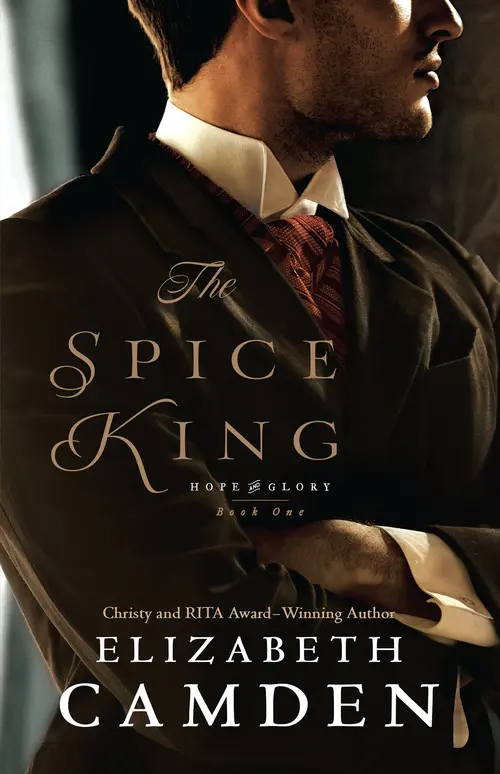
The Spice King
Cover
Books by Elizabeth Camden
HOPE AND GLORY SERIES
The Spice King
The Lady of Bolton Hill
The Rose of Winslow Street
Against the Tide
Into the Whirlwind
With Every Breath
Beyond All Dreams
Toward the Sunrise: An Until the Dawn Novella
Until the Dawn
Summer of Dreams: A From This Moment Novella
From This Moment
To the Farthest Shores
A Dangerous Legacy
A Daring Venture
A Desperate Hope
Title Page

One

MAY 1900
WASHINGTON, DC
Annabelle Larkin hadn’t meant to offend the world’s leading spice tycoon with her bold request, yet it seemed she had. The letter he’d written in reply made that clear, but she read it a second time, searching for a shred of hope in its prickly text.
Dear Miss Larkin,
I am in receipt of your letter asking me to donate my plant collection to the Smithsonian Institution. I spent two decades searching the world to gather those rare specimens, during which I sacrificed, sweat, and nearly died. Please be assured I have a better track record of nurturing plants than the feeble assortment I’ve seen at the Smithsonian, most of which are dead and mounted for display. I must therefore decline your offer to take the collection off my hands.
Gray Delacroix
Owner, Delacroix Global Spice
She dropped the letter onto her laboratory worktable with a sigh. Winning the donation of the Delacroixs’ plant collection had always been a long shot, but desperation gave her few options.
“Dare I ask?” Mr. Bittles inquired from the opposite side of the table.
Mr. Bittles was her supervisor and had had nothing but contempt for her since the day she began working at the Smithsonian only two months earlier. Fresh from Kansas and needing a tourist’s map to find the famous research museum, Annabelle didn’t really belong in Washington, where she felt as green as a newly sprouted hayseed. While everyone else at the Smithsonian had studied at places like Harvard and Princeton, Annabelle’s diploma came from Kansas State Agricultural College. She was not the most glittering ornament among the scientists at the Smithsonian.
“Mr. Delacroix declined our offer, but I still have hope,” she said, refusing to take his blunt refusal as a personal insult. She was merely the latest in a long line of botanists who’d tried and failed to make headway with Gray Delacroix.
The lab where she worked with Mr. Bittles was tiny, and she needed to nudge her way around him to reach the office typewriter. She pecked out a brisk response.
Dear Mr. Delacroix,
I meant no disrespect in my previous letter. Everyone at the Smithsonian is impressed by your remarkable collection, especially given the challenge of transporting exotic plants to America while they are still alive and fruitful. The rarity of your accomplishment is why we hope you will share the plants with world-class scientists who might build upon your success for the betterment of the nation.
Should you donate your collection to us, the Smithsonian would be prepared to name a wing in your honor.
Sincerely,
Miss Annabelle Larkin
Botanical Specialist,
The Smithsonian Institution
The promise of a wing was genuine, for the director of the Smithsonian had already authorized it, and everyone knew that Dr. Norwood would barter his own grandchildren to get his hands on Gray Delacroix’s plants. Dr. Norwood’s main interest was the orchids, but he’d asked her to go after the entire collection. She didn’t understand his zeal, but she would do her best to get it for him.
This task was especially important, for her job here was only temporary. She’d been hired for a six-month position to preserve and catalog a large shipment of plants from Africa and Australia, but in a few months she would be out of work. Dr. Norwood had dangled the prize of a permanent position if she could persuade the famously reclusive Gray Delacroix to donate his extraordinary plant collection.
As she set her letter to him in the outgoing mailbox, she silently prayed for success. It was an honor to work at the Smithsonian with scientists who sought to explore and understand the world around them, and she desperately needed to keep this position. Even if it meant cooperating with people like Mr. Bittles. Her supervisor didn’t like any woman unless she was bringing him coffee or ironing his shirts. He’d been appalled when Dr. Norwood appointed her to be his assistant, but Annabelle was merely happy to have the job.
“Come, get back to work,” Mr. Bittles ordered, setting a new crate from Australia before her. The box was filled with grasses, moss, and seedpods, and it was her job to catalog them for posterity. Each plant would be dried and preserved on a sheet of parchment, its seeds packaged in an accompanying envelope, and then stored in oversized metal filing drawers. She liked to imagine that hundreds of years from now, scientists would consult these specimens, fascinated by this glimpse into the botanical treasures of the past.
“Why do you suppose Dr. Norwood is so anxious to get inside the Delacroix collection?” she asked.
“It’s all about the vanilla orchid,” Mr. Bittles replied. “He doesn’t give a fig about the other plants, only that original vanilla orchid. I don’t think it even exists anymore.”
Annabelle had already heard about Dr. Norwood’s quest to hunt down the progenitor of the modern vanilla orchid. The Spaniards came upon it when they encountered the Aztecs in the sixteenth century. They smuggled it into monasteries and overseas to the eastern spice islands, where over the centuries it had been crossbred with other varieties of vanilla and was now believed to have been hybridized out of existence. No one had seen a living example of the original vanilla orchid in over a hundred years.
Despite herself, Annabelle was intrigued. “Do you think Mr. Delacroix has one?”
“Dr. Norwood does. Gray Delacroix collects all types of vanilla orchids, but he keeps them under lock and key, which is stoking Dr. Norwood’s curiosity. You may as well give up. I think that original orchid went extinct long ago. No more dawdling. Get that crate unpacked.”
Annabelle nodded and reached for another cluster of grass from Australia. Most of the grasses she cataloged looked similar to what they had in America, but tiny differences in a plant’s biology could alter its flavor, fragrance, or hardiness. Indeed, those tiny differences were causing her family’s wheat farm to fail after years of drought. Her parents had gone into debt to buy her train ticket to Washington, and she couldn’t afford to lose this job.
Which was why she waited with pained anticipation for Mr. Delacroix’s response to her second letter. It arrived the following morning, and Mr. Bittles snatched it out of the delivery boy’s hand before she could intercept it.
“That’s my letter,” she gasped, trying to grab it from Mr. Bittles as he dangled it well above her head. Sometimes it was horrible being short. She made a leap for it, and Mr. Bittles stifled a giggle as he continued waving it just beyond her reach.
“But it’s addressed to the Botanical Department, of which I am the supervisor,” he said, yanking the single page from the envelope. Frustration nearly choked her as his eyes traveled along the lines of the letter. He shook his head in mock despair. “Such a pity,” he murmured.
“What does it say?”
A smile hovered over his face as he read the letter aloud. “‘Dear Miss Larkin. Under no circumstances will I grant you access to my plant collection. Stop asking. Sincerely, Gray Delacroix.’” He didn’t hide his gloat as he gave her the letter.
She turned away to read it, praying Mr. Bittles was only being cruel, but it was exactly as he had said. She masked her discouragement as she tucked the letter into her satchel, for she wasn’t ready to give up yet.
“I’m going downstairs to tell Dr. Norwood of this latest development,” she said. “It’s time to shift strategy.”
“Best of luck,” Mr. Bittles said with a sarcastic wink.
That wink renewed her determination as she headed to the director’s office. Mr. Bittles had been rude and bad-tempered from the very beginning, but bad tempers didn’t frighten her. She had come of age on the plains of Kansas, where she’d battled ice storms, wind storms, crippling droughts, and plagues of locusts that literally darkened the wide prairie skies. There weren’t many things she feared, but losing her job at the Smithsonian was one of them.
Dr. Norwood’s office was a reflection of his obsession with orchids. Rows of the exotic flowers lined the windowsill, and their sweet, spicy scent perfumed the air. Maps on the wall documented orchid fields around the world, and fossilized blossoms filled a bookshelf.
Wiry, balding, and bespectacled, Dr. Norwood was pruning a vibrant Cephalanthera orchid when she entered. He didn’t even look up from his work as she summarized Mr. Delacroix’s latest rejection, but he paid fierce attention when she proposed a different approach.
“I have a feeling that as a man of business, Mr. Delacroix will respect forthright dealing,” she said. “Perhaps if we directly ask for access only to that single vanilla orchid, he would be more forthcoming.”
Dr. Norwood shook his head. “Vanilla is one of the most valuable commodities in the world, and Delacroix only wants that orchid for its monetary value. His father was different. His father could be reasoned with, but ever since the old man died, Gray Delacroix holds the keys to the kingdom. He has no respect for scientific marvels, only monetary profit.”
Between the two, Annabelle had more sympathy for monetary profit, but maybe that was her practical farming heritage coming to the fore. Nevertheless, she would do whatever was necessary to please Dr. Norwood.
“Sir, I am painfully aware that the clock is ticking on my temporary appointment. If you want that orchid, I will figure out a way to get it. All I need is your permission to approach Mr. Delacroix directly. Face to face. I think I can reason with him.”
Dr. Norwood set down the pruning shears and looked her in the eyes. “When your college professor recommended you for this position, he claimed you were one of the sunniest, most optimistic people he’d ever met.”
“I am,” she admitted with a pleased smile.
“That’s the kind of person who drives Gray Delacroix insane,” Dr. Norwood said. “He is all business and has no patience, no manners, and is immune to female charm.”
Which was why Annabelle planned a different strategy. Mr. Delacroix might be rude, but everything she knew about him indicated he had a deep and abiding passion for the plant world, and on that level, they could connect. His travels spanned the globe, and wherever he went, he collected a seed, a bulb, a cutting, or a root. She admired a man like that.
“If you want that orchid, I’ll get a cutting,” she told Dr. Norwood confidently. “And Mr. Delacroix will be smiling as he hands it over to me.” She outlined her unconventional plan that would only cost a blow to her pride if it didn’t work.
Dr. Norwood seemed intrigued. “I suspect he’ll laugh you out of his office. It’s likely to be a complete failure.”
“The Smithsonian has had years of failure,” she said. “Nothing else has worked. You might as well let me try.”
Dr. Norwood picked up his pruning shears, trying not to laugh. “You are likely to fall flat on your face, but I wish you luck.”
Two
Two days later, Annabelle took a series of streetcars to the nearby town of Alexandria, where the Delacroix family had lived for generations. Instead of asking favors, Annabelle had come prepared to offer Mr. Delacroix something first. She’d brought a charming gift to honor his fascination with spices and plants, and new plant specimens to demonstrate how the Smithsonian could help his business if he would cooperate with them. The oversized portfolio made walking ungainly, but the gift she carried was neatly rolled up beneath her arm.
She’d first spotted the whimsical map in a curio shop shortly after arriving in Washington. Printed on soft leather, it looked like a Renaissance map that could have been carried by an old-world conquistador. Compact illustrations covered the fanciful image, like a treasure chest on the Malabar coast brimming with peppercorns and a Spanish galleon near the port of Genoa carrying ginger and nutmeg. A dragon frolicked in the treacherous waters along Cape Horn. The useless map was a charming celebration of the flavors of the world, and maybe it would help get her foot in the door. It was a spice map for a spice king!
The oversized portfolio was cumbersome after she disembarked from the streetcar in Alexandria, a port town starkly different from the classical splendor of Washington. Alexandria had a quaint charm, with worn brick sidewalks carrying an echo of its colonial past. Linden trees shaded the narrow streets where townhouses abutted coffee shops and lawyer’s offices, and the Potomac River could be glimpsed in the distance.
By the time she reached the street where Gray Delacroix lived, the shops and townhouses seemed grander, but most impressive were the ladies who strolled through the shopping district. Did women really dress like that on an ordinary Thursday afternoon? They wore elegant ensembles of wraps, sashes, and scarves. Annabelle wore a practical cotton dress of maroon gingham with sensible buttons down the front. While the other ladies had their upswept hair styled with jeweled clips, Annabelle’s dark hair was worn in a simple braid down the center of her back.
A drizzle of rain caused her to quicken her steps, the bulky portfolio banging against her hip. The cobblestone street eventually came to the three-story townhouse belonging to the Delacroix family. Glossy black railings led up a flight of steps to a home that looked like it had been there for centuries. Probably because it had. When Mr. Delacroix’s forefathers built their shipping empire in Virginia, Annabelle’s ancestors had been pulling potatoes out of the rocky soil in Ireland.
She hurried up the short flight of steps to knock on the front door. The black man who answered looked about her age but was a lot taller.
“Mr. Delacroix is not seeing visitors,” he responded to her request to visit.
“Can I make an appointment to see him later today?”
“Unlikely.” The answer was blunt but not rude, which gave her courage.
“Mr. Delacroix and I have been engaged in business correspondence, and I believe it will go better if we meet in person rather than continue through letters.”
The drizzle intensified, bringing a spattering of fat raindrops. There was no overhang protecting the front stoop, and this spice map wouldn’t stand up to a soaking.
“Might I come inside until the rain lets up? I have a valuable artifact to show Mr. Delacroix.” Or rather, a cheap curio map, but the sight of it caused the young man to beckon her inside.
It wasn’t the sort of place she expected an international shipping magnate to live. The spare front hall, low ceilings, and plain colonial furnishings seemed homespun and comforting. The center hallway stretched all the way to the back of the house, where an open door led to a small garden behind the house.
“You can wait in the parlor until the rain lets up, but then you’ll have to be on your way. Mr. Delacroix is in no condition to receive visitors.”
If he was ill, she shouldn’t take her dismissal personally. And the young man seemed nice.
She stuck out her hand. “Hello. I’m Annabelle Larkin. And you are?”
He must have been surprised, because he stared at her outstretched hand for a moment before offering his own. “I’m Otis. Otis LaRue.”
She returned the handshake with vigor and a healthy smile, for this man was her first hurdle in getting to Mr. Delacroix. “Nice to meet you, Otis. Is there a towel I could borrow to dry the artifact? It’s very rare.”
Otis nodded. “Have a seat in the parlor, and I’ll fetch a cloth so you can dry the . . . the artifact,” he said with a curious glance at both the rolled map and the bulky portfolio.
“I’d be grateful,” she said. She walked into the front room, where nautical maps and a shiny brass captain’s wheel decorated the walls. Old floorboards creaked as she moved farther inside. Well-made but simple colonial furniture sat in groupings before a brick fireplace.
Otis returned, standing before her with a cloth at the ready. “Ma’am?”
She wasn’t accustomed to being waited on, and it took a moment to realize he was prepared to help dry the map.
“Yes, here. Thank you.” She unrolled the map to blot the back, but Otis flipped it over to study the front.
“What a fantastic map,” he said with a laugh. “I’ve never seen anything like it.”
“Isn’t it delightful? I saw it and immediately thought of Mr. Delacroix.”
Otis nodded. “I agree. On a good day, I think he might like it very much.”
“Otis!” a voice roared from somewhere deep in the house.
“One moment, sir,” the young man called down the hall, then handed the map back to her. “Wait here. I’ll be back in a minute.” He dashed down the hall with admirable agility.
Why did women have to be burdened by so many skirts and layers? On the farm she usually wore her father’s old denim pants to scramble up into haylofts or tend the goats, but that probably wouldn’t go over well in Washington.
Muffled voices leaked out from a closed door at the end of a hall, and a few moments later, Otis returned with his hand outstretched.
“Mr. Delacroix overheard our conversation. He wants to see the map.”
Annabelle tightened her grip on it. If Mr. Delacroix wanted to see the map, he could meet her like any other civilized person. “Oh dear . . . it is a very valuable map. I hate to let it go. Perhaps I can make an appointment to come back and show it to him at a more convenient time?”
Given the uneasy look on Otis’s face, it didn’t feel right to paint him into such an awkward position, but she needed to meet Mr. Delacroix in person.
“Otis, send her back here,” the grumpy voice hollered.
Hope welled inside her, and she followed Otis down the hallway. More antiques hung on the wall, where dour-looking people in white wigs frowned from old family portraits. She was shown through a door into a book-lined study. When she got a look at the man behind the desk, she gasped.
The surly expression on his face darkened. “Don’t worry. I’m not contagious,” he said.
But he looked horrible! He wasn’t even dressed properly, wearing only a loosely tied dressing robe. He had bloodshot eyes and unkempt black hair, but most appalling was his skin. He was sickly white and soaking wet, with trails of perspiration rolling down his face and dampening his robe. His untidy appearance didn’t stop him from rudely looking her up and down.
“You’re short,” he said.
She straightened. Her height was always the first thing people noticed about her, but rarely were they so rude as to comment on it. “And you are very ill.”
“But not contagious,” he said bluntly. “And I want to see this valuable map. Where is it?”
Maybe he wasn’t contagious, but there was something seriously wrong with him. She took a single step forward and extended the rolled map, then retreated the instant he snatched it.
While he unfurled the map across his desk, she took a deeper look at him, for he was a handsome man despite the sickly pallor, with finely molded features and deep-set eyes. But most fascinating to her was his jaw. It was strong and chiseled, the kind of jaw that spoke of strength and looked like it was accustomed to carrying the weight of responsibility. She loved the way he rubbed it as he scrutinized the map, and his gaze morphed from skeptical to curious to interested.
To her amazement, a slow smile crept across his face. A raspy, weak laugh started, but it was only a single breath, as though he didn’t have the strength to finish it off.
“I love it,” he said. He put on a pair of spectacles and leaned closer to the map. “Ha! They’ve got the cloves wrong in Malabar. They ship them dried, not green.” He leaned back in his chair, drumming his fingers on the desk. “So you’re the tedious Miss Larkin from the Smithsonian.”
“I am Miss Larkin from the Smithsonian.” It was hard not to smile, for it was obvious he was testing her, but he had no idea who he was up against.
“And you come bearing gifts. Hoping to soften me up.”
“Is it working?”
“Not yet. I’m curious, though. My last letter to you was final, and you have zero chance of changing my mind, so why are you here?” He spoke with no sign of hostility, only genuine curiosity. It made her believe there was hope.
“You wouldn’t respect me if I gave up too easily.”
“What makes you think I respect you at all?” A challenging glint lurked in his dark eyes, and it was oddly intriguing. How could a man be so rude and yet appealing at the same time?
She rose to the test. “As a human being, I am worthy of respect by default. And as one botanist to another, I think you and I should cooperate.”
“I’m not a botanist. I’m a businessman.”
“I won’t hold it against you, Mr. Delacroix. Especially if you don’t hold my association with the Smithsonian against me.”
He took off his spectacles, then mopped his face with a handkerchief before looking at her through bloodshot eyes. “The Smithsonian has been trying for years to get their hands on my vanilla orchid, but this is the first time they’ve sent a woman to try for it. I’ve actually got it quite well guarded, and I’m protective of my plants, so I’m afraid your visit here is going to be fruitless.”
So he knew the value of what he had. “Can you tell me how you managed to keep it alive during transportation?”
“No.”
“Perhaps you could tell me how you are caring for it. As a tropical vine, Virginia must be a challenging environment for it.”
He shrugged and remained silent.
The Story Continues on BooksBarbecue!
Enjoyed this preview? ❤️ Do not stop here!
Read the complete book free online → 🔗
Continue reading now on BooksBarbecue and discover every page!
Love reading? Bookmark BooksBarbecue.com for more amazing books!
Happy Reading!