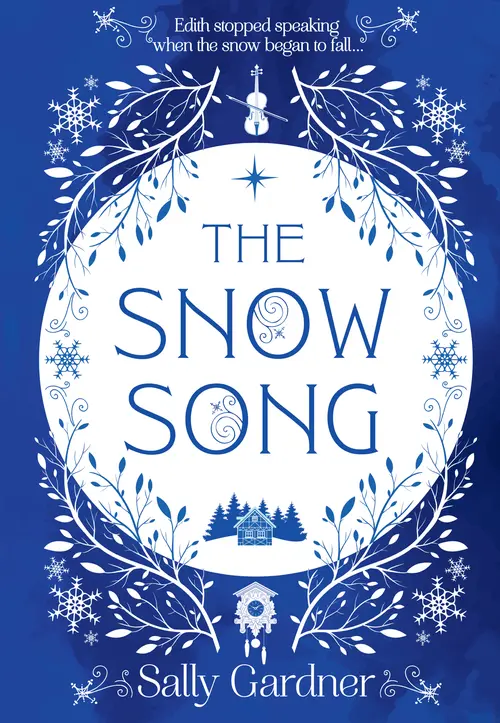
The Snow Song
Cover
Praise for Sally Gardner
‘This heartbreaking, brilliantly written novel is the most original publication for years’
The Times
‘Shades of Sarah Waters…irresistible’
Guardian
‘Arresting and original and written in a singular voice’
Telegraph
‘The prize-winning Gardner is a dab hand at literary world-creation’
Observer
‘This is an inspirational piece of writing’
New Statesman
‘A truly original voice…a thrilling read’
Spectator
‘Beautiful, twisted and dark. A masterpiece’
Big Issue
About the Author
SALLY GARDNER is an award-winning children’s novelist who has sold more than two and a half million books worldwide and been translated into 22 languages. This is her third adult novel.
 @TheSallyGardner
Also by Sally Gardner, writing as Wray Delaney
AN ALMOND FOR A PARROT
THE BEAUTY OF THE WOLF
Note to Readers
This ebook contains the following accessibility features which, if supported by your device, can be accessed via your ereader/accessibility settings:
- Change of font size and line height
- Change of background and font colours
- Change of font
- Change justification
- Text to speech
- Page numbers taken from the following print edition: ISBN 9780008217402
Dedication
To my great friend and mentor, Jane Fior, who has given me so much love and support. When I told her I didn’t think I could write a book about snow, she wisely said,
‘You can.’
So here it is.
I have used the term ‘gypsy’ in this story as it’s appropriate for the time the story is set in. I mean no disrespect to the Roma who where called Tzigane in Transylvania. But whatever name is used, the Roma people have suffered prejudice and discrimination throughout the history of the world.
Epigraph
This is the Hour of Lead –
Remembered, if outlived,
As Freezing persons, recollect the Snow –
First – Chill – then Stupor – then the letting go –
EMILY DICKINSON
Chapter One
Snow Song
It was the sound of his violin that first cast a spell on Edith. Even before she saw him, the restless notes of his melody drew her to him. The musician was sitting on a bench outside the cobbler’s, a pair of new boots beside him. The morning sunshine illuminated his outline, striking against the burnt orange of the cobbler’s house. The violin looked to Edith as if it were made of liquid honey so polished was its surface. The rhythm of the song with its languid melancholy echoed her own feelings. His music danced into her heart to free her troubled soul from its cage, and she stood mesmerised.
When he had finished he looked up at her, his eyes the colour of a blue winter sky, his hair dark like her own, his face elegant in its composition. Generous lips, a straight nose – unlike the young men of her village with their blond, dumpling faces that lacked definition, as if they had all been baked in the same oven.
‘What’s the music called?’ she asked.
‘Snow Song,’ he said.
‘But it’s spring – the snow has gone,’ she felt herself blushing. Normally she would never have had the courage to speak to a stranger. It wouldn’t have occurred to her to do so if it hadn’t been for the violin. Or so she told herself.
He smiled at her. ‘The snow will come again in time.’
This day became in Edith’s mind the border between two worlds. Whatever she had been before she heard him play the Snow Song, she would no longer remember. By the time he had finished she felt she had entered her realm. She had never known what it was she wanted, now she did: she wanted to hear his music for the rest of her days. She was standing and the tune made two giddy sticks of her legs. She sat down beside him and only then did she notice his small, raggle-taggle dog. They were silent for a while.
‘Do you know the secret of the violin?’ he asked. ‘And how it came into this world?’
‘No,’ said Edith, aware she was being watched by disapproving villagers hidden behind shuttered windows. None of it mattered. ‘What is the secret?’
He had turned from her and was putting the violin back in its case. ‘A gypsy could tell you the story of the violin’s birth.’
Edith asked, ‘Do you know it?’
‘I do,’ he said.
And she boldly asked if he might like to have supper with her and her father that evening, adding, ‘You could tell us the story of the violin.’

The butcher, in the shadow of his doorway, was angry to see Edith talk with such ease to a stranger. Strangers weren’t welcome in this village, she should know that. He made a mental note to fine the cabinet maker for it. The old drunk should keep a closer eye on his daughter. The butcher looked again and saw Edith and the stranger sitting side by side as if they had always sat that way – two beautiful creatures. He hit his fist into his hand and returned to the slaughterhouse.
All that day Edith felt her heart to be still dancing to the young man’s music. She sacrificed one of her chickens and cooked it with great care and with great care laid the table. Only then did she tell her father of their guest. He had as usual been drinking since midday. There was plenty of work for a cabinet maker but not for a drunk who could only be trusted to finish a bottle of wine.
‘I don’t want a gypsy at my table,’ he said.
‘He isn’t a gypsy,’ said Edith.
‘He’s a stranger,’ said her father. ‘You know what happens when a stranger enters the house.’
Edith sighed. She’d grown up with these endless superstitions, too many to remember. ‘No, what does happen?’ she asked, knowingly perfectly well her father had forgotten the old tale of how the bloodless often came disguised as strangers.
He took a bottle and, holding it tight to him, said, ‘On your head be it,’ and went to his room.
As Edith put out the painted plates she realised she hadn’t asked the musician his name or what he did to earn a living.
Her father was too drunk to stay long awake and, shortly after the young man arrived with cheese and wine, the cabinet maker excused himself.
‘A gypsy if ever I saw one,’ he mumbled as he went to his bed.
Edith said simply, ‘He’s a drunk. I’ve never known him not to be like that. I should’ve asked you your name.’
‘Demetrius,’ he said. ‘I’m a shepherd.’
They sat down to eat and to begin with she could hardly think what to say but he said, ‘I heard that this village had a great storyteller.’
‘That was my grandmother. She died nearly five years ago.’
‘I’m sorry to hear that. I was told she knew the story of the violin.’
‘If she did, she never told me or anyone else in the village. But she had many stories she would tell. Round here, nobody wants to hear gypsy tales, more’s the pity. She said she cut hers to fit the mood of the listeners.’
He laughed. ‘That’s what I try to do with my playing.’
It was on the tip of her tongue to say, ‘You do,’ but she stopped herself and asked if he would like more to eat.
‘Are you a storyteller?’ he said.
Edith had never thought of herself as having that gift. True, she knew all her grandmother’s stories, but the idea that she might be able to hold a crowd spellbound had never occurred to her.
‘I’m too shy for that,’ she said.
‘But you love story and music?’
‘Both,’ she said. ‘I know plenty of stories. It’s music I thirst for.’
He sat back in the chair and for a moment she imagined them to have been long married and their children grown.
‘Once,’ he said, ‘in a village not far from here lived a girl who all believed to be cursed because no man would ask for her hand in marriage despite her wealth and beauty. As for the girl, she was in love with a farmer who never cast a glance in her direction. She did all she could to get his attention and, seeing that her efforts were fruitless, she called on the devil. He came holding a mirror in his hand. She looked at herself in its icy glass and then the devil asked her what she wanted. She told him of her love for the farmer.
‘“If that’s all,” said the devil, “I can help you. Bring me your father, your mother and your four brothers.”
‘The girl gave them up without a sigh. Out of the body of the father the devil fashioned a violin. Out of the white hairs from the mother’s head he made a bow. Out of the four brothers he made the strings and strung them across the fiddle. “Now,” he said, “when your beloved comes, play the instrument.”
‘She did, and when the farmer heard the music he fell under its spell. Never had two people been happier. Nine days passed and the young lovers were walking in the forest when the devil appeared in their path.
‘“I am your lord and master,” he said. “Worship me.”
‘“No,” they said, “never.”
‘The devil laughed and held up his mirror. The farmer saw his reflection and knew it was too late.
‘“Both of you have listened to my music,” said the devil, “and both of you have looked into my mirror. Now you will have to pay the price.”
‘The devil carried them away and the violin lay at the crossroads in the forest until a gypsy happened to find it. He plays it still, driving men and women wild when they hear its intoxicating sound.’
‘I can well believe it,’ Edith said. ‘Will you play again?’ As Demetrius picked up his bow she thought how extraordinary it was that a piece of wood could be transformed into an instrument and the music it made could weave its way into your soul.
And slowly he played the fiddle in a key that sang to the rhythm of her very being and the yearning chords filled with longing were carried softly away into the spring night.
Only when he was leaving did he ask, ‘Would you marry me?’
And she said, ‘Yes.’
They stood a long while, close together, not touching. Finally he put his hand to her face and then he left.
She cleared the plates almost in a trance and knew as if she had always known that she would marry the shepherd.
Chapter Two
A Tall Tale From Thin Thread
Love came later, or so Edith told herself, though she wasn’t sure that she believed that. Every night Demetrius sat with her on the verandah and she felt the stars had aligned to bring her the shepherd and his violin. She hadn’t known until then how love could transform you. The mountain appeared more beautiful than she had ever seen it; the fresh leaves on the little walnut tree in the yard seemed greener, brighter.
Such happiness as she felt with Demetrius was intoxicating and she feared that in her passion she might lose her footing and be swept away.
‘Where do I begin and where do you end?’ she asked him.
He thought for a while and said, ‘When two rivers collide can you tell, in that whirling water, which river was which?’
‘No,’ she said. ‘And does it matter?’
She found in his love the healing balm she needed.
Demetrius talked to her as an equal, unlike the miller’s son who not long ago had tried to woo her with an eye on her hips and an eye on her breasts.
Demetrius told her, ‘Hold up your questions. They’re boulders,’ and laughing said, ‘Throw them down and don’t be satisfied with half-thought-out answers.’
One evening he asked her to tell him a story.
‘What story would you like to hear?’ she said.
‘You choose.’
She thought for a time and why this one came to her she couldn’t say.
‘There were two brothers, neither were rich nor poor. A letter arrived to tell them they had been left in their uncle’s will a tall house and a chest full of gold. The letter went on to say that whichever brother arrived first, it would all be his. If the brothers arrived together, they could share it between them.
‘The two brothers had never been close nor far apart and they agreed that they would set off together in the morning. But the next day the younger brother had gone. The older brother sighed and went to open his shop for business as usual. He’d had a night to sleep on things and he’d thought about the letter. Their uncle had never been a kind man and the town where they were to go had no tall houses that he could remember.
‘The younger brother walked there and did not wish to arrive looking shabby so the minute he entered the town he bought himself new shoes, a suit, a coat and a hat. Not having the money, he promised to pay the cobbler, the tailor and the hatter as soon as he had the chest of gold. He decided that as he was now rich he would stay in a fine hotel, and as he had walked so far he would have a meal fit for a king. His head filled with wine, he went to claim his inheritance.
‘He was pleased when he found the house for it was a grand building, though he wouldn’t have described it as tall. “It doesn’t matter,” he said to himself. “All this will be mine and mine alone.”
‘A butler took him upstairs and opened a door. The room was the nursery and in the middle of the floor was a tall dolls’ house and beside it a small toy chest filled with toy coins.
‘“This must be a mistake,” said the younger brother.
‘The butler said nothing. Broken by disappointment and having no money, the younger brother tried to leave the town without paying for his new clothes, his hotel bill, or the meal fit for a king, and found himself in prison.
‘The elder brother worked hard and one day he met a tall woman and fell in love. Time passed as time always will.
‘The younger brother, freed from jail, took comfort in wine and bemoaned the injustice that life had thrown at him. In his sober moments he grew curious about his older brother and wondered if he, like himself, was penniless. He returned to the village and found his older brother living in the same house, happily married to the tall woman. Having no resentment, the older brother asked the younger to stay and dine with them.
‘“How did you know that the will was a trick?” the younger brother asked.
‘“I would have told you but you were in such a hurry to leave.”
‘“Told me what?” said the younger brother, his eye greedy on the wine.
‘“That all the riches we have are to be discovered inside us. My wealth I found in the love I have for my wife. Such a promise as our uncle made us were hollow words from a shallow grave.”’
When Edith had finished she said, ‘I didn’t understand that story when my grandmother first told me it. I thought it must be missing a part. I know now it is about love that lies within us. Love is greater than a tall house and chest of gold.’
Demetrius kissed her. ‘You don’t know how wise you are,’ he said.
Demetrius asked the cabinet maker for Edith’s hand. The shepherd was not from these parts and therefore was considered an outsider and not a suitable husband. But in a drunken moment Edith’s father weakened and gave his consent to their betrothal. With sobriety came regret.
The butcher had long let it be known that he wanted Edith for his wife. The cabinet maker, hat in hand, with a sore head and a worried heart, paid a visit to the butcher to tell him what he had done. The butcher was skinning rabbits at the time. He didn’t look up from his work.
He said, ‘The lambing season’s nearly over.’
‘That’s so,’ said the cabinet maker.
The butcher wiped his knife on his apron and said, ‘The shepherd will soon take his flock to graze farther afield.’
The cabinet maker hadn’t thought of that.
‘You are her father. Tell them they can’t be married until after the harvest supper and not a day before. As for Edith – make her swear on her dead mother’s bible that if the shepherd isn’t back by the first snowfall, she will marry me. If she does that – swear, I mean, in front of the mayor – then you can forget about the money you owe me.’
The cabinet maker walked home with a spring in his step. All would be well, he told himself. He would stop drinking, turn his business round. And with each step he began to spin himself a tall tale from thin thread.
The cabinet maker told the young couple his terms.
‘Then we’ll be married on St Catherine’s Day,’ said Demetrius.
‘The saint of old maids,’ said Edith.
‘Can you wait that long?’ the cabinet maker said to Demetrius. ‘Wouldn’t you like a younger girl? More available? From another village, perhaps?’
‘No,’ said Demetrius.
‘Someone more like you?’
‘In what way, like me?’
‘A gypsy,’ said the cabinet maker.
‘I’ve not an ounce of gypsy blood in me,’ said Demetrius, laughing. ‘More’s the pity.’
The cabinet maker, intending the suggestion as an insult, hadn’t expected such a response. The humour of his future son-in-law irritated him and he scurried away as might a cockroach, congratulating himself that he hadn’t disclosed the last part of the butcher’s request. He would tell Edith tomorrow when the shepherd was seeing to his lambs.
‘I doubt you’ll find that funny, gypsy,’ he muttered and lifted the bottle to his lips.
The thought that he’d outwitted the shepherd pleased the cabinet maker. What could the shepherd do when he found out Edith was promised to another man? Nothing. Like the rest of us, he thought, he’ll be under the butcher’s boot.
That night, when they were alone, Edith gave Demetrius her gold coin. He didn’t know the custom of the region and she told him it was a token of her love and represented a bond between them that couldn’t be broken. He put his arms about her and held her close, and promised on his life it never would be.
‘On our wedding day,’ she said to him, ‘we will put this coin under our mattress and there it will stay to be handed down to our daughter when it’s her turn to choose a husband.’
He kissed her. ‘When I come back at harvest time, I’ll bring you a ring.’
‘And I’ll give you the red shirt that I’ll sew for you to be married in.’
Chapter Three
Her Mother’s Bible
‘This is foolish,’ Edith said to her father when he told her what the butcher wanted. ‘I’m to be married to Demetrius. I will never marry the butcher. How much do you owe him?’
‘Nothing to do with you,’ said the cabinet maker. ‘That’s my business. But if it’s not done today the butcher will forbid the elders from letting your wedding go ahead.’
‘I want to speak to Demetrius first,’ Edith said. ‘Surely it can wait until tomorrow.’
‘No, it can’t,’ said the cabinet maker. ‘There will be no marriage unless you swear.’
Edith looked at his purple blushed face, the wine-red veins that inked his puffy features. How could this man be her father? They had nothing in common other than they lived under the same roof – and a leaky roof at that. She tried to think of one loving memory she had of him and couldn’t.
‘Well? What do you say?’ He came towards her and she stepped back. ‘Don’t you trust the gypsy to keep his word? Is that it?’
He poured himself a glass, his hands trembling. ‘You’ll do as you’re told. Swear on your mother’s bible.’
However much she hated the idea, she knew, as did every other village girl, that without the consent of the elders nothing happened in this community – and the head of the village elders was the butcher himself. Her freedom lay with the shepherd. She had to trust that Demetrius would return to her before the first snowfall.
‘Why wouldn’t he?’ she said defiantly to herself. ‘Why wouldn’t he?’ she said again as reluctantly she went to find her mother’s bible.
‘No, no,’ said her father when Edith returned with it and began to take the oath. ‘Not here; this has to be witnessed. It has to be proper.’
‘Witnessed by whom?’
‘The mayor.’
‘Father, I’m marrying Demetrius.’
The cabinet maker put on his hat.
‘Wait,’ said Edith and before she could stop him he had taken a firm hold of her arm and they’d set off through the yard, her father kicking the hens out of his way as they went.
She noted that her father showed the same determination to have this oath done as he normally would when in search of a bottle of wine.
The mayor’s house was painted yellow ochre and was far more substantial than any of the other houses. The mayor and his wife, Georgeta, had a son, a sickly young man who was away at university. The mayor employed two maids and a cook, unheard of in a small mountain village. He had been born into privilege, yet for all his fine clothes, his library and chain of office everyone knew who held the power. Not the mayor but the butcher.
One of the maids came to the door to say her master was not at home.
‘Poppycock,’ said the cabinet maker, pushing her aside. ‘Don’t stand there, girl, go and get him.’
The maid tried again. ‘As I said, the mayor…’
‘This won’t take long,’ said the cabinet maker who was a bottle short of sobriety.
The mayor’s wife, hurried into the hall to see who was causing the fuss. She was a tall, striking woman, cleverer than her husband, and had been married to him long enough to be deeply disappointed by him. Unlike the other women in the village she wore modern dress and still after many years was regarded as a newcomer. Her only friend had been Edith’s grandmother.
‘Can I help you?’ she said.
She was perplexed to see Edith was holding a bible.
‘No,’ said the cabinet maker. ‘Women only complicate matters. I want to see the mayor.’
‘Is it about the wedding?’
‘Yes. And I want to see the mayor.’
The Story Continues on BooksBarbecue!
Enjoyed this preview? ❤️ Do not stop here!
Read the complete book free online → 🔗
Continue reading now on BooksBarbecue and discover every page!
Love reading? Bookmark BooksBarbecue.com for more amazing books!
Happy Reading!