The Sin Eater
Cover
THE
SIN
EATER
MEGAN CAMPISI

AUTHOR’S NOTE
Sin eaters existed in parts of Britain until roughly a century ago. How many and who they were, apart from being social pariahs, is almost entirely lost. What we know is that they ate a piece of bread beside people’s coffins to absolve their sins in a folk ritual with Christian resonances.
The story I’ve written starts with this sliver but is spun out of fantasy. Some of the characters resemble historical figures, but this is not history; it’s fiction.
 A SELECTION FROM

A Compendium of Diverse Sins Both Large and Small and Their According Foods
| Adultery | ______________ | Dried Raisins |
| Bearing a Bastard | ______________ | Grapes |
| Betrayal | ______________ | Mutton Chop |
| Blinding | ______________ | Pork Pie |
| Blood Sacrifice | ______________ | Hippocras |
| Burning | ______________ | Kidney Pie |
| Conspiracy | ______________ | Brandy Posset |
| Deception | ______________ | Whipped Syllabub |
| Desecration | ______________ | Shortbread |
| Dissembling | ______________ | Sack Posset |
| Drunkenness | ______________ | Hippocras |
| Envy | ______________ | Cream |
| Fault finding | ______________ | Eel Pie |
| Heresy | ______________ | Honey Cake |
| Idleness | ______________ | Pickled Cucumber |
| Incest | ______________ | Dried Plum |
| Inhospitableness | ______________ | Garlic |
| Lies | ______________ | Mustard Seed |
| Lust | ______________ | Rose Hips |
| Miserliness | ______________ | Garlic |
| Murder (in Defence) | ______________ | Rabbit’s Heart |
| Murder (Wrathful) | ______________ | Pig’s Heart |
| Oath Breaking | ______________ | Cake Bread |
| Original Sin | ______________ | Bread |
| Poisoning | ______________ | Pigeon Pie |
| Quarrelling | ______________ | Humble Pie |
| Rape (Child) | ______________ | Lamb’s Head in Ewe’s Milk |
| Rape (Woman) | ______________ | Capon’s Head |
| Recreancy | ______________ | Neat’s Tongue |
| Revenge | ______________ | Black Pudding |
| Sacrilege | ______________ | Gingerbread |
| Slander | ______________ | Crow’s Meat with Plum |
| Spying | ______________ | Cock Brain Tart |
| Tale Bearing | ______________ | Stewed Gurnards |
| Thieving | ______________ | Roast Pigeon |
| Treason | ______________ | Beefsteak |
| Vagrancy | ______________ | Frumenty |
| Witchcraft | ______________ | Pomegranate |
| Wrath | ______________ | Gristle |
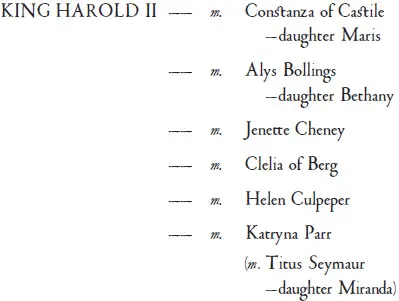
ROYAL FAMILY TREE
BEFORE
OAT PORRIDGE
SALT FOR PRIDE. Mustard seed for lies. Barley for curses. There are grapes too, laid red and bursting across the pinewood coffin – one grape split with a ruby seed poking through the skin like a splinter through flesh. There’s crow’s meat stewed with plums and a homemade loaf, small and shaped like a bobbin. Why a loaf in such a shape? I think. And why so small? There are other foods too, but not many. My mother had few sins. She was a fox, running from the scent of trouble with wary eyes and soft feet. Tussling only when she was sure she’d win. The salt, mustard seeds, and barley grains are the only foods I know the sins for. They’re for childhood sins, the kind parents chasten you with or children sing rhymes for in the street.
Little Jack Horner,
Sat in the corner,
Eating a winter pie.
He ate all its meat,
For being a cheat,
And said, ‘Now a good boy am I.’
The sin eater comes next, hefting her belly into the front room where the coffin sits, boards fresh and blunt from the saw, the nails placed but not sunk. She smells of wild onions already begun to sprout despite a full month until May Day. I feel ashamed at my small truckle bed in the corner, our house not fine enough for me to have a room of my own. The sin eater gruffs for a seat, and Bessie, our neighbour, brings her a stool. It disappears so completely under her skirts, I imagine her great buttocks swallowing it whole. A burp of laughter escapes my lips, and I clap my hands across my mouth.
Bessie takes me to the window. ‘You’re not to look,’ she whispers in my ear. She pushes on, hearing my intake of breath readying for words, knowing I’m my mother’s own little gabby goose. ‘The sin eater walks among us. Unseen. Unheard,’ she says.
‘But I can see her—’ I hiss.
‘Unseen. Unheard,’ she silences.
I’ve heard sin eaters have branded tongues, but this one hasn’t opened her mouth.
Bessie speaks again. ‘Sins of our flesh become sins of hers through the Eating, praise be. Your mother will fly right up to the heavens, May. Not a sin left to weigh her down.’
I go back and take my place next to my da. His face looks like sheets dropped off at the door for washing, hung with wrinkles that won’t shake out.
‘I’ll wash your face,’ I whisper. ‘I’ll hang it on the line.’
Da gives me the look he always does when I say something that doesn’t seem right. His face widens open as if I’ve just told him good news. ‘What are we ever going to do with you?’
Grapes, red and bursting. A loaf shaped like a bobbin. Crow’s meat. They stick in my mind like porridge in the gullet.
NOW
1. ROAST PIGEON
THE BREAD’S STILL warm under my shawl, my heart echoing through its crust. I run, quick as I can, along the ditch beside the road.
A wide brown nostril swings into my face breathing hot horse breath.
‘Get on!’ calls the cart man, coming from a side lane, urging the mare into the mess of the main thoroughfare. She shuttles her head from side to side, the bit buckling against her yellow teeth. My way’s blocked.
Too visible, I scold, even as I climb out from the ditch onto the flat of the road. I fold my prize into the hollow between my breasts and dart past the baulking horse and a hay wagon.
‘Aye! That’s her!’ the baker yells. I daren’t turn, just break into a run. I go down a narrow lane. At the crossroads I look to one side, hesitate, and go to the other, passing a stable and a smithy. But the baker’s son tailing me doesn’t hesitate. His hand cuffs my neck and knocks me to the ground. The side of my face presses into the mud. I can see the blacksmith’s boots through his open door. My breath comes hard from running. I push the bread up with my hands and rip off the end with my teeth. Might as well eat, the thought comes. If I’m going to the jail, might as well do it with food in my belly.

May Owens. The turnkey calls me out of the cell. Calls me along with the other girls that came in my week. Twenty in all. Three girls who ran away from homes in other towns but don’t have kin here or begging passports. Two whores without the chummage to bribe the constable to turn a blind eye. Five pickpockets. Eight cozeners and worse. One other goodly girl, like me. She killed a stray dog to eat, but turned out it had run off from a lord. Bad luck, that.
We walk in single file out into an early-spring morning heavy with mist. The damp creeps into my bones after the cell, where so many folk made for a comfortable fug. We march down the middle of the road, stopping carts and wagons, making carriage drivers call out in fury. The courthouse is next door, but this is part of our punishment. All the eyes seeing our shame. They shout, calling us wicked women and Eves.
I wish you could show folk your insides the way you show your face. Then they’d know I’m not wicked at all. Or I wish that they’d see my hair and see how it looks just like the Queen’s hair, the same black waves. Then folk would know I am goodly, like her. I am no Eve. Eve wasn’t content to live in the heavenly plains with the Maker. She leapt to earth and sought out Adam, keeper of the fields and orchards, made him lead her to the Maker’s tree and stole its fruit. When she ate all but the last bite, which she fed to Adam, the Maker cursed her for her treachery and sent her to be mistress of the underworld. She’s purest evil. Even worse than Judas, who betrayed the Maker’s son.
The turnkey takes us into a fine building with a roof so high even the tallest of folk couldn’t touch it. We line a bench, twenty shivering girls. I guess some of us are women. I’ve been one for two years, though I don’t know that I feel like one. Then again, I don’t know what a woman is supposed to feel like. I twist my ring. It’s thin and uneven and not real gold, but I like to imagine it is. It’s the only bit left of my da. A token of him.
‘What’s to happen now?’ I ask the dog eater, who’s sitting beside me.
‘Justice takes his decision,’ says a dirty girl a ways down the bench. She stole a silver cup.
‘Recorder is what he’s called,’ the turnkey says.
‘Why a recorder?’ I ask.
‘My fate’s decided,’ says a ratlike girl who tried to sell the bastard she bore, mayhap trying to trade her soiled name away with it.
‘Yeah, but it’s got to be pronounced,’ the dirty one tells the rat.
‘Why is he called a recorder?’ I try again. ‘Does he record what happens?’
The turnkey shushes me.
‘Sounds like donkey paddies to me,’ the rat girl answers softly, an eye rounding the rest of us for nods. The others ignore her, so I drop my eyes too.
‘When does the recorder come?’ I ask the turnkey, but he’s already starting to stand.
The recorder comes in by a side door. He walks to a high wooden table and climbs onto a high wooden chair. He looks for a moment like a child mounting his da’s stool, and the laugh comes before I can stop it. The turnkey and recorder look over sharply, but I deaden my face, and the other girls don’t give me away, even the rat. I feel bad I looked down earlier.
‘Chasy Stow?’ the recorder speaks. The turnkey waves for the girl to stand. ‘Vagrancy and begging without a licence.’
‘I’m from Chester Town,’ Chasy says all quiet.
‘This isn’t Chester Town,’ says the recorder without even looking up.
‘But there wasn’t any work, and I couldn’t stay at home!’ Chasy tries.
Even I know it doesn’t matter the reason. Folk without a settled place to live are swept up by the constable for being vagabonds unless they’ve a special passport from the Queen.
The recorder’s eyes stay on his parchment. ‘Can you produce two credible witnesses to speak for you?’
It’s a fool thing to ask. ‘There’s no folk here but us,’ I tell the dog eater. ‘Only the turnkey, and what’s the chance he’s her brother?’ The recorder bangs a wooden mallet on his table, and I shut my lips.
The recorder pronounces Chasy’s punishment, as the dirty girl said he would. She’s to be whipped and then burned through the gristle of her ear with a hot iron as thick as a man’s thumb. ‘And should you come before this court again,’ the recorder goes on. ‘You will be hung by the neck until dead.’
This is foolish too, since when does a folk hang until not dead? But I don’t tell the others. I just say it inside my head. Then I scold myself. Unkind thoughts: The sin eater will eat parsnip on my grave.
The recorder runs us down, girl by girl. Some get hanging, some get whipping. The rat-faced girl is to be burned alive. The recorder doesn’t look at any of us. Asks no questions, except if we’ve got credible witnesses to speak for us, which he knows well enough we don’t. Each time he asks it, I get star-shaped heat right in my chest where the rib bones meet. By the sixth or seventh time, I’m angry, and I’m not prone to choler. I want him to stop asking it. Or at least look at us.
‘May Owens,’ he calls.
‘Yes,’ I speak loudly, surprising myself as well as the turnkey, who gives me a scolding eye. But I’ve done it. I’ve made the recorder look.
He looks long. He stares, more like, his eyes turning to dark creases. The other girls raise their heads at the silence, broken out of whatever daydream they fell into. ‘May Owens,’ he says again, this time turning over each letter, running them across his tongue. ‘Born Daffrey.’
‘I’m an Owens,’ I say, my voice coming sharper than I mean it to. My fingers go straight to my da’s ring. I don’t know how the recorder knows my mother’s family name. His eyes don’t even blink. Little moons of black, watching, watching. Mayhap he’s seeing my insides like I wished for before, like a witch’s spell.
Then, from nowhere, he calls out, ‘Winnie Fletcher,’ and the spell breaks. We all gaze at the recorder dumbly. ‘Winnie Fletcher!’ The recorder looks to the turnkey, who looks to us. Winnie Fletcher stands uncertainly. ‘Picking a man’s purse. Any credible witness to speak for you?’
After the last pronouncement, the recorder leaves through the same side door. The turnkey waves at us to stand.
‘But I didn’t get a punishment,’ I say to him. I didn’t even get a crime. All I got was my name. And that look.
We walk back through a dirty, wet midday to the jail.
‘What about me?’ I say again to the turnkey as I pass him at the cell door.
He shrugs as if to wash his hands of it and goes. I look at the other girls.
‘What about me?’ They avoid my eyes as we all did the rat’s.
It’s almost worse than a sentence, not having one. The girls set to hang are set to hang in three days’ time.
‘Am I to be hung with them?’ I ask the turnkey through the bars, but it’s like he’s turned to stone. ‘Should I ready myself?’
Not that there’s much for us to ready. Winnie promises her shoes to one of the whores if she’ll eat her sins. Unless they’re rich, folk in jail get the Simple Eating that’s saved for those who can’t confess before they die. The whore says no.
‘But your soul is already lost,’ argues Winnie. ‘It can’t do you harm. It’s not much. Just the stealing and some lies; I swear it.’
The other whore shakes her head before Winnie even asks. ‘No folk can look at a sin eater. No folk’ll touch her. How am I to work if I’m not seen or touched?’
The rat girl is more successful. She offers a coin to the dog eater to bring a locket to her sister. She promises another coin from the sister when it’s done.
‘Won’t be till next autumn,’ the dog eater warns. She’s in jail through spring and summer, which is as long as it’ll take her family to pay off her fine.
‘Not like to go bad,’ says the rat of the locket, and places it in the dog eater’s hand. I smile at the jest, but her eyes glaze past mine.
I pass the following day thinking on my da. How he lay on the bed with the blue patched quilt over him shaking and shivering after he cut his hand fixing the town’s mill. How I called the doctor to come, but the doctor just looked him up and down and said there wasn’t anything I had money enough for him to do. How Da asked me to tell him about what I saw from the window and didn’t mind when I talked through my every noticing, even the ones like clouds that changed shape as they passed. How I couldn’t bear to call the sin eater and so left it too late. One morning as I warmed the milk, Da shrank away from himself, leaving a husk and me all alone. His shadow stayed in the house for weeks. It wasn’t dark like a shadow, just an empty place in the shape of my da. I would see it out of the side of my eye and turn knowing he should be there. But when I looked there wasn’t anything.
The hardest was not having folk to say my noticings to, like if I saw a spider when I rinsed my hands in the basin. Or how I could make river waves by whipping the edge of dry bedclothes up and down, up and down.
I tried telling my noticings to our neighbour Bessie. She was welcoming when I first came to chat, laughing, calling me a gabby goose as my mother had done. But as the days went on, I’d catch her sagging a bit when she’d see me coming over. Days got to weeks, and she’d sigh loudly when I came, as if I wouldn’t hear her sigh softly.
I tried speaking to the cat that liked to hunt in the weeds of my fallow garden. Or I’d speak to the sachet of flowers my mother had kept on the mantel. I’d trip over myself just to greet the few folk who still came for laundry. To hear their ‘Thank ye kindly,’ and say, ‘’Tis nought,’ in return. Sometimes I’d speak to their clothes as I washed them, as if they were the folk who wore them. But I missed the answering back. So even though I knew she wasn’t happy with me, I’d wait by my shutters, and when Bessie went out into her kitchen garden, I’d scamper over to share my news.
Then one day she was there on her knees, six dirty carrots at her side. One carrot, I remember, looked short and misshapen like a broken finger. I had come over to tell her about a crow that was pecking at an old bit of leather. She stood before I even got to the leather part.
‘No, no, no, you don’t. It’s too much,’ she cried. ‘I’m not your ma. I’ve Lee and Tom to look after. Not you too.’
‘You’re my neighbour,’ I said.
‘I’ve done my neighbourly duty by you plenty.’ Her words jumped all over me. ‘What you need is kin, and you’ve got a whole lot of them down by the river. Go there with your chitter and chatter about what a dog smelled this morning and which cloud is shaped like a lamb.’
Kin was the last thing I needed.
Two mornings on, the hanging girls march out of the jail. The turnkey doesn’t even blink when I say, ‘What’s to become of me?’
Just a few of us are left behind. It’s better because of the piss pot. There’s just the one, and when the cell is full, the pot fills so quick we have to piss in the corner. If I had known before how much piss there is in a jail, I’d have brought pails by to collect it. There’s places will buy old piss. My mother and I used it for whitening laundry and fullers use it to clean new wool. Woad dyers use it too, but I don’t know for what.
More girls arrive. The piss pot overflows again. Lots of thieves in the new lot, including four sisters who worked in the royal kitchen and had a good side custom selling the uneaten food from off Queen Bethany’s tables when she and her court were staying in town.
On the hip bones of the year, spring and autumn, Queen Bethany and her court come up the river from the big city in great barges to live here. We all turn out to watch her arrive with her servants and ladies and trunks upon trunks of baggage. It means work and money. But the town sort of swells up in an uncomfortable way, the roads thickening with folk and carts and horses, pantoboys performing the news, tinkers and trinket sellers setting up stalls, vagabonds and beggars skulking about, like in the rhyme:
Hark, hark the dogs do bark,
The beggars are coming to town,
Eaters of sin, and drinkers of spirits,
And players in velvet gowns.
The four sisters who worked in the kitchen are a small society unto themselves, talking and laughing and sometimes holding one another through weeping. I sit on the fringes and pretend I’m a part. It makes me feel like I have friends. They seem not to mind.
‘Selling leftover food weren’t against the law in our mum’s day,’ says the eldest sister one morning. ‘Was part of the job!’
‘Everyone’s feeling the squeeze now,’ gripes a younger sister. ‘Queen makes her court ladies pay their own keep, you know’ – she speaks to those of us who don’t – ‘food, candles, firewood, even – though they serve at the Queen’s pleasure. The spiteful Queen!’
‘Hush, Lila!’ scolds the eldest.
‘Those are words to say inside your head,’ I suggest aloud.
‘Gemma saw the Queen stick a knife in a lady’s hand for smiling at her favourite! The blade went clean through and got stuck in the table,’ says Lila.
‘You still don’t say such things if you don’t want your tongue cut out and hung up on the castle wall,’ says the eldest.
‘A wedding would solve it quick,’ says another sister. ‘No more favourites.’
‘If the fighting over her hand doesn’t bring us into another war,’ moans the eldest.
‘Oh, think of a royal wedding,’ says Lila. ‘Plenty of money and plenty of eating.’
‘I hope she’ll not marry a stranger,’ says the eldest. ‘Such a wealth of countrymen. From south and west and up north.’
‘Up north’s not strangers?’ I say. Everyfolk knows Northern men wear skirts, eat nought but bag pudding and will fug anything, man, woman, even their own sheep. The sisters go on together as if I haven’t spoken.
‘Do you recall the young suitor with the red stockings?’ says the youngest, and they all fall to laughing. Then a sigh settles over the group, and they nestle in together like doves in a cote.
The Story Continues on BooksBarbecue!
Enjoyed this preview? ❤️ Do not stop here!
Read the complete book free online → 🔗
Continue reading now on BooksBarbecue and discover every page!
Love reading? Bookmark BooksBarbecue.com for more amazing books!
Happy Reading!