The Silver Pigs
Cover

GET A CLUE!
Be the first to hear the latest mystery book news…
With the St. Martin’s Minotaur monthly newsletter, you’ll learn about the hottest new Minotaur books, receive advance excerpts from newly published works, read exclusive original material from featured mystery writers, and be able to enter to win free books!
RAVES FOR LINDSEY DAVIS AND THE MARCUS DIDIUS FALCO SERIES
“The Rome of Davis’s imagination is licentious and entertaining.”
—San Jose Mercury News
“An excellent series.”
—Library Journal
“Excellent…a cross between I, Claudius and Mystery!”
—Rocky Mountain News
“A pure delight…brilliantly [immerses] us in the marvels of ancient Roman life.”
—Good Book Guide on The Accusers
“An irresistible package of history, mystery, and fast-moving action, all punctuated by a sense of humor that few writers can match.”
—Cleveland Plain Dealer on Venus in Copper
“Roman history and culture are nice accessories for the more durable tool that Davis employs—hilariously good writing.”
—The Washington Post Book World on Last Act in Palmyra
“Davis’s vision of everyday life in the Roman Empire is superb. I haven’t read historical fiction this good since I, Claudius by Robert Graves and The Persian Boy by Mary Renault.”
—Detroit Free Press on Shadows in Bronze
“Lindsey Davis doesn’t just bring Rome to life—she brings life to Rome better than anyone else ever has.”
—Detroit Free Press on The Iron Hand of Mars
THE FALCO SERIES BY LINDSEY DAVIS
The Silver Pigs
Shadows in Bronze
Venus in Copper
The Iron Hand of Mars
Poseidon’s Gold
Last Act in Palmyra
Time to Depart
A Dying Light in Corduba
Three Hands in the Fountain
Two for the Lions
One Virgin Too Many
Ode to a Banker
A Body in the Bath House
The Jupiter Myth
The Accusers
Scandal Takes a Holiday
THE SILVER PIGS
A Marcus Didius Falco Mystery
LINDSEY DAVIS
Dedication
FOR RICHARD
DRAMATIS
AT THE IMPERIAL PALACE
| Vespasian Augustus: | A jovial old cove who has jumped up from nowhere and made himself Emperor of Rome. |
| Titus Caesar: | Aged 30. Vespasian’s elder son; popular and brilliant. |
| Domitian Caesar: | Aged 20. Vespasian’s younger son; not so brilliant, and not so popular. |
IN REGIO I (THE CAPENA GATE SECTOR)
| Decimus Camillus Verus: | A senator (a millionaire). |
| Julia Justa: | The senator’s noble wife. |
| Helena Justina: | The senator’s daughter. Aged 23 and recently divorced: a sensible young woman. |
| Publius Camillus Meto: | The senator’s younger brother; engaged in the import/export trade. |
| Sosia Camillina: | Meto’s daughter. Aged 16. Blonde, beautiful, and therefore not obliged to be sensible. |
| Naïssa: | Helena Justina’s wide-eyed maid. |
| Gnaeus Atius Pertinax: | A junior official, holding the rank of aedile (special interest: discipline). |
IN REGIO XIII (THE AVENTINE SECTOR)
| Marcus Didius Falco: | A private informer with republican views. |
| Falco’s Mother: | A mother; with views on everything. |
| Didius Festus: | Falco’s brother. A National Hero (deceased). |
| Marcia: | Aged 3. Falco’s brother’s child. |
| Petronius Longus: | Patrol Captain of the Aventine Watch. |
| Lenia: | A laundress. |
| Smaractus: | A property speculator; also the owner of a gladiators’ training school. |
PERSONAE
IN OTHER PARTS OF ROME
| Astia: | A drayman’s floosie. |
| Julius Frontinus: | A captain in the Praetorian Guard. |
| Glaucus: | A Cilician. Proprietor of a respectable gymnasium: an unusual character. |
| A hot-wine waiter: | (Pungent.) |
| A watchman: | (Drunk.) |
| A gardener’s horse: | (Disposition unknown.) |
IN BRITAIN
| Gaius Flavius Hilaris: | Imperial procurator in charge of finance; whose brief includes the silver mines. |
| Aelia Camilla: | The procurator’s wife, youngest sister of the senator Camillus Verus and his brother Publius. |
| Rufrius Vitalis: | An ex-centurion of the Second Augustan Legion, living in retirement at Isca Dumnoniorum. |
| T. Claudius Triferus: | (A Briton.) Holder of the contract to manage the Imperial silver mine at Vebiodunum in the Mendip Hills. |
| Cornix: | A sadist. Foreman in charge of slaves at the Imperial silver mine. |
| Simplex: | Medical officer to the Second Augustan Legion at Glevum (special interest: surgery). |
CONTENTS
AUTHOR’S INTRODUCTION
AUTHOR’S INTRODUCTION TO NEW AMERICAN EDITION
PART I: Rome
CHAPTER I
CHAPTER II
CHAPTER III
CHAPTER IV
CHAPTER V
CHAPTER VI
CHAPTER VII
CHAPTER VIII
CHAPTER IX
CHAPTER X
CHAPTER XI
CHAPTER XII
CHAPTER XIII
CHAPTER XIV
CHAPTER XV
CHAPTER XVI
CHAPTER XVII
CHAPTER XVIII
CHAPTER XIX
PART II: Britain
CHAPTER XX
CHAPTER XXI
CHAPTER XXII
CHAPTER XXIII
CHAPTER XXIV
CHAPTER XXV
CHAPTER XXVI
CHAPTER XXVII
CHAPTER XXVIII
CHAPTER XXIX
CHAPTER XXX
CHAPTER XXXI
CHAPTER XXXII
CHAPTER XXXIII
CHAPTER XXXIV
CHAPTER XXXV
CHAPTER XXXVI
CHAPTER XXXVII
PART III: Rome
CHAPTER XXXVIII
CHAPTER XXXIX
CHAPTER XL
CHAPTER XLI
CHAPTER XLII
CHAPTER XLIII
CHAPTER XLIV
CHAPTER XLV
CHAPTER XLVI
CHAPTER XLVII
CHAPTER XLVIII
CHAPTER XLIX
CHAPTER L
CHAPTER LI
CHAPTER LII
CHAPTER LIII
CHAPTER LIV
CHAPTER LV
CHAPTER LVI
CHAPTER LVII
CHAPTER LVIII
CHAPTER LIX
CHAPTER LX
CHAPTER LXI
CHAPTER LXII
CHAPTER LXIII
CHAPTER LXIV
CHAPTER LXV
CHAPTER LXVI
AUTHOR’S INTRODUCTION
Every author must treasure their first published book. Looking back now, it seems hard to recall how difficult it was at the end of the Nineteen Eighties to persuade publishers to accept the idea of popular fiction set in the Roman period. This was thought to be somehow “too difficult.” Only a certain kind of literary classic could be about the ancient world, and new novels about the remote past were seen as off-putting for modern readers. Nowadays that seems a snobbish and commercially foolish attitude, but then I was taking quite a risk. Like many innocent new authors, I refused to give up.
Eventually I found Heather Jeeves, a literary agent trapped for six weeks with a broken leg in New Zealand, who had plenty of time to consider how best to place such a “difficult” manuscript. Like many slightly unusual books, mine acquired a fine history of being rejected by publishers. Hearing of an editor who was rumoured to be a classicist (not true, in fact), Heather took The Silver Pigs to Oliver Johnson, who had recently been given the task of starting a fiction list at Sidgwick & Jackson, an imprint just acquired as a subsidiary of Macmillan. More astute than the others, Oliver bought the first two books, with the same contract giving paperback rights to another sharp young editor, Bill Scott-Kerr at Pan Books. An American sale of both titles quickly followed.
Almost as soon as the books were published in Britain, that mysterious force known as “word of mouth” began to prove us all right. Every new book in the series has remained consistently in print. This is the best possible tribute to those who had faith from the start. Without them and without the timely flukes that brought us all together, the first two books would probably never have appeared, and no more would have been written. While I shall always be grateful to Sidgwick and Pan for taking a risk with curiosities by a then unknown author, I am delighted that The Silver Pigs and its sequel Shadows in Bronze are now to be reissued in the same imprint as the rest of the Falco series, which Oliver, now a magisterial presence at Random House, still edits. For the first time, all the Falco books will be together, and I have the thrill of seeing a brand new version of my first book. This time, I am allowed to introduce it too!
I had always read historical novels and when I started to be a writer historical subjects attracted me most. I believed that there was a keen audience waiting for good stories with an interesting period background. Novels which deliberately set out to force-feed history to people are ghastly, but that’s a different thing. Shun those authors’ books—and settle down instead with the proper stuff. My correspondents, who are people of all ages, orientations and backgrounds, confirm that they have a huge appetite for the past. Some do like learning from scratch in an entertaining way, others are nostalgic for the classics they learned in their youth. Then there are keen re-enactment groups hankering for anything that connects with their chosen period, together with many young people studying ancient history, archaeology, or classical languages, who enjoy a more relaxed perspective on their serious studies. All Falco enthusiasts are looking for the proverbial “good read.” Fiction readers want escapism. One way of achieving it is to go into a different world; be it fantasy, travel, or the past—and with this series I could see from the start I could encompass all three.
As a would-be romantic novelist, I first tackled the Roman period with a “straight” historical novel (at least, as straightforward as anything by me will ever be) about the long love affair between Antonia Caenis and Vespasian. This would appear many years later as The Course of Honour, though after I had finished it I started to think only my closest friends and family would ever see it.
I needed a new direction. My research into the Rome of the Caesars was what then gave me the idea, partly as a joke of course, to set a typical private eye figure, like those of the modern genre, among the graceful porticoes and dangerous back lanes of the Golden City two thousand years ago. This seemed an exciting milieu in which shady and colourful characters could operate scams. The post-Claudian era, with the Empire just settling down into its most glorious years, offered an apparently respectable, well-run society where plenty of people would be on the make in ways that might or might not be legitimate. Just like the classic gumshoes, an “informer” (a delator) would have to be a streetwise dodger living on his wits and by his fists, despised for his chosen career.
Archaeology even allows him the right kind of upstairs tenement office; the living quarters of ancient Rome were gimcrack places which we know from the Latin satirists were dangerously neglected by crooked landlords. They consisted of cramped, teeming, repetitious apartments where the poorest lived up the most flights of stairs. To this eyrie all kinds of characters could come in the traditional manner, bringing Falco dubious offers of poorly paid work. The vigiles, the night watch who acted as both fire brigade and police force, could provide our hero with a friend in officialdom, that indispensable old pal and contact whom all successful private eyes cultivate.
At the same time, because my man would not have read the books about the modern fellows, he would not know the rules and therefore need not follow them. For instance, although Falco likes women, nobody has told him he is supposed to love them and leave them; dallying with a different gorgeous creature in every adventure and never having to face an enraged father or even to risk a paternity suit. I don’t want to spoil the story so won’t say what he does instead. The way it turned out was not even what I planned, let alone what he would have expected himself…
I could see much scope for overturning clichés, especially when doing so can be a joke. The classic private eye is a loner, a man with the sketchiest past—recent war service usually—in which he may hint that he was a hero so we believe he can win his fights. This tough cynical figure is normally remarkable for having no visible family, at best beset by some stormy divorce, but never boasting parents or siblings, a home town, or schooldays. It seemed to me that Falco had to be provided with the absolute antithesis; a rampaging Italian family headed by a forthright mother—a matriarch furiously on the loose in this supposedly patriarchal society. Family responsibility was a duty for a Roman male, and I wanted him to have the right preoccupations—even when he is trying hard to avoid them. How was I to know that this would be so popular? My hero’s troubled, troublesome relatives, his loyal friends and his devious foes, his neighbours in the baking hot alleys around Fountain Court on the Aventine, have become for many readers the best-loved feature of the books. It provides me with tremendous fun as I catalogue the ever-increasing cast and their curious lives. The regular characters—many of whom new readers will meet here in The Silver Pigs—have acquired passionate followers, often supporting the worst reprobates. Even the pets now have their devotees. I am hotly berated if I omit people’s favourites.
Writing about a historical period gave me distinct advantages. The exotic details, social settings and locations instantly make a novel more lively and give it greater depth. Researching these aspects is a pleasure for me; whether it involves books, museums, archaeological sites or travel. In the course of writing the series I have explored backgrounds in Italy, Spain, Germany, Syria and Libya, not to mention parts of Britain where I had never been before. There are also responsibilities. I see no point in writing about the past unless you try to make it as authentic as our current perception of that period may be; otherwise you may as well create your own place and time in science fiction or fantasy. So I do try to be accurate. But this is fiction, which I am writing fast to meet readers’ keen demands, and writing in a daring, innovative way sometimes. Mistakes may creep in; there were a few loose ends and carelessly chosen words due to inexperience in The Silver Pigs. We have discreetly corrected some in this new edition (no, I shall not list them!).
In the twelve years since I started, I have learned more and hope to continue to improve. Scholarship itself moves on. Once British archaeologists automatically called lead ingots “pigs.” Now (perhaps even arising out of interest in this novel) there is a debate about how those ingots were really formed—whether the molten metal would cool too quickly to run into channels, for instance, and whether real “pigs” ought to show snibs where they were broken off the main channel. On reflection, it does seem likely that the silver/lead ingots we see in museums were made in individual moulds. So it’s possible that when Falco describes the process to Petronius, he is wrong. Well, he is not infallible and it’s a scene I was always fond of, too. It shows their relationship well. I mention this, as it shows the problems an author can face in keeping up-to-date even after publication, but on reflection I have decided not to change the scene. Another thing I feel we cannot do is retitle the book, not least because The Silver Moulds would sound like plates of blancmange!
I admit mistakes and correct them later if I can. By publishing this book I set myself up as a target for “helpful” people who would feel driven to point out my errors. Once, I was mortified by this, but I now merely reflect that as a crime writer it is useful to observe the darker motives that afflict otherwise pleasant folk.
It seems to me that in fiction, which is not intended to be taken too seriously, ultimately only the narrative sense matters. Do readers believe in Falco’s world and his actions? Some find the leap of imagination hard, but in general yes they do. No author can please everyone. I can forgo the sceptics and the nitpickers, in return for the passionate faith of those who are convinced.
Luckily, there are plenty of those. From the moment The Silver Pigs appeared I began to encounter completely delightful readers, many of whom urgently want to say thank you. It is a great joy to me that many seem to feel they are writing to a friend and often they start by saying, “I have never written to an author before…” This very first book in the series brought my first letter from my official “Number One Fan.” He is Nigel Alefounder, a devoted supporter, though typically diffident about his vital role. He set the pattern: cheerful, intrigued, fascinated by the Romans, yet always very sensible about what this kind of fiction is really trying to do.
Falco readers are, I must say, the most strikingly nice group of people. It is a pleasure to write for them. It is an inspiration too, and while I cannot obey those who urge me to “Write faster!” at least for the time being I can promise not to stop. I do hope that some of you reading this will be new to Falco and Helena, just setting out on the series and about to be converted. To you, a warm welcome. While to old friends, welcome again—and as always, thank you for your continuing loyalty.
Lindsey Davis
London, March 2000.
AUTHOR’S INTRODUCTION TO NEW AMERICAN EDITION
I am delighted that St. Martin’s Paperbacks are now to reissue The Silver Pigs and Shadows in Bronze, which have been long out of print in America. I know the early books have been missed in the States and it is wonderful to have them available again. I try to write the books in the series so new readers should be able to pick up any one and start, and then continue in any available order; nonetheless, there is a running story and this is where it all begins. This is where Falco first meets Helena Justina and her family, while the plot he uncovers will continue to have repercussions affecting all the Camilli. I won’t say any more—but if you like to see a story through from its beginnings you will definitely want to start here…
I do know that The Silver Pigs is often used in American schools and colleges. Up to a point this is good news for an author, but I really write for your private pleasure and entertainment. My novels are emphatically not textbooks. I think novels are for reading when you bunk off from your real assignments. So if you are a student who is reading this book because it is on your school or college reading list, I hope you will enjoy it—but I heartily apologise. I do hope I have given a good picture of Roman life and that it may make you eager to learn more about this fascinating period, but please remember the novel is fiction—and honestly, it is meant to be fun.
And now, happy reading to everyone!
Lindsey Davis
London, January 2006
PART I
Rome
SUMMER–AUTUMN, AD 70
I
When the girl came rushing up the steps, I decided she was wearing far too many clothes.
It was late summer. Rome frizzled like a pancake on a griddleplate. People unlaced their shoes but had to keep them on; not even an elephant could cross the streets unshod. People flopped on stools in shadowed doorways, bare knees apart, naked to the waist—and in the backstreets of the Aventine Sector where I lived, that was just the women.
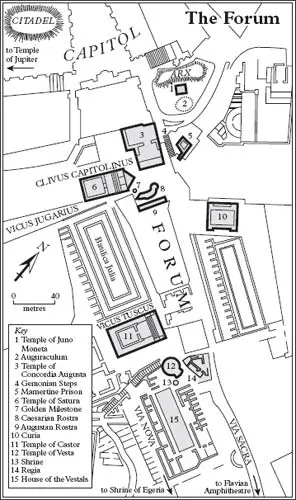
I was standing in the Forum. She was running. She looked overdressed and dangerously hot, but sunstroke or suffocation had not yet finished her off. She was shining and sticky as a glazed pastry plait, and when she hurtled up the steps of the Temple of Saturn straight towards me, I made no attempt to move aside. She missed me, just. Some men are born lucky; others are called Didius Falco.
Close at hand, I still thought she would be better off without so many tunics. Though don’t misunderstand me. I like my women in a few wisps of drapery: then I can hope for a chance to remove the wisps. If they start out with nothing I tend to get depressed because either they have just stripped off for someone else or, in my line of work, they are usually dead. This one was vibrantly alive.
Perhaps in a fine mansion with marble veneers, fountains, garden courtyards deep in shade, a leisured young lady might keep cool, even swaddled in embroidered finery with jet and amber bangles from her elbow to her wrist. If she ran out in a hurry she would instantly regret it. The heat haze would melt her. Those light robes would stick to all the lines of her slim figure. That clean hair would cling in tantalizing tendrils against her neck. Her feet would slip against the wet soles of her sandals, runnels of sweat dash her warm throat into interesting crevices under all that fancy bodicework…
“Excuse me—” she gasped.
“Excuse me!”
She veered around me; I sidestepped politely. She dodged; I dodged. I had come to the Forum to visit my banker; I felt glum. I greeted this smouldering apparition with the keenness of a man who needs troubles taken off his mind.
She was a slight thing. I liked them tall, but I was prepared to compromise. She was wickedly young. At the time I lusted after older women—but this one would grow up, and I could certainly wait. While we sashayed on the steps, she glanced back, panic-struck. I admired her shapely shoulder, then squinted over it myself. Then I had a shock.
There were two of them. Two ugly lumps of jail-fodder, jellybrained and broad as they were high, were pushing through the crowds towards her, just ten paces off. The little lass was obviously terrified.
“Get out of my way!” she pleaded.
I wondered what to do. “Manners!” I chided thoughtfully, as the jellybrains came within five paces.
“Get out of my way sir!” she roared. She was perfect.
The Story Continues on BooksBarbecue!
Enjoyed this preview? ❤️ Do not stop here!
Read the complete book free online → 🔗
Continue reading now on BooksBarbecue and discover every page!
Love reading? Bookmark BooksBarbecue.com for more amazing books!
Happy Reading!