Chapters (50)
- Front Cover
- Title Page
- Copyright
- Contents
- Part I
- Chapter One
- Chapter Two
- Chapter Three
- Chapter Four
- Chapter Five
- Chapter Six
- Chapter Seven
- Chapter Eight
- Chapter Nine
- Chapter Ten
- Chapter Eleven
- Chapter Twelve
- Chapter Thirteen
- Part II
- Chapter Fourteen
- Chapter Fifteen
- Chapter Sixteen
- Chapter Seventeen
- Chapter Eighteen
- Chapter Nineteen
- Chapter Twenty
- Chapter Twenty-One
- Chapter Twenty-Two
- Chapter Twenty-Three
- Chapter Twenty-Four
- Chapter Twenty-Five
- Chapter Twenty-Six
- Chapter Twenty-Seven
- Chapter Twenty-Eight
- Chapter Twenty-Nine
- Part III
- Chapter Thirty
- Chapter Thirty-One
- Chapter Thirty-Two
- Chapter Thirty-Three
- Chapter Thirty-Four
- Chapter Thirty-Five
- Chapter Thirty-Six
- Chapter Thirty-Seven
- Chapter Thirty-Eight
- Read on for a sneak peek at the next Violent Crime Investigations Team mystery!
- Chapter One
- Acknowledgments
- About the Author
- Back Cover
In other columns, she listed age, height, weight, location of body, posture of body, items found at crime scene. By the time she finished the spreadsheet, an hour had passed. She thought about the way Mahler had yelled at her to stop taking notes. Was he mad at her? If she was being tested, as Frames said, would she be the one dropped from the team? What if nothing was to be found in these old cases? What did Mahler mean when he told her to look at the “quality of the light”? Was it some kind of joke he played on new hires?
Eden went through the Irwin Partridge file chronologically. The documents captured a life through the lens of the justice system: arrest reports, indictments, pleas, and appearances before the court. After she finished, Eden paged through her notes. What did it mean? Remember your history. Professor Hiatt tapped the knuckle of her forefinger on the podium. We build cases on the discoveries of those who came before us.
From her Advanced Forensic Psych course, Eden knew researchers used systems for classifying the personality types of serial killers. Holmes and DeBurger recognized four types: visionary, mission-oriented, hedonistic, and power/control. The evidence in the current cases seemed to indicate the killer, or killers, fit the hedonistic type—someone who killed for pleasure and regarded his victims as objects for his own enjoyment.
According to the literature, hedonistic-type killers choose their victims selectively. Their “ideal victim type” is someone they find sexually appealing. In their text on serial murder, Holmes and Holmes wrote that Ted Bundy picked his victims based on how they walked and talked.
Eden looked at her spreadsheet. Foss, Hart, MaryEllen Reese, and Beth Hunter were about the same age and body type.
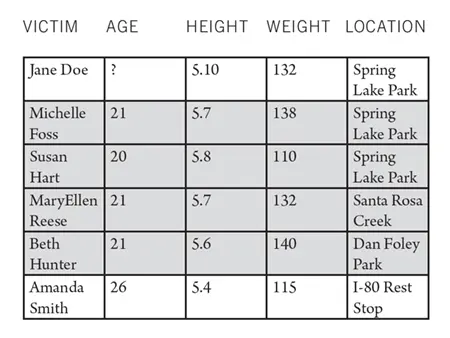
The next column on the spreadsheet was location. Eden remembered studies in the 1990s showed the significance of geographic location in serial murder cases. Serial killers usually prefer specific locations and rarely vary from them. Geographic profiling had even been successfully used in tracking killers. In three of the cases Eden studied—Foss, Hart, and Hunter—the victim had been killed in a public park. Jane Doe had been found, not killed, in a public park.
Studies also showed serial killers use specific methods of killing. Fox and Levin at Northeastern found the dominant motive for the killer’s behavior is to exert control over another person’s life. To exert that control, serial killers prefer strangling or stabbing instead of a firearm. All the victims in Eden’s spreadsheet had been strangled, and all but Jane Doe had been strangled with a smooth object, probably a cord.