The Serpent
Cover
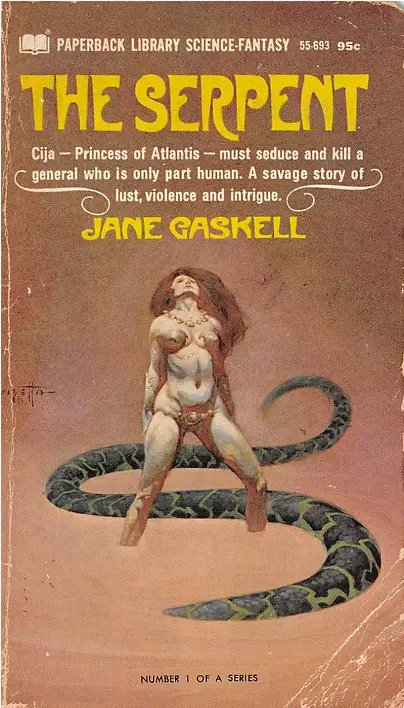
Intro Blurb
THE FIRST AMERICAN PUBLICATION OF
THE SERPENT by Jane Gaskell
________________
One of the most astonishing fantasy novels of our
time—a work to rank with Tolkien’s THE LORD
OF THE RINGS and Eddison’s THE WORM
OUROBOUROS.
Set in the legendary beginnings of time, THE SER-
PENT tells the story of Cija, Princess of Atlantis,
who has been raised in complete seclusion, believ-
ing herself a goddess. Suddenly she is thrust into
the world on an incredible mission. She must
marry and slay the powerful general threatening
her kingdom—the strange, brutal half-human
Zerd, also known as The Serpent.
Crammed with lust, violence, intrigue, set against
the barbaric splendor of the world of sword and
sorcery, THE SERPENT is a gripping fantasy no
one will ever forget.
Title
Copyright
PAPERBACK LIBRARY EDITION
First Printing: June, 1968
Copyright © 1966 by Jane Gaskell
The characters in this book are entirely imaginary and bear no relation to any living person.
This Paperback Library Edition is published by arrangement with Hodder and Stoughton Limited.
Paperback Library books Ore published by Paperback Library, Inc.
Its trademark, consisting of the words “Paperback Library’’ ac-
companied by an open book, is registered in the United States
Patent Office. Paperback Library, Inc., 315 Park Avenue South,
New York, N.Y. 10010.
FOREWORD
I’ve translated this as nearly as I can not only into the language of our country, but into the language of our day; for the Diarist herself used a great deal of then-colloquial slang, even in the earliest parts of her book, which leads us to suppose either that she picked it up from her mother’s servants on the rare occasions that she met them, or that her nurses were not quite so abysmally strict as she came, in her adolescence, to believe. It will be noted how this style leaves her as her journey forces her out of childhood.
The almost unbelievable age of the Diary is indisputable. Also, most convincingly, its accounts of everyday life at the time of Atlantis almost exactly correspond with legend and the calculations of Atlantis experts. Quite a number of separate details in this book are now known as ancient myths. They are mainly ancient Celtic or South American myths—and Britain is believed to be a remnant of Atlantis, after it had grown ugly in the sight of Heaven and the princess who had found out the secrets of the Great Dikes helped to destroy it.
I can’t go here into the proofs or otherwise that Atlantis and Mu did exist and that there was a time when the earth had no moon, (our previous satellite having circled nearer and nearer, pulled over millions of years by our greater gravity, and crashed on us), the conclusions of geologists, Gondwanaland, the evidence of flora and fauna, the dove-tailing legends of the ancient world, the world’s languages, the patterned placing of the world’s pyramids, the flocks of migratory birds which every year fly to the place where Atlantis is supposed to have lain, and circle round and round, searching for the land the Atlantis-believers tell us they know must be there because of the racial-memory instinct in all animals. Here I can give only a short, very incomplete, list of the myth-ingredients I’ve found relevant to this Diary. Students of this sort of thing will recognize them all anyway. Many of them I already knew; others turned up later and astonished me with their relevance.
Atzlan was the prehistoric birthplace of the Aztecs of America—the pride, hybris, of the Atlantes in Plato’s account—The American Linapy tribe had an ancient song telling of the land of Rusuaki and how it was destroyed in a great fire and cloven by the Earth Snake, Zio, the scarlet-faced war-god of prehistoric Britain—The crocodile—demon Set of Egypt, always supposed to be a colony of Atlantis—The Aztec goddess Cioacatl ‘“by whom sin came into the world” usually represented with a serpent near her—The whole story of Adam and Eve and the Garden—The sons of God saw the daughters of men that they were fair—There were giants in the earth in those days; and also, after that when the sons of God came in unto the daughters of men, and they bare children to them, the same became mighty men which were of old, men of renown—The rites of initiation into womanhood, for the South American jungle girls, which includes their promise that they will cherish the mortal men they must marry, and not resent them for their difference from the god to whom each girl was wed before her birth.
The puma dates from the Pleistocene, and the behaviour o. Cija’s “white puma” is perfectly credible. Even today the gaucho of the Argentine pampas calls the puma amigo del cristiano—The extra large snails of South America aroused interest in Colonel Fawcett—The huge birds used by th Northern army are obviously the prehistoric Diatryma, one prevalent in America, about seven feet tall.
Cija is pronounced Key-a. This slightly Celtic pronunciation gives the clue to the only other difficult names in the adventures.
Gagl—Gahl.
Ious—Yuse.
The main action of the book takes place in what is now South America.
PART ONE
THE HOSTAGE
CHAPTER ONE
THE TOWER
I can’t see things so well from any other window.
The nearest mountain, a huge hazy turquoise-green thing, conical, terrible, is so near I can see the thickly-forested ridges and the blue precipices and the grey chasms. The mountain behind that, and separated from it by the sea, is less evenly shaped and on clear days looks as though it’s going to lurch forward. It is fascinating but ominous. The third mountain, between and beyond them, is so distant that even on clear days I can’t make out more than a vague pattern of changing shades, valleys and slopes, floating in the insubstantial horizon.
And beyond the horizon lie the Northern lands, where the terror-legends come from. My own nurses used to scare and horrify me with tales of how I would be given to the cruel barbarous animal-people there, if I were not good. The people there are animals, they are not descended from the gods as we are. There is no kindness, no mercy, pity or gentleness possible to their natures. They are avaricious and savage; at best they are callous, at their worst they are sadistic and no atrocity is beyond giving them pleasure. Physically they are brutish, graceless. So it is exciting to look out over the sea and mountains and know that they enclose me from the Northern lands, secure, safe in the benediction of our ancestors the gods, in our own prosperity and beauty.
And the sea is nearer to see from this window than any other in the tower. It would be gorgeous to watch it during storms except that then it is mostly hidden from me by the huge swift continuous sweeps of rain.
The tumbled stones lying round the ruined window-way were of a great heat when I first ventured to touch them.
One rocked, hesitated, plunged and fell into the abyss.
I leaned over as far as I dared and watched its awful drop. It left an unfamiliar space on the sill. That really was a day on which there was a happening. I was shaking all the time but I got up slowly, steadied myself, climbed on to the broad sill,
and walked over the unsteady tumbled ancient stones on it until I had nearly come to the edge. I lowered myself with slow, slow care to stooping and then looked down for the first time on what is below.
It was wonderful; I felt like a poet and an explorer in one daring creamy skin.
I was so enthralled I almost forgot how dangerous my position was on the edge of the sill.
The first time was wonderful and the others have really been just as wonderful but also more conscious of the danger. There is a small round plateau down there. It is grassy in its centre and rocky round the edges and a little thin blue thing shone through it. And from my reading, I knew at once that I must be beholding a stream.
I gazed down at this new unguessed of scene and all the time the corner of my eye was aware of a white glint. I craned round till my neck was horribly ricked and, my hands gripping violently at a bit of protruding wall, I saw a piece of a white stone building.
Unblinking, my eyes widened.
At least, I expect they did, they have to anyway for this type of happening, according to most of the prose I’ve read.
I hung, silently, gazing at new horizons.
The white building whose end I was seeing obviously began somewhere quite beyond my range of vision. I thought (just at first) it might be a bit of this tower but I didn’t recognize it.
It’s a stone terrace, open to the sun, behind a beautifully-worked stone balustrade which looks tiny from this distance, and behind is a flat-roofed hall into whose shady clean blue colonnades I can see for some way before it disappears into its own shadows.
It all looks so cool, and unattainable.
I wondered and wondered.
Was it part of my own tower? But no, I had explored it from corner to corner since babyhood. (I know far more about it even than they do.)
“It must be the end terrace of my mother’s palace,” I thought.
Then I twisted myself back till my whole weight rested on the hot board sill again. I clambered back over the uneasy stones and lowered myself into the secure little Passage beyond. I would ask my mother some questions next time.
So I did, and she evaded them and questioned me instead and I had to be very clever and evade her questions because I don’t want anyone to find out about the Passage. But I am sure, by now, that that is the end of my mother’s palace and that I have seen part of the outside World.
On the third day of every single week, every week might be permissible but always the third day, they put long revolting aprons over their trousers and scrub the floors. If they think I have been particularly bad, they make me help them and I have been helping them for months now with only one week off.
The whole point of my starting this diary is that I am utterly fed-up and I must work off my steam somehow and a good way to do it is to write it all down, so I shall.
Actually I wouldn’t care if Glurbia got hold of it and read just what I think of her, and all the others but particularly Glurbia, but I am writing it in my private code and to keep it even more to myself I am keeping it in the Passage. At the rate of present progress (ha ha!) I may have to use this Diary as a safety valve for years and years and years but luckily it is a huge book made even bigger really by the fact that it has thin pages which are a nuisance to write on but gives me more pages. It Is one of Glurbia’s account-books which should have lasted her for the next five years but she’s had to get another one because this one has disappeared. As far as she’s concerned it has anyway. But she thinks she must have mislaid it because if I had taken it what would I have used it for? Well, we shall see.
I have made a place for it at the end of the Passage. Have hidden it, together with this sticky-tipped deep black scriber which I have attached to the lock of the book, together with the dear little key, by a long tape—have hidden it under some stones (which make it rather dusty but never mind).
And I have made a vow to be just as rambling and infantile as I feel like being because what else is a secret Diary for if not to be a recipient of all one’s feelings?
Of course, some people can record happenings in their Diaries, if my books are to be believed, but what hope have I of that?
Their legs are thick and blue-white and when they pull up their trousers, nearly to the knee, so they can kneel easier, this is blatantly visible.
Not only are the legs repulsive but it almost makes me sick to have to look at them.
And poor little me, my own legs are of course longer and
slenderer and a much more aesthetic shape but it wasn’t very nice to have to know that my legs were just as blue-white. Whenever the colour of the legs of the women in the books are mentioned they are “beautiful gold-brown legs.” And I yearned for them. But I can’t even get a little satisfaction like that, oh no. Glurbia caught me lying beside the fountain in the sun, with my trousers off.
“Cija!” the dear old lady gasped and went such a charming shade of magenta. “You wicked, wicked girl! Oh, you wicked—put your clothes back on at once. How dare you act in such a way? What would your mother say? You sinful, shameful girl!”
“I want to get brown,” I said.
Mild enough. No need at all for all the nagging that went on solidly for weeks afterwards, and it’s still always being mentioned.
Haven’t breathed to Glurbia that I’d read of the women with brown legs. So she thought it was an original idea on my part—“original sin.” But if I reminded anyone of the existence of those books they’d be removed from the book-room.
At least, whenever I can, I sneak away to this window-niche at the end of the Passage.
And here, where the sun pours in past the mountains, I remove my clothes. I am now a beautiful creamy colour. Surfaces like my shins are a crisp gold like well-done fry. Places with a little almost-fold like where my breasts meet my armpits, or my tummy meets my groin, are pale gold. Veins still show blue though. From here, I can just hear the sound of their voices as they call, “Cija! Cija!” If they want me for some very annoying task, or if I am in a very daring mood, I just sit quiet and don’t answer them.
They never search for me here.
I don’t think they ever even knew of the entrance to the Passage behind the old wall-hangings.
They are very stupid.
The daily quarrel is over for today (unless it’s a more-than-one-quarrel-day).
I had been here and ignored their squeals, “Cija, Cija, Cija,” etc., etc., etc.
Then at meal-time, “Cija,” said Glurbia, “where have you been?”
“Oh, nowhere.”
“You are defiant and impudent,” said Snedde. “Lately, Ci-ja, you seem to be forgetting all the care and affection with which we have laboured to make you into a lovely and well-bred girl.”
Not because I was stricken by remorse at the stark truth of Snedde’s words but because it is rather a shame to upset the old imbecile, I quickly kissed her cheek. Snedde’s moustache prickles. I withdrew myself from Snedde’s answering embrace, trying wearily to stifle the distaste I know I am wicked and ungrateful to feel.
“Here is your bread,” Rorla said, handing over a plate.
I took the plate, not even mentioning the charming cracks across it in which mould is growing. If I had mentioned it Rorla would be in for it from Glurbia for giving me the plate, because Rorla cracked it and is supposed to use it until the supplies come, including extra plates. I hope they come soon.
So then I asked as carelessly as possible, “When is my mother’s next visit?”
“Your mother is coming tomorrow, so the floors must be polished.”
“Again?”
“I don’t like your tone,” Glurbia said, using her cold voice.
“I wouldn’t mind so much if the floors were dirty,” I said reasonably. “But they are no less clean now than they will be when we’ve polished them.”
“Your opinion as to cleanliness is not that of conscientious persons, Cija. And it’s quite disgusting of you to moan whenever you have to set your hands to a little work. Other girls of your age have many more hardships to suffer.”
In a couple of long cold sarcastic sentences she can make me hate her. In fact, I hate them all nearly all the time now.
All right, all right, so I’m selfish and lazy and never think of anyone but myself. (Incidentally, that’s surely permissible when I’m the only interesting person about?) However, that seems to be me and I prefer it to changing to them so I shall stay selfish and lazy.
So just now I said, “Other girls of my age aren’t treated the way I am—they meet people—” and then I stopped.
I know, really, that that one is going too far.
I suppose it is unkind, it is disobedient and immodest of me to talk in that way.
Only because I am so special (though not too special to scrub floors) am I allowed to reside in this finely-laid-out and comfortable castle, with a dozen women to look after me—if not actually at my beck and call. I am different from other
people, my blood is unique. I am treated with great care, have been since I was born, because I’m more than the equal of any piece of precious fragile porcelain.
But I shrugged my shoulders.
“What breaks my heart,” I said bitterly, more to be disagreeable than because I think it true because I know a lot of it is my fault, “is that you all used to be so nice and talk to me and read to me and play with me before you suddenly started to scold me all the time!”
I turned my back on them and walked across to the fountain.
It hurts to know you’ve hurt someone as close to you as they are, but there’s a sad sort of sour joy in hurting anyone.
I slipped my feet from my sandals and into the fresh cool spray.
“My darling child,” Glurbia’s sober voice said, and I don’t think she was hurt and I don’t think she was loving me, she was just ticking me off (they never, never, never, never do anything else), “what you fail to realize is that you have, in the last year, become intractable and moody and you can’t bear to be told when you are wrong, even though you must know that you are.”
“I’m sick and tired of being scolded,” I remarked and began to splash my feet. “You treat me like a baby. I’ve been alive for seventeen years.”
“You may have larger breasts and hips than you had a few years ago, but in other ways you are still a child and under our guard and guidance. You didn’t resent our authority when you were eight, why should you now? And you will be under it for a long time come. You are not yet old enough for us to become your maids; we are your nurses and have every right to expect obedience and gratitude—at least respect.”
I jumped up.
“That’s what I can’t bear!” I yelled as loud as I could. “That’s the thing driving me mad! I’m to be stuck here with you how many years till I can see the World and new faces and become real? I’d like to commit suicide, often, I’m so bored and I only feel alive, my mind gets thrown back from its live sections because it has nothing but this all the time.”
“Cija—”
“You tell me I’m precious, but what’s the good in it for me?”
I snatched up my last piece of bread and honey, flung it angrily and wastefully into the fountain, and ran into the room leaving them hurt and angry and offended and worried. By the time they had followed me I was here, inside my hidden Passage.
Hiccuping slightly, I walked through the cobwebbed darkness.
It makes me more angry, perhaps, than anything else does to realize that all the endless advice they’re always giving me about running about during meals is quite correct.
It does give one hiccups.
The nurses bowed their heads down as far as they could, which was not very far because their rheumatism was bad again today, and my mother walked slowly between them.
She came to me, put out her hands, so that all her armlets and rings clanged together, and placed them on my shoulders.
“What a lovely dress, Cija darling. Who made it?”
“Cija made it herself,” Glurbia said with pride.
“Indeed? You are teaching her well.”
“They helped me a lot with it,” I said sullenly. I didn’t want to take all the responsibility for the dreadful thing.
“And has she been good since my last visit?”
“Quite good, Dictatress.”
My mother smiled, the women filed past her, and the little courtyard was empty but for Cija and her parent who sat down beside the fountain, and of course but for the slaves who stood holding the Dictatress’ train clear from the pavement.
“What sunny weather we are having.”
“Yes, Mother.”
It seemed to me my mother was preoccupied.
She was smiling vaguely round at the sky and the sunlit stone and the silky-looking sea far below the parapet, plucking with the fingers of one hand at the gigantic onyx ring on the hand which so maternally held mine.
The Story Continues on BooksBarbecue!
Enjoyed this preview? ❤️ Do not stop here!
Read the complete book free online → 🔗
Continue reading now on BooksBarbecue and discover every page!
Love reading? Bookmark BooksBarbecue.com for more amazing books!
Happy Reading!