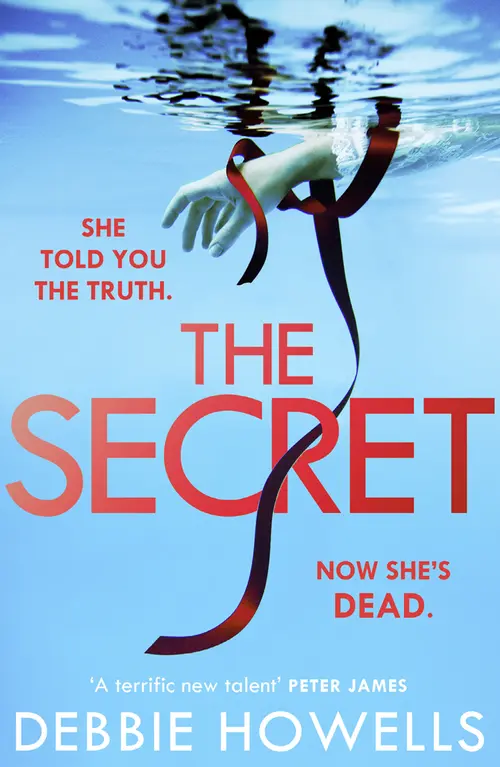
The Secret
Cover
Praise for Debbie Howells
‘A terrific new talent’
Peter James, author of the Roy Grace series
‘Dazzling’
Daily Mail
‘Sharply written … holds you tight and then drops you like a stone’
Liz Nugent, author of Our Little Cruelties
‘Haunting’
Good Housekeeping
‘A sinister, twisty tale you won’t want to put down’
Sam Carrington, author of The Open House
‘I was completely immersed … a superb thriller’
B P Walter, author of Hold Your Breath
‘Brilliantly twisty’
Tammy Cohen, author of When She Was Bad
‘Utterly compelling and addictive’
Samantha Hayes, author of Until You’re Mine
Readers gave The Vow five stars …
‘Superb story, characters and twisty ending’
*****
‘I read it within 24 hours – I loved it and couldn’t put it down’
*****
‘She has a beautiful way of writing’
*****
‘Full of twists and turns all the way through’
*****
‘Mesmerising from the start’
*****
‘Kept me guessing right to its satisfying final pages’
*****
‘I highly recommend this and all of Debbie’s books’
*****
‘The exciting plot and interesting characters all had me hooked’
*****
‘A roller coaster of a read’
*****
Dedication
For my sisters
Sarah, Anna and Freddie
Niamh
It began with Dylan and the way he captivated people, drawing you into another world where anything was possible. Once you glimpsed those glittering horizons of his, you couldn’t go back. Not ever.
Hollie didn’t have a chance. She was too fragile, looking for a love she needed but had never had. Not even from the people closest to her: the mother she adored who screwed her up, then killed herself; the father who didn’t have time for her; the stepmother who tried to love her, but couldn’t give her the mother’s love she craved.
It seemed inevitable that Hollie and Dylan would fall in love. And, for a while, it was glorious. In a village where we were the only teenagers, they were a common sight – hand in hand, his dark head towering above hers, Hollie in ripped jeans and an oversized coat that only accentuated her ethereal beauty. When love consumed you the way theirs did, everything else was irrelevant.
Until the day of yellow sky and wild winds, when it all stopped.
Chapter One
Elise
I’m strapped into my crew seat. As the aircraft accelerates down the runway and takes off for London, I watch the woman sitting in the first row opposite me. Her blond hair is shoulder length, her eye makeup minimal, her lips red. I’m envying the biker jacket and green dress she’s wearing, when I’m drawn to a headline on the cover of the magazine she’s reading: ‘Only Ten Per Cent of People are Good’.
Ten per cent … It seems a small number. I frown, trying to work out if I’m one of them. As the ground falls away I glance through the window, watching the world shrink, snow-capped mountains suddenly dominating the view. There’s a chime as the seat belt sign goes off and I get up, glancing for a moment down the length of the aircraft. One hundred and twenty-three faces that can see my neatly pinned-back hair, my mask of immaculate makeup, my navy uniform dress and smart shoes. One hundred and twenty-three lives I know nothing about, just as they know nothing about mine.
As I set up the drinks trolley, the statistic on the magazine cover stays with me, and I think about how many people who, for all kinds of reasons, cause suffering to others. I used to believe that even the worst behaviour could be explained by abusive childhoods or desperation. But that was before I realised people have choices; make decisions. Before I realised that brutality can be intentional.
The passengers are mostly students in big coats and trainers, blank-faced business travellers, and wealthy Italians in designer wear. As I serve cups of tea, I usually imagine them to be parents, families, friends, vacationers. But none of us knows what lies behind appearances, or what we’re capable of in extreme circumstances. As I look at them I’m wondering which of them are in the ten per cent – out of one hundred and twenty-three, that’s only twelve or thirteen – but it’s impossible to tell.
Now and then, I catch a glimpse through a window of the bird’s eye view of which I never tire – a view of a world that’s endlessly beautiful. At thirty-five thousand feet, you see the landscape in large scale: stretches of sea, jagged mountain ranges, hundreds of miles of patchwork farmland. Today, beneath a pale blue sky, the mountains have given way to a sea of snow fields, broken here and there by a circular town or a spider’s web of serpentine roads; by monolithic chimneys from which vertical smoke rises, scored into the whiteness. Over northern France, the snow reduces to an icing-sugar dusting. Then, as we start our approach into London and I go through the cabin checking seat belts, the clouds thicken and the reality of my life on the ground comes flooding back.
*
The passengers disembark and I make my way on the bus to the crew room, then onto another bus that takes me to the staff car park, my face impassive for the journey. Only when I’m alone in my car do I let my feelings show. As I leave the airport perimeter road, I open the window and breathe in the cold air, suspending my reality for as long as I can: of the neighbours who think they know me, my cheating husband, Andrew, whose patients think he’s God, my changeling daughter who lives in her own world … How tenuously our family life is held together.
Abingworth is a thirty-minute drive from the airport and as I turn off the main road, my eyes narrow when I think of Andrew, wondering who she is this time. As far as I know, this is his fourth, though I’ve no reason to believe there haven’t been more. This latest one’s been discreet so far and I’m grateful for that small mercy. The humiliation of not being enough for your husband is multiplied a hundredfold when everyone else knows.
Reaching the village, I slow down as I pass the sign reading ‘Abingworth’. We moved here seventeen years ago, after I discovered Andrew was having an affair for the first time. Wanting to believe his assurances that it was over and that he’d made a terrible mistake, I’d let him persuade me to view a large country house here, with a tacit agreement that this was a chance for a new start. After moving in, naïvely, I’d believed it possible. But not for long. My husband is a serial adulterer, our home no longer somewhere I want to be. The only reason I stay is for our daughter.
Now, as I drive, I try to remember how I had felt back then. My hope for a new life tainted with mistrust; my jaded anger with Andrew. My overriding need to protect my family – that took precedence over anything else.
I turn into our lane, then again a little further on, through the tall gateposts flanking our driveway, my tension easing slightly when I notice the empty space where Andrew normally parks. The garden is surrounded by flint walls, the cedar trees in front of the house giving it seclusion, privacy. My relief that I’m alone is instantly squashed by the thought that’s never far from my mind. He could be with her.
Once, I would have phoned his practice to confirm my suspicions, desperately cobbling together an excuse for calling when I didn’t need to, but I no longer care enough. Today, I park by the back door and take my crew bag inside, thinking about the three days off that lie ahead, imagining tidying the house and going for a run, or catching up with one or two friends before next week’s flight schedule starts. Maybe I’ll take Niamh shopping and get her a new pair of those awful velour leggings she lives in. Maybe Andrew will dump his lover. Actually see me properly again. See Niamh. See anyone but that fucking bitch he’s sleeping with. But even if he did, I’m not sure I’d want him. Swallowing hard, I blink away the hot tears filling my eyes, hating how the thought of him makes me feel.
In the kitchen, my heart skips a beat as I see the light flashing on the house phone. I leave it until I’ve showered and changed, until I’ve made myself a cup of coffee. Putting it off until I can’t any longer. When I play the message, there are no distinguishable words, just a faint crackle before the caller hangs up. After it plays through, I delete it, then retrieve the caller’s number, my blood suddenly like ice in my veins. I write it down with shaking hands, knowing it’s her, even though there’s no need for her to call here. But then, I know it’s one of Andrew’s games – telling her to call him here, in our home. It’s a way for him to twist the knife, undermine me. It’s what always happens when he starts seeing someone new. It’s just a question of when.
There is no escape from my husband’s betrayal. Even in my home I’m surrounded by the ghosts of his lovers, their silent messages of possession. Most women would have left. And I would, if it was possible. But I can’t. Not yet. So the only way through is to play the part of loving wife, hide the truth from Niamh, and let Andrew do what he wants to do, knowing the day will come – one way or another – when it ends for good.
I pick up my mug and sip my coffee, finding it cold, bitter. My hands still trembling, I hurl it at the wall.
*
The latest message on the house phone has unsettled me. With an hour or so before Niamh’s bus gets back, I pull on running clothes and shoes, needing to shift my sense of unease before seeing my daughter.
The sky threatens rain as I slip the back door key into a zip pocket, pulling up my collar and walking briskly down the drive onto the lane. Breaking into a run as I reach the main road, I feel the cold clinging to my hands, my cheeks; it’s only as I run harder that the slow spread of heat through my body begins thawing them.
I see no-one through the village. Windows are closed and dark, drives are empty, gardens damp. Only as I pass Ida Jones’s house are there signs of life: the warm glow of light from her downstairs windows, wood smoke spiralling from her chimney. A thought comes to me suddenly: Ida’s lived in the heart of this village most of her life. She knows everyone and I wouldn’t mind betting she knows what goes on. Maybe she even knows who she is.
I could ask her, but I’d rather not admit to what’s going on under my nose. I carry on past the last houses without stopping, taking a footpath that slopes down through woods and across a stream. Under the trees, the path is dark and muddy, fallen leaves making it slippery underfoot, and I pick my way carefully over the narrow bridge, then up the other side before coming out of the trees into the churchyard.
Here, among the dead, I stop, looking at the graves that have become familiar to me. My eyes pass over their inscriptions as I walk between them, always pausing in the same place to read words I know by heart about a life that ended too soon. Never forgotten.
Most days, I find a quiet sense of peace here, but today I’m thinking of the magazine statistic again. Only ten per cent of people are good. The rest are like Andrew. They charm, captivate and seduce, but eventually you see the truth about them – that they do what they want, whatever it takes to sate blind ambition, perpetuate arrogance, slake lust.
As I stand there, a desperate sense of hopelessness washes over me, as instead of fighting my tears, I let them stream down my cheeks. The woman I was when I married Andrew had hopes and dreams. But nothing has worked out as I’d imagined it would. Instead, I was foolish enough to be taken in by the charming doctor, a man who consistently cheats, while the only thing keeping me going is my daughter. In my pointless world, Niamh is the only person who’s important to me.
Niamh
I live on a road to nowhere in a village of tall trees and stone walls; a place of cold hearts and secrets. As I get off the school bus, cold air rustles the leaves and I feel the first spots of rain. My stop is the last and I’m the only teenager from my village who goes to my private school. No-one gets off with me.
While I walk up the lane, no traffic passes by. ‘Hey, Cat,’ I say to the cat that often sits waiting for me. A motionless sentry perched on the wall at the side of the road, his yellow eyes are unblinking, his black head battle-scarred. I know that his presence is an honour, rather than a given. A cat belongs to no-one but himself.
By the time I turn into our drive, he’s already vanished. Gravel crunches under my feet as I walk towards the house, its grey, stark façade softened in spring by lilac wisteria.
I walk around the side to the back door, where music from the radio drifts outside. As I go into the kitchen, I find my mother wearing jeans and a wide-necked sweater that slides off one of her tanned shoulders.
‘I need some money for the science trip,’ I tell her, putting down my school bag and getting juice from the fridge before going to the larder for a bag of crisps. Opening it, I take a handful, watching her leaf through today’s mail. Her hand pauses on a letter, her intake of breath audible, coupled with the perceptible paling of her skin.
‘It’ll have to wait, Niamh. I don’t have any cash.’ She adds, ‘Don’t eat all of those.’
Taking another handful, I ignore her. ‘Whatever. You can pay online. Probably easier.’ I shrug as her phone buzzes, her face closing over as she picks it up and glances at the screen.
‘Remind me later, honey. I have to get this.’
Noticing a catch in her voice, I stare at her. ‘Who is it?’
In the time it takes her to respond, the hairs on the back of my neck prickle. ‘A friend. No-one you know.’ As she glances in my direction, I notice the semitone rise in sharpness in her voice, the five seconds of fake brightness in her smile. She turns her back and leaves the kitchen, and it’s only when she knows she’s out of earshot that she starts talking.
That’s when I know it’s another of her lies. She’ll tell herself I haven’t noticed anything wrong, then forget all about it. Taking the bag of crisps, I go outside, shaking off my uneasiness as I wander down to the end of the garden where it borders the road, wondering if all families lie to each other.
Pulling myself up onto the same flint wall where the cat was waiting for me just minutes ago, I envy the simplicity of his life; his past forgotten, his future uncontemplated, his only concern the eternal present.
I like to sit here and watch our neighbours, all of them hiding who they really are – just like my father in his doctor’s office, my mother in her airline uniform – putting on the faces they want the world to see when, underneath, they could be someone else entirely.
*
It’s dark when Hollie appears in my bedroom doorway later that evening. Her long hair is windswept, her cheeks tinged with pink, as though she’s run here. I can tell from her eyes she’s been crying. Staring at her face, I’m already guessing what she’s upset about.
‘Your dad?’ I ask. He’s the only person Hollie cares about. She nods as words, tears, and snot begin pouring out of her. I’ve never seen anyone cry as messily as Hollie does.
‘He was talking to someone on his phone.’ Her hair gets in the way as she breaks off to wipe her face on her sleeve. ‘Whoever it was, they’re a bastard.’ Her voice is filled with hatred.
Not wanting my mother to overhear, I glance towards the open door, then lean towards Hollie, curious, asking quietly, ‘What were they talking about?’
Her lip wobbles. ‘I can’t tell anyone.’ Then her shoulders start to shake. ‘Do you know how that feels?’
I’ve no idea what she’s talking about. ‘You can tell me, Hollie.’
She shakes her head. ‘I can’t. You’re too young.’
I wonder what she means. She’s only two years older than me.
But then she comes towards me, awkwardly stroking my hair before perching on the end of my bed as she tries to get control of herself. When she turns to look at me, her face is tear-stained, her distress obvious. ‘I wish I could tell you, Niamh. But I can’t.’
Chapter Two
Elise
‘I hope you haven’t forgotten about tonight.’ Without offering a greeting or explaining why he’s late, Andrew walks into the kitchen and puts the kettle on. He never justifies anything. Even off duty, he behaves with the same air of authority he has at work.
My heart sinks as I remember. He’s talking about drinks in the pub – a village tradition – meant to celebrate the end of January and a month off alcohol, which no-one ever actually achieves. I had forgotten. If I hadn’t, I’d have invented an excuse, but it’s too late for that now. ‘I had, actually.’ I pause, wanting to say I’m too tired as it’s not untrue – I had an early start this morning. Instead, I glance at the clock and give in to the inevitable. It’s seven thirty. ‘What time is everyone meeting?’
‘Eight.’ Evidently changing his mind, Andrew switches off the kettle and uncorks a bottle of red wine.
‘Fine.’ My mind is restless. If she lives locally, as I suspect, the population of the village is so small that she’ll almost certainly be there. The probability is I’ll know instantly – I usually do. ‘I’ll go and change.’
Upstairs, I pull a black tunic on over my jeans, knotting a pale scarf over it, then brush my hair and touch up my makeup. The spritz of perfume is defiant, reflecting my mood – it’s one I know Andrew doesn’t like. As I go downstairs, I hear there’s music coming from the sitting room. I push the door open wide enough to see Niamh slumped on the sofa and Hollie sprawled on the rug in front of the fire. Neither of them looks up.
‘We’re just going out, girls. We won’t be late.’ My voice is intentionally light, painting the picture that Andrew and I are off on a cosy evening out, but I suspect it doesn’t fool anyone.
Niamh turns briefly, hair the colour of flax falling across her face. ‘OK, Mum.’ Her face is expressionless, her eyes blank, mirroring mine. Not for the first time I berate myself for not being the kind of mother who can make everything right in her world with a hug, a laugh, a joke …
I look at Hollie. ‘Are you staying, Hollie?’
Hollie Hampton lives at the other end of the village from us. At sixteen, she’s two years older than Niamh, but they’re kindred spirits. Riveted to the television, Hollie nods imperceptibly, pulling her long dark hair over one of her thin shoulders. Elfin-faced, with pale skin, in the frayed jeans under the silver dress she’s wearing, she’s diaphanous.
‘There are snacks in the cupboard if you’re hungry,’ I remind them. ‘See you later, girls.’
Pushing the door closed behind me, I go to find Andrew. Already wearing his coat, he barely glances at me as I pull on a jacket and knitted hat.
‘Ready?’ His tone is brusque, but unless there’s anyone around to notice, Andrew is never affectionate towards me.
*
We walk to the pub in silence, the air damp, the drops of rain from earlier yet to turn into anything more.
For some reason, Hollie is on my mind. Her father, James, is a writer, her stepmother, Stephanie, a hairdresser – I’ve been to her salon in the next village once or twice. Over the last couple of years, Hollie’s seemed increasingly troubled. I’ve seen it when she appears at the door, uninvited, looking as though she has nowhere else to go; sometimes it’s as if her mind is far away, while other days emotions race across her face like storm clouds scudding across the sky.
Hands in my pockets, I hurry through the darkness, trying to keep up with Andrew’s brisk, staccato steps. Like everything about him, they’re deliberate, purposeful. I wonder if he’s thinking of her. Fighting the urge to turn around and go home, I remind myself, this could be my opportunity to find out who she is.
When Andrew speaks, he takes me by surprise. ‘We should plan a holiday, Elise.’
The Story Continues on BooksBarbecue!
Enjoyed this preview? ❤️ Do not stop here!
Read the complete book free online → 🔗
Continue reading now on BooksBarbecue and discover every page!
Love reading? Bookmark BooksBarbecue.com for more amazing books!
Happy Reading!