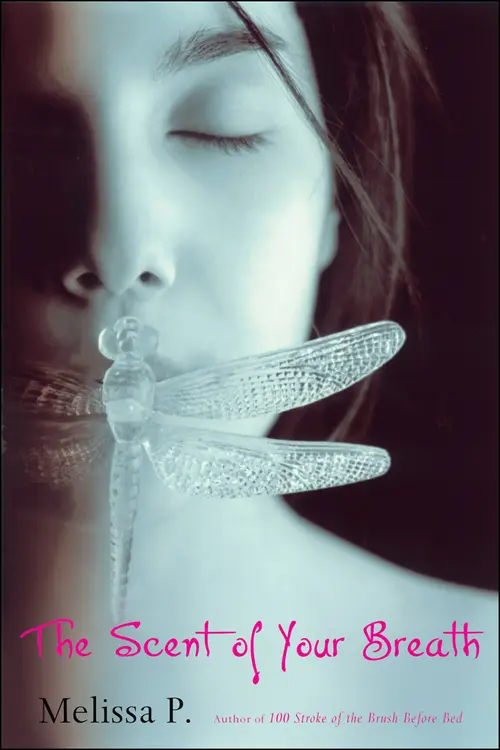
The Scent of Your Breath
Cover Page
Praise for 100 Strokes of the Brush Before Bed:
“The erotic adventures of a sexually ravenous girl … A wisp of a book that had a wallop of an impact … Readers have simply devoured it.”
—The New York Times
“A mixture of old soul and sexual newcomer … [Melissa P.] brings an emotional authority to her work…. 100 Strokes is by turns romantic, erotic, sensationalistic, and disturbing.”
—Bust
“Melissa P. is the ne plus ultra of an eye-watering literary phenomenon.”
—Telegraph (UK)
“Catherine Millet can go put her clothes back on.”
—Les Echos (France)
“Melissa P.’s fictionalized memoir is shockingly frank, explicitly detailed—and, she insists, entirely true.”
—Teen Vogue
“What’s most remarkable about this staggeringly assured debut is not the sexual smorgasbord—voyeurism, sado-masochism, group sex, etc., etc.—but the utter lack of any distractions from sex.… A junior-league Catherine M. bound to raise just as many eyebrows this side of the Atlantic.”
—Kirkus Reviews
“Remarkably self-assured … the shock waves of this self-revealing schoolgirl’s confession … are still reverberating.”
—The Times (London)
“An erotic chronicle of loss of innocence, charged with high-voltage sex.”
—El Pais (Spain)
“Speaking with the honesty of Céline and the sensitivity of Duras, Melissa P. has given us a book that is at once astonishingly sad, astonishingly perceptive, and ultimately, astonishingly beautiful.”
—Nic Kelman, author of Girls
“Scandalous, word perfect, languid like those thoughts that first start to coalesce in adolescence … a story that cannot be put down.”
—Gazzetta del Sud (Italy)
“The clear and uninhibited style of 100 Strokes of the Brush Before Bed is a great literary achievement.”
—Het Parool (Holland)
“The sex diary of Melissa P. shows she is experienced—and wise—beyond her years … A combination of candor and intelligence, and a compelling mix of aggression and passivity.”
—GQ (UK)
“Remarkable. With any luck this book will utterly scandalize the people who still think of teenage girls as half-formed dolls in pretty boxes.”
—BelleDeJour.com
“Melissa P.’s impressive autobiographical novel … makes a rather sophisticated commentary on desire. Combining adult subject matter with a child’s imagination, the author succeeds in powerfully capturing a young woman’s sexual coming-of-age.”
—The Observer (UK)
The Scent of Your Breath
Also by Melissa P.
100 Strokes of the Brush Before Bed
The Scent of Your Breath
MELISSA P.
Translated from the Italian by
Shaun Whiteside

Dedication
To Thomas, who knows how to sniff my skirt,
to my mother the forest,
to my sister the storm,
to my Nonna Madonna.
So go, take the train
’cause if you don’t go now, you surely will
—Virginiana Miller, “Elsewhere”
ONE
I threw myself into the streets of the world with a bee in my hair. A bee that buzzed among my tresses, beat its wings convulsively, and buzzed, buzzed, buzzed. I didn’t brush it away, I let it build its hive in my head, and everyone who met me said, “You’ve got hair like honey,” and didn’t know that there was a bee in my head, rolling around playfully among my thoughts with its soft, bicolored body. And it kept me company, my bee did; it became an indispensable if not very trustworthy companion: sometimes it gave me little bites on the back of my neck that should have hurt. But my bee was too small to hurt me; it left honey in me but never poison.
One day the bee whispered something in my ear, but it was too faint a murmur for me to hear. I never asked what it had tried to say to me and now it’s too late. My bee flew away from my hair, all of a sudden, and a passerby killed it. It was squashed. On the white marble I can see a liquid gleaming, a substance: I pick it up with a little spatula and take it to an analytic laboratory.
“Poison,” the biologist tells me.
“Poison …,” I repeat.
My bee died of poisoning; it wasn’t squashed. A few hours before, it had bitten me.
Who’s going to keep my silences company? I miss the bee’s buzzing; I need its soft whisper. When the morning sun shines, I find my teeth clenched and a sound coming from my mouth: zzzzzzzzzzzzz …
TWO
Were you OK yesterday? When you got home and lit yourself a cigarette from the gas ring in the kitchen, when our cat rubbed against your neck, breath quivering, when you shut your eyes and folded your legs like a fetus, what did you think about? Were you OK?
My torments began when I said good-bye to you at the airport, when I came over and said, “So, did you get all that? You check in, go up those escalators and then through the metal detector,” and I pointed to it with a finger, “after which you go toward the gate marked on your boarding card, and you’re there. Call me when you get home.”
That’s what I said to you, and then I moved away, came back, and repeated it all word for word. I even repeated my gesture, pointing to the metal detector.
Finally I kissed you softly, our bodies apart, and whispered in your ear: “Thank you.”
You, in a voice less harsh than mine, replied, “Thank you, darling, thank you.”
That same evening I made love with Thomas. “Let’s do it as though it’s the last time,” I said to him, looking him straight in the eyes.
He hesitated for a moment, then asked, “What do you mean?”
“Don’t be stupid … nothing apocalyptic. Just an excess of love.”
“Why?” he asked, dumbfounded.
I shrugged. “Because I’ve had enough of giving myself away piecemeal. I need to stretch to infinity.”
“But you always do that,” he said.
I shrugged again and snorted.
No, I’ve never stretched to infinity. I don’t know infinity. What I know is boundaries, paralysis, impairment. But not infinity.
“Let’s do it this way. Imagine one of us dies tomorrow; imagine that one of us has to go traveling for years and years and then we had to see each other again after a long time … or maybe never see each other again. How would you love me, how far would you go?”
He was extremely handsome, I was extremely beautiful. We were warmed by the light from the lamp on the chest of drawers, which bathed our faces with specks of color.
When we made love he didn’t exist, but he did exist and so did you. I existed, just an apparition. You and he loved me, tore me apart and kissed me. I saw your nose, his mouth, your ears, and his eyes. I felt two hearts beating rather than one, and when my body surged I shouted, “I love you so, so much,” and I was saying it to you as well.
You and he, guardians of my soul and my body. Presumptuously appearing on the terrace of my life, you watch and protect it as I have not asked you to, as I do not expect you to.
His sweat smelled like your neck, and his neck smelled of you. Then it was over. My eyelids lowered like the curtain after a show, and my soft, gratified breath merged with the smells of the room. And you stayed.
You’ve never made an attempt on my life or my liberty. You’re so frail, and I’m too heavy. Now and again I’ll have to silence all my theories of life to give more room to that extreme but gentle feeling I have for you.
Maybe you deserve that.
“A one-way ticket for Rome,” I said.
The man at the travel agency looked at me and smiled. “Where are you off to this time?”
I looked at him for a moment, tracing every feature of his face inside my head.
“Home,” I replied.
He lowered his head as a sign of reverence and, looking up at me furtively, said, “Straightaway.”
As he clicked away at the keys of his computer, I studied the brochures behind me. From the Congo to Laos, I could have gone anywhere. From Paris to Hokkaido. From Valparaiso to Athens. Endless possibilities spread out behind me, with many promises and few demands. I could have begun my escape right then, since I was there. But I was scared of the lack of responsibility; it’s always frightened me.
“So you’ve decided on Rome?” the man asked.
I turned around and nodded with a smile.
“Do you want me to make you an electronic ticket?”
“No, please don’t. I’d like to be able to hold it in my hand.”
It was like suddenly turning in to the road I’ve seen so many times on the horizon from my street, the one I’ve been traveling down for such a short time, but I feel as though I’ve lived a hundred years already, half of those years spent well, the other half so-so, to put it optimistically.
It’s always struck me as impossible to reach the point where the two roads cross, so that I’ve indolently traveled the whole journey without wondering where it would take me and what I would do when I got there.
All of a sudden I’ve found myself at the entrance to that unknown street, which a gilded sign identifies as “Likely Street. You can go straight ahead or turn left.”
So I looked back and saw my footsteps leading to the place where the parallel lines of the street joined in a perfect perspective: the tarmac was half destroyed, ruined by hail, rain, the wind, cratered and worn to the thinnest of crusts. I saw trails of blood where people had fallen; here and there I saw corpses lying naked and gaping. No trace of you. Just hints of a mammalian smell that spread along the lifeless, deserted street. I took another look at the gilded sign: it looked like the entrance to paradise. But someone once told me that there is no better paradise than your own personal hell (or perhaps my conscience told me that, to give me an alibi?). In any case, I decided to tempt fate, and rather than continue along that gray street, which I reached by passing through a black hole shouting, “Light! Light!” at the top of my voice, I sniffed the air and turned left, holding both hands crossed over my heart.
I took the airline ticket and held it delicately with two fingers: my ticket of entry.
As I left the agency, a thin line of cold made my skin ripple. I wrapped myself up in my overcoat (the red velvet one, the one Ornella thinks looks like a dressing gown) and climbed the street called the Acchianata di San Giuliano. I decided to pass by Piazza dei Crociferi, where the excess and luxury of the baroque vie with the degradation, death, and decomposition of the graffiti-scrawled houses, with flowers inexorably sprouting and withering from their stones. That’s where I had my first kiss, where I came to blows with some half-wit; farther over is the staircase where, one evening, I sipped a beer with a boy I didn’t know, who didn’t even ask for anything in return.
But no memory reawakened sensations that had been covered over by time.
So I went down, down as far as Piazza dell’Elefante, and all I saw were the gray coats of the council workers.
I walked on toward the fishmonger’s, and even there the only thing that came to mind was that time many years ago when you, Grandmother, and I came here to buy fish, and I was struck by the sight of that starfish on the back of the swordfish, still alive. A few, a very few memories, most of which are pointless and faded now.
If someone asked me which city I hated the most, I would say Catania, and I would give the same reply if they asked me which city I loved the most.
You’ve always told me that being far from your own land is the most painful thing imaginable. You’ve always told me that if and when I went away, homesickness would grab me by the throat and drag me down into a pit of sorrow and despair.
I told you that as far as I was concerned, one place was pretty much the same as another, and actually Catania was the place I feared most, because Catania swallows people up.
Darkness, ash, lava cooled and congealed. In spite of the sun forever peeping among the baroque reliefs and the white lace curtains of the old houses in the center, the whole city seems plunged in a big, endless, abysmal gloom. Catania is dark. It’s as though it were sliding into a vast, gaping mouth, being pulled by an exhausted train. Catania’s even like that when it seems that life can’t be contained by its small squares and its stone-scratched streets, at night when young people, bag snatchers, whores, drug addicts, families, and tourists all arrange to meet in the same place, at the same time, leading to exotic, chaotic orgies. Catania is beautiful because it has no hierarchies, because it has no time, because it is unaware of its fascination. It’s beautiful like a naked woman, white-skinned and with black, black hair, opening her eyes wide when a brute clamps his hand over her mouth, hissing, “Don’t breathe, you whore.”
That’s what Catania is like, a whore who doesn’t speak, because someone is suffocating her.
I am a deeply Catanian creature. I have both life and death within me. I’m not afraid of either, but sometimes my life tends toward death.
Often I hear people who have been away from home for too long being told that the only thing drawing them back to their own beds is the need to take possession of their own roots, to eviscerate the earth and reappropriate their roots. Roots? What the fuck kind of roots are they talking about? We aren’t trees; we’re human beings—human beings who have sprung from a seed and remain seeds for all eternity. If anything, the only place we have ever put down roots is in the womb.
And, if one day I want to return back to my origins, if I want to eat my roots, I’ll just have to rip open your belly, climb in with my whole body, and bind myself to you with a cord that is nothing but a fiction now.
But it wouldn’t do me any good. I want to go on being a seed. I want to be my origin and my end, and I don’t want to rot in the ground, any ground; I want the wind to carry me forever. I don’t want ordered spaces.
It isn’t really spring yet, even if technically it is. The sky is still so wintry … and the faces of the people are wintry, too. The Colosseum stands dramatically at the heart of the city, its fat ass in the middle of the road, exposed to everyone. I try as hard as possible not to look at it when I go shopping. I don’t like the Colosseum. It looks like a middle-aged man trying to convince everyone of his virility, even though he lost it ages ago. I can’t bear it. It wears me out. I walk down the noisy street, bags in hand and eyes lowered; I walk so fast that by the time I get to the front door my calves are hard and tense and my fingertips are sawn in half by the plastic bags, fat and swollen like a pack of sausages.
I suckled on the Catanian nipple for too short a time; perhaps I was weaned too soon, but it was what I asked for.
What did I do with all those years, in that dark, cramped chasm? How could I have failed to notice that Catania was taking over my soul, when I hadn’t even granted it permission? Why didn’t you tell me?
Did you conspire with the city to make me stay there forever, clinging to your breasts? You constantly told me that I would be homesick for my city and my family, that if I went elsewhere I’d find loneliness and conflict, and that there’s nothing finer than waking up in the morning and feeling the sea breeze stinging your nostrils. I don’t care: I hate the sea and I’m really fond of loneliness and conflicts.
Shame, though, that you got it wrong.
Sorry, I’m being harsh. I’ve always had a deviant vision of other people’s thoughts; perhaps you didn’t think all those things. But perhaps you hoped them, just a bit.
THREE
I didn’t love him, I felt no tenderness for him, I wasn’t particularly fond of him. I exploited his adulthood, his experience, the security he was able to give me.
He exploited the childish part of me that I guard so jealously, because it’s small, insignificant, soft, and yet precious. We exploited our bodies with the excuse that we were freeing our souls. He said I had given my freedom to him, that with me he felt like a falcon. But what had he given me?
I gave myself to him because he was the only one at that moment in time who could lick my wounds. Lick them, open them up, and make them burn. And then lick them again.
I told myself that his body was exactly the same size as the deep abyss that had formed inside my own. I thought his body, stretched out on top of mine, might suddenly heal the bloody wound that opened up a little more each day, each day another centimeter.
Then I let him love me, and he let me love him.
At the precise moment when I came, I already felt sated and full, and wanted to be alone with myself. He turned his back on me and I curled up in a fetal position on the bed, closed in on myself. I masturbated.
Then he left me alone and stayed motionless on the unmade bed, completely naked, one arm over his head and his eyes fixed on the ceiling, lost in thought. His body still pulsed with erotic discharges, his virility a powerful presence.
In those moments of silent stillness, when the darkness of the hotel room was lit at intervals by the headlights of passing cars, I wondered what he would be left with if the natural perfume in which he was drenched were assimilated, swallowed, fixed within me. He would become an arid oak tree, about to die of dehydration, and his roots would be firmly planted in the earth, but the sap would no longer course through that rough and imposing trunk.
FOUR
There’s a sofa, and the soft blue light from the television screen. The sofa is covered with a pale fabric patterned with big brown flowers, and I’m wearing a tartan blanket. I’m four years old or maybe younger. I’ve spent the whole day with my father, and we’ve been watching the elections of the new president of the Republic. I haven’t the faintest idea who he is, but Oscar Luigi Scàlfaro is a nice name—it sounds pretty. It reminds me of my heroine, Lady Oscar. You’re in bed with a headache, Dad soon joins you, and I’m left alone on the sofa, listening to the music of the cartoon, whispering, “Lady Oscar, Lady Oscar, the blue of your eyes holds the rainbow … your sword … in battle … don’t ever change, don’t ever change … Lady Oscar …” My eyelids close heavily.
I fall into a deep sleep, not at all disturbed by the flashes from the television.
Someone is lying beside me, zapping the TV with the remote control.
An itch in my legs wakes me all of a sudden, my eyes are half closed, and in a voice still thick with sleep I ask, “What are you doing?”
Another voice replies, “Don’t worry, I’m just checking to see if you’ve become a lady.”
I go back to sleep, immersed in a field of brown flowers that Lady Oscar is elegantly felling with a clean sweep of her sword.
Blood drips from the stem of a flower.
FIVE
I awake with a start, drenched in sweat, the sheet wrapped around my legs. I’m almost tangled, trapped as mosquitoes are trapped in tears.
Thomas is lying beside me; he’s gone to sleep with his glasses on and with II Manifesto in his hand. I slip off his glasses, turn out the light and tell him I love him, lay my head on his chest and feel his heart squeaking, like a malfunctioning mechanism. Not regular, human beats, just a squeak, an attempt to stay alive. My first thought is this: until a few months ago, his heart would have exploded at contact with my face. Now it squeaks. What do you need, I wonder, the grease of love?
Back in Catania: I was dressed the way Claudio liked, and I didn’t mind going along with his aesthetic tastes and his desires: I was the one he desired. The fact that I liked him was neither here nor there, because pleasing him was the most important thing. We were sitting outside, at the table of a restaurant just behind Piazza Teatro Massimo.
The Story Continues on BooksBarbecue!
Enjoyed this preview? ❤️ Do not stop here!
Read the complete book free online → 🔗
Continue reading now on BooksBarbecue and discover every page!
Love reading? Bookmark BooksBarbecue.com for more amazing books!
Happy Reading!