The Salt in Our Blood
Cover
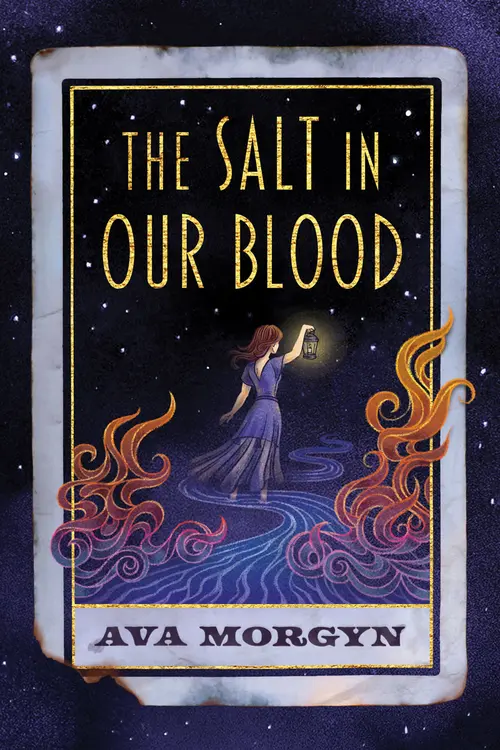
YOU CAN’T OUTRUN THE STORY THAT IS YOU.
Ten years ago, Cat’s volatile mother, Mary, left her at her grandmother’s house with nothing but a deck of tarot cards. Now seventeen, Cat is determined to make her life as different from Mary’s as possible.
When her grandmother dies, Cat is forced to move to New Orleans with her mother. There she discovers a picture of Mary holding a baby that’s not her, leading her to unravel a dark family history and challenge her belief that Mary’s mental health issues are the root of all their problems.
But as Cat explores the reasons for her mother’s breakdown, she fears she is experiencing her own. Ever since she arrived in New Orleans, she’s been haunted by strangely familiar visitors—in dreams and on the streets of the French Quarter—who know more than they should.
Unsure if she can rebuild her relationship with her mother, Cat is realizing she must confront her past, her future, and herself in the fight to try.
Albert Whitman & Co
More than 100 Years of Good Books
Printed in the United States of America
Jacket art copyright © 2021 by Albert Whitman & Company
Dedication
For my mother, Ruth, and her mother, Mary, whose own story of estrangement inspired this book, and all the women who challenged me to be a better, more compassionate version of myself.

I.
I HAVE NEVER SEEN A DEAD PERSON BEFORE.
As I stand in the doorway of my grandma Moony’s room, this thought floats across my mind. But her lifelessness is unmistakable. Something fluid has left her limbs, and they lay rigid at her sides. I can’t say exactly how I know that without touching them. I am simply aware of an unyielding quality that wasn’t there before. Her mouth is open, but her jaw is set at an odd angle. She must have been snoring again. Her lips are white, like bleached cotton. I look for the telltale signs of breathing, using my own pounding heartbeat as a measure, but there is no rise or fall of her chest beneath the sheet. Her eyes are closed as if in sleep, but even without the gruesome stare, I know she’s no longer here.
And of course, there is the fact that Moony is always up before the sun. Her alarm clock on the nightstand reads 8:30 in harsh, red, block numerals. I stare at the numbers until my eyes glaze over and my vision blurs. They remind me of something I’ve misplaced since standing here—a flash of scarlet in my dream. The dream that woke me up. A dream of skeletal men riding skeletal horses through a forgotten battlefield, their red sashes blazing under a merciless sun, their black flags waving in a hot wind. Death on parade.
I blink and rub at my eyes. I fold my arms over my chest, willing the night terrors away. I don’t like to entertain fantasies, good or bad, give them room to breathe and grow, to spread like mold across the wrinkles of my mind. Moony always said an overactive imagination is just another gateway to sin.
She is as still and blank as paper. I cannot bring myself to step into the room.
I cannot go to her.
It occurs to me that I should be sad. That I should scream or cry or express some deep and troubled emotion. After all, Moony has practically been a mother to me for the last ten years. She won’t be here now to watch me graduate from college with a “sensible” degree, or remind me that art should have a point, or ground my wilder tendencies. But all I feel is a vacancy where the sadness should be and a brutal clarity that makes everything around me look sharper and brighter than normal. Like the faded, yellow-floral curtains pulled across her picture window that seem as though they’ve been drawn on with a highlighter. Or the edge of her cotton lampshade, where every speck of lint is rising like the hairs along my arm. As though this moment when my grandmother has died is more real than any other moment in my short life. Being just this side of seventeen, I would assume that there will be more moments like this one, more violently alive moments. And yet, I don’t believe it standing here.
I think this is the first time I’ve ever really seen Moony. Really noticed her sagging breasts like paperweights rolling off her ribs and the patches of white-pink scalp that show through her short hair when she doesn’t have it combed just right. I think this is the biggest impression Moony has ever left on me—the biggest impression life will ever leave on me. But I suppose this impression doesn’t belong to life at all.
The carpet is like burlap against the soles of my feet, but the seam at her doorway won’t permit me to pass. There are things one should do in a moment like this. Words to be spoken. Authorities to be alerted. Affairs to put in order. I know nothing about Moony’s affairs, except the scattered bits she told me—social security every month, an account somewhere with money saved for my college, paper bills that come in the mail every week and get sorted into stacks on her desk in the hall. I’m not sure anyone knows more. But as I am the only one here, I realize it falls to me to take the proper steps.
My stomach rumbles beneath the oversized SeaWorld T-shirt I slept in. Is it wrong to think of food when you just found someone you love dead? There is a definite not-rightness about it. But I can’t say it’s completely wrong. I’m not sure my stomach has gotten the message that Moony has died. Clearly my heart hasn’t, so how could my stomach? Only my brain is online right now, and it’s not telling anyone else. Not yet.
I contemplate having a bowl of cereal while I figure out what to do. I should make a list. Moony was always making lists—grocery lists, to-do lists, lists of weekly sins she needed to share in confession. She was big on lists. Lists provided structure, and she was big on structure. She would like it if I made a list about her. I register a small sting of emotion at this thought, but it doesn’t sink deeper than my clavicles, like a piece of ice lodged in the throat. Uncomfortable, sure, but you can still swallow around it.
I walk to the kitchen and take the magnetic pad of paper off the fridge. I decide cereal can wait. It would look wrong if I ate first. Moony always believed someone was watching. Mostly God. And not in a kindly, mother hen sort of way. More in a devious, gotcha sort of way. God was watching Moony, and Moony was watching me. I’m not watching anyone.
I sit at the table, the vinyl seat sticking to my naked thighs, and begin. I write #1.
With any plan of action, something always comes first, but it’s not obvious to me what that would be. It’s here that I realize I’m not thinking clearly. My brain may be online, but it’s not running on all cylinders. Even my metaphors are confused. I try to imagine myself as someone else, a total stranger. What would that person do if they found their grandmother dead? My stomach rumbles again, and all I can think about is cereal, but I refuse to eat.
It takes a good seven minutes, but I finally realize the first step. I am not cut out to handle this alone. So, I think there must be only one step for me. I write, Tell someone on the magnetic pad.
I could go next door. Eric and Damien would help me. But Moony hated them. In part because they’re gay—a grave indecency at best and an unpardonable sin at worst, according to her very non-PC, pre-Vatican II-era Catholic logic—and in part because their cockapoo always shit in our front yard. She would not appreciate them seeing her this way.
Moony didn’t have any real friends. Acquaintances, maybe, like the lady at the drugstore who always put extra peppermints in the bag when she got her medications refilled. But no one close. Moony didn’t let anyone close. Except me.
I don’t have many friends of my own, and the ones I do have are useless here. I’ve tried a couple of sleepovers with Julie Perkins, and I always eat lunch with Jaq and Gracie. But I can’t imagine us discussing this over chicken tenders in the cafeteria. Besides, it’s summer.
And I am woefully short in the relative department. Only child of an only child. Absentee father. Dead grandfather. My family tree has one branch and two names. Scratch that—one name now.
The sting returns. It sits a little lower this time, like a pill working its way down my esophagus.
I don’t want to face the last remaining name on my family tree, but I can’t see that I have a choice. Frankly, Moony would probably prefer Eric and Damien. But now that the thought has registered, even a magic eraser wouldn’t scrub it out. It’s the right thing. I know that. The same way I know that eating cereal is wrong and that Moony’s arms no longer bend.
I sigh deeply, resigned.
I should know her number by heart, but I don’t.
I have to get up and go to the little writing desk in the hall. That’s where Moony keeps her address book. We got her a cell phone three years ago, and I put all her contacts in it, but she could never figure out how to look anyone up. With Moony, you learn pretty quickly not to push things. She is old-fashioned and prefers it that way. Was old-fashioned, I mean.
It won’t be under G for Gage because she changed it years ago, though I’m still listed as Catia Gage on my birth certificate. And Moony was always Edna C. Gage. But that wasn’t good enough for her.
I flip to the Rs for Rush. Which is perfect for her because she rushes into everything—sex, relationships, jobs, parenting…not parenting.
I find it quickly, since Moony seems to know very few people with R names. She knows very few people period. I pick up the phone receiver and stare at the little glowing buttons. I don’t have to do this, I think. I could not call instead. I could pack a bag and walk out the front door and not tell anyone. I could get in Moony’s car and drive to Connecticut or Portland or anywhere. I could never speak to her again. I could pretend none of this happened.
But in my heart, I know I cannot abandon Moony like that. I can’t let strangers find her. I stare at the phone. I could call someone else. Really. Anyone else. I could call the police. But even that seems wrong. She should know. I should tell her. I don’t have to do this, but I will.
I dial the number and press the phone to my ear until I hear it ringing. I am agonizingly aware that the open door to Moony’s room is just behind me and to the right. And then I become aware of other things. Or rather, other not things. The absence of the smell of coffee and chicory. The quiet where the sounds of the television—the clipped and hurried speech of newscasters—would be.
There’s a click and muffled laughter. I can picture her finger over the speaker of her phone, but to the side a bit so that it doesn’t completely drown out the sound. And then a breathless, “Hello? Edna?”
“No. It’s me.”
“Cat?”
The laughter stops and her breathing changes automatically. As though she’s holding it in, letting it out slowly through her pinched lips with control.
I am unfazed. “Yes.”
“H-hi, sweetie. This is a surprise.”
Her tone is higher now, laced with sugar. I am aware that she is trying to impress me, to sound maternal and together. I feel guilty for my unaffectedness. Doubly so now that Moony is dead, and I can only react like some kind of teenage android. “I know.”
I hear my own voice come out shaky and faint. This is not how my thoughts sound. They are solid before they leave my mouth, like they’ve been carved out of ironwood. I don’t understand what I’m hearing.
“Is everything okay?” Her tone changes again. Her voice deepens as she drops the act and flattens to a practical, no-nonsense edge.
This change softens something within me. It catches in my throat, a noise that is wholly unhuman. “No,” I manage.
“Catia, what’s wrong, baby? What’s happened?” There is a desperate ring under her words, the panic that precludes bad news when it could be anything, which is always so much worse than when it actually becomes something.
“It’s Moony. I…I think, I mean I know she’s died.”
There is silence. No breathing. No background noise. I imagine even her heart has stopped beating, the world around her frozen like the scene inside a snow globe. “I see,” she says at last, the words as short as she can make them.
The chill creeps through the receiver and wraps itself around me like a shroud. I see the flash of scarlet from my dream again, the line of sashes sagging over rib bones. Please don’t make me ask, I think. What kind of mother would make me ask?
I hold my breath.
“I’m coming,” she says after a moment. “Give me a few hours to make the drive.”
“Okay.” My body sags in relief. More so because she didn’t make me ask than because she is actually coming.
“And, Cat?”
“Yes?”
“Don’t stay there, honey. It’s bad luck to be alone with the dead.”
I hang up without responding. The only thing she and Moony shared were their superstitions.
I glance over my shoulder toward the open door to her bedroom. I imagine a draft emanating from it. My arms go prickly. I decide Eric and Damien’s is a good choice after all. I rush to the kitchen and grab the box of cereal to take with me, pulling some dirty shorts out of the hamper in the garage before starting for the front door.
I am nearly out of the house, one hand on the knob, when the latch inside me breaks. My grandmother is dead, and my mother is coming to get me. The flood of feeling that my brain was so focused on holding back rushes into every cell like blood after your leg has gone numb. The pain is incomprehensible, and the sound of my sorrow penetrates my consciousness like a thousand angry spears.
I sink to the floor, my back against the door, and pull my knees inside the SeaWorld T-shirt as I sob. I would like to believe that every tear was for Moony, for her tight laugh and clockwork schedule. For the biscuits she would make on Saturday mornings and the cans of hairspray she used to set her hair just so. For the countless nights playing Uno at the breakfast table and the smell of Murphy’s Oil Soap as it would fill the living room every Friday morning after mass—the very same they used in the parish hall. But I know it was hearing my mother’s voice that weakened the hinges of my resolve, and even if this teary-eyed unwinding is considered a “normal” reaction to grief, I hate the feeling of my control puddling on the floor with my emotions—and I hate her all the more for being the one to release it.
II.
SMALL TOWNS ARE ALL THE SAME. BY THE TIME I’VE made it to the last bite of cereal in the bowl, Eric has already managed to set off a cascade of texts and phone calls that mean nearly two-thirds of our town knows that Moony is lying stiff and untouched in her bedroom next door.
I settle into one corner of the couch and pretend to watch some high school drama, but Deena whines at me continuously, and I can’t make my brain stick to anything for more than a few seconds. It took me a good half hour to peel myself from the polished wood floor in our entry and make my way across the lawn. I haven’t cried again, but the purge of emotion has left me feeling hollowed out, like one of those gourd birdhouses they sell at the Charity Guild craft fair.
And my heart beats like the second hand of Moony’s vintage watch. Tick…tick…tick…
Counting down the moments until my mother arrives.
It is the wolf I notice first.
I am standing at Moony’s bedroom door; it opens onto a field of yellow flowers like her curtains. The sun is setting and the sea of blooms pales to a diaphanous white. In the distance, the dying flowers begin to dance with a wind I can’t feel. I watch as they finally part like the pages of a book falling away from each other. The wolf emerges, bristly and arctic, yellow eyes gleaming as it leaps through the meadow toward a barrier of trees.
I follow, reaching the trees moments after the wolf, and squeeze between them. That’s when I see the boy. He stands under a low-hanging limb wearing a yellow waistcoat. He is taller than the wolf, but not by much. His face is odd, with eyes too large and cheeks too sharp and a chin that tapers to a point. A pack slung over one shoulder drips a menacing red at his heels. He grins, as if he has been waiting for me. He spins and takes off, the wolf sprinting beside him.
I press on, catching only flashes of golden waistcoat or moonbeam fur in the gloom ahead. Even though I run at full tilt, I can barely manage to keep their trail until I break into a clearing and see the boy standing, bright against a blackening sky. I open my mouth to call out, but he turns, his eyes dancing with mischief. I feel the hot tickle of deceit snaking through my bones. The wolf releases a low, mournful howl. The boy’s lips curl with the same wicked grin he wore earlier. And then he flings his body forward.
I watch, dumbfounded, as the wolf leaps wildly behind him and they both disappear.
I take off through the deep grass after them, skidding to a stop at its edge just before the earth drops out beneath my feet, my toes curling over the cliff’s face. Staring into a void of swiftly ascending night, it’s as if the world has been turned upside down, and the sky is beneath me instead of above. Laughter bubbles up through a tangle of clouds parting below. I hear the panting of a large animal behind me. I turn to see the boy with the yellow waistcoat standing there, his wolf sitting on dazzlingly white haunches beside him. His grin twists into something maniacal, and his arms spring out, propelling me over the edge into the yawning night.
I am out of time. I am out of earth. Everything washes black.
I open my eyes to find Deena licking my hand as though it were coated with honey. My mother is just inside the doorway speaking with Eric. I recognize the part of her hair first—a little to the right and fringed with coppery flyaways at her temples. I wonder what I will remember about Moony when ten years have come and gone. There are the obvious things, like the color of someone’s eyes or how tall they are. But the real nuggets are the weird, little things you don’t even realize you’re noticing, like someone’s crooked incisor or the pattern of freckles on the back of their hand. With my mother, it has always been the part of her hair, the way it flops to the left in a heavy wave of auburn that used to smell like passionfruit from her shampoo. That, and the deep, throaty laugh she would give when something really tickled her—a gift courtesy of her decades-long cigarette habit.
I decide then to remember the soft pads of Moony’s fingers, which were always wrinkled as though she had spent too much time in the tub. I couldn’t choose what would stay when my mom left me at seven years old, but I can choose now. I will remember Moony’s fingers. And I will remember the wicked names she called Deena the cockapoo under her breath when she’d catch her squatting in the yard. And her lists. And the scent of Murphy’s Oil Soap, like old wood and orange peels.
I sit up, and my mother shifts her hazel eyes from Eric to me. “You’re awake,” she announces. She gives me a smile, but the skin puckers between her eyes.
“You’re observant.”
Eric calls Deena to him, tucking her up under one armpit like a clutch purse. My mother always liked Eric and Damien. They are her kind of people, colorful and unique. She would “pop over” to “catch up” with them after her visits with me. These are things my mother does; she pops and catches, as though life is one big series of dance moves. Moony would never pop. Moony would never dance.
“I should probably let you two chat,” Eric puts in. “I’ll make some coffee.”
“Don’t trouble yourself, Eric. We’re going to get out of your hair,” my mother tells him.
“Are you sure?” He makes a questioning glance in the direction of Moony’s house—our house. There are a lot of funny beliefs and superstitions floating around this state, especially where the dead are concerned.
“They’ve already taken her,” my mother reassures him. “And I stripped the bed. We only need to pack Catia’s things, and then we can hit the road. We should make New Orleans by nightfall.”
“Yeah, sure,” he chirps, happy to have his role in our family saga—however helpful—draw to a close.
The Story Continues on BooksBarbecue!
Enjoyed this preview? ❤️ Do not stop here!
Read the complete book free online → 🔗
Continue reading now on BooksBarbecue and discover every page!
Love reading? Bookmark BooksBarbecue.com for more amazing books!
Happy Reading!