The Rose Labyrinth
Cover
THE ROSE LABYRINTH
Titlepage
Copyright page

A Division of Simon & Schuster, Inc.
1230 Avenue of the Americas
New York, NY 10020
This book is a work of fiction. Names, characters, places, and incidents either are products of the author’s imagination or are used fictitiously. Any resemblance to actual events or locales or persons, living or dead, is entirely coincidental.
Copyright © 2008 by Titania Hardie
Design, illustrations, and layout © 2008 by Quadrille Publishing Ltd.
Originally published in Great Britain in 2008 by Headline Review Published by arrangement with Quadrille UK
All rights reserved, including the right to reproduce this book or portions thereof in any form whatsoever. For information address Atria Books Subsidiary Rights Department, 1230 Avenue of the Americas, New York, NY 10020
ATRIA BOOKS and colophon are trademarks of Simon & Schuster, Inc.
Lines from “He wishes for the Cloths of Heaven” reprinted with the permission of Scribner, an imprint of Simon & Schuster Adult Publishing Group, from The Collected Works of W. B. Yeats, Volume I: The Poems, Revised, edited by Richard J. Finneran. New York: Scribner, 1997. All rights reserved.
Library of Congress Cataloging-in-Publication Data
Hardie, Titania.
The rose labyrinth / by Titania Hardie.
p. cm.
1. Dee, John, 1527–1608—Fiction. 2. Family secrets—Fiction. 3. Code and cipher stories. I. Title.
PR6108.A723R67 2008
823'.92—dc22 2008023406
ISBN-13: 978-1-4165-8603-6
ISBN-10: 1-4165-8603-2
Dedication
For my husband, Gavrik Losey,
who is my peace whenever the Tempest blows.
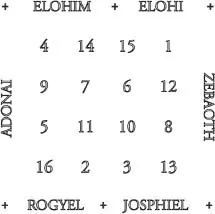
CHALLENGE: The parchments tucked under the flap are a key part of the quest in The Rose Labyrinth. The central characters will not uncover them for many chapters; you have the advantage. Can you decipher part or all of them, and discover where the quest will lead? Do so and you’ll also reveal deeper secrets, not fully explained within the narrative.
There is a carefully worded message hidden across the pages: can you find it, even though the characters never do?
The illustrations on the backs of the cards form a puzzle. Assemble the images in the right order, and a visual clue will emerge from the labyrinth. Spot it, and you may claim a permanent place at the heart of The Rose Labyrinth.
In great contests, each party claims to act in accordance with the will of God. Both may be, and one must be, wrong. God cannot be for and against the same thing, at the same time.
—Abraham Lincoln
“Vexilla Regis prodeunt inferni
verso di noi; pero dinanza mira,”
disse ’l maestro mio “se tu ’l discerni.”
PROLOGUE
ST. GEORGE’S DAY, APRIL 1600,
AT AN INN ON THE ROAD TO LONDON
A SNOW-BEARDED, ELDERLY MAN IS SEATED AT THE HEAD OF A REFECTORY table, close to a fire, with his head bowed. He grasps a dark, shiny object in the slender fingers of his right hand. Blooms of Rosa Mundi—white petals streaked pink-red—carpet the table in front of him. Thus, all those who are seated at the trestle know that what will unfold here is secret, a marriage of the spirit and the soul of everyone present, and the birth of something unique, which they await: the Philosopher’s Child. Against the bubbling din of other inn patrons behind closed doors in adjacent rooms, they are hushed, waiting for his words. A door softly opens and closes, then a sudden shuffle of feet around him intrudes into the silence. A note from a servant, who has entered largely unobserved, is put into his fine hands. This he reads slowly; his high forehead—surprisingly smooth for a man of his years—creases into a dark frown. After a long moment, he looks at every face in turn, gathered around the long table. Finally he speaks, his voice hardly more than a vesper.
“Some little time ago, in the month of lights, Signor Bruno was burned at the stake in the Campo de’ Fiori. He had been given forty days to recant his heresies: that the earth was not the center of this world, that there were many such suns and planets beyond our own, and that the Savior’s divinity was not a literal truth. Monks offered him a crucifix to kiss in repentance of his errors, but he turned his head from them. As a demonstration of mercy, the clerical authorities placed a necklace of gunpowder around his head before they set the fire—to hasten his end. They also nailed his tongue fast to his jaw to stop him from talking.” He raises his eyes to each of his dinner companions, and takes some moments to speak again.
“For some of us, then, the thread now begins to unravel, and another journey starts here.” His eyes now rest on one man, sitting hunched over a tankard just to the left of the head of the table at the opposite end. His neighbor is nudging him, whispering to him, alerting him to the gaze of the speaker, which has settled on him alone. Both men stare, quite locked together, until the younger allows a half-smile to soften his features, prompting further quiet words from the senior man.
“Is there a way,” he asks, in a stronger cadence now, “to use all the fierce endeavors of our wit, to keep his thoughts of love, and universal harmony, as fresh as dew? May it ever be that Love’s Lost Labors can be Won?”
1
A BLACKBIRD’S SONG BROKE INTO HIS UNEASY DREAMS, BUT THE SHUTTERS on the cottage windows were still tightly closed.
Will had arrived late, the faded September twilight long gone, but the moon had been bright enough to find the secreted house key among the geraniums. He woke now in panic in the darkness, strangely disorientated, though a tiny shaft of light was trying to force its way in. Without his noticing, morning had come.
He leaped from the bed in a rush, and worried at the window catches. The wood had swollen in the rainy weather, and the shutters stuck for a moment before his fingers understood them. Then instantly he was bathed in intense light. It was a perfect early autumn morning, the lowlying mist already pierced with sunshine. The myrrh scent of roses came in with the light and the moist air, blending with the distinct note of French lavender from a hedge somewhere below. Such bittersweet memories stole in with the smell, but at least they restored some sense of calm and drove the haunting faces that had crowded his dreams from his mind.
He had forgotten about the immersion heater last night, but he was desperate to shower off the dust from yesterday’s long ride from Lucca. He found the cool water refreshing, sorry only to lose the heat that might have eased the stiffness in his body. His Ducati 998 was definitely not a touring bike: it was like a tetchy supermodel. Breathtakingly quick, absurdly demanding, yet exhilarating to ride, it suited Will’s humor and eccentricity to perfection; but over long stretches without a break it was uncomfortable, if he were honest. His knees had been cramping a little in the leathers late yesterday, but he shrugged that off. You had no business riding such a bike if you were fainthearted.
His face in the mirror confirmed his mother’s view of him as “an angel a little fallen”; he resembled an extra in a Zeffirelli film, he thought, his jawline outlined with dark stubble. He laughed with shock, recognizing that at this moment the look would unsettle even her. There was something manic in the face laughing back at him, and he knew he hadn’t kept the demons of his journey from getting a little too close to his soul.
He pared—rather than shaved—away the growth of several days, and wiping soap from the razor he suddenly noticed a slightly faded rose which had dried perfectly in an old ink bottle by the sink. Perhaps his brother, Alex, had brought someone there in the last couple of weeks? He had been so immersed in his own thoughts lately, he hardly knew anyone else’s movements. He smiled, intrigued at the idea.
“I’ll call him early this evening,” he said aloud, surprised at the unfamiliar sound of his own voice, “once I get to Caen.” The ferry wasn’t leaving until nearly midnight; but right now, he had things he wanted to do.
In the serene morning light of the kitchen he started to relax for the first time in weeks, losing the disturbed, fugitive feeling he’d found shadowing him recently. The smell of apples in the orchard spilled through the open door—bringing the comfort of the thirty-one autumns he’d enjoyed before this one. He’d run from everything and everyone, but it felt good that he was coming home. He rinsed the bloodred wine stain from the glass left from last night and threw what was left of the French loaf into the oven to encourage it for a few minutes. He decided to check the bike, as he barely remembered how he’d parked it: all that had kept him going during those last grinding miles at speed from Lyon was the thought of refuge, breaking into the pungent Meaux brie he’d packed in his rucksack, with a baguette, a glass of his father’s St.-Emilion, and bed.
Outside, everything was disarmingly peaceful. There was a late flush of wisteria scrambling over the front of the cottage. Apart from superficial signs of neglect betrayed by an uncut lawn and unswept path, the house didn’t reveal the family pain that had shaped its solitude for many months. Following the sudden and terrible loss of Will’s mother from cancer late in January, no one had appeared to want to visit it. Easily accessible on any three-day weekend from their home in Hampshire, this had been her space, her escape, her joy to paint and garden in; and her ghost haunted every corner even now, in broad morning light. His father was grieving quietly and saying little, working as hard as ever to avoid thinking too much; and Alex seemed somehow to cope with all events without letting others in on the depth of his feelings. But Will was proudly his mother’s son, emotional in his response to life and passionate in his relationships. And here, in her enchanted space, he missed her.
His eyes swept the short pebbled lane from the road to the door, but nothing exceptional caught his attention. The emptiness was almost an anticlimax—but a welcome one. It seemed that no one knew, or cared, where he was—at least for now. Unconsciously his fingers toyed with the small silver object suspended from a short chain around his neck, suddenly closing on it possessively. Then he headed toward his mother’s rose garden. She had spent more than twenty years gathering a collection of old blooms, in homage to the great rose growers, that would have looked perfectly at home in Malmaison. She had painted them, embroidered them, cooked with them; but if they noticed she was gone, they whispered it to no one. Set into the fountain among the beds was a bright mosaic tiled with broken china, which she had made herself when he was small. It was a spiral with a motif of Venus, patroness of roses, in the heart of it. It exerted a magnetic pull on him.
Vaguely noting that the sunshine-yellow bike was grimy with the miles, but perfectly safe in the shade by the house, Will retraced his footsteps. The smell of good coffee brought him back to the present as he went into the kitchen. He ran his hands through his untidy curls. His hair was clean and already dry from the warm air, but badly in need of a cut. He’d better do that before Alex’s birthday lunch on Sunday: things were frosty enough between his father and him already, without his looking quite so vagrant. His fairer brother, with straighter hair, was always neat and untangled, but after more than a month in Rome Will had started to resemble a local. And that suited him; he preferred to blend in wherever he could.
There was no butter, but the warm bread was good smeared with jam from his mother’s last batch in the pantry. He was licking his thumb when a postcard on the dresser took his eye: unmistakably her handwriting. “For Will and Siân,” it began. He reached for it. When could she have written this?
For Will and Siân. Try to rest for a few days. There’s some venison in the chest freezer—can you make use of it? Be sure to check the knot garden for me. See you at home over Christmas—D x
Last November, it must have been. He and Siân had spent most of that year quarreling, finally splitting up late in the spring, but strife had dogged them at least since his birthday in August last year when her unceasing demands for commitment had convinced him that it would be better to abandon the idea of a week in the house in Normandy together. Siân had no other friends there at the time, and without much French she was thrown back entirely on him, which he doubted their relationship could take at that moment. So they had never come and collected the note, walked in his mother’s healing garden, nor eaten a last supper in the Pays d’Auge.
He smiled now to think of her: three months on the road had softened his anger. She was so strikingly unusual—not to everyone’s taste, but thus, somehow, doubly so to his, and he suddenly felt an unanticipated longing for her physically, as though aware for the first time of the blank space beside him and in his heart. But setting passion aside—the passion that had been the nucleus of their relationship—he knew he had been right to end it. Their love was springtime, and the skies had changed. He was not forgiving and pragmatic like Alex, nor always a finisher of what he started, and he could never be the husband she wanted—the achiever, the man to shop with on Sundays at the Conran Shop, the lover who would sell his Ducati and buy a Volvo. Having declared a passion for his wildness, she had sought from the beginning to tame him. He was happy to cook for her, make her laugh, sing to her, and make love to her as no one ever had; but he knew he could never dissolve his personality to silence the strong political opinions he held, which always led to violent arguments with her mindless girlfriends and their docile partners. Ultimately he couldn’t inhabit her safe—and in his view, bland—world. He was committed to experience life, whatever the cost.
He flipped the card over. It was the Great Rose Window at Chartres. His mother had painted it often, from inside, from out. She loved the light through the glass—the way it almost stung your eyes with its brilliance, penetrating the gloom.
He toyed with his cell phone for a moment. It was now charged and, without taking his eyes from the image on the card, he texted his brother.
Have at last invaded Normandy! U’ve been here l8tly? Sailing from Caen 23:15 tonight. Will call you B4. Much to ask U. W
In one smooth motion he slid into his leather jacket, pocketed the phone, and secreted the postcard against his chest, right next to the treasured document that had sent him spinning into Italy for the summer on a frantic research quest. He had started assembling some of the answers he’d come looking for, but a continuum of questions seemed to be opening up even now around him, and a sense of mystery deepened. He stepped into dusty boots and swiftly closed the house, depositing the key in its hiding place. He didn’t even chamois down the bike, just pulled on his helmet, took his gloves from the tank bag, and swung into the saddle. He’d need fuel for the forty or so miles to Chartres.
2
SEPTEMBER 19, 2003, CHELSEA, LONDON
LUCY BLINKED IN THE STARK EQUINOX SUNSHINE, WHICH WAS FILTERING through heavy leaves. She was sitting under a mulberry tree of impeccable lineage at the Chelsea Physic Garden, pleased just to be there. The tree was fruiting, and a heavy scent permeated the air. She’d felt better this morning, and her doctors had cautiously agreed she could go for “a gentle walk,” to pass some of the time that they understood seemed so strangely suspended for her, as long as she rested often. She had walked a little too far really; but she wouldn’t tell them that, and anyway, it was so good to get away from the confines of the building, where your feelings and emotions were common property, and just have some private time alone with her thoughts. These days were a miracle, and she planned to be out in them as much as possible.
Patiently awaiting a heart operation too serious and potentially dangerous to think deeply on, and ready for transfer to Harefield at the first sign that it might be possible, she felt today newly alive, thrilled by the beauty of autumn. Keats was right: autumn was the season England did best. She was lulled by the moan of bees and lawn mowers and by a child somewhere, and especially the absence of traffic noise.
And she was contemplative and surprisingly hopeful on this bright September morning, reading from a well-thumbed volume of John Donne’s poems: “A Valediction: Forbidding Mourning.”
As virtuous men pass mildly away
And whisper to their souls, to goe,
While some of their sad friends doe say,
The breath goes now, and some say, no:
So let us melt, and make no noise…
MARCH 28, 1609, ON A BEND IN THE RIVER, CLOSE TO LONDON
AN OLD MAN IS DYING IN A FINE, RAMBLING HOUSE ON THE THAMES. HE has followed Signor Bruno’s fate carefully. He is a friend—a fellow philosopher and scholar, a man of learning and wisdom. He may be the only other soul alive who is privy to the same extraordinary secrets as Bruno. Elizabeth, the great Queen, had been like his goddaughter and held him in trust for many years, called him her “eyes”—though she too has not very long since gone to her grave. Her successor is the dour Scottish king who is fanatical about ghosts and demons, afraid of anyone who can by any means challenge his authority. The old man has laid low at this, formerly his mother’s house, for several years now.
It is an unusually foggy night just after the March equinox. Lanterns bounce back off the mists as a boat pulls steadily up the river from Chelsea to Mortlake on the rising tide. A shrouded figure stumbles onto the pier in the half-light and makes its way to the door. Ushered in by an upright little woman of uncertain years, the young man flies to the privy chamber of his old master. Candles flicker and almost die from the haste at which he enters.
“Ah, Master Saunders.” His words are spoken softly. “I knew you would come to me, though I was hesitant to demand this task of you. Alas, no one else can be trusted.”
“Your Grace, I am sorry to see you this way. Are you wanting me to help prepare you for this last long journey the angels have spoken of to you?”
The old man manages a grim, ironic laugh. “Journey? Aye, I have lived long enough: I should in truth be on my way. Listen carefully to me, Patrick. I am certainly dying, and time is measured. I cannot answer the questions I know you will wish to ask, but I myself ask that you listen.”
The words come between increasingly short gasps, which only partly reveal the effort they must cost the old man now to speak out.
Slowly he continues: “Next to the three caskets you see here beside me, there is a letter penned by my own hand, which will make clear anything you don’t at present understand. At any moment we will receive three visitors who will perform an operation at my request. Please, do not fear for me, but wait while they are here. When all is ended, they will give you these three chests. Follow my instructions to the letter. Do not deviate, I implore you. It is my last wish, and such a thing is beyond the scope of my dear daughter, Kate. You know it is a lifetime’s thoughts that go with that wish.”
The Story Continues on BooksBarbecue!
Enjoyed this preview? ❤️ Do not stop here!
Read the complete book free online → 🔗
Continue reading now on BooksBarbecue and discover every page!
Love reading? Bookmark BooksBarbecue.com for more amazing books!
Happy Reading!