The Revelations
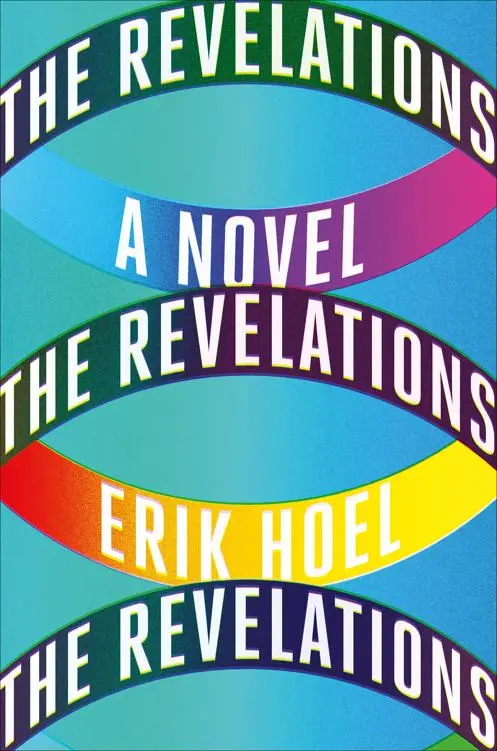
Cover
“Let us now return to our main problem. This is to locate the ‘awareness’ neurons and to discover what it is that makes their firing symbolize what we see. This is like trying to solve a murder mystery. We know something about the victim (the nature of awareness) and we know various miscellaneous facts that may be related to the crime.”
—Francis Crick, The Astonishing Hypothesis
“Silly fish learn nothing in a thousand years.”
—James Joyce, Ulysses
MONDAY
Kierk wakes up in the back seat of his car, brought into being by a knocking on the window so loud and forceful the whole car shakes. Silhouetted by the dawn light coming through the back seat window the knocker is opaque and strangely shaped. Kierk’s movement in the sleeping bag stirs books aside as he struggles to extricate himself, then, expecting another policeman come to hassle him about sleeping in his parked car, he unlocks the door. Quickly it swings open and then more than one set of arms pull him out, his shirt riding up, his form dragged and his palms skinned against the pavement until he’s up, standing, pushing away, and then everyone retreats for a moment to look at one another and consider the scene. Beyond there is the expanse of a high school parking lot made wide and empty by morning. There are three of them. One has a nose ring, the other a shaved head, and the third is heavyset and shaggy. All are acned, teenagers or recent high school graduates. The shaggy one is lounging against the car and smoking a cigarette. The shaved head is now digging through Kierk’s back seat, tumbling books out, angrily kicking aside the sleeping bag with a boot. He hands a plastic bag from the back seat to the one with the nose ring and he empties it, pages spilling.
“Your phone. Give us your phone.”
“Cash, man. Where’s your cash?”
Kierk fingers the small wad of cash inside his pocket. This money is supposed to be for gas, coffee, some trail mix to munch on, and, most importantly, a new notebook. Today Kierk had planned on using those supplies to—not for the first time—give his writing one last try. He’s supposed to be out here in California devoting himself solely to his work, living on what little he had stashed away. Back as a graduate student in the wintery folds of Madison, Wisconsin, when he had found time to write in the stolen midnight hours after leaving the lab, there had been a rich river of prose waiting for him. Fiction, poetry, nonfiction, everything. But with the hours of the day now empty, that torrential river had instead become a stream, then a creek, then dried up altogether, running itself out in ink. His previous attempts, all that writing, all those words failing to take hold, are now being scattered on the ground . . .
Nose ring holds out his hand and Kierk sighs, warily giving over the money, which is snatched away immediately and handed over to the shaggy smoker.
“So who are you, anyways? We’ve seen you out here before, you know.”
“Can I have a cigarette?” Kierk asks, scratching at his beard, watching his pages stir in the wind. “And I don’t have a phone, so that’s it.”
Ignoring him, nose ring holds up a book with a brain on the cover titled The Neural Correlates of Consciousness: Vol 2.
“Who the fuck doesn’t have a cell phone? You’re some kind of college student, right?”
“I left graduate school ABD . . . all but dissertation. Like T. S. Eliot.”
“So you dropped out. Or got kicked out?” When Kierk only shifts mutely, nose ring gestures to the books. “What’s all this stuff about, anyway, brain surgery?”
“Neuroscience. In fact, I ah, coauthored a paper with the writer of that very book.”
“No shit, a genuine scientist. I haven’t met a homeless scientist before.”
“Give us your fucking phone man.”
Kierk looks at each of them in turn, then says sadly—“You’re all just kids who don’t know what you’re doing.”
The closest, nose ring, first scoffs at him, then pretends to turn to the others before whipping back around and punching Kierk squarely in the jaw. Everything speeds up and they are all around Kierk, who’s curled up in a ball, both arms covering his head as they kick him. After a dull pause, after the parking lot has emptied itself of all motion and the kid with the shaved head has gone back to digging around in the car, Kierk realizes that he isn’t actually seriously injured. Next his feet are digging underneath him searching for traction and he takes off running to shouts and for a while there is only the sound of eight pounding pairs of sneakers over pavement and then grass and then pavement again and then Kierk hops a curb and has gotten his speed and the kids fall behind halfheartedly. Kierk crashes through the crowns of thickets and brambles and scrambles up the jungle of a chain-link fence and then circles around to the other side of the parking lot to watch the kid with a shaved head put a rock through his windshield like a punk. After some fiddling around the kid pulls out the intestines of the car radio and carries it under his arm out of the lot, the other two following. Kierk is pretty sure they destroyed the radio in the process of extracting it.
He sits down in the tall beach grass and watches from afar as the morning fills up with sky and the car hemorrhages his meager belongings into the windy lot. In the dry scrubs Kierk takes stock of his wounds. He notices with interest that when there’s a lot of blood in your mouth it doesn’t hurt, but rather it’s like your mouth is overflowing with water, your tongue moving about in a pool. He thinks—my cup runneth over. Something keeps leaking into his vision, and he wipes at the arch of his eyebrow, which a stray sneaker had cut a significant gash into. His lungs are still ragged from the mad sprint and as some sort of aftereffect of the violence his mind is so crystalline bright it aches.
After about half an hour Kierk stalks his way back to his car, spinning when he hears a noise to see the three of them just a couple hundred feet away, running toward him now, and Kierk sprints the rest of the way, starts his car, and in his haste throws it in drive instead of reverse and goes straight into the lamppost in front of him, the hood giving a small cave and Kierk bouncing forward in his seat. Then Kierk reverses and burns out of the lot.
After a couple miles, smoke starts billowing up in gulping gouts from the hood, each plume swallowing the last, and Kierk pulls over to the side of the road and starts yelling—“FUCK FUCK FUCK you little shits you’re going to die in a gutter little goddamn FUCK YOU and fuck ME stupid stupid fuck me what the FUCK am I doing here”—and beats violently his steering wheel and then in a frantic search finds an old bottled water under a seat and pours it over his head to calm down and wash the blood from the cut over his eye, leaving a damp spot on his jeans. By the side of the road he uses a dirty T-shirt to beat at the smoking parts under the hood until they subside. Panting and praying it hadn’t been lost, he digs around the back seat for a letter that had arrived in his PO box last week. Finding it smudged and folded he lets out a small half sob, double-checking that it contains the number to call.
Dear Kierk Suren,
We are extremely pleased to accept you to the Francis Crick Scholarship program at New York University . . .
With the letter folded in his back pocket he quickly stuffs what little is worth salvaging from the back seat into an old backpack of his, from journals to unwashed clothing to loose change to books with their bindings long broken. Leaving the rest behind, he starts hitching. No one picks him up. Cars blow past, children pressing their faces against the glass.
The arrival of the letter from the director of the program had been a shock given how tenuous his connection to the world was. Kierk has been living in his car for almost six months. Car insurance, his next meal, and a place to park overnight have been the daily concerns. Every week he’s driven to the San Diego Public Library to grab a new pile of books and use the computers and revisit the bank to extract cash from his minimal savings, less and less each time, approaching the limit of being flat broke. The sunsets here have been like falling bundles of white wood, and standing amid the birch forests of light he had thought he might never return to civilization, that his brief life was over at twenty-seven. It’s been months of dry California nights sleeping in his car somewhere on the coastline with his legs hanging out the window, his toes feeling out the slow seas of air. In all this Kierk has known that he was slowly receding from the world, that his depression was rising like an internal tide. He had sifted through the dog-eared copies of his favorite novels until they did nothing for him. In the halving and letting sunsets he would patrol the beach to write on the windy, scattering bugs of pages. Of the several books he had started writing (a monograph on measuring consciousness using information theory, a poetry collection, and an autobiographical bildungsroman), all had failed to take form, and he had been left in a cyclical pattern of self-reference, delving deeper and deeper into his own paths and roads and words.
Only a few reminders from his old academic life remain. Occasionally he would drive up to Caltech to hang out with a PhD student and have long arguments about twentieth-century philosophy, always returning in the end to the same question: who was the greater philosopher, Russell or Wittgenstein? The master or the student? But mostly he’s spent a lot of time at a cafe on the outskirts of San Diego, until the older woman owner had started bringing him Tupperware filled with food, then inviting him over to her house if he needed a place to stay. It took a few visits to realize he was just one of a group of street people she let sleep in the basement. Kierk saw them as shaggy and smelly shamblemen nodding blearily, or drowsing like a dusking heap on the couch, making their awkward conversation and pauses, their tics. He knew that even if he wasn’t there yet he would be soon. No one would have guessed that less than a year ago he had stood in a beautiful mansion, clean-shaven, wearing a blazer and with a glass of Chardonnay in hand, participating in toast after toast with famous scientists, each toast getting more and more extravagant—“To science!”—“To the next generation!”—“To the beautiful mystery of consciousness!”
Eventually his dusty and sweating form reels into the parking lot of a CVS. Inside Kierk grabs a bottle of hydrogen peroxide off the shelf which he uses to douse his bleeding forehead and then stands bent over swearing in the aisle when some of it gets in his eye. A young clerk is paused a bit away, one hand out, eyebrows raised.
“Wait, you’re gonna need to buy that first.” Then he sees the blood. “Whoa, are you okay, man?”
Kierk, standing in the aisle, stinking of smoke, blinded, holding his hands to his face while the hydrogen peroxide leaks between his fingers and makes small fizzling bubbles on the white tile, smiles, and responds—“As well as Saint Paul on the road to Damascus.”
“What?”
“Do you know the Caravaggio? The second one of course. He didn’t really get cooking until the second one. Next time you’re in Rome, please, treat yourself and go see it. Paul’s revelation is reified in the viewer. It’s in the basilica off the Piazza del Popolo. Ack! This stings.”
“Listen, if you don’t leave I’m going to have to call the cops.”
“I’m, um, being forced to reconsider my life choices here, so of course you will. But before you do: where is the nearest payphone?”
The clerk, after directing him to a payphone down the street, watches mutely as Kierk leaves clutching the brown bottle and a package of bandages without paying. Kierk walks up the street listening to the babbles and fizzes above his eye, trying to wipe away some of the blood on his cheek and spitting black globules on the sidewalk.
He had called the number on the letter last week, unsure if it was a lifeline or a temptation back into a world that had almost destroyed him. A professional voice had introduced itself as the director of a new scholarship program that was being assembled at New York University, the first of its kind. Eight positions in a research program on the neuroscientific basis of consciousness. Kierk had applied for the so-called Francis Crick Scholarship over a year ago for a potential postdoctoral position, before he knew he’d be abandoning his PhD, his research career, everything. But apparently the obscure workings of the government funders had kept the schedule and viability of the program in doubt until the last minute, and everyone was now rushing to put the program together. The director had said that Kierk was one of their top choices, even despite having never technically finished his PhD, and had offered Kierk a seventy-thousand-dollar stipend, dropped the names of the famous researchers who would be leading the program, and told Kierk that this, right here, was the opportunity of a lifetime. And most importantly, it was a chance to pursue consciousness again. Kierk had said no. Last time the pursuit had all but broken him, and the only solution had been to cut himself off from it completely.
Now, standing on that stretch of road outside of San Diego, his car with its crumpled hood a few miles away, everything worth anything in this ragged backpack, his clothes spotted with blood, listening to the operator’s voice, hating himself for his stubbornness and pride, Kierk is praying that same voice will pick up and be his deliverance. When it does, he can barely croak his hello. But soon he’s yelling into the receiver as cars whizz by. “I said: you told me last week you didn’t have a replacement, right?”
“Oh, well, yes, that’s right. We’re working on—”
“I accept.”
“What?”
“I accept the position. I officially accept. I’m coming to New York. There’s an apartment, right, you said so last week?”
“The program starts in two days!”
Kierk says that he’ll be there and hangs up before there can be any argument and he’s left alone with just his ears buzzing and the fizzing of his eye. Eventually, after wrapping his head with comically misshapen and bloody bandages, he’s able to call a local garage and offer to sell them his broken-down car for a few hundred bucks if they tow it. The rest of the day is a blur of activity and logistics. Later in the San Diego Public Library frantic emails between him and the scholarship program make everything official and get an emergency stipend transferred into his account. The only overnight flight with an available seat to the East Coast is to Boston, and that plane, that deep rumble when it finally reaches liftoff, is to Kierk like the sound of an angelic steed breaking atmosphere.
TUESDAY
Kierk wakes up from the first sleep he’s been able to catch in the odyssey of cross-continental travel. Roused by the shudder of the bus over a pothole, shaken from his sleeping slouch against the window, Kierk’s eyes blink open and the scene outside resolves into perception. Beyond the smudged glass is a busy sidewalk where people are fanning themselves with magazines, waiting for the walk signal, shielding their eyes as they exit the glare of glass doors, moving quickly carrying suitcases and purses and airs of motion. Dogs explore on leashes like searching filopodia as baseball caps are adjusted under lances of sun. There are vendors with coolers full of bottled water. People emerge from and disappear into the stark shadows the buildings cast like great sundials. The bus trundles along Manhattan’s capillary-like streets, heading for the city’s heart.
Kierk wipes at his mouth, sitting up straight. The woman next to him goes back to reading her magazine after eyeing the young man with the wild scraggly beard who had just woken from fitful, small-noised dreams. In his startled waking his arm had hit her thigh. There is another lurch and Kierk drops the notebook which had sat cupped in his lap, forcing him to grope around the rooted feet, the dark underbellies of smells. There is the tang of talcum powder and McDonald’s from the seat behind him. Flipping to the folded page of his notebook, Kierk exhales slowly and blearily crosses out a sentence, pauses, and then expunges an entire diagram he had drawn right before he had drifted off from the buzzing of the bus engines. The pages in the notebook are overflowing with his distinctive byzantine scrawl, along with spidery drawings of neural networks, vector fields, probability spaces, attractor dynamics, but also unfinished portraits, the delicate treelike branching of dendrites under a microscope, while all throughout, between the drawings and equations and along the margins, words run in thick torrents. All the content is from months ago. Nothing is recent.
On entering a tunnel and facing his reflection in the window, Kierk realizes he cannot remember the last time he shaved—has it been three months, four? He reaches down in the darkness and fiddles with the zipper of his bulging backpack, then forces the notebook between a tangle of boxers, socks, books, and crumpled paper. Everything he owns is either in this backpack or a member of the flock of books en route to New York in heavy cardboard boxes that he had packed early yesterday evening back on the cold concrete floor of the storage unit he had been renting in San Diego.
The bus shakes and something, some arrangement of perception—the familiar angles of looking out a window beyond the frame of a seat—had unlocked something inside him, a shuddering click that is felt as déjà vu. What about? His earlier dream? No. A memory. Another bus ride in New England, also in the summer heat, and then he is suddenly on the way to see the body, the corpse left when the grandmother on his father’s side had died. He had been eleven and Kierk’s mother, all hands bundled up in urgency, had rushed about stern-faced trying not to let Kierk see exactly how much of an inconvenience this all was. Then the two clamored, all in silent black and under the eyes of the other riders, into another hot and sticky seat, and then the shaking and grinding bus headed northward to Maine.
The Story Continues on BooksBarbecue!
Enjoyed this preview? ❤️ Do not stop here!
Read the complete book free online → 🔗
Continue reading now on BooksBarbecue and discover every page!
Love reading? Bookmark BooksBarbecue.com for more amazing books!
Happy Reading!