The Record Keeper
Cover

By Agnes Gomillion and Available From Titan Books
BY AGNES GOMILLION AND AVAILABLE FROM TITAN BOOKS
The Record Keeper
The Seed of Cain (June 2020)
Title Page
TITAN BOOKS
Copyright
The Record Keeper
Print edition ISBN: 9781789091151
E-book edition ISBN: 9781789091168
Published by Titan Books
A division of Titan Publishing Group Ltd
144 Southwark Street, London SE1 0UP
First edition: June 2019
10 9 8 7 6 5 4 3 2 1
This is a work of fiction. Names, places and incidents are either products of the author’s imagination or used fictitiously. Any resemblance to actual persons, living or dead (except for satirical purposes), is entirely coincidental.
© 2019 Agnes Gomillion
No part of this publication may be reproduced, stored in a retrieval system, or transmitted, in any form or by any means without the prior written permission of the publisher, nor be otherwise circulated in any form of binding or cover other than that in which it is published and without a similar condition being imposed on the subsequent purchaser.
A CIP catalogue record for this title is available from the British Library.
Dedication
To Herron always, and Lana. More, to the birds and the Byrds, especially Bill and Connie.
RECORD OF THE LIFE
OF
ARIKA COBANE
AN
AMERICAN SLAVE
WRITTEN BY HERSELF
“To make a contented slave, you must make a thoughtless one. It is necessary to darken his moral and mental vision, and, as far as possible, to annihilate his power of reason. He must be able to detect no inconsistencies in slavery … If there be one crevice through which a single drop can fall, it will certainly rust off the slave’s chain.”
FREDERICK DOUGLASS
EDITED BY M. LARK PARADISE
SOUTH CAROLINA COLONY
c.1739 A.D.
Preface
PREFACE
Dear Reader,
The following record is no fiction. I am aware that many of my adventures will seem incredible to you. And yet, they are true. I have not concealed names or places that you might substantiate the facts as they come to pass. I cannot know where or when you are. If you are Kongo or friends of the English. Will you keep my words or toss them away? I cannot know. And yet, like any good Kongo, I hope my story, faithfully told, will persist. I will speak it out onto these pages so, even when I die, my story will live on. And even when these pages die, breaking into dust, my story will live. Now in a book, now in a letter, now on a breath. Now in a song, now in a dance, now in the sea. Now, I cannot imagine. Such things are best left to the one true God, Soltice.
Arika Cobane
Part One: The School House
The Rebel
THE REBEL
SOUTHEASTERN NORTH AMERICA 170 A.E., AFTER THE END
I sang a song as I sprang from the womb—which is not unusual. After nine months many Kongos come like baby birds—crying and craning. What’s strange is that I remember being in my mother’s womb. The heat of the birthing channel, the thickness of the fetal fluid, the embrace of my enemy—Funiculus umbilicalis. It wrapped around my neck before I realized. I opened my unborn eyes to see it reared up over me, and I caught the snake by the throat. I tossed it over my shoulder like a braided scarf. Thus, I was delivered. Embattled and calling like a canary.
I recall the shock of the cold world on my skin, and the hands that caught my slippery form. I can’t forget my mother’s face—because I never saw it. It was hidden from me, and I from her, in accordance with the law. The laws, back then, were many. And this one applied only to us, the darkest race in the southernmost territory—the Kongo.
They say my voice resounded that day. A victorious refrain, although I don’t personally recall the song. Years later, my papa sang it to me again and again, until I remembered:
I am Arika of House Cobane.
Do not swaddle me.
I dare you.
I dare you.
* * *
In keeping with full disclosure, I’ll share my reservations. Men, as you know, are not permitted in birthing rooms in any American territory, except the Northridge, where male doctors attend. How, then, my papa came to hear my first song, from his hut, where he would have been obliged to wait, I cannot know. All I can say, without trampling on his memory, is this: for seventeen years, before I met him and he sang it to me in buttery baritone, that song he could not have heard clung to the back of my throat like coal.
Shortly after my birth, I was settled in the Cobane nursery, with every other baby born in the village that year. They called us brothers and sisters and we suckled from the same handful of heavy-breasted attendants. I milked one ripe coconut, touching toes with my sister, who fed off the other. Across the room, our brothers fed in much the same way. We were not related by blood, but we were closer than family; we were comrades! So close, the lines between us blurred. I was me, and them, and us—and we were comrades!
Instead of one mother, we had many. And every Kongo man was our father. On Sunday afternoons after work in the field, mother would come en masse, forming a line so long it curved like a hazel rainbow. I remember hearing her slough off the week as she waited to mother us, pulling her neck from side to side so it popped.
I remember the day she ran late. I cried incessantly, so a nursery attendant offered me her dry breast. I sucked in a mouthful of sour milk, retched and pushed it away—only to have her pull me back and pin me by the neck. She was new, and didn’t know any better.
I broke free, of course. I reared back and sent out a cry to my comrades. Hurrah! They rallied at once. Hurrah! Waking from their naps, slapping their own tits away. With me at the helm, we bawled—Hurrah!—until our cries reached the fields of Cobane. Our mother came at once—as I knew she would. I saw their face in the nursery door, like dawn, and I gave the okay. We settled down, cooing like kittens. We had won.
In the old world, where they studied the stars for signs, they’d say I was born on a cusp. Part bull, part twin, double-minded and stubborn, practical and adventurous. The old world had many strange beliefs. This one seemed true that day, as I curled in our mother’s lap. In my ignorance, I supposed my bullishness had won the day. I knew not the law of the land, the Niagara Compromise. I had not heard of its omnipotence. Nevertheless, it hemmed us all in, every day.
The next morning, I was classified as a Record Keeper. I woke early, as a pair of dark hands lifted me from our crib. His dark lips kissed my forehead as he carried me out of the nursery and across the meadow to the big white house serviced by the Cobane village. I was one year old that morning.
A Teacher with a pale face received me. She took me to a small crib where, alone for the first time, I cried. I cried and cried, growing weak and sick. I imagined my nursery family waiting, just beyond the ecru cage of bars, and I called to us—Comrades—but we did not come. That was the first night of the first phase of my training, Separation.
The second night was the same, as was the third. I resisted for seven times longer than any initiate before or since. As a result, I was held back from my class and spent the next phase of my training, Ingraining, in my dormitory—alone—with three exceptions. I heard conversations through the power-fan grates, though I never spoke back. Second, a trio of nervous Clayskin maids, diplomats from the Clayskin Territory, alternated bringing my meals.
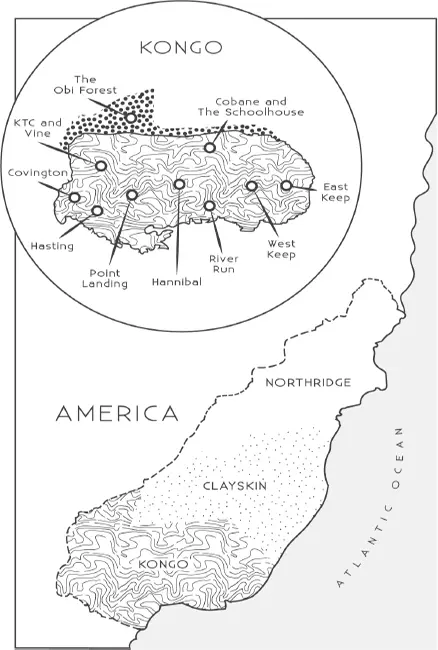
My third companion was one of three dozen diplomats from the Northridge, where the English people dwell. These diplomats handpicked us from our village nurseries and lived with us in the Schoolhouse. I never learned this particular woman’s name. I called her Teacher.
“The Niagara Compromise, Article 4, Section 3, Kongo Classification.” She paced before me, wan-faced, as she lectured. “We, the Committee of Representatives, have observed two brothers of men, each as dark as the other. The first has a narrow nose and ample intellect.”
She stopped, turned and thumped my nose.
“His hair grows in the thick bush fashion, and his mouth is finely drawn.” She waved a hand at my cap of dark brown hair, declining to touch it. Then her eyes skimmed my mouth, leveling on the small black dot just above it. I ducked my head, hiding the mole from her sight.
She slid a glossy drawing of a Kongo man onto my desk, pointing out his features with a bony finger. “The Second Brother has a heavy nostril,” she said, tapping his nose. “He is brutish in mind and sparsely furred. His mouth is like his spirit, coarse and low. Both men are Kongo, each as dark as the other. But the First Brother, the Record Keeper, shall rule the Second.”
I studied the picture, then blinked up at her. We’d gone over this before, hundreds of times.
Her lip curled. “You, girl, are classified as a Record Keeper. Your role, under the Compromise, is to manage the Second Brothers of your race—the workers. See to it that they know their place is in the field. You are better than them and you must conduct yourself accordingly. Now, repeat after me: no yelling, no running, no jumping—for the greater good.”
“No yelling, no running, no jumping,” I said.
Her eyes, the color of overcooked broccoli, narrowed. “Do you enjoy solitude, girl?”
I glanced at my dormitory window. There were other students in the Schoolhouse. Each morning, they filed out for exercise. They were stiff-backed, even as they played for an hour, then filed back in. Only then was I let out for exercise, a walk with Teacher close beside me. “No, Teacher. I would play with the others,” I said.
“Then, for both our sakes, be assimilated! No yelling, no running, no jumping for the greater good.”
I didn’t know what be assimilated meant; I decided it meant be quiet. I stiffened my back, like the students at play, and whispered, “No yelling, no running, no jumping—for the greater good.”
She nodded. “Now again.”
For five years, I learned the hallmarks of my classification—reading and writing. And, in time, I assimilated—or, at least, I appeared to. In truth, my spirit lay dormant. When Teacher wasn’t looking, I imagined myself complete with wings arching from my back. And in my head, where she couldn’t follow, I flew on those wings to my family.
I was seven when I got approval to join my peers in the next phase of training: Primary School. On the first day, I scurried along the Schoolhouse halls until I found the primary classroom door. I grasped the knob and stepped inside with a sigh. Finally! There, in stiff chairs, with their hair braided back too tight, was the skin of my skin, my family. And, just like that, my spirit awoke. My assimilation fell away.
“Comrades!” I cried, swelling with love. I hiked up my skirt and took the helm, jumping onto the nearest desk. It was occupied, but I didn’t care.
“Comrades! It is I!” I dipped my knees and threw up a fist. “To me!”
Slowly, they turned, pupil after pupil, eyes narrowed and intelligent. But they didn’t move. I frowned.
Suddenly, the classroom door opened behind me. Heels clicked, coming my way. It must be the rules, I thought. No yelling, no running, no jumping. They’d been quieted. I shouted again to wake them up, “Comrades, it is I! To me!” Leaping onto another desk, and another, I pleaded, buying time for them to rally. How long did it take me to realize that they wouldn’t?
When it finally struck me, like lightning square in the heart, I slipped and fell. My nose cracked against the ground and spurted blood.
Above me, the other students jittered nervously as the heels at the door clicked closer. They whispered a name I didn’t recognize. “Jones,” they choked. “Jones!”
A gray skirt stopped beside me. Pointed boots protruded from beneath. The toes, fortified with steel, were black as rat snakes. A drop of blood shivered on the tip of my nose, as one toe began to tap. Tap. Tap…
The Pit
THE PIT
The tapping stopped as a voice spoke from above. “Do you know what happens to children that won’t learn their lesson?”
My eyes peeled from the boots and rolled up the skirt. I shivered, meeting her eyes. Ice blue and colder than her voice.
“Primary Cobane, I asked you a question.” Her eyes sparked. “Answer me!”
My fear ripened and my teeth chattered in my head, sounding an alarm—run! I obeyed without thinking. Taking her by surprise, I jumped to my feet, and sprinted through the classroom door.
I didn’t look back, but a pinch in the back of my throat told me she followed.
I sped up, racing down the hall, pumping as fast as my hobbled skirt would allow. My heart beat like a bird as I looked for escape. Suddenly, I found it, a window at the end of the wood-paneled hall. I lowered my head, ripping my skirt as I ran.
For years, I’d watched the workers from my dormitory window. In bambi cloth britches, they swayed with their labor, in the heat of the Kongo sun. They were hundreds of yards away. I couldn’t hear their song. But I learned it from the rhythm of their work: swinging the sickle, catching the wheat, tossing the wheat, swinging the sickle.
I imagined I toiled along with them as I ran. Swinging the sickle, catching the wheat, tossing the wheat, swinging the sickle. The song became my breath, in and out. Swinging the sickle, catching the wheat, tossing the wheat, swinging the sickle. I lengthened my stride, and leapt up from the ground as my back began to tingle. I imagined I felt something sprouting there—my wings! They would lift me! Into the air, into the trees, where the wind breathed. Swinging the sickle, catching the wheat, tossing the wheat, swinging the sickle. I was close now. I’d dive through the window, fly to the village, rally my comrades there—only, would they rally?
I was at the window, about to leap, when I faltered. I pivoted, looking for another route. There wasn’t one, and she was right behind me. I was cornered. I squared my shoulders and turned to face her.
“Primary Cobane,” she said, delight in her eyes. “Students must not run in the Schoolhouse.”
Before she could say more, I threw up a fist and charged at her middle. “Hurrah!”
Her hand darted out like a viper, opening and snapping shut, barely missing my throat.
I reared back, rallied, and charged again. “Hurra—”
Her fist drove into my ribs. I flew back, cracking my head on the pane. The last thing I saw was her nametag etched in gold, pinned to a cold, hard breast—Headmistress Jones.
* * *
A garbled sound woke me. A whisper crackling in and out—and there it was again! A girl chirping in the pitch black, but I couldn’t make sense of her words. My eyes strained to see her. I tried to shift, turn my head, but I couldn’t move. I was locked in a space so tight, I barely fit. I was seated upright, my arms around my knees and my chin jammed between.
I was certainly alone, so what was that voice? A ghost? And where was I? A tomb? Suddenly, I remembered. The wan-faced Teacher had warned me of a dungeon in the Schoolhouse basement. This was not a tomb, but the Pit. Panicked, I arched my back and gasped for breath, bruising the knobs of my spine as, all around, the indistinct harping continued.
My only concept of time came each day, when Jones opened the iron grate above. Over my heart’s refrain—hold on, hold on, hold on—I’d hear her ask the question. The same one, every day: do you need more? When I didn’t answer, she’d give me a swallow of water, then slide the grate shut for another day.
Day three—the dark is complete. It sucks my bones to the marrow. Do you need more?
Day six—my grip on reality frays. My memories wobble. What is real? Did I only imagine my birth—my mother, my comrades? Were we all, like wings, merely figments?
Day eight—I am disappearing. Hold on Hold on Hold on. My nails grip the flesh of my arms, carving crescent moons in my biceps. My mind unravels. Do you need more?
Day ten—I am gone, lost in a dream, when the grate opens above me. Clean air rushes in and I drink it, as quick as I can. Suddenly, a hand grasps my arm and lifts me out of the Pit.
Blood needled through my limbs as she—Jones—dragged me from the dungeon. Bright light scorched my eyes. And, oh, the thirst! The thirst made me delirious. She pulled me up the stairs and down corridors until we came to the window from whence I’d attempted escape.
“Open your eyes,” she commanded.
I did, seeing nothing but frightful shadows. Her gigantic form, a massive fist raised like a thundercloud.
“You will learn your lesson, girl. You will learn your lesson now.”
The thundercloud zoomed and clapped. My nose broke. Fluid spewed. My neck snapped left and right. And still, the fist came. Relentless, whaling. Whumph, a tooth cracked. Whumph. My thirst paled as my head swam with pain. I dove and dodged—no good. The blows were methodical, falling again and again. I had to think. There had to be a way out. I twisted wildly. She caught me in the temple—once, my ears rang—twice, I went limp.
A sound woke me sometime later. A garbled whisper. The same voice from the tomb! Only now, the harping made sense. Broken exchanges I’d heard through the power-fan grates and whispers of pure fear. She’ll beat you like nothing for this. More, ’cause you’ve made her wait. Listen to me! Fall down with the first blow, okay? And don’t scream. It’ll make her mad. Don’t plead; roll over and grovel. Play dumb. She’ll like that. She likes to see the marks. So turn your face up, okay? Can you hear me?
I opened one eye just as the shadow fist fell again. I angled my chin up, crack, it drove into my jaw. Again, again. Her hands, slick with blood and sweat, lost their grip. I slid to the floor. Fear whispered in my ear.
Whatever you do, stay far back from her feet. She’ll kick like a donkey.
I curled into a ball, just in time. Her heavy foot drove the air from my lungs. I heaved with two more blows. Umph umph. My lips puckered and blood pooled in my mouth. Her leg swung back once more. My dread mounted. Back—up, up—for the blow, it swung. It would finish me. It would strike and I’d be done.
Don’t plead! Roll over and grovel. Play dumb. She likes that.
Instinctively, I obeyed. My shoulders convulsed. I lay down on my belly and turned my face up, a humble swollen thing.
She grimaced, unsatisfied.
If you can, drool and roll your eyes. She likes that.
My neck stiffened and my gut resisted one final time—No! I will not. I will—Oh, but the pain was bad. And her leg was swung back for the kill. I hung my head, rolled my eyes and let my lip hang. Drool trickled down my chin.
For a heavy second, her leg hung there, suspended with my fate. Then, finally, she stepped back, shaking life into her dominant hand.
I collapsed.
She cracked her joints. “For a First Brother, you’re a stupid mule, aren’t you?”
Make sure you agree with everything she says, but stay quiet.
With my cheek flush to the ground, I nodded vigorously.
“Now, let’s see if ten days in the Pit taught you anything.” She bent, grabbed me by the neck and breathed into my ear, “Do you need more?”
When she came for me, I’d been dreaming of my papa, judicious with his affection, but fierce. He would look me over from a distance, with his hands tucked in at the waist, until he found something familiar in my face—a crooked tooth, an attached lobe. Then, he would smile. His song was always the same, and he sang it over and over, until I repeated.
Say Papa.
Say Papa!
Come now, say Papa.
Say Papa.
Say Papa!
Come now, say Papa.
A tear joined the mess on my face as I looked up at Headmistress Jones. Silver fish eyes, yellow hair, a thin line of lip. “Please, no more,” I said. “Enough.”
She straightened and pulled me upright.
My nose ran, tracing jowls on my cheeks.
“Very well. Now, stand up and follow me.”
Her gaze sat upon me as I struggled to my feet, clutching the windowsill for balance. There was a thin line creeping up from the center of the pane. Once it reached the top, the glass would break in two. I froze.
If you jump now, the glass will oblige.
The Story Continues on BooksBarbecue!
Enjoyed this preview? ❤️ Do not stop here!
Read the complete book free online → 🔗
Continue reading now on BooksBarbecue and discover every page!
Love reading? Bookmark BooksBarbecue.com for more amazing books!
Happy Reading!