The Primal Screamer
Cover
INTRODUCTION
Roger Neighbour, MA, FRCGP
I recently heard the novelist Margaret Drabble and her husband the biographer Michael Holroyd discussing the rival claims of fiction and non-fiction as paths towards understanding. The debate was entertaining, but only in the sense that a firework display is entertaining. Then at question time someone in the audience stood up and wondered whether, in their search for truth, human beings are capable of anything other than fiction. Doesn’t everything we express, no matter how “truthful” we intend it to be, come out distorted by virtue of having passed through our individual and unique minds?
People often say they want to know “the truth”. But even more than truth, we crave meaning. Unless we can make our experiences “mean something”—and that’s what our brains are for—we flounder and drown in a torrent of overwhelmingly arbitrary circumstances. Truth is just whatever, for now, gives events enough meaning for us to get by on.
So truth comes in different flavours, according to whatever experiences would be meaningless without it. Scientific truth, judicial truth, literary truth and mystical truth can all be different, yet equally valid.
Fifteen years ago, early in my career as a general practitioner, I thought I knew a lot of psychological truths. I’d had training in counselling and psychotherapy, Jungian analysis, Gestalt and family therapy. All can be good ways of imparting meaning to a wide range of human distress. But the distress of one young man, who slashed his wrists in a lonely thicket and could no more tell me why than could a newborn baby explain why it cries, would not be coaxed into any of these frameworks. It was powerful and violent; nonverbal. Preverbal. Then one day as I was trawling through his memory for clues, his voice trailed off. He drew his knees up to his chest, and his head inclined more and more to the left until his head was almost down onto his shoulder. Something infantile about his appearance made me ask, “How old do you feel right now?” The reply came at once: “No age at all”.
In Zen there is a saying, “When the pupil is ready, the Master appears”. At that time, the end of the 1970s, humanistic psychiatrists such as Arthur Janov, R. D. Laing, Bill Emerson, Stan Grof and Frank Lake were developing concepts of birth trauma, intra-uterine memory, “the hostile womb”. And what gave value to their ideas was that they led to what the hard language of science calls “therapeutic interventions”—ways of working with the victims of embryonic trauma that might, if not rewrite the prenatal record, at least spring the lock on the prison of its effects.
Well, I tried. And the rest is history.
History? Or fiction? As you read Nick Blinko’s story, you may feel less sure than you did of the difference between fact and fantasy, between science and metaphor. Who better knows the landscape—the mapmaker or the traveller? At all events, I in my way and Nick in his both know the truth of George Santayana’s epithet, “Those who cannot remember the past are condemned to repeat it”.
March 1995
TUES NOV 20
This day has been the most harrowing of my career to date. A young man was ushered into the surgery by his mother. As the drastic nature of his condition became apparent, I was sent for immediately.
Both his wrists had been cut, as deep as is possible without actually severing the arteries, which were semiexposed and quivering. He hadn’t lost much blood. That which had been spilt was nevertheless a frightening purple colour. Fortunately, thick clots had already formed on the wounds. He had only slight feeling at the base of his thumbs, but otherwise his hands functioned perfectly. I was hurriedly informed that the case was an attempted suicide. He had really meant it.
I was greatly shocked. My stomach turned. The young man apologised for being a burden and for the obvious distress he was causing me; common enough sentiments among such cases. He also stated that this place was not where he had intended to be, as if he had failed to reach some preordained destination. I believe he said these things partly in reaction to the nurse who, in her fright, was muttering under her breath the cliche “it’s a cry for help” and generally tut-tutting. Rather than offering the insight of amateur psychology, her response was more an effort to calm herself. I must have a word with her about this.
It is never pleasant dealing with emergency cases, but at least one can normally label such incidents as genuine accidents and quickly tend to the injury. However, I have never—even during my training—seen such grievous self-inflicted injuries as those that lay upon the wrists of Nathaniel Snoxell.
Within the hour, using a new “freezing” spray aerosol as a makeshift local anaesthetic, I had completed the stitching of his horrific lacerations. I found the work went better if I imagined myself stringing my violin. The nurse completed treatment with lints and bandages and an overall clean up of the affected areas, whilst I spoke with the young man’s mother. I had seen the knife he had used and an antitetanus injection wasn’t necessary—not that they’re of any real use, save as placebos. The youth and I then retired upstairs to my room, the remainder of my afternoon schedule being cancelled. Two greatly appreciated cups of tea were brought up to us.
I had never met Nathaniel before, his family doctor being one of my colleagues. The patient was tall and thin, slightly bent over, with short but wild black hair erupting over a high dome-like forehead. In fact, his head seemed too heavy for his neck to support and he held it to one side, virtually resting it on one shoulder. His eyes were very piercing yet somehow old. They were almost as black as his hair; an impression intensified by the glowing whiteness of his face. Dressed entirely in black he was on the darker, Gothic side of Romantic. He was not exactly clumsy in his movements, but he was self-conscious to a painful degree. He surveyed the view from my window whilst eagerly sipping his tea, which was piping hot. A somewhat fastidious appetite was, at least, intact, as he would take neither sugar nor milk. Eventually I coaxed him into a chair. I thought he looked like a mad doll, but quickly dispensed with the dangerous preconceptions suggested by his appearance, and began the gentle probing of his psyche.
“Well, what do I call you?” My usual opening gambit in such situations.
I already knew his strange and peculiarly pronounced name from the brief conversation I had had with his mother: “Nathaniel Snoxell”.
“That’s perfect iambic pentameter!” I had exclaimed.
“Yes”, she had said, suddenly calm. “He was a very poetic baby”.
I wondered, however, if he preferred to be called by an abbreviation or nickname. I had expected at best a morose reply, but was surprised by his smile and his laughter. So many things, it seemed, had to be contained within that laughter.
“Nat”.
This high-pitched, monotone, monosyllabic form of verbal communication was, I soon found, greatly favoured by him and, at first, he practiced it almost exclusively. It had taken him a long time to reply, and after the utterance he returned to studying the pattern of my carpet.
“Well, Nat, where do we go from here?” I prodded. “Usually people are carted off to mental hospitals for what you’ve just done”. I was attempting to provoke him into responding. “It’s not exactly Britain’s favourite way of ending it all, is it?”
Between long pauses he informed me of his high ideals and how the cruel world had shattered all his hopes; a familiar enough story. He grimaced frequently, lending pathos to each precisely worded statement. Nat had a magical reverence for certain things which had only recently been dashed. He had struggled to break free of his family, but the ties with his childhood had proved too strong, and he had allowed his mother to brow-beat him into finding work, in a toy shop. This was the antithesis of all his artistic and spiritual ideals. He had therefore decided to annihilate his existence.
So few and far between were his ejaculations that I had to be wary of putting words into his mouth and could not tell for sure if the picture I was building up of him was true, or merely a fabrication purposely designed to trap me.
Of the violence itself, he said the following. His parents had gone to work. His elder brother, who works the night-shift at a helicopter factory, was asleep. Funny, I’d had Nat down as an only child! His younger brother, with whom he shares a room, was at school. First Nat had tried jabbing at his arm with a variety of bizarre sharp objects. These included a jaw-bone of unknown origin, and some eighteenth-century scissors. (Perhaps a tetanus was in order after all.) Then he had taken a kitchen knife, which had recently been sharpened by his father, who was once a saw-doctor. Such personal minutiae seemed to obsess the gawky youth. This knife was the one the nurse and I had seen. Then Nat had set out for a nearby wood, “Oval Wood” I believe he called it. He had known it as a child. It was here that Nat had hacked away at his wrists but, he claimed, become too bored with the murderous task to finish the job. Lacking this passion, he had returned home, where his mother found him when she got back from her part-time work.
“It must have been very painful”. I found myself adopting his pathos-filled grimaces. Although I quite often choose to mirror patients’ expressions, this reaction was involuntary.
He spoke slowly but bravely of the most painful emotions, but refused to discuss sex. The abrupt ending of his spiritual quest had brought to the surface some previous conflict which he had been obliged to reenact.
We spoke, and gazed into space and at one another, for over two hours. His eye contact was good, if a little alarming at times. Eventually I concluded that he wasn’t mad and informed him of my verdict. He looked a little disappointed, as if he felt he might belong in an “asylum”, but it was difficult to tell. Whatever was happening to him was happening internally.
I told Nat I had some free time, late in the afternoons, and would be more than content to see him. I also informed him that I was well qualified psychologically speaking. We mutually agreed on an appointment for the following day. I gave him my card and he read it softly to himself: “Dr. Rodney H. Dweller M.A., M.B., B.Chir., D.Obst., R.C.O.G.…”
Afterwards I spoke again with his mother, and also his father, who by this time had been summoned from work. They seemed immensely grateful that I was taking the case on. Money was not mentioned. Instead I advised them not to allow Nat to let his hands flop, for he appeared to be all too ready to take on the guise of an elderly invalid.
The look in his eyes didn’t belong to a youth of eighteen. I felt that the secret of what those eyes had gazed upon would not be surrendered lightly. It was this demoniacal-visionary aspect of Nat that has made my day so utterly disturbing, and not merely the physical carnage, upsetting though that was. However, I felt we had established a useful contact and, despite remaining darkly morbid and speaking openly of his desire for death, it was my belief that Nat would not suicide. My intuition detected within him a strand—a spark—of something strong. I felt that this would sustain him through the problematical days that inevitably lay ahead of us. I had made him promise to contact me if, at any time, he felt he would kill himself, and had sufficient confidence in him not to burden him with drugs, which would only compound his worries.
TUES NOV 27
Over the last week Nat has seen me each afternoon, at the surgery on week-days and at my home at the weekend. It is as regular as clockwork. Actually, he is the most punctual and polite young person I have ever worked with.
On Friday, whilst examining his wrists, some pus squirted in my eye. No infection has yet developed.
Nat’s death wish is both incredibly deep-rooted and close to the surface. Ergo, most of the psychotherapy had centred around his strong desire for oblivion. Throughout the week I have been gleaning fragments of information regarding childhood traumas, and I can now assemble what is known more or less as a “normal” childhood, whatever normal means. There were the usual infant tears caused by falling down stairs, wetting the bed, fear of the dark etc. More revealing is what he chose to find relevant.
A spell in hospital, for what in its time was a routine childhood operation, was seen by Nat as a cosmic experience: “The sky made an evil yellow pattern”. This, he claimed, was nothing to do with it being the first separation from his parents.
I have simply no experience whatsoever of what he describes as “doom-laden” feelings, nor the utter desolation and loneliness he senses lurking somewhere within him at all times. He speaks of being sucked upstairs, into the darkness, away from the rest of his family. This fantasy dates from the third year. Most striking of all his childhood images is the concept which he had been formulating, and brooding upon, up to the age of five. Namely, that he was the only human being and all others were aliens examining him.
The patient soon dispensed with usual and more obviously ego-related childish notions, such as the idea that one is Jesus Christ. In fact, he became revolted at the thought that he had once readily entertained so infantile a notion.
Also anno aetatis quintus suae Nat was constructing small books from scraps of paper. Few of these curious creations survive, but when they drove Nat to my house on Saturday, the family showed me one example, which described the macabre journey of a worm into a crow’s belly and its eventual escape into outer space—cleverly illustrated to boot.
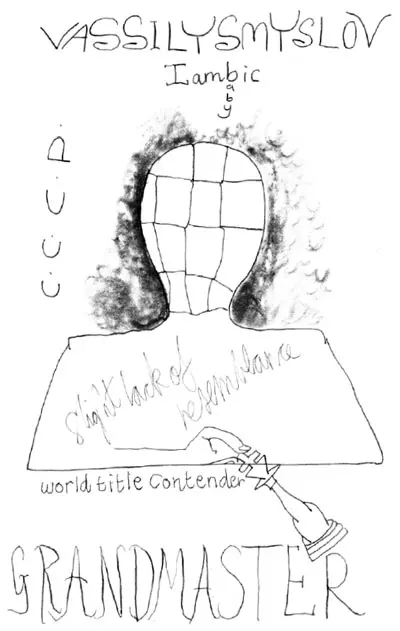
This was made at the time when Nat had played chess for the county: in the third team, on a low board, in a high chair. He had learnt the moves from watching his father playing a friend. “Pictures of moves” had entered his head. Although he had no idea of how to set up the pieces, somehow he could devise beautiful combinations, many moves deep. He still remembered some, despite having long since discarded the lovingly written scoresheets made at the time by his father. Nat had defeated skilled and experienced players, some many times his age. One of his more youthful victim-opponents has since recovered enough poise to go on and become European Hexagonal Chess Champion, whatever that is. However, Nat rapidly grew bored with chess and ceased to play altogether, claiming he had imagined every game of chess there could ever be. This was after he had defeated Vasily Smyslov, who had been World Champion a few years before. In a simultaneous display, Nat was the only one out of thirty players to obtain a result against the Soviet. Perhaps he was embarrassed by his success. He spoke of the futility of pushing pieces of wood about a board and mumbled about having fallen hopelessly under the spell of the Black Queen. His style of play had been similar to the American Grandmaster Bobby Fischer, whom he identified as the last in a long line of innovative geniuses of the game. Nat had particularly admired Fischer, who “ate, breathed and slept chess”. After Fischer, said Nat, the theory and practice of chess would merely degenerate into a regurgitation of what had gone before. He had this same pessimistic view of most subjects, as if they’d reached their final states of development and awaited only apocalypse.
But not music. Music, he insisted, had scarcely been born. The world of harmonics and ultrasonics lay waiting to be tapped.
After this, Nat was sent to a nursery run by nuns. He came home screaming on the first day, begging his parents never to send him to “those black witches” again. All the other children in the neighbourhood had by this time started school, but as he was younger, he was allowed to stay at home with his mother and his younger baby brother. Nat wandered around the garden examining things in minute detail. Once he cut a red admiral butterfly into tiny little pieces: the logical conclusion of much time spent studying and modifying its wing structure. He also had a “pet” butterfly: it always came back to him, but only because he had rubbed the scales from its wings.
Then Nat became a vegan; a particularly severe form of vegetarianism. His father had taken him on one of his business calls, which happened to be to a man at an abattoir. The man, dressed in dingy white overalls, spattered with blood and worse, wielded a massive carving knife (could this be relevant?) whilst in conversation. The sight of this “butcherman” and the atrocities he saw there made Nat vow never to touch meat again. To me this seems an obvious, if understandable, denial of the hunting impulse. Thousands of years of instinct surely cannot be wiped out in a single generation.
Nat was so shocked that, for five years, he had been eating the corpses of animals and had even inflicted pain upon little creatures himself that he began to construct birds’ nests and other homes for all manner of suburban wildlife. Some beasts even took to these ready-made “homes”. Cats were particularly attracted to the infant and even spoke to him in their own language, not the usual “miaows” which he informed me were reserved with disdain for other humans.
With his younger brother Nat had concocted a secret language, a common enough thing for siblings to do, though this was quite a deep and rich lore involving a vast array of fantasy figures and high-pitched obscure utterances. The brothers shunned the television, unlike their older sibling who watched it incessantly. The only memory Nat cared to disclose in which both of his brothers featured involved a “ball of fire” which chased them all round the garden. He saw it as important that it followed them exactly; but it was only a stray piece of paper, from a bonfire, blown by the wind.
When Nat started school he adapted his behaviour to resemble that of his peers. Perhaps we all do this; not everyone is able to, but he certainly faded into the background. He remained outstanding at art, winning numerous competitions. Even then, however, he destroyed his crayoned efforts. A teacher had said that if the pupils didn’t want their drawings, they should leave them at the school to be stored, or hung on the wall: on no account should they ever throw pictures away. Nat tore one of his drawings to shreds and dropped the remains in the churchyard which he walked through every day, to and from school. A fellow pupil, a little girl in the class above Nat’s who lived only a few doors from his own house, discovered the misdemeanour and took a fragment to show the teacher. Nat complained that those colours could never be his. The little girl, however, had cleverly chosen the one piece of paper that bore his childish signature. This little incident did not change his attitude towards his pictures. He needed to make something, but not with the wise elders watching over his shoulder.
The friends he chose were invariably outsiders, who eventually came to reject him; or else their families, with an uncanny regularity, moved away from the area; or they became very ill. This bad luck with relationships also dogged his father, whose idea of helping Nat back to normality has been to recount in great detail his own entire life history.
“Ah, the curse of the Snoxells”, I quipped, much to Nat’s amusement. He tried to make something of the child repeating the parent’s experience, but I could tell he despised such a notion.
By the time he was nine, Nat was an avid collector of fungi, placing the caps on paper and preserving the patterns made by the spores. Later he was found to be allergic to such fungal emissions and his huge collection of spores was destroyed. He did, however, go on picking a wide variety of toadstools and mushrooms to cultivate and to eat, but only after a course of injections had made him immune to the minute seedlings.
Nat was most careful to recount any scrap of information he felt might be helpful, within his own limitations: he still refused to discuss sex.
Nothing seemed of any use. Although the childish memories brought many smiles to his face he continually reiterated his intention to take his life.
“Well, it won’t be the first death in a family”, I found myself uttering in desperation.
FRI NOV 30
It is becoming clear that whatever troubles Nat to the very core of his existence will not be found within the conscious memories of childhood. It is important that he realises this.
The Story Continues on BooksBarbecue!
Enjoyed this preview? ❤️ Do not stop here!
Read the complete book free online → 🔗
Continue reading now on BooksBarbecue and discover every page!
Love reading? Bookmark BooksBarbecue.com for more amazing books!
Happy Reading!