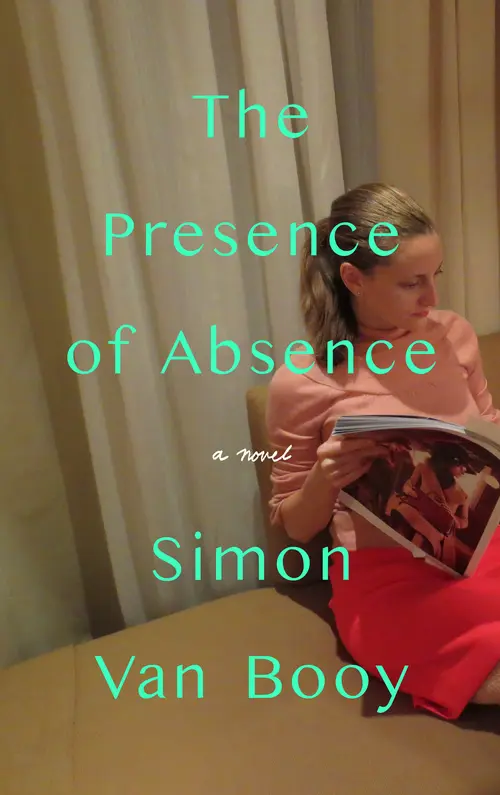
The Presence of Absence
also by simon van booy
fiction
The Secret Lives of People in Love: Stories
Love Begins in Winter: Stories
Everything Beautiful Began After
The Illusion of Separateness
Tales of Accidental Genius: Stories
Father’s Day
The Sadness of Beautiful Things: Stories
Night Came with Many Stars
nonfiction
Why We Need Love
Why Our Decisions Don’t Matter
Why We Fight
children’s fiction
Gertie Milk & the Keeper of Lost Things
Gertie Milk & the Great Keeper Rescue
the presence of absence
Title Page
Dedication
Always, for C.E.D.
Epigraph
Then love, love will tear us apart again . . .
Joy Division
Prologue
Some years ago, I received a letter from a woman in New Jersey. She wanted to talk on the telephone regarding her late husband, the author Max Little. I had attended the odd reading of Little’s over the years and had four of his books on the shelf at home—one of which he signed for me in San Francisco at the beginning of 2007, when we chatted briefly about the absence of tea kettles in American hotel rooms (Max was also British).
After talking with Hadley Little for two hours one Sunday afternoon, it came to light that her husband had left a small journal of his last days, and Hadley wanted to see it published posthumously. Max Little’s book editor Carrie K. at Sipsworth House had already examined the work and felt it too fragmented in its original form and not indicative of the whole story, which continues to this day. Eventually it was decided that Hadley would approach me with the idea of incorporating the fragments of her husband’s final thoughts into a novel that I would write and publish under my own name with an introduction explaining the circumstances of our collaboration.
Shortly after our conversation, a package arrived from Sipsworth House with a copy of the manuscript. As I started reading, it was soon very clear that Max Little had intended his thoughts to be shared, despite the intensely personal nature of this work. But the book wasn’t much more than a short collection of notes, with no dates to indicate any intended order. Despite the challenges, I found that I was soon emotionally attached to the work, and agreed with Hadley and her late husband’s editorial team that the only way to convey the story in the way Little may have intended was to incorporate the dying author’s feelings and observations into something with structure. Like many authors I know, I believe that a story will often choose a particular writer to bring it into the world, by some mysterious process that is both instinctual and deliberate. This is why a work of fiction seemed like the best way forward.
It’s an unexpectedly intimate experience getting to know someone after they have died. If such a thing is even possible, then language really does have magical qualities. I am honored by the trust Hadley and all at Sipsworth House placed in me, and grateful for the friendship that has developed as a result. At Hadley’s request, all the names in the book have been altered to protect the privacy of herself and others. This includes her husband’s, which was changed to Max Little, so if you type his name into the internet you’ll discover some interesting people, but none connected to this work. I have tried to remain true to Little’s evolving vision of life and death throughout the text, but should you find any weak areas, they are most assuredly a result of my hand, while any parts you find worthy of praise will undoubtedly be the work of Little.
—Simon Van Booy
the presence of absence
Part One
In Vivo
27.
Most readers expect some crisis in a story’s first pages. The idea being that if you keep reading, the narrator has succeeded in distracting you long enough to forget you exist outside the book, where—like me—you are dying.
All I have this time is my life. Or what’s left of it.
The square hospital room from which I type this missive is as familiar to me now as my own hands. There are two windows, one in the door and another in the wall, but I have not been outside for almost eight months. In that time, however, I have visited places and people as permitted by the drunk librarian of memory, whose random dispatches have not led back into the past, but into the future where there is often clarity—but also helplessness.
And so if contrived disaster is why you’re here—to be diluted by the suffering of others—then I suggest you stop reading and put this book down. Find a parable-style work with a cover that has been purposefully designed to trick you. I mean it. I’m not joking, nor am I trying to be antisocial. I won’t tell you what this story is about, and you can just go on with your life—forget the moment ever happened—never think of me again as you step back from the unexpected intimacy.
In this story, pain is the only reliable proof of happiness.
26.
You do realize that by turning the page you’ve decided to follow a complete stranger down a possibly meaningless path?
I’m going to try and lead you home by a different road. Home is where you’ve been wanting to go for some time. It’s why you read; unless you’re in school and this is forced, in which case, you have my sympathies, as childhood is a series of small disasters that conspire to become something precious.
If this story doesn’t get you all the way home, you’ll at least feel closer. I know because there’s already a bond between us. If I didn’t sense it right now, I would stop all this.
I’ve arrived here after reading books and authoring books, some of which you may have suffered through in the past. The point is, I know enough now to recognize that everything I’ve written was child’s play—actually, not as wise, because children know they’re playing. Whereas we deceive ourselves into believing play is real, while the truth slips further and further away, until one day rearing up, perhaps after an ordeal, disguised as a terrifying monster we once tried to assimilate as a god—something that has come from outside to obliterate, but in reality, has risen from within.
25.
It’s time to begin our journey forward by moving through what is past. Our destination lies on the other side, though is yet to be imagined. We will get there together, and there will be others, but you will not know the others.
Through the act of reading this novel, it’s actually you telling the story. For example, when you see words, what’s imagined comes from your experience of life, not mine:
The bus appeared at twilight
We were almost home when rain turned to snow
In the afternoon we simply walked, arm in arm across the cold sand
He was sleeping, when
That was our first kiss, then, in
How could I know the things you’ve seen and felt in the years we’ve been apart?
This journey won’t feel like remembering—more like a dream, because I control the structure of what you see, but never the content. That’s for you to feast upon.
What are you imagining?
Feast takes me to Romans in togas at long tables. A mosaic pieced together by small fingers I cannot see but know were there. It’s June and I’m a sweating child in shorts. Thirsty. At Chester Museum on a school trip in nineteen-eighty-something. Just standing there, staring at the ancient multitude, overcome with despair at not having enough money to buy a toy centurion in the gift shop. I’ve eaten my lunch but feel hungry again. I’m also wondering where she is. I didn’t see her on the school bus, or in the chattering queue that snaked all the way back to Ancient Egypt.
All that from the word feast.
Where did you go? We started in the same vicinity but saw and felt different things. Stories lead us behind the curtain of somebody else’s life into the deepest chambers of our own. And so, the events that take place in this narrative have already happened to you. This book is your past but also your future.
What a relief it’s only your voice that can be heard as you crawl headfirst through tunnels of sentence. Emotion comes from your relationship to the words themselves, and the words in relation to other words. There is less of me here than you think. Maybe none. Maybe only a ghost hovering between each silent resurrection.
And though we may never be together in body, this book will ensure that we never part. That you and I, in this moment, are the universe in soft and difficult pieces.
24.
This story is mostly about her. The she I mentioned. My life partner.
(Who will you cast in the role?)
She is out there now, in the world. You might see her and never know. She’s walking around. Listen for her shoes on the concrete if you live in a city. Watch for the orange flash of her turn signal on a crowded highway. She was driving a white car the last time I saw her. And every Wednesday at a club she plays tennis, which to me has always seemed like a game of punctuation with the net as a sentence neither player dares to conclude. But, god almighty, she was good. Such a powerful serve. Grace and form on the return, too. She had it all. Unbelievable.
And she’s out there now over the top of this book, dancing without music like everyone else. She’s hair and teeth and painted lips sipping wine and laughing through the restaurant window.
To you, just some woman.
A face that moves.
A body that turns by itself.
But to me.
Life doesn’t start when you’re born—it begins when you commit yourself to the eventual devastating loss that results from connecting to a person who to everyone else appears completely ordinary. This story is woven from the fabric of my devotion to someone who could be anyone to you, which is why you should cast your own hero.
Sex doesn’t matter.
Gender doesn’t matter.
Age and physical appearance don’t matter.
It’s in the eyes. That’s where you can tell. And, of course, by how—long after they’ve disappeared from your life—you somehow find a way to go on.
Loving them.
23.
You might be wondering where I am, where this voice is coming to you from—even though there’s no sound and it’s your voice you can hear. Perhaps you would like to know which hospital? The town? If I’m still around, and if not, how many years have elapsed since?
None of that matters, because our lives are braided here and now by this sentence.
Most books lie about all that. Questioning the voice is not rewarded. But I’m tired of the deceit, even by omission or by habit—which is why, before I hand over the reins of this story to you, I need to point out that every person is, at the very least, two people simultaneously.
The first split occurs in childhood, the moment you say something that is not truly how you feel. From that point forward, you have a second voice to negotiate your way through the world, while the first voice retreats. This is the person I hope I’ve been speaking to: the one behind the curtain. Remember that here, in this place, we’re not obliged to defer intimacy. Trust is immediate. In this book, duplicity is acknowledged. Here, small but determined waves of language move between our shores.
So, will you run with me in the wilderness, side by side, like the animals we once were and will be again?
Sorry.
Sometimes I get carried away by sudden gusts of feeling. Especially now, in this cool, hard bed, I can move up and down with a button, like some navigational instrument as we row through the dark toward morning.
By the way, I’m not the first person to point out a duplicity of the self, the idea of a first and second voice. It’s everywhere in art: a mirror in which you see a version of yourself that’s been hiding.
Remember Ibsen’s A Doll’s House? Specifically at the end of the play, that moment Nora reverts to first voice and her world ends. She must now separate from Nora’s husband, separate from Nora’s children. Untangle herself from the memories of a woman she has been impersonating.
Are you familiar with Cordelia, the youngest and most favored daughter in Shakespeare’s King Lear? Cordelia tries to share first voice with her father and gets banished for it—but not from herself . . . only from what she could never be.
So, if the voice most of us share with the world is not the inner voice, the first voice, then all our adult relationships inevitably begin with deceit.
Even the ones that don’t end that way.
Anyway, we must get on. I have to stay focused. The notion of a third voice will come later. From this point, what time I have left will be spent cultivating what’s left of yours.
22.
Based on my current situation here in bed, I’ve learned that it’s best to sincerely pretend to not know who you are, nor where you are. Then anything you figure out must be true, as it’s not from assumption, but direct, immediate experience of the moment.
You might be reading this book on the train to Gare du Nord; soaked to the skin in a jungle; sailing up some caramel river at dawn; in a Beijing hotel with the curtains drawn at midday; or at home in a chair as evening opens like a dark flower.
Maybe you are close to the moon on a vessel of sleepers in the breath of space, one stitch in the jeweled cloth—those dead eyes of a living god.
Perhaps you are, like me, prostrate in a hospital bed.
Anyway, stop reading this book and look around for a moment.
Go on.
I mean it. Look around . . . now.
(If someone notices you and also starts looking, you have my permission to laugh.)
Do you see?
While out there in the world with this book, you are also here, mummified by these sentences in a non-physical universe. The body and the mind can travel independently of each other. Perhaps one day they’ll go so far as to be lost. I’m not saying it’s bad, I’m just saying it’s possible—and I, of all people, should know. For instance, I’m writing this in the present, and you’re reading it in the present. Except there is a gulf of time between us.
I might even be dead.
Yet, here I am.
Between the page and your eye.
Countless paradoxes like this redeem language.
But the voice cleaved in two during childhood is not a paradox of language. It’s a division of self, which is the multiplication of possibility. Don’t worry. Again, I’m not saying it’s bad. It might even ripen in us the appetite for love, the impulse to dab color onto stretched cotton, to make sounds that are beyond anything rational, but that sharpen rationality and make us see for the first time what we’ve been looking at our whole lives.
And so, as I said earlier, birth is a false start. It’s in the country of childhood where our lives really get going—where the stage is set, the players readied, and the lines put down for everything that is happening to you right now.
21.
There was a television in the corner of my room in the early days. Before the pain was controlled, I used it as a tool to distract—though I’m not going to tell you anything about the treatments, nor what my corpus has been through, because feeling sorry for me is not why we’re here, remember? I don’t want this book to be a distraction from life, but a way for you to go deeper.
I’ve since had the television removed, but having it for a time did make me wonder how bad childhood was before soaps and action-drama. For thousands of years, without this glowing window into others’ lives, children must have felt their home environments were completely normal. Now, parents can no longer indulge their delusions between the front and back doors.
As a boy in Wales, I wanted my life to be like The A-Team. I wanted it to be like Knight Rider. But it wasn’t like Knight Rider. Nor was it like Dallas or Falcon Crest.
My life was walking to school worried my socks were too red. One morning, as I neared the grassy knoll before the busy road I had practiced crossing with my father over and over, I heard my name in the mouth of another boy. I turned and there he was, barreling toward me, lips curled back to reveal a mad riddle of teeth. It seemed he was cupping something precious in his loosely clenched fists, something he was determined to share with me. What was it? A butterfly wing? Pincers from a stag beetle? A 1970s soda can ring pull? World War II aircraft bullet casing? (Chris Page once found three by the BMX track along with a porno mag in the hedge.)
But then the red-faced boy was spitting words over bared incisors: Paki! Wog! Paki bastard!
I would hear these often growing up. They’re woven into the fabric of my life, part of our story. I learned to fight but never refute their claim—for if it wasn’t me, it would have been someone, some other small body, some other brown hand like mine that picked up toys and reached for the deep fur of any passing dog.
Those words were most certainly the red-faced boy’s second voice. But I wonder if with first voice, he was saying: Ilovemydad. Ihatemydad. Ilovemydad. Ihatemydad. Helovesme. Mumcriesallnightwiththebathroomdoorlocked. Hercriesdislodgemyinsides. Shelovesdad. Ilovemydad. Tohangon. Tolove. Imusthit. It’snormal. Hastobe. Willfindareason. Skin . . . Body . . . Voice. Anythingtosavemyselfandmum. Anddad. WhoIwillalwayshate. Loving.
As I lie here in this hospital bed, old enough to think I’m not old, I’m starting to wonder if all hate isn’t just the unbearable pain of inexpressible love.
I think the first blow landed in the middle of my forehead. Then I was on my back, his knuckle ramming, grinding my head bone and eye sockets. We were like a single machine in the act of breaking down.
Another digression: Try and imagine somebody at work has dragged you from your cubicle and is beating you next to the photocopy machine; blood runs down your chin; you can taste metal in your mouth; teeth wobble with any pressure from the tongue.
Everyone in the office is watching this—even people you like. Some are not just watching but laughing.
When the kicking stops, you lie there for a while, then drag your bruised, shamed body to the opaque glass doors of those in charge. They pretend to be upset and ask questions. They write things down.
After a while they come to believe you are somehow to blame for your own victimization.
You go home.
People you love act as though it were your fault, too.
You withdraw your heart from public circulation, like a library book no one can read without damaging.
Then, a week later, it happens again.
This time, others join in; it’s the only way they can make sure it never happens to them.
You can’t go to the police because your colleagues are, for some reason, immune to prosecution. And they know this. They can do anything they want to you.
You can’t leave the office or get another job because you’re not allowed to. The people in charge and the people you love are criminally obtuse. You simply must find a way to live with monumental shame and suffering, to let part of yourself die so that other parts may go on living.
This is what it means to be bullied.
When I opened my eyes, I was still on the ground. I couldn’t see much because of wetness and swelling. But then something happened, the deus ex machina that makes this book possible. As the rock-hand was pounding the rubbery mass of my bloodied nose, from the sky came divine intervention in the form of a pink tennis racquet with rabbit stickers on the handle. It struck the boy only once, but with such force that in the following days, kids at school would say his cheek looked like fleshy graph paper.
I lay there for what seemed like all day but was probably one minute.
I was waiting for her to go away.
But she wouldn’t go away.
She sat down, cross-legged, and pretended to pet the rabbit stickers on the frame of her pink tennis racquet, supposedly to make me laugh.
When I didn’t move, she opened her lunch box and put a small package of very expensive cookies next to my cheek. But I just lay there on the grass, mesmerized by pain and the very expensive cookies, hoping she would think I was dead and bugger off.
But she didn’t bugger off. She tried to help me up, which was intensely irritating. Then she trailed me to the school gates, and all the way into class where, thank god, she went to the place she usually sat, as I went to mine.
The Story Continues on BooksBarbecue!
Enjoyed this preview? ❤️ Do not stop here!
Read the complete book free online → 🔗
Continue reading now on BooksBarbecue and discover every page!
Love reading? Bookmark BooksBarbecue.com for more amazing books!
Happy Reading!