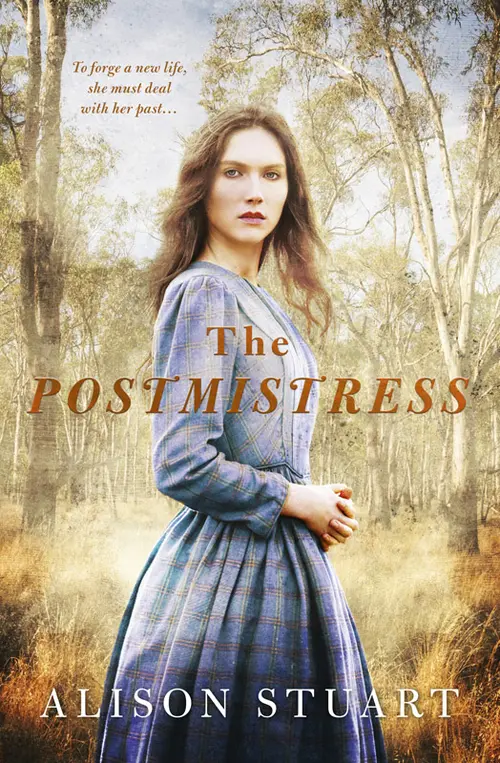
The Postmistress
Cover
About Alison Stuart
About Alison Stuart
Australian author Alison Stuart began her writing journey halfway up a tree in the school playground with a notebook and a dream. Her father’s passion for history and her husband’s love of adventure and the Australian bush led to a desire to tell stories of Australia’s past.
She has travelled extensively and lived in Africa and Singapore. Before turning to writing full time, she enjoyed a long and varied career as a lawyer, both in private practice and in a range of different organisations, including the military and the emergency services.
Alison lives in a historic town in Victoria.
Also by Alison Stuart
Also by Alison Stuart
Available in ebook from Escape Publishing
Lord Somerton’s Heir
By The Sword
The King’s Man
Exile’s Return
Title Page
The Postmistress
Alison Stuart

Dedication
This book is dedicated to the memory of Australia’s pioneer women,
who endured untold hardship to make their way in a man’s
world and an unforgiving land,
whether they chose to work the land or the gold claims,
run businesses or keep homes and raise children—or,
indeed, all of these things!
Prologue
Prologue
Oldfield House
Liverpool, England
6 December 1861
Tock, tock, tock …
The muffled tick of the marble and gilt clock on the mantelpiece beat out the minutes of Adelaide’s life. She stared at the egg congealing on her plate and fought back rising nausea. At the far end of the table, her father, Sir Daniel Lewis, read his morning mail.
Tock, tock, tock …
‘More tea, Miss Lewis?’ Hawkins, the footman, hovered at her elbow.
Adelaide shook her head.
As the man turned away, her father brought his fist down on the table with such force that it rattled the crockery and caused Hawkins to slop tea onto the oriental rug, the dark liquid spreading across the pattern of entwined leaves. The footman gave a cry of alarm, fell to his knees and mopped frantically at the wet stain with a table napkin.
‘Leave that,’ Sir Daniel snapped at the footman. ‘Get out.’
The man rose to his feet and inclined his head, closing the door behind him with a soft click.
‘What is it, Papa?’ Adelaide’s voice sounded reedy and thin.
Her father looked at her, his mouth a hard line and his brow furrowed. He waved the telegram he held. ‘Calamitous news. The Evangeline has not made port in Savannah.’
‘The Evangeline is lost?’ The room spun and Adelaide grasped at the table.
‘I fear so.’
‘What of … what of Mr Barnwell?’ It took a supreme effort to keep the tone of her voice even and disinterested.
Her father shrugged. ‘If the Evangeline is lost, we can only assume all hands are lost with it. I will have to inform his father, of course, but His Lordship has other sons.’
Adelaide’s hand rose to her mouth but not in time to choke back the sob.
He cleared his throat and for a fleeting moment his features softened. ‘I believe Barnwell had indicated that he intended to ask for your hand on his return from America. I know you had formed a tendresse for him and I liked young Barnwell, but you are only seventeen and I would not have given my consent to such a match. Marriage is not about love—’ Sir Daniel cast her a hard look. ‘I have other plans for you, my girl. You’re not settling for any third sons when you could be a countess.’
Adelaide forced herself to meet her father’s hard eyes, searching for a chink of weakness, some indication that he truly cared for her, but she met only the impenetrable armour that had enabled Daniel Lewis to become one of the wealthiest and most successful shipping magnates in England.
‘You can dismiss my heart so readily, Papa? I wish I could do likewise.’
‘There will be other men, better prospects.’
Adelaide looked at her hands, still clutching the table, the knuckles white. She couldn’t tell him, couldn’t admit to the foolish moment of weakness, the naivety of two people who had fancied themselves in love and gone that step too far. Now Richard was dead, and the lacings of her corset would not conceal her shame for much longer.
Her father indicated the telegram with an exasperated wave of his hand. ‘A cargo lost. Nothing for it. I need to go to London to talk with the insurers.’
‘What about the crew and their families?’ Adelaide ventured.
‘I daresay I shall now be beset with pleas for compensation. I’ll pay the men’s wages for the voyage, if that’s what concerns you.’ He pulled his watch from his waistcoat and consulted it. ‘I will catch the eleven-fifteen train. Do not expect me back before week’s end.’
Adelaide took a deep shuddering breath and straightened. ‘Very well. If you will excuse me, Papa.’
But his attention had already turned back to the telegram from his Savannah agent. At the door, Adelaide gave her unloving father one last look.
Only when she reached the sanctuary of her bedchamber did her stiff resolve give way. She fell, howling, into the arms of her maid, sobbing out the dire news about the Evangeline and the loss of Richard Barnwell. She had no secrets from Netty Redley. Netty had been with her since childhood and had realised the horrible truth even before Adelaide.
‘What are we to do, Miss Adelaide?’ Netty ventured when the tears at last subsided.
Adelaide dashed at her swollen eyes. ‘I can’t stay. You know what he will do when he finds out that I am with child. Remember cousin Edith?’
Netty’s mouth tightened and she nodded.
If Adelaide ever found the courage to tell her father the truth of her condition, she would be sent away for the duration of her pregnancy. The child would be taken from her arms as soon as it drew breath and placed in an orphanage or, if it was lucky, with a family that wanted a child. That had been the fate that had befallen her cousin, Edith. Edith, who now lay in a lonely, unmarked suicide’s grave hard up against the churchyard wall.
Netty straightened and held Adelaide at arm’s length. ‘Don’t you fret, Miss Adelaide. We’ll pack your bag and go to my sister in Whitby. She’ll take us in for a little while until we can make some plans.’
‘What do you mean “we”? I can’t take you with me,’ Adelaide sobbed. ‘I’ve no means to pay you.’
Netty’s shoulders straightened. ‘I’ll hear none of that, Miss Adelaide. I’ve been with you since you was a bairn and I’ll not leave you now. Whatever is in your future is in mine and we’ll make the best of it.’ She paused. ‘As for means, there’s your mother’s jewellery. That’s yours to do with as you think fit.’
Adelaide wiped her eyes on the handkerchief Netty offered and a small gleam of hope edged its way into her heart. She would take nothing that would lead her father to an accusation of theft, but the trinkets bequeathed to her by her mother would help. Her fingers circled the chain she wore around her neck, a plain silver locket. The last gift from Richard containing a lock of his hair. She had given him a matching token. Now it lay at the bottom of the unforgiving ocean.
She crossed to the window in time to see her father stomping from the house to the waiting carriage, the epitome of wealth and success in his well-tailored wool coat and beaver hat.
When he returned from London, she would be gone.
One
One
Williamstown, Victoria
21 November 1871
Caleb Hunt narrowed his eyes and considered the odds in the ridiculous game of chance that the locals called two-up. His life now depended on the fall of two pennies: heads and tails, or heads and heads, or tails and tails? He knew his limits and would have cashed in his losses a good hour ago, but luck had turned his way, and a scruffy pile of crumpled banknotes was accumulating to his credit.
Now it came down to Caleb and a sweating, bearded Irishman wearing corduroy trousers and a moleskin waistcoat. With a cold gambler’s eye, Caleb could tell that the man had wagered his entire life on the fall of these two grubby coins. A life now neatly folded and in the custody of a large bald-headed man called the boxer.
A second man, who acted as ringmaster in this circus, stepped forward out of the jostling crowd. He jerked a thumb at Caleb’s opponent. The Irishman wiped a hand across his sweating forehead, his eyes narrowing and his breath coming in huffs as if he had run a hundred yards.
‘I calls odds,’ he said, casting Caleb a sideways glance. Odds—the two-way bet of one head and one tail. Nothing either of them could do or say would influence the outcome. It was chance, nothing but chance.
Caleb crossed his arms. ‘I call heads.’
The ringmaster placed the two coins on a flat piece of wood, which he handed to a third man. ‘Come in, spinner,’ he said.
The spinner gave a practised flick of the wrist, sending the pennies twisting into the air. The light of the gas lamp caught their graceful arc as they hovered for a heartbeat and then fell to the grubby flagged floor. One coin fell flat, revealing the well-worn visage of Queen Victoria, but the other continued to spin on its side. The whole room held its breath as the coin resolved itself.
A roar went up.
‘God Bless Her Majesty,’ the ringmaster called. ‘Heads have it.’
Hands slapped Caleb’s back and he released his tightly held breath in a whoosh.
He glanced at his opponent. All the colour had drained from the Irishman’s face and he stared at the two coins as if they might magically resolve themselves into odds, but the gods of chance had spoken and Caleb had prevailed.
‘Again,’ the man said, casting wild glances around the circle of faces. ‘Toss again.’
‘Don’t be a fool, man. You’ve nothing left to bet,’ the boxer said. ‘Sign this paper and be on your way.’
The Irishman’s face coloured and his eyes glinted as he scrawled on the paper the boxer gave him, signing away his life and his livelihood. He turned on Caleb. ‘You cheated. I know you cheated.’
Caleb held up his hands. ‘And how exactly do you think I did that?’
‘I don’t know, but you conned me.’ He lunged at Caleb.
Younger, fitter and more sober, Caleb easily evaded the man’s flailing fists.
The boxer stepped in and gestured to two burly men. ‘Take him outside and dunk him in the horse trough. That’ll cool him down.’
The men ejected the Irishman from the hotel even as he still screamed invectives at Caleb.
The boxer handed over Caleb’s winnings: a bag of coins, the crumpled banknotes and the signed paper.
‘If I was you, mate,’ he said, ‘I’d make myself scarce. You’ve made yourself an enemy there.’
‘Thanks for the advice,’ Caleb said. As if one more angry drunk in his life made any difference. He set coins down on the sticky surface of the bar. ‘Drinks for all.’
A roar of approval went up and the barkeeper passed tankards of foaming beer to eager hands.
Caleb slowly downed his beer, only his second for the night. He’d long since learned that the secret to successful gambling was a clear head.
He unfolded the paper that the Irishman had staked in the game. Surmounted with the coat of arms of the Colony of Victoria, it appeared to be the registration form for a mining claim in the name of Roderick Hannigan. He turned the document over and read the elegant copperplate that gave the details of the gold-mining claim: ten acres at Pretty Sally in the Maiden’s Creek Goldfield. A second scrap of paper signed by the same Hannigan gave the bearer the rights to the claim.
Caleb’s pulse quickened. When he had boarded the ship in San Francisco, all he knew about the distant British colony of Victoria had been one thing.
Gold.
He tilted his head and considered the legality of the transfer. In this rough and tumble place, who cared much for legalities? As far as he was concerned the claim at Pretty Sally was now his.
‘Where’s Maiden’s Creek?’ he asked the barkeeper as he carefully folded the papers and stowed them in his pocket.
The man leaned an elbow on the bar and scrutinised a dark corner of the room as if it contained a map of Victoria. ‘About a hundred miles east of Melbourne in Gippsland.’
Caleb had been in the Colony barely twenty-four hours and all he had seen were the stinking streets of the port of Williamstown. Anything beyond this town remained a mystery.
‘How would I get there?’
‘Best way is to find one of the coastal traders heading for Port Albert but there’s a regular coach from Melbourne.’ The man paused. ‘If you want some advice for nothing, I can tell you that the only money to be made on the goldfields is in the pockets of the shopkeepers, the whores and the grog shops. Seen too many of you new chums heading off with gold fever in your eyes.’
Caleb laughed. ‘Seen them myself on the Californian goldfields.’
The barkeeper straightened and ran a dirty cloth across the counter. ‘You from California?’
‘Virginia,’ Caleb replied.
‘Virginia,’ the man repeated. ‘Did you fight in the war?’
Caleb picked up his empty beer glass, his fingers tightening around it. He pushed the glass at the barkeeper. ‘Pour me a whiskey,’ he said.
As he did so, the barkeeper jerked his head at a lithograph hanging above the bar—an elegant three-masted barque—and said, ‘We had a ship here back in sixty-five. They had her up in dry dock, so they was around for a while. The officers were popular with the ladies. All the high and mighty from town was down here courting them. Took on a good crew before they left.’
‘What was she called?’ Caleb asked out of politeness rather than interest.
‘It had a pretty name. Too pretty for a warship … Shenandoah. That’s it.’
Shenandoah.
Caleb downed the vile liquid that passed for whiskey in this place in one gulp. How could one word have the power to evoke pain as real as the jerk of a knife?
Several whiskeys later, he had become maudlin and homesick and when that happened, it generally resulted in singing. He pushed to his feet and turned to face the crowded room.
Oh Shenandoah,
I long to hear you,
Away, you rolling river.
Oh Shenandoah,
I long to hear you,
Away, we’re bound away
’Cross the wide Missouri.
The fiddle player who had been entertaining the bar with Irish ballads picked up the old melody.
’Tis seven years
since last I’ve seen you,
Away, you rolling river.
’Tis seven years
since last I’ve seen you,
Away, we’re bound away
’Cross the wide Missouri.
Caleb broke off with the drunken realisation that it had been seven long years since he’d crossed the Missouri, never to return. One more whiskey and he would be sobbing on the bar.
‘Got to get back to my lodgings,’ he slurred at the barkeeper as he paid for his drinks.
‘Good luck with the claim—’ the barkeeper said.
Caleb stepped out onto the street.
For November, the night was oppressively warm and the waterfront street was busy with trade from the many pubs and brothels. He crossed the road and stood on the water’s edge looking out into the night. Beyond the stinking mud flats, the riding lights of innumerable ships shimmered across the calm, still water of Hobson’s Bay. Beyond the boats, distant pinpricks marked a settlement on the far shore.
His soldier’s instincts prickled, and he turned in time to catch the gleam of a knife in the street lamp as a man lurched out of the darkness.
‘Don’t do it, Hannigan,’ he said, holding up his hands and stepping backwards. ‘I’m not armed,’ he lied, the familiar weight of his Colt revolver resting against his hip, hidden by his jacket.
‘You took my claim!’ Hannigan lunged, but Caleb sidestepped and whirled on his heel, sending Hannigan staggering past him. The Irishman turned, his lips bared in a snarl.
‘You don’t want to kill me,’ Caleb said. ‘I reckon that’d be a hanging offence in this town. Nasty way to die.’
The knife wavered and Caleb held his breath, his fingers itching to draw the Colt. But he didn’t want to shoot the man. It had been just such an unfortunate misunderstanding that had led to his hasty departure from San Francisco.
Hannigan gave a sob and moved the knife to his own bearded neck. ‘I’ve nothing left,’ he sobbed. ‘May as well just—’
Caleb jerked forward to stop him but he doubted Hannigan had the guts to end his own life. ‘Listen, Hannigan,’ he said, ‘I’ve a proposition for you. ‘Tell me about this claim of yours.’
Hannigan’s hand dropped to his side. ‘What do you want to know?’
‘Is there gold at this … Pretty Sally?’
‘Oh, there’s gold,’ Hannigan said. ‘The alluvial stuff’s gone but there’s a reef running through the hillside.’
‘How do you get it out?’
Hannigan spluttered. ‘What do you know about gold mining?’
‘Some,’ Caleb said. ‘Dig it up and stomp it out of the rocks?’
‘That’s pretty much it.’
‘Sounds like hard work.’
‘It is. And bloody expensive too.’
Caleb scratched his unshaven chin. ‘I have a problem, friend. A problem you might be able to help me with.’
‘What’s that?’
‘I now have the right to mine a piece of land for gold, but I don’t know where this land is and what I know about gold mining you could write on a postage stamp.’
Hannigan straightened. ‘So, what are you proposing, Yankee?’
‘Nothing if you are going to call me by that name.’
‘So what do I call you?’
‘Caleb Hunt. How were you planning to fund this expensive expedition?’
The man sucked in a breath through his moustache. ‘I came to town to register the claim but I needed money to pay for the equipment I ordered from McEwan’s. I thought there would be easy money to be made with two-up—’
‘My father used to say, never gamble with money you’re not prepared to lose.’ Caleb’s father would never have considered gambling at all—the words were good advice from a friend that Caleb had consistently failed to follow in his life.
Caleb took out his pipe, filled it with tobacco and struck a match on the sole of his boot. He drew in the smoke and kept his eyes fixed on the twinkling lights of the boats. ‘I think you and I could strike up a deal, Hannigan. I’ve got the money you need for the equipment, but I need someone who knows what he’s doing to work the claim. I’ll pay you a fair wage and, if we strike gold, then you get ten per cent of the profits. Does that sound fair?’
The Irishman’s beard jutted. ‘But it’s my claim.’
‘Not any more. That’s my offer, take it or leave it.’
Caleb straightened and started to walk away, leaving the big man standing on the sidewalk, the knife still in his hand. He half-expected the knife between his shoulder blades but if he had judged the man rightly, Hannigan was no murderer. Hotheaded perhaps, but not one to knife a man in the back.
‘Wait, Yankee.’
Caleb smiled. Hannigan would continue to call him ‘Yankee’ precisely because he knew it annoyed him, but if that was the price of this man’s cooperation, it was worth it. He turned back to face Hannigan, relieved to see he no longer held the knife.
The Irishman spat on his hand and held it out. ‘A deal, Mr Hunt.’
Caleb returned the gesture before wiping his hand on his trousers.
They arranged to meet in the morning and Caleb went back to his lodgings in the dingy street behind the main thoroughfare. As he washed his hands in the battered tin basin, he hummed the tune of ‘Oh Shenandoah’ with the sense that, for the first time in seven long years, he really had crossed the Missouri for a new life at the bottom of the world.
Two
Two
Maiden’s Creek
10 December 1871
Adelaide Greaves set aside her sketchbook and drew her knees up to her chin, enjoying the rare feeling of freedom that Sunday afternoons brought to her busy life. She and Danny had climbed the hill behind the cemetery to their favourite picnic spot, a large rock sheltered in a stand of tall gums. From here, they had a clear view down the steep-sided valley in which the township of Maiden’s Creek nestled. The town clung to the curve of a once pretty creek, now a clogged and stinking sewer, into which all the waste, both human and industrial, poured. Commercial buildings fronted the main street, exuding an air of prosperity and respectability, while the homes of the town’s residents were scattered higgledy-piggledy across the hillsides above, placed wherever a piece of flat ground could be found or hewn from the rocky soil. Whisps of smoke rose from crooked chimneys constructed from the local stone, bringing with them the smell of eucalyptus and roast meat.
At the far end of the valley, a massive spoil heap of broken rock spewed down the hillside, bright and harsh against the darker granite. Most days of the week, the tall chimney below the Maiden’s Creek Mine belched smoke from the boilers that were used to run the mine’s machinery, particularly the heavy stamping batteries that crushed the raw rock and measured the steady rhythm of the town’s heartbeat. On Sundays, only a watching fire trickled a thin line of white smoke from the chimney and the stamping batteries were silent. The townspeople found the silence deafening.
Above her a flock of bright, multicoloured parrots chattered among themselves as they swooped and dived in the stand of trees. She rarely saw the strange, shy fauna of this land. The endearing little wallabies with their soft, dark eyes and fat wombats kept their distance from the town. However she kept a wary eye out for snakes and spiders before setting the picnic blanket down in the shadow of the rock.
The Story Continues on BooksBarbecue!
Enjoyed this preview? ❤️ Do not stop here!
Read the complete book free online → 🔗
Continue reading now on BooksBarbecue and discover every page!
Love reading? Bookmark BooksBarbecue.com for more amazing books!
Happy Reading!