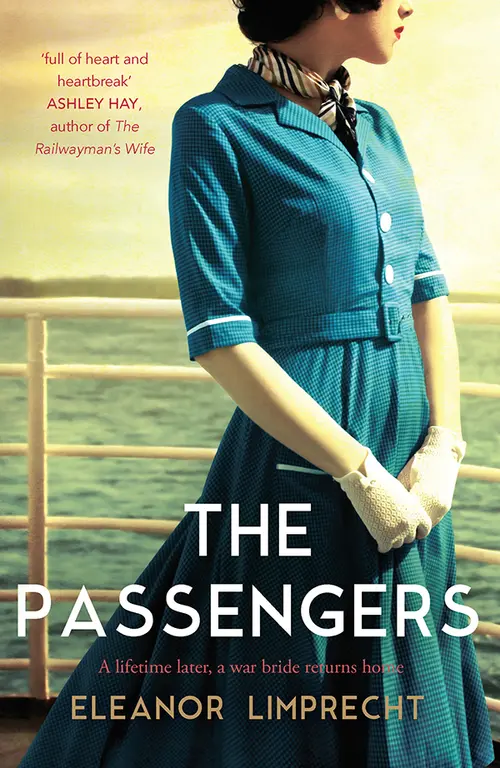
The Passengers
COVER PAGE
ABOUT THE AUTHOR
Eleanor Limprecht spent her childhood in the US, Germany and Pakistan but now lives in Sydney, Australia. Eleanor’s previous novels, What Was Left and Long Bay were both published by Sleepers Publishing to critical acclaim.
BY THE SAME AUTHOR
What Was Left
Long Bay
DEDICATION
In memory of Charlie
Up ahead they’s a thousan’ lives we might live, but when it comes it’ll on’y be one.
JOHN STEINBECK, THE GRAPES OF WRATH
CHAPTER 1
CHAPTER 1
I watch her at the railing, looking out to sea. Skin so soft it slopes from her cheeks, fine white hair billowing around her face. I like to imagine her—the same age I am now—making the opposite journey, with no idea of what is on the other side. I’ve seen old photographs, curling at the edges, of her lounging in a chair on an upper deck, shading her eyes from the sun with a hand. Shorts and a halter top, hair wild from the wind, mouth open in laughter. I hold her coffee now and wait for her to turn, studying the rough, wrinkled skin on the backs of her elbows, the veins which bulge behind her knees.
Grandma turns and her bright blue eyes blink away the water from the wind.
‘Hannah.’ She smiles and steps towards me, taking my arm. ‘You’ve brought coffee. Aren’t you a doll.’
We walk the deck in the early sunshine, the yellow hulls of the lifeboats above us. The only sign the ship is moving is the vibration of the deck. Hardly anyone gets seasick now, Grandma says, because they put stabilisers on all the cruise ships.
‘Good for you,’ Mom said when I told her I wanted to travel back to Australia with Grandma. ‘She’ll need your help—she’s not exactly spry these days.’
‘I know. That’s why she asked me. And I need to get away. Come with us?’
Mom had sighed, a rush of air in the phone, and I could hear the turn signal in her car ticking, the low murmur of the radio news.
‘Can’t afford to take that much time off. But this is something she’s talked about forever. Since before Grandpa died. I’m glad one of us can go. You need to be strong, though, to help her. Up stairs, in and out of cars once you’re there. Are you being healthy?’
‘Yes,’ I said. ‘You forget I’m a nurse—at least, training to be one.’
‘Like I’d forget.’
Now the deck has grown busy with passengers making their way to breakfast.
‘Are you hungry?’ I ask.
‘I will be when I see the food.’ Grandma threads her arm through mine and we turn around to walk to the dining room. ‘Let’s go see what’s on offer.’
Once we’ve chosen from the heaped fruit and pastries, the bains-marie of bacon and potatoes and eggs, we find a vacant table beside a window, on the starboard side of the ship. There are two dining rooms that serve breakfast and I’ve already forgotten their names. They both sound like Italian mobsters. Food is everywhere—I can’t escape it. For an extra cost we can eat Japanese, Brazilian, pizza in the fake Italian piazza or Ben and Jerry’s. Just swipe your room card to eat more calories than you’d ever consume on land.
I can tell the cruise regulars because they have lanyards for their key cards—ranging from the simple kind they got for free at a work conference to the bling-laden version that screams bridge-playing retiree. Grandma has a tasteful lanyard of blue and white beads—they’re plastic, she says. I don’t have one, and don’t have a pocket on my dress, so I’ve stuck the key card in my bra. Plenty of room in there.
Ash says he doesn’t mind my lack of boobs. Says he prefers it, which I find hard to believe. Was it only yesterday we drove down together from LA? Already it feels like weeks ago. We picked up Grandma from her retirement villa near San Diego among the glaring green golf courses and electric carts, the Lincoln Town Cars and permed ladies in perma-creased pants with white-soled shoes. Grandma hadn’t met Ash yet. I had only mentioned him once or twice. I worried she’d say something to embarrass me—she loves to remind me how at my age she was married. As we sat in traffic Ash tapped his fingers on the wheel. Grandma was surprisingly quiet though, her head nodding to the jazz playing low on the radio.
‘What do you normally do on cruises to pass the time?’ Ash asked her as he drove us to the dock.
‘Play a lot of bridge, go to the shows. I dance if anyone asks me. Walk the decks. I’ve never been on one this long, one with a destination. I always bring something to read but I never seem to find the time. Mostly, I plan to enjoy the company of my granddaughter. Did you bring a book, Hannah?’
Grandma reached back from the passenger seat and patted my knee with her manicured fingers, and I put my soap-dried hand on top of hers.
‘Did I ever. I have a stack of textbooks I’m meant to read.’
‘Don’t tell me you brought all your nursing textbooks,’ Ash said, looking at me in the rear-view mirror. He was wearing his Ray-Bans. It was hard to tell if he was joking when I couldn’t see his eyes.
‘I did.’
‘It’s a vacation, babe. You’re not going to want to study.’
‘If I don’t ace the exams I probably won’t get the clinical internship I want. Paediatrics is super competitive.’
Grandma pointed out the window then, changing the subject. ‘I think I see it. There, that huge one. That’s our ship.’
It was so big sitting there at the wharf it looked fake. It dwarfed everything else; the other boats looked like small toys beside the gleaming white beast.
‘A floating mall,’ Ash said, and I kicked the back of his seat. He had made plenty of comments about the environmental ethics of cruises, and at home I’d agreed, but I didn’t want to seem ungrateful now that I was here.
Ash hugged us both goodbye at the passenger terminal, where we joined a snaking line of tourists in fanny packs and bright t-shirts. We were different from them, I’d decided. We had a purpose to our journey. While Grandma got her passports out—she had both, US and Australian—Ash put his hand on my cheek. I pushed his sunglasses up to his forehead. In his pupils were tiny reflections of me.
‘Will you miss me?’ I asked.
‘More than you know.’
He kissed me. I watched him walk away, turning back to wave when he stepped off the kerb. I had forgotten to say that I’d miss him too.
•
I move the food around on my plate, cut it into smaller pieces. I find the salt shaker and smother the two teaspoons of egg. Laughter explodes at a table near us, a woman raises her voice to be heard over the cackles of the others at her table. The room is broken up with railings and drapes but it is still cavernous, ornate like a cheesy Italian restaurant where the waiters sing.
Most people in the dining room are in Grandma’s age bracket but there are also families with small children, wide-hipped mothers wiping maple-flavoured syrup from the hands of their wriggling toddlers, counting down the minutes until they can send them to kids club. Middle-aged couples who spend their days by the Calypso Reef pool, skin already peeling from sunburn, drinking mimosas and bloody marys with breakfast. Teenagers moving in small packs, carrying plastic soda cups and avoiding their parents’ table. The only demographic missing seems to be mine.
My friends are spending their spring breaks backpacking in South America or snowboarding in Vermont. Even drinking margaritas in Cancun. But this is Grandma’s trip home. She said she could use my help: getting around, the suitcases, the travel. But I suspect there’s something more. I watch her lay her napkin carefully on her lap. The way she eyes mine. She has always had these perfect manners; she takes her fork in her left hand, her knife in her right. In this way she carves every little bite, even the bacon, and brings it to her mouth in dainty, careful portions.
She has kept so many of these habits she grew up with, in spite of being so far away. How easy it would have been for her just to give up and eat like the rest of us, using her fork as a shovel, her knife only when necessary, ignoring the different forks and spoons and the order in which they are used. But she’s hung on, and it makes me think it is out of longing as much as habit.
‘Grandma,’ I say, pushing my plate away, ‘you must be so excited to be going back to Sydney. How many years since you’ve been home?’
She pats her mouth with her napkin, lipstick smearing the linen pink.
‘Sixty-eight,’ she says. ‘But Sydney isn’t home, love. Never was. Home is the farm we lost when I was sixteen.’
CHAPTER 2
CHAPTER 2
I remember leaving like it was yesterday. The sky breaking open with rain, Blackie’s howls fading the further we drove away.
Up until that point my life had been defined by milking.
Waking before dawn while the sky was grey, my limbs heavy, I pulled a dress and apron over my nightclothes. In the kitchen the sounds of my two brothers scratching, blowing their noses, Mum passing us cups of tea, too early for actual words. Smoke from a twig fire in the stove. Our boots from the verandah and we walked to the shed, rocks and sticks crunching underfoot, the first greenish light visible beyond the bush to the east. There Dad waited for us with the buckets, milkers already tied by one leg with a rope, the damp, sharp smell of urine-soaked hay. Cows snuffled, lifting their heads from the trough of bran. Some lowed at the sight of us, glad for the prospect of relief from the weight of milk in their teats. I dragged my stool beside one and ran a hand along her side gently, the warmth and silkiness of her hide. Then, both hands on her full udders, I began to pull and squeeze, smelling the milk as it came, leaning my head against her flank. Her long tail swatted me, her untied back leg quivered and stamped. Sometimes I wondered if the cow pretended I was her calf, her sweet gangly-legged thing, come back to nurse. Mostly my mind wandered other places though, for my hands knew this motion as my lungs knew to breathe, and I went from cow to cow, passing filled buckets to my dad. He put the milk into the hand separator—the cream would be delivered up the road to the butter factory, and the skimmed milk sent to Sydney in a big truck with steam-driven refrigeration to keep it cold. Some farms had milking machines now, but not small ones like ours.
On their stools my brothers farted and muttered and gradually woke, their rowdy movements frightening the cows. Dad once said I was the best milker of us three, the only compliment he ever gave me. I just loved the cows, their clumsy movements and wide wet noses, whiskers beaded with dew. Slow-blinking eyes with long lashes, mouths always chewing, tongues rough and surprisingly dry. A dairy cow is a gentle beast, a predictable thing, a creature who can stand in a paddock all her life with the sun on her back, munching grass, raising her tail to release wet, black, damper-sized stools. From when I was six I woke every single day before dawn to milk, coming back to the house for breakfast as the birds were chattering in the trees, the whipbirds calling like slingshots, slow tension and release, the black cockatoos hinges that needed oiling.
Mum had fed the poddy calves who still called for their mothers, then fed the dogs and let them off their chains, and they would run to meet us, tails wagging low, pink tongues out the sides of their mouths. Blackie always stayed at my heels; I had rescued her when my dad was going to drown her in the dam because she was a runt pup, so she thought she would always be safe with me. She was the smallest and ribbiest of the kelpies, but clever and cunning. She could round up the cows with the strongest and fastest because she knew whose heels to nip. I saved her scraps from the Sunday roast, crusts of bread, a stale biscuit. Her tongue on my hand was wet and warm. Her eyes were gold-flecked green lined with black, as though she had painted them like a film star.
We kicked off our boots again on the verandah—it was Jack’s job to clean them—and went into the kitchen, where Mum had bowls of porridge ready for us, slabs of bread thick with butter. The dogs panted behind the flyscreen, and beyond them the sun broke up the fog which collected overnight in the valley, until only little patches remained in the coldest corners of shade. Dew sparkled on the spider webs and blades of grass glowed as the sun lit them from behind.
After breakfast we got ready for school. The only benefit of being a girl was that I got to use the washhouse first. I scrubbed my face and hands and combed my hair, plaiting it so it swung heavy to the small of my back. Then, back in the house, I changed from my milking clothes and nightdress into my school clothes, the chemise and stockings, the pinafore and blouse, everything grey from having been washed so often and coarse and scratchy. An hour after the sun rose we were saddled up and on our way to the Yatte Yattah school, around a three-mile ride to the south, across Yackungarrah Creek and through Myrtle Gully. Blackie came as far as the creek most days, then sat on her haunches and whined when I told her to go home. She was always there, waiting, in the afternoon. I rode Big Bill, who was called that because he was the smallest of the three but thought himself grand. He had a way of striding with his head high, his step quick, as though he were leading a parade. The kids nearest the school walked or cycled, and a few from larger farms came in cars, but there were still many of us who rode horses and ponies, and there was a long post to tie them to in the shade and a trough for their water.
I had been going to that school since I was seven, and the teacher only changed once in that time. There was possum-faced Mr Buckland, with his hard metal ruler and lunchtime flask, and when he left we had pudding-faced Miss Wren. She could not control the older boys, but she would read stories to us and showed me how to write in a beautiful hand.
The school had one large room, the youngest pupils sitting closest to the coal stove while the eldest sat at the back. It smelled of damp socks and pencil shavings, chalk dust that made me feel on the verge of a sneeze. We washed the chalkboard, cleaned the erasers, used our pencils until they were just nibs and filled every blank space on a piece of paper. After lunch we were allowed outside for half an hour to feed and water the horses, play cricket on the grass; the little ones played hopscotch or swung from the lowest branches of the trees. Then a fly-drowsed afternoon of trying to keep my eyes open while the others droned their recitations. For the first four years I sat watching the creases of dirt on the back of Thomas Ryan’s neck. Then he drowned at sea, swept off his father’s fishing boat, and only when he was no longer there did I wonder how it was he sat in front of me for four years and we never once spoke.
I loved school and I learned quickly, craving the praise I received. It was also my only chance to see my friends Evelyn and Ada. Evelyn lived near the school—her father ran the post office—and Ada was on another dairy farm along Little Forest Road. She had hands like mine, rough from milking, and the same difficulty keeping her eyes open after lunch. We stood beneath the scribbly gum together at lunch, trading pictures of film stars cut from magazines, pictures of dresses torn from mail order catalogues which we could never afford but dreamed we’d buy one day. I wanted Evelyn’s blonde hair rather than my own muddy brown, Ada’s small and perfect feet. They envied the blue of my eyes. They told me if Ellis Jones had been staring at me. Ellis was the other reason I loved school. He sat at the very back, as the eldest, and rode a motorbike from the butter factory his father owned. He was taller than my father and brothers. He lived only a mile or two from our farm and was friends with my brother Fred. I felt his eyes on me sometimes, his amber eyes, and there was a place on my waist he had held when he helped me down from my horse, a place where I imagined his handprint to be still, hot against layers of cotton and wool. Unlike the dead Thomas Ryan, Ellis and I spoke sometimes, though it was often awkward and stilted.
‘How is your mother, Sarah?’
‘Fine, thank you, Ellis, and yours?’
‘She has had a bad cough this winter but she is recovering.’
‘Oh dear.’
These conversations frustrated me; we had talked easily as children. Ellis would come with his father to inspect the dairy and he and my brothers and I fell into one of a hundred games. He taught us rude words and silly songs and kissed me when I was only eleven, behind a paperbark while we played hide- and-seek. His lips were dry and hot, the skin peeling off them like bark, and before I could ask what he was thinking Fred shouted, ‘Ready or not, here I come,’ and Ellis ran off towards the dam.
Ellis was often absent from school, and I wondered if it was his choice or his father’s. I never missed school on purpose, but I could not go if a cow was calving or the neighbour’s sheep were being shorn, or if my brothers were away, for it took three times as long to milk the cows. If my mother had a spell I could not go, for then it fell to me to clean and cook and do the washing. Oh, how I longed for school on those days.
‘What are they teaching you, anyway?’ my father said when I complained one morning. ‘You know how to read and write already.’ He was rolling tobacco from his pouch into a thin cigarette.
‘I’m learning to be faster with my sums,’ I replied. ‘And she’s teaching us biology, geography.’
He struck a match on the verandah post, cupping it and sucking in until the tip of his cigarette glowed red. He squinted at me, exhaling, a cloud of smoke dissipating around us.
‘Fat lot of good that’ll do you. Who needs to know where Africa is if you can’t find your own arse?’
Jack rescued me then, saying that Mum needed my help in the kitchen. When I went she wasn’t there, but he rolled his eyes and sat on the bench, crunching an apple. ‘Avoid him if you can, he’s cross about Fred.’
‘Why?’
And that was how I learned that Fred was moving to Sydney, and I admit my first thought was for myself and how there would be more cows to milk when Fred was gone. I would be the eldest child and the most responsible, and Dad was unpredictable. We knew somehow to blame it on the war. He had fought in France. Of the men he was over there with, one had an amputated leg, one a disfigured face, one a hand blown to bits. Some of the men hadn’t returned. Dad’s injuries were the less visible sort; the sort which made him drink, and snap into a rage at something as small as a button missing from his shirt. We cowered like dogs when he’d been drinking, doing our best to stay out of his sight.
Dad had burst capillaries in his cheeks and nose, his eyes dripped and his nose watered. There were blisters on his lips from the sun and his yellowed thick fingernails were split and broken. Sometimes I looked at him and wondered if my mum had ever desired him. But if I came across him splitting firewood, snigging logs with a chain, shovelling out the yards, I saw his strong back, his thick neck, his capable arms. I saw from afar what made no sense up close.
Milking was not just mornings but afternoons as well. On school days I rode the half-hour home to milk again, Blackie at my side, and then finished in time for tea. Afterwards there were dishes to wash, then schoolwork, until I could no longer keep my eyes open and went to bed. Weekends were no break from work, but Sundays there was Mum’s roast to look forward to. Pumpkin skin blackened and flesh melting into the juice of the lamb. Gravy thickened with flour and stretched with water from the kettle, always a splash of sherry or brandy from the cupboard to the left of the stove.
The Story Continues on BooksBarbecue!
Enjoyed this preview? ❤️ Do not stop here!
Read the complete book free online → 🔗
Continue reading now on BooksBarbecue and discover every page!
Love reading? Bookmark BooksBarbecue.com for more amazing books!
Happy Reading!